多边贸易体制

Search documents
王文涛部长会见巴斯夫集团执行董事会主席凯礼
Shang Wu Bu Wang Zhan· 2026-03-23 06:40
Group 1 - The meeting between Wang Wentao, Minister of Commerce, and Martin Brudermüller, Chairman of BASF's Executive Board, focused on China-Europe economic and trade relations and BASF's operations in China [1] - Wang emphasized the importance of strengthening dialogue and cooperation between China and Europe to counter unilateralism and protectionism, advocating for free trade and a multilateral trading system centered around the WTO [1] - Wang highlighted BASF's 40 years of investment and development in China, noting mutual growth and win-win outcomes, and encouraged BASF and other foreign enterprises to continue investing in China to expand new market opportunities [1] Group 2 - Brudermüller expressed BASF's positive outlook on China's economic development and commitment to seizing opportunities in sustainable and green development, indicating plans to further increase investments in China [1] - The discussions aimed to stabilize and enhance the economic and trade relationship between Germany and China, as well as between Europe and China, focusing on expanding cooperation in emerging industries [1]

商务部:继续发挥好中美经贸磋商机制作用,加强对话沟通妥善管控分歧
第一财经· 2026-03-19 09:29
Group 1 - The core viewpoint of the article emphasizes the ongoing constructive dialogue between China and the U.S. regarding trade, highlighting new consensus reached during recent negotiations in Paris [3][4]. - The Chinese side, represented by Vice Premier He Lifeng, and the U.S. side, represented by Treasury Secretary Janet Yellen and Trade Representative Katherine Tai, engaged in discussions focused on tariff arrangements and promoting bilateral trade and investment [3][4]. - Both parties agreed to explore the establishment of a cooperation mechanism to enhance bilateral trade and investment, aiming to manage differences and expand practical cooperation [3][4]. Group 2 - The upcoming World Trade Organization (WTO) Ministerial Conference (MC14) will take place in Yaoundé, Cameroon, from March 26 to 29, with Chinese Commerce Minister Wang Wentao leading the delegation [4]. - The conference is significant as it addresses challenges to the multilateral trading system, including unilateralism and protectionism, and aims to discuss major issues such as WTO reform and food security [4][5]. - China has committed to not seeking new special and differential treatment in current and future WTO negotiations and has submitted a position paper on WTO reform [4][5]. Group 3 - During MC14, China plans to host a high-level conference focused on supporting Africa's industrialization process through Chinese investment, with participation from WTO Director-General and African ministers [5]. - The conference aims to explore economic development through trade and investment, emphasizing the importance of cooperation among developing countries [5].

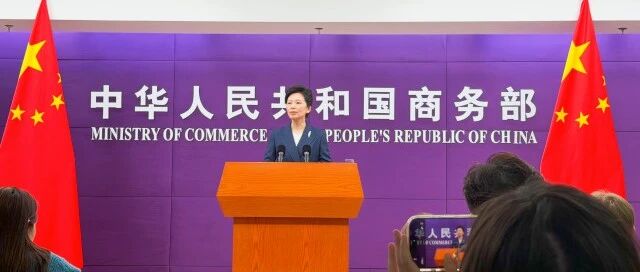
特朗普对华失去重要筹码,日本却被坑惨,高市将登门送上大礼
Sou Hu Cai Jing· 2026-02-25 04:28
Core Viewpoint - The recent U.S. Supreme Court ruling has significantly impacted U.S. trade policy, particularly undermining the legal basis for the Trump administration's tariffs against China, which were deemed unlawful [1][3]. Group 1: U.S. Trade Policy Changes - The Supreme Court's decision restricts the President's ability to impose tariffs without Congressional approval, marking a critical institutional constraint on Trump's trade practices [3]. - Following the ruling, the Trump administration quickly reinstated a global uniform tariff of 15% under the Trade Act of 1974, indicating a shift in strategy despite the legal setback [1][10]. Group 2: China's Response and Position - China has demonstrated resilience and a mature response to U.S. tariff threats, maintaining a principle of rationality and countermeasures to protect its national interests [5][6]. - The Supreme Court ruling has alleviated the tariff pressure on China, allowing it to transition from a reactive to a proactive stance in the U.S.-China trade negotiations [8]. Group 3: Impact on Global Trade Dynamics - The new tariff measures have uneven impacts on global economies, with the EU managing to mitigate losses through retaliatory tariffs and legal actions, while Japan faces significant economic damage due to its previous concessions to the U.S. [10]. - Japan's reliance on the U.S. has been highlighted as a critical vulnerability, as the recent tariff changes have rendered its prior concessions ineffective, leading to substantial economic repercussions [10]. Group 4: Broader Implications for Global Trade - The U.S. trade policy reflects a broader instability in the post-Cold War global trade order, with unilateral actions undermining multilateral trade systems and global supply chains [10][11]. - China's commitment to multilateralism and free trade is positioned as a counter to U.S. unilateralism, emphasizing the importance of strategic autonomy and fair cooperation in the evolving international landscape [11].
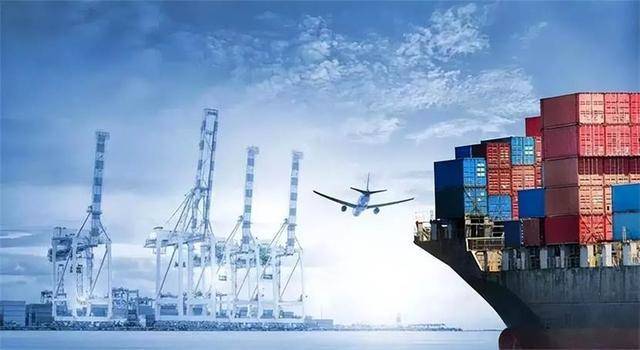
赶在川普访华前,我国反将美国一军,沙利文说了句大实话,不简单
Sou Hu Cai Jing· 2026-02-24 10:15
Core Viewpoint - The U.S. Supreme Court's ruling against Trump's tariff actions has created a significant political embarrassment for the Trump administration, while China appears confident in its strategic position amidst U.S. political turmoil [1][3]. Group 1: China's Response to U.S. Tariff Ruling - China is currently evaluating the Supreme Court's decision, demonstrating a rational approach to the situation [5]. - The Chinese government opposes unilateral tariffs and is committed to defending the multilateral trade system [5]. - China emphasizes the importance of safeguarding its interests and maintaining a bottom-line mindset in trade negotiations [5]. Group 2: Implications of the Ruling - The ruling has led to increased uncertainty in the market, potentially damaging the credibility of the U.S. and the stability of global supply chains [5]. - China's assessment of the U.S. Supreme Court's decision indicates a strategic move to pressure the U.S. to eliminate unilateral trade measures [7]. - The timing of China's statements and actions has caught the U.S. off guard, particularly ahead of Trump's planned visit to China [7]. Group 3: Future Negotiations - The U.S. administration's credibility may be at stake if it disregards the Supreme Court's ruling, which could undermine its authority [9]. - China sees no need to negotiate under uncertain conditions, placing the onus on Trump to respond to the ruling and its implications for future trade discussions [9].
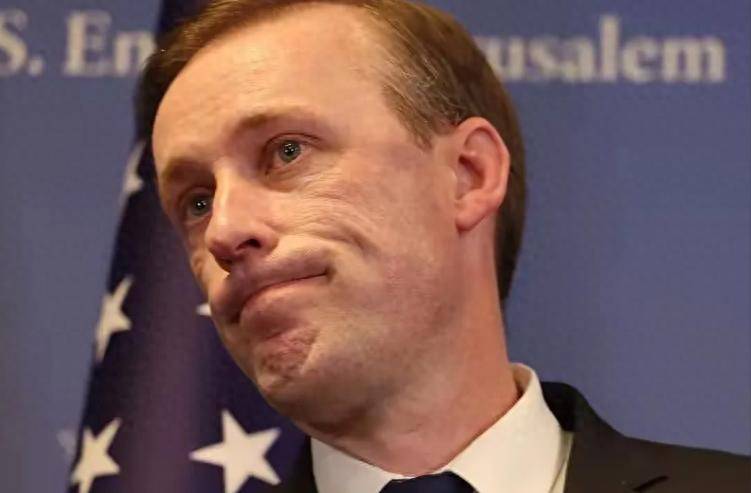
德国总理默茨明日访华!随行阵容庞大,将访问宇树科技
Hua Xia Shi Bao· 2026-02-24 10:00
Group 1 - The visit of German Chancellor Merz to China is significant as it marks his first official visit since taking office, with meetings scheduled with President Xi Jinping and Premier Li Qiang to discuss bilateral relations and mutual concerns [1][3] - China and Germany are described as comprehensive strategic partners, with close high-level exchanges and deepening practical cooperation that benefits both nations [1][3] - The trade relationship between China and Germany has been robust, with trade volumes exceeding $200 billion and bilateral investment stock surpassing $65 billion, accounting for nearly a quarter of China's total trade with the EU [3][8] Group 2 - The German delegation accompanying Chancellor Merz includes approximately 30 executives from leading companies in sectors such as automotive, chemicals, biopharmaceuticals, and machinery, indicating a strong desire from Germany to deepen economic ties [3][7] - The visit is expected to focus on traditional cooperation areas while also exploring new opportunities in clean energy, intelligent technology, biotechnology, and industrial digitalization [4] - Recent statistics indicate that China has surpassed the United States to become Germany's largest trading partner, with projections suggesting that trade between China and Germany could reach €251.8 billion by 2025, reflecting a growth of 2.1% [8]
默茨率30家头部企业高管访华,中方介绍相关安排
Xin Lang Cai Jing· 2026-02-24 08:00
Core Viewpoint - The upcoming visit of German Chancellor Merz to China signifies a strong commitment to deepen bilateral economic and trade relations, with a focus on both traditional and emerging sectors [3][4]. Group 1: Current Economic Relations - China and Germany have maintained a robust economic partnership for over 50 years, with Germany being China's largest trading partner in Europe and a significant source of foreign investment [3]. - The trade volume between China and Germany has consistently exceeded $200 billion, with bilateral investment stock surpassing $65 billion, accounting for nearly one-fourth of China's total trade with the EU [3]. Group 2: Future Cooperation Opportunities - The visit will include a high-level economic delegation from Germany, featuring executives from approximately 30 leading companies in sectors such as automotive, chemicals, biopharmaceuticals, machinery manufacturing, and circular economy, indicating Germany's strong desire to enhance bilateral trade [3]. - China is keen to explore new cooperation opportunities in emerging fields such as clean energy, embodied intelligence, biotechnology, and industrial digitalization, aiming to transform these opportunities into tangible results [4].
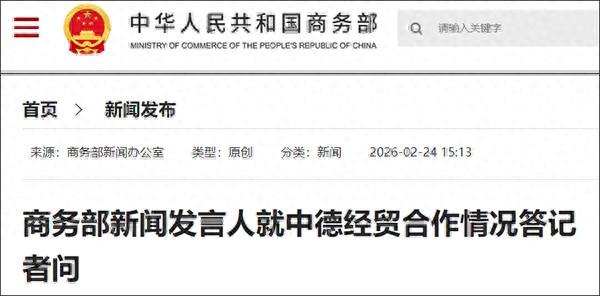
德国总理默茨25日访华 中方介绍相关安排
Shang Wu Bu Wang Zhan· 2026-02-24 07:51
Core Insights - The upcoming visit of German Chancellor Merz to China on February 25-26 is expected to enhance bilateral economic and trade cooperation, with a focus on various sectors [1][2] - Germany remains China's largest trading partner in Europe, with trade volumes consistently exceeding $200 billion and bilateral investment stock surpassing $65 billion, accounting for nearly one-fourth of China's total trade with the EU [1] - The visit will include a high-level economic delegation from Germany, featuring executives from approximately 30 leading companies in sectors such as automotive, chemicals, biopharmaceuticals, machinery manufacturing, and circular economy, indicating Germany's strong commitment to deepening economic ties [1] Economic Cooperation - The Chinese side emphasizes the importance of the economic relationship with Germany and is actively preparing for events such as the China-Germany Economic Advisory Committee meeting to facilitate dialogue and cooperation [1] - The Chinese government encourages German companies to seize new opportunities arising from China's high-level opening-up, while also exploring potential collaborations in emerging fields such as clean energy, embodied intelligence, biotechnology, and industrial digitalization [2] - The aim is to transform cooperation opportunities into tangible results, supporting free trade and maintaining a rules-based multilateral trading system to promote high-quality development of China-Germany economic cooperation [2]

商务部:我国提交首份全面系统阐述世贸组织改革立场政策文件
Di Yi Cai Jing· 2026-02-19 07:04
Core Viewpoint - China is a staunch supporter and active contributor to the multilateral trading system, advocating for the WTO to play a greater role in global economic governance [1][2] Summary by Sections Overall Position - The position paper outlines China's understanding of the WTO and its basic attitude towards WTO reform, emphasizing that the WTO provides an open, non-discriminatory, stable, and predictable institutional guarantee for economic globalization [4] - The multilateral trading system faces challenges from unilateral tariff measures, but WTO rules remain a crucial barrier against trade turbulence [4] Emphasis on Economic Globalization - The position paper stresses that economic globalization is an unstoppable historical trend, and WTO reform should aim to strengthen multilateral trade governance [6] - The WTO has facilitated a fivefold increase in global goods and services trade from 1995 to 2024, with developing economies accounting for 47% of global goods exports and 33% of services exports by 2024 [6] Work Recommendations - The position paper suggests that members should develop a gradual, structured reform work plan at the 14th WTO Ministerial Conference, focusing on decision-making mechanisms, development, and fair competition [7] - It advocates for flexible decision-making while respecting the principle of consensus and encourages developing members to seize opportunities in digital transformation and green transition [7] Dispute Resolution Mechanism - The position paper calls for the restoration of a fully operational dispute resolution mechanism accessible to all members, reflecting China's commitment to multilateralism and addressing the concerns of other members [8] Focus on Development and Future - The position paper emphasizes placing development at the center of the reform agenda, helping developing members leverage opportunities in emerging industries [9] - It highlights the need to discuss government measures that distort international trade and to seek consensus on fair competition, respecting different economic systems and development stages [9]
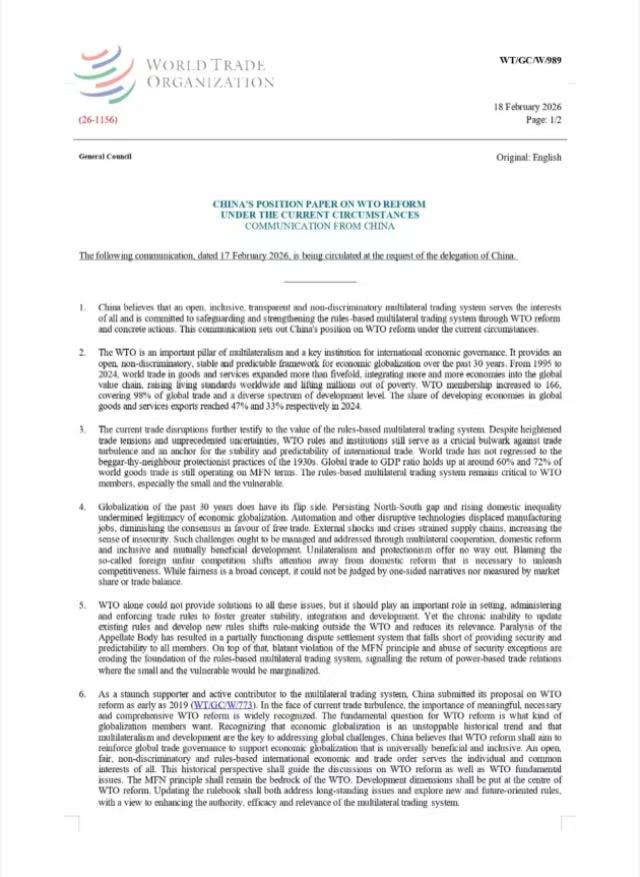
中国提交关于当前形势下世贸组织改革的立场文件
Xin Lang Cai Jing· 2026-02-19 03:30
Group 1 - The core viewpoint of the news is China's submission of a position paper to the WTO, emphasizing the need to center development in the reform agenda to help developing members seize opportunities in digital economy, green transition, and artificial intelligence [1][2] - The position paper is the first comprehensive policy document submitted by China to the WTO since the initiation of the reform process, outlining China's supportive stance towards inclusive economic globalization and the multilateral trading system [1] - The document suggests implementing special and differential treatment provisions in a more precise and effective manner, encouraging developing members to capitalize on future industries and trade opportunities [1] Group 2 - The WTO initiated a necessary reform process in June 2022, achieving some progress in areas such as mechanism operation, in response to unilateral tariff measures and decision-making abuses by certain members [2] - The WTO members plan to start deep reform consultations in the second half of 2025, aiming to address urgent issues like operational inefficiencies and rule deficits based on previous work [2]
特朗普以为能压垮中国,一年后美国彻底清醒了
Sou Hu Cai Jing· 2026-02-18 06:48
Core Viewpoint - The article discusses how China has successfully countered the trade war initiated by the U.S. under Trump, demonstrating resilience and strategic depth rather than succumbing to pressure [1][8]. Group 1: Trade War Tactics - The U.S. initially believed that high tariffs and technology blockades would force China to concede, underestimating China's resolve and strategic response [3][5]. - China implemented measured countermeasures, targeting key U.S. sectors such as agriculture and energy, thereby inflicting pain on American farmers and businesses [5][6]. - The U.S. aimed to exploit China's reliance on its market and technology, but China's response was calculated and strategic, focusing on self-reliance and innovation [6][8]. Group 2: Strategic Responses - China increased investment in research and development to address technology vulnerabilities, promoting a self-sufficient industrial chain [6][8]. - The country expanded its market reach through initiatives like the Belt and Road and partnerships with ASEAN, reducing dependence on any single market [6][8]. - China maintained a commitment to multilateral trade systems and dialogue, gaining support from the international community while highlighting U.S. unilateralism [6][8]. Group 3: Outcomes of the Trade War - The U.S. objectives, such as reducing trade deficits, were not achieved; instead, domestic inflation increased, burdening American citizens [8][10]. - China's technological advancements accelerated due to the U.S. restrictions, leading to greater unity and determination within China [8][10]. - The trade war has reinforced China's position, allowing it to uphold its development rights and national dignity, showcasing resilience against external pressures [10][12].