
智能驾驶芯片

Search documents
旗舰车芯片延期,英伟达的“王炸”让谁更焦虑?
3 6 Ke· 2025-04-14 00:46
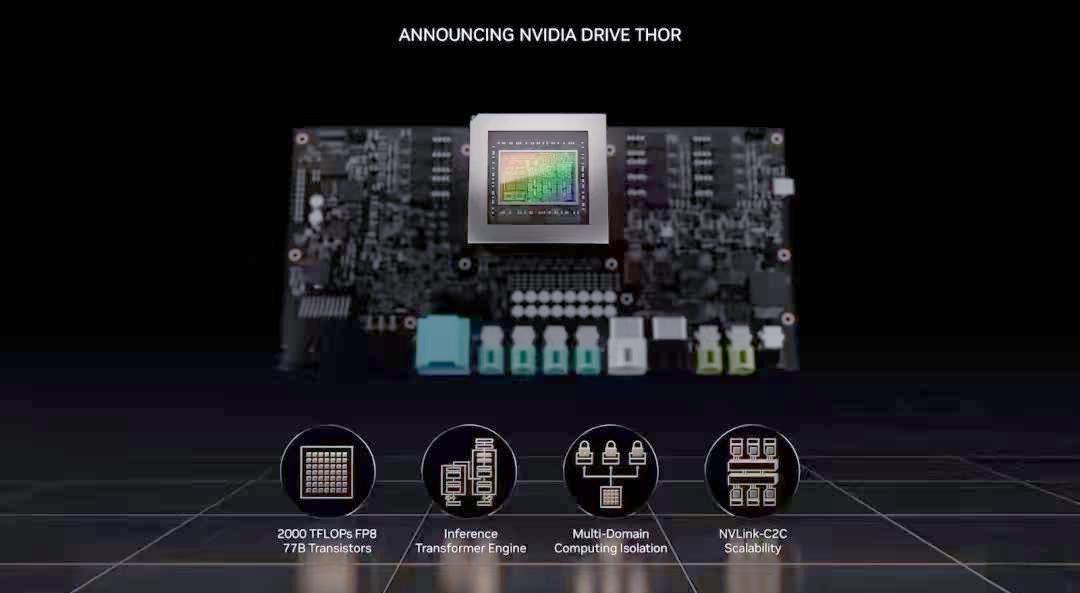
Core Insights - Nvidia's flagship Thor autonomous driving chip, initially planned for mass production in 2024, has faced multiple delays, potentially pushing the timeline to 2026, with only a low-performance version expected to be available [1][5][9] Group 1: Product Delays and Impacts - The Thor chip, boasting a peak performance of 2000 TOPS, was anticipated to dominate the market but has encountered significant production delays, affecting Nvidia's market strategy and partnerships with automotive companies [3][5][9] - The delays have led automotive manufacturers, such as Xiaopeng Motors, to accelerate their own chip development efforts, reducing reliance on Nvidia [9][11] Group 2: Technical Challenges - The production issues are attributed to design challenges with the Blackwell GPU architecture, which is tailored for large language models and generative AI, as well as potential manufacturing defects identified by TSMC [7][11] - The complexity of the chip architecture and external supply chain challenges, including U.S. export controls on semiconductor manufacturing, have further complicated the production timeline [7][11][16] Group 3: Competitive Landscape - Competitors like Qualcomm and Mobileye are launching integrated automotive computing solutions, increasing pressure on Nvidia to ensure Thor's performance and functionality remain superior [11][13] - The trend of automotive companies developing their own chips is growing, which could diminish Nvidia's market dominance as firms seek to reduce dependency on external suppliers [13][16] Group 4: Strategic Concerns for Nvidia - Nvidia's automotive business, while previously a strong growth engine, still represents a small portion of the company's overall revenue, raising concerns about its long-term viability if delays continue [16] - The ongoing delays and competition may jeopardize Nvidia's relationships with key automotive partners, as seen with Mercedes-Benz, which has expressed frustration over unmet product expectations [16]


英伟达雷神难产,蔚来:一颗更比四颗强
3 6 Ke· 2025-04-08 10:49
Group 1 - Nvidia's Thor chip production has been delayed to mid-2025, falling behind the original schedule by a year and only offering a low-performance version with 750 TOPS [1][2] - The initial promise for mass production was set for 2024, a critical year for Chinese automakers transitioning in the electric vehicle market, but technical issues and global chip supply chain constraints have caused delays [2][3] - The chip's design integrates multiple functions, including autonomous driving and infotainment, which presents significant technical challenges, compounded by reliance on advanced manufacturing processes from TSMC [3][4] Group 2 - Chinese automaker NIO has developed its own smart driving chip, the NIO Godson NX9031, which was officially launched in December 2023, aiming to reduce dependency on Nvidia and enhance software-hardware synergy [5][6] - The NX9031 chip utilizes a 5nm process, offering superior performance compared to Nvidia's Orin chip, and is designed to support NIO's autonomous driving system [6] - NIO plans to integrate the NX9031 into its ET9 model by Q4 2024, with large-scale production expected in 2025, while still using Nvidia's solutions as a transitional measure [6] Group 3 - The development of domestic smart driving chips in China has progressed, with companies like NIO and Horizon attempting to break the dominance of international giants like Nvidia and Qualcomm [7][8] - Despite advancements, domestic chips face challenges in technology maturity and market competition, with predictions indicating that by 2025, only 30% of the market will be occupied by self-developed chips from Chinese automakers [7][9] - The competitive landscape is stratified, with Nvidia's Drive Thor and Qualcomm's Snapdragon Ride Flex expected to dominate the high-end market, while domestic chips are primarily focused on mid-range and low-end segments [9][10]
