
月球演化

Search documents
月球背面月幔相比月球正面的更“冷”?嫦娥六号样品研究新成果解析
Xin Hua Wang· 2025-10-06 02:23
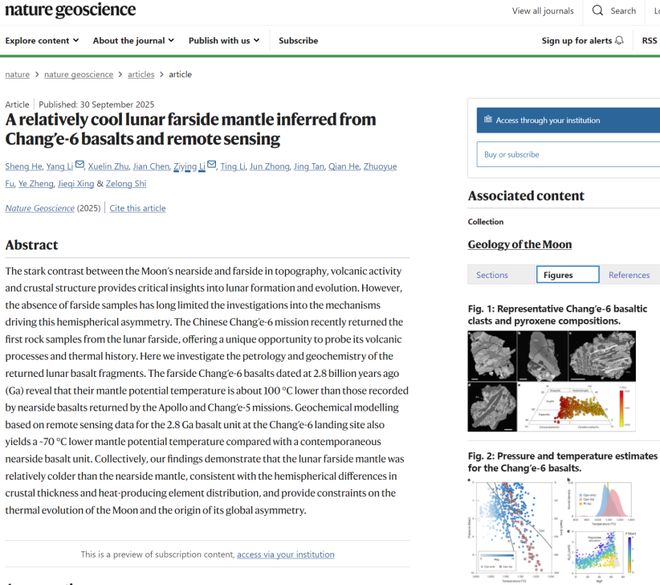
Core Insights - The latest research from the Chang'e 6 lunar mission indicates that the lunar mantle on the far side of the moon is cooler compared to the near side, enhancing understanding of the moon's "bipolarity" phenomenon [1][2] Group 1: Research Findings - The analysis of basalt samples from the lunar far side revealed a crystallization temperature of approximately 1100 degrees Celsius, which is about 100 degrees Celsius lower than samples from the lunar near side [2] - The potential temperature of the lunar mantle on the far side is estimated to be around 1400 degrees Celsius, compared to approximately 1500 degrees Celsius on the near side [2] - Remote sensing data corroborated these findings, showing that the potential temperature of the lunar mantle on the far side is about 70 degrees Celsius lower than that on the near side [2] Group 2: Geological Characteristics - Significant differences exist between the lunar near and far sides in terms of topography, elemental distribution, and rock characteristics, with the near side being relatively flat and the far side featuring more rugged terrain [3] - The near side contains over 30% of its surface covered by lunar maria, formed by early volcanic activity, while the far side has only about 1% to 2% of its surface covered by maria [3] - These differences are referred to as the "bipolarity" phenomenon, which is considered a key scientific question related to the moon's formation and evolutionary history [3]
嫦娥六号月球背面样品研究取得新成果
Xin Hua Cai Jing· 2025-10-06 01:28
Core Insights - The research conducted by China's National Space Administration and the National Atomic Energy Agency reveals that the temperature of the lunar mantle on the far side of the moon is lower than that on the near side, providing critical scientific data for the study of lunar evolution and its "bipolarity" characteristics [1][10]. Group 1: Research Findings - The study indicates that the crystallization temperature of basalt samples from the Chang'e 6 mission is approximately 1100 degrees Celsius, which is about 100 degrees Celsius lower than the samples from the Chang'e 5 mission on the near side [6]. - The potential temperature of the lunar mantle on the far side is found to be around 1400 degrees Celsius, compared to approximately 1500 degrees Celsius on the near side, indicating a temperature difference of about 70 degrees Celsius [10]. - The research utilized various analytical methods, including mineral composition analysis and rock models, to ensure the scientific validity of the findings [6][10]. Group 2: Scientific Implications - The differences in topography, elemental distribution, and rock characteristics between the near and far sides of the moon are significant, and this phenomenon is referred to as "bipolarity," which is considered one of the key scientific questions in lunar exploration [10]. - The findings deepen the understanding of the lunar "bipolarity" phenomenon and provide geological and geochemical evidence for the temperature differences between the lunar mantles on both sides [10].

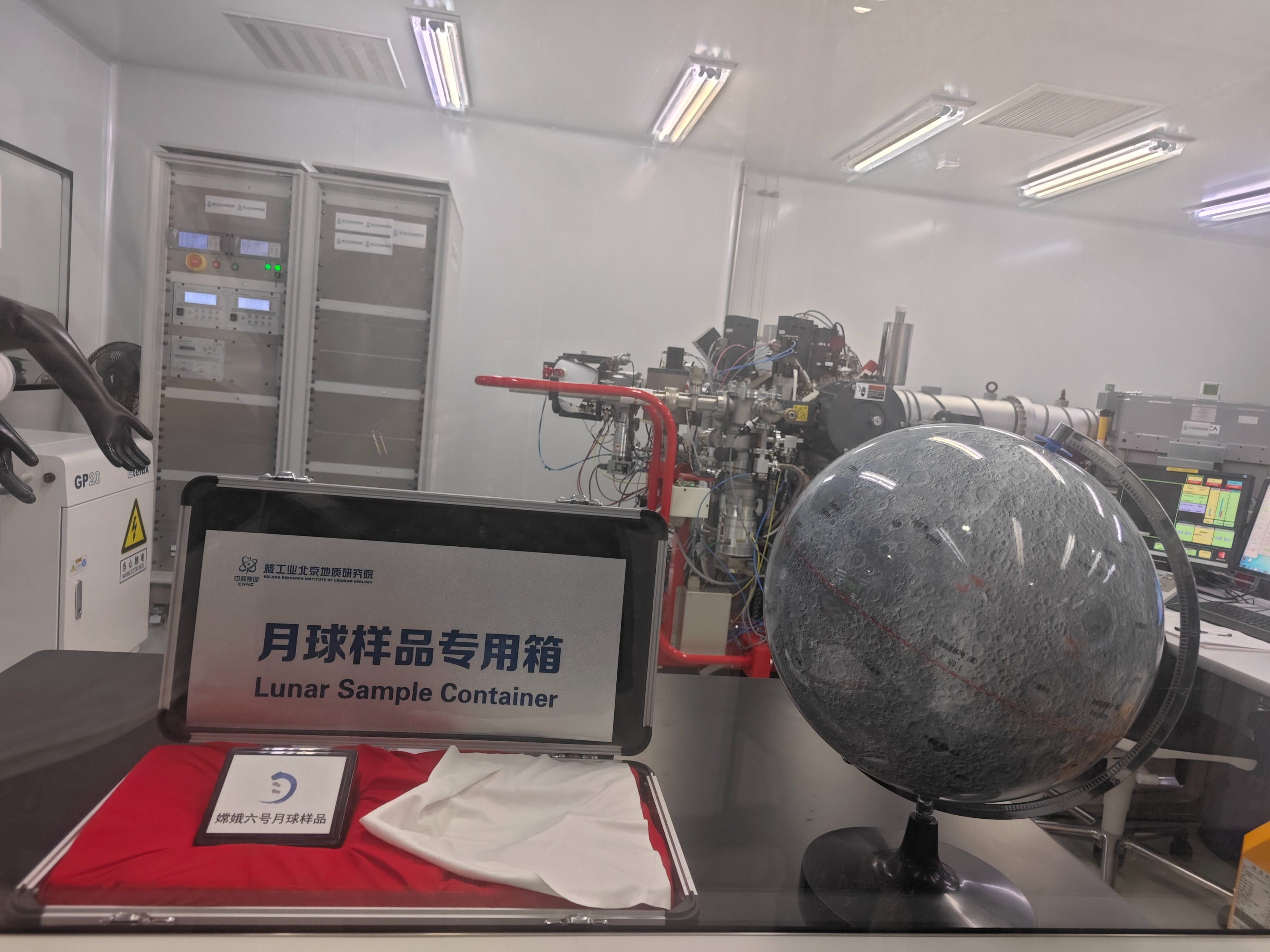
嫦娥六号月球样品研究新进展发布 中国科学家研究发现月球背面月幔有点“冷”
Huan Qiu Wang Zi Xun· 2025-10-06 00:17
Core Findings - The research reveals that the lunar mantle on the far side of the Moon is cooler compared to the near side, enhancing the understanding of the Moon's "bipolarity" phenomenon [1][9] - This study provides critical scientific data for understanding the evolution of the Moon and its distinct characteristics [1] Research Methodology - Scientists conducted a detailed analysis of basalt samples brought back by the Chang'e 6 mission, utilizing various methods to determine the crystallization temperature and pressure of minerals such as clinopyroxene and plagioclase [4] - The crystallization temperature of the Chang'e 6 basalt samples was found to be approximately 1100°C, which is about 100°C lower than samples from the Chang'e 5 mission on the near side [4][6] Temperature Findings - The potential temperature of the lunar mantle on the far side is estimated to be around 1400°C, which is lower than the near side's estimated 1500°C [6] - Remote sensing data corroborated these findings, indicating that the potential temperature of the lunar mantle on the far side is approximately 70°C lower than that of the near side [6] Lunar Characteristics - The study highlights significant differences between the near and far sides of the Moon in terms of topography, elemental distribution, and geological features, which are collectively referred to as the "bipolarity" phenomenon [9] - The near side is characterized by a relatively flat terrain with extensive basaltic plains, while the far side features a more rugged landscape with fewer basaltic areas [9]
嫦娥六号月壤样品新发现 揭示阿波罗盆地形成于41.6亿年前
Yang Shi Wang· 2025-08-21 16:18
Core Findings - A Chinese research team has accurately determined that the Apollo Basin on the Moon formed 4.16 billion years ago, marking a significant advancement in lunar geological studies [1] - This discovery pushes the timeline for the beginning of the Moon's "impact bombardment" period forward by at least 100 million years, enhancing the understanding of the evolution of the Earth-Moon system [1]
嫦娥六号采回的月球背面岩石,揭示月球内部“异常贫瘠”之谜
Xin Jing Bao· 2025-07-09 15:28
Core Insights - The Chang'e 6 mission has successfully returned samples from the Moon's far side, specifically from the South Pole-Aitken Basin, revealing significant geological characteristics of the lunar mantle [1][2][3] Group 1: Scientific Findings - The analysis of the basalt samples indicates a "super-depleted" state of the lunar mantle, characterized by a significant lack of incompatible elements [3][4] - The South Pole-Aitken Basin is the largest and oldest impact crater on the Moon, providing a unique opportunity to study the deep lunar crust and mantle [3][4] Group 2: Theoretical Models - Two models have been proposed to explain the "super-depleted" characteristics: 1. The "primordial depletion" model suggests that the Moon's early magma ocean underwent crystallization, leading to a natural depletion of incompatible elements [4][5] 2. The "post-impact modification" model posits that the massive impact that created the South Pole-Aitken Basin significantly altered the composition of the lunar mantle, resulting in the depletion of volatile elements [5][6] Group 3: Implications for Lunar Research - The findings from the Chang'e 6 mission provide critical evidence for understanding the early layering, cooling, and evolution of the Moon's interior, which is essential for addressing the differences between the Moon's near and far sides [6]
新华鲜报|月球样品又有新发现!嫦娥六号揭示月背演化密码
Xin Hua She· 2025-07-09 15:23
Core Insights - The Chinese Academy of Sciences has released significant research findings from the Chang'e 6 lunar sample series, published in the journal Nature, revealing insights into the evolution of the Moon's far side and providing key evidence to understand the Moon's "bipolarity" mystery [1][2] Group 1: Lunar Sample Findings - The Chang'e 6 mission returned 1935.3 grams of samples from the Moon's South Pole-Aitken Basin, confirming two distinct periods of basaltic volcanic activity approximately 4.2 billion and 2.8 billion years ago, indicating a broader time span of volcanic activity on the far side compared to the 2 billion years identified on the near side by Chang'e 5 [1] - The research team obtained ancient magnetic field data from the far side, suggesting that the Moon's magnetic field strength may have rebounded around 2.8 billion years ago, challenging the traditional view of a monotonous decline in magnetic field strength [1] - The study revealed that the South Pole-Aitken Basin, a major geological unit with a diameter of about 2500 kilometers, has significantly lower water content in its mantle compared to the near side, indicating a dichotomy in the Moon's internal water distribution [1] Group 2: Impact of Findings - The discovery of a new type of rock, South Pole-Aitken impact lava, is described as a "time capsule" for studying impact effects on terrestrial bodies, highlighting the importance of the South Pole-Aitken Basin in lunar evolution research [2] - The Chang'e 6 mission has filled a research gap regarding the evolution of the Moon's far side, with the South Pole-Aitken Basin being a critical geological unit for understanding the effects of large impacts on lunar evolution [2] - The success of China's lunar exploration program represents a significant integration of science and engineering, with the potential for China to transition from a "follower" to a "leader" in planetary science through the acquisition of more primary data [2]