
棉花目标价格补贴政策

Search documents
棉花:震荡偏强,关注需求
Guo Tai Jun An Qi Huo· 2025-12-14 07:59
Report Summary 1. Investment Rating The report does not provide an investment rating for the cotton industry. 2. Core View In the short - term, Zhengzhou cotton futures are expected to maintain a volatile and slightly bullish trend, but the upside space may be limited. Attention should be paid to changes in the spot basis. ICE cotton is likely to remain in a narrow - range low - level oscillation [1][18]. 3. Summary by Directory 3.1行情数据 - ICE cotton main contract: opened at 63.91, closed at 63.83, down 0.12 or 0.19%, with a trading volume of 86,499 lots and an open interest of 181,633 lots [4]. - Zhengzhou cotton main contract: opened at 13,735, closed at 13,835, up 85 or 0.62%, with a trading volume of 1,229,713 lots and an open interest of 397,499 lots [4]. - Cotton yarn main contract: opened at 19,950, closed at 19,980, down 25 or 0.12%, with a trading volume of 33,795 lots and an open interest of 20,835 lots [4]. 3.2基本面 3.2.1 International Cotton Situation - ICE cotton: It has been fluctuating in a narrow range at a low level this week. US cotton export data is still average, lacking upward momentum. However, the weak US dollar and the absence of new negative news have led to some bargain - hunting, providing support for ICE cotton futures [5]. - USDA December monthly supply - demand report: In the US cotton balance sheet, the 2025/26 US cotton production is estimated to be 14.27 million bales, 150,000 bales higher than the November estimate. US cotton exports are lowered by 100,000 bales to 1.6 million bales, and the ending stocks increase by 200,000 bales to 4.5 million bales. In the global cotton balance sheet, the 2025/26 global cotton production is estimated to be 119.79 million bales, 290,000 bales lower than the November estimate. The global cotton consumption is estimated to be 118.61 million bales, 270,000 bales lower than the November report. The ending stocks are estimated to be 75.97 million bales, slightly increasing by 40,000 bales compared to the November report and 1.36 million bales more than the 2024/25 ending stocks [6]. - US cotton weekly export sales data: As of the week ending November 13, 2025/26 US upland cotton weekly contracts were 42,600 tons, a 36% week - on - week decrease and a 10% increase compared to the four - week average. The 2025/26 US upland cotton weekly shipments were 25,700 tons, a 17% week - on - week decline and a 27% decrease compared to the four - week average [7]. - Other major cotton - producing and consuming countries: - India: The Cotton Association of India estimates that the 2025/26 Indian cotton will have a high carry - over stock. The production is forecast to increase by 450,000 bales to 30.95 million bales, while the consumption is expected to decrease by 500,000 bales to 29.5 million bales. The ending stocks are expected to increase by 4.65 million bales to 10.709 million bales [8]. - Brazil: CONAB lowers the 2025/26 Brazilian cotton production forecast to 3.96 million tons due to a slight reduction in the planting area. In November, the raw cotton export volume reached 402,000 tons, a 37% increase from October [9]. - Pakistan: Cotton import demand remains weak due to the narrow - range oscillation of futures prices, attractive local cotton prices, and weak downstream demand [10]. - Bangladesh: In November, cotton imports were relatively low, and garment exports increased month - on - month but decreased year - on - year. The preliminary data shows that the November cotton import volume was slightly over 120,000 tons, a nearly 10% increase from the previous low level but significantly lower than the imports from July - September [10]. - Southeast Asian textile industry startup rates: As of the week ending December 12, the startup rates of textile enterprises in India, Vietnam, and Pakistan were 67%, 62%, and 65.5% respectively [11]. 3.2.2 Domestic Cotton Situation - Cotton prices: The domestic cotton futures and spot prices continued to rise steadily. The one - price spot transactions were good, mainly due to purchases by individual large cotton merchants. The low - basis transactions were also good, mainly for locked - basis transactions, while high - basis transactions were sluggish [12]. - Cotton warehouse receipts: As of December 12, there were 3,109 registered warehouse receipts and 3,708 pending warehouse receipts for No. 1 cotton, totaling 6,817 receipts, equivalent to 286,314 tons [12]. - Downstream situation: The pure - cotton yarn market was sluggish, with few new orders. The yarn price increase was difficult, and the transaction center of gravity declined. The cotton fabric market also had a weak trading atmosphere, with low orders and high inventory [13]. 3.3操作建议 ICE cotton is expected to maintain a narrow - range low - level oscillation. Zhengzhou cotton futures are likely to be volatile and slightly bullish in the short - term, but the upside space may be limited. Attention should be paid to changes in the spot basis [18].
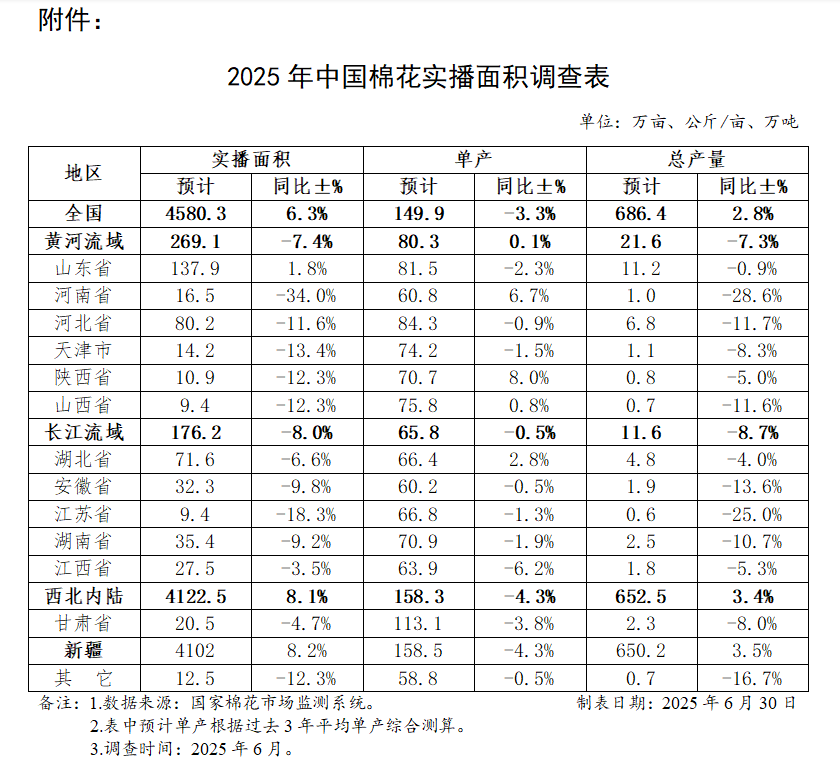
中储棉信息中心:2025年中国棉花实播面积同比增加6.3%
Xin Hua Cai Jing· 2025-06-30 11:48
Core Insights - The national cotton planting area in China is projected to reach 45.803 million acres in 2025, an increase of 2.707 million acres or 6.3% year-on-year [1][4] Regional Analysis - The northwest inland cotton planting area is expected to be 41.225 million acres, with a year-on-year increase of 3.093 million acres or 8.1%. Xinjiang's cotton planting area is projected at 41.02 million acres, up by 3.103 million acres or 8.2% [1][4] - The inland cotton planting area is expected to decrease to 4.453 million acres, a reduction of 368,000 acres or 7.6% year-on-year. The Yellow River basin's cotton planting area is projected at 2.691 million acres, down by 215,000 acres or 7.4% [2][4] - The Yangtze River basin's cotton planting area is expected to be 1.762 million acres, a decrease of 153,000 acres or 8.0% year-on-year [2][4] Factors Influencing Cotton Planting Area - The stability of cotton planting income in Xinjiang, supported by government price subsidy policies, has encouraged farmers to increase cotton cultivation. The current subsidy policy is in its final year, maintaining strong motivation for cotton expansion [3] - In contrast, the inland cotton planting area continues to decline, with various provinces experiencing significant reductions. For instance, Henan's planting area decreased by 34.0%, while other provinces like Tianjin and Hebei saw reductions of 13.4% and 11.6%, respectively [2][4] - Adverse weather conditions, such as continuous rainfall during the planting season in the Yangtze River region, have negatively impacted mechanized sowing, contributing to the decrease in planting area [3]

美农数据压制预期,棉价短线承压
Xin Da Qi Huo· 2025-05-19 01:21
棉花:新疆的棉花目标价格补贴政策保持稳定,棉农的种植积极性较高, 种植面积略有增加;而内地棉区由于比较效益低和机械化推广难度大等因 素,种植面积持续下降。在棉花播种和出苗期间,主要产区的气候条件良好, 预计单产为每公顷 2172 公斤(每亩 144.8 公斤),与去年持平。棉花总产 量预计为 625 万吨,比去年增加 1.4%。受美国过度征收关税的影响,棉花 消费预期偏弱,但未来仍存在一定的不确定性。预计新年度的棉花消费量为 740 万吨,较去年小幅减少 20 万吨,进口量也下调至 140 万吨,减少 10 万吨。短期观望。 信达期货有限公司 CINDAFUTURESCO.LTD 杭州市萧山区钱江世纪城天人大厦19-20楼 邮编:311200 请务必阅读正文之后的免责条款 1 商品研究 | 走势评级: | 白糖 | 震荡 | | --- | --- | --- | | | 棉花- | 震荡 | 张秀峰—分析师 从业资格证号:F0289189 投资咨询证号:Z0011152 联系电话:0571-28132619 邮箱:zhangxiufeng@cindasc.com 期货研究报告 美农数据压制预期,棉价短线承压 ...