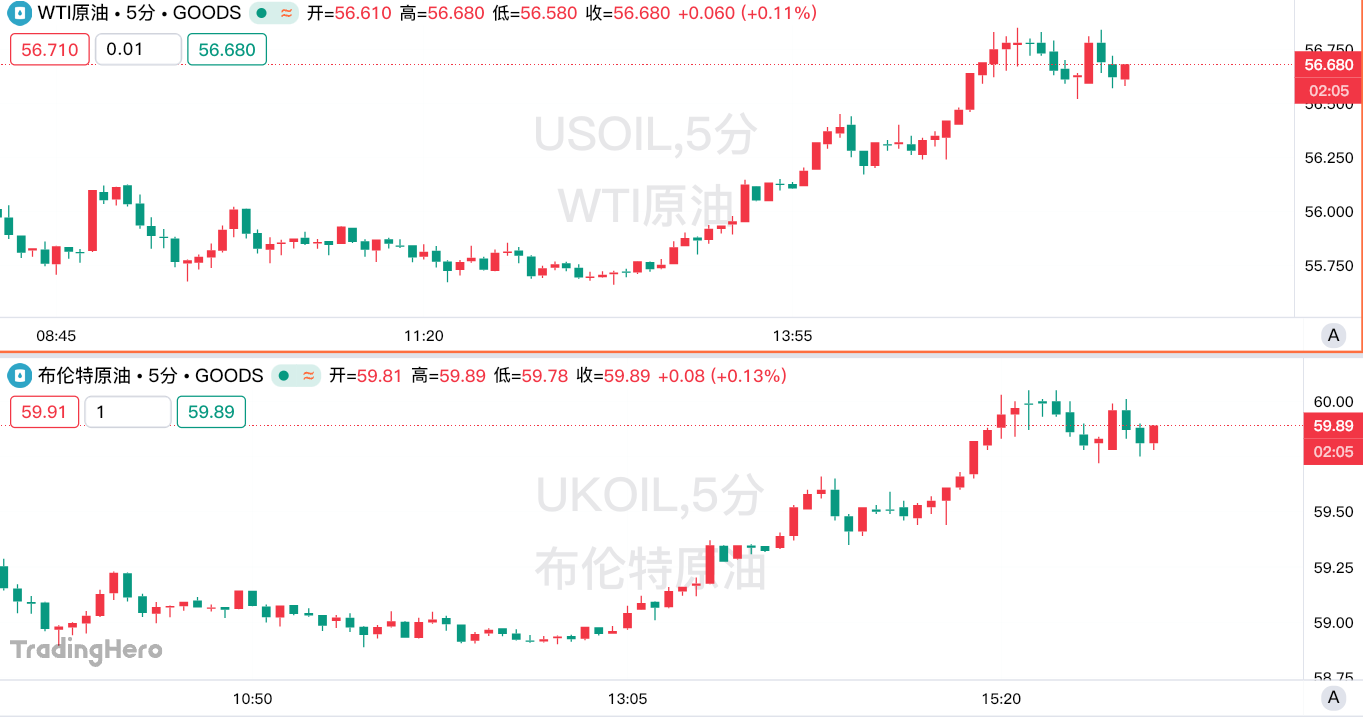
油价下行风险

Search documents
澳新银行:预计油价面临下行风险。
news flash· 2025-05-08 05:44
Core Viewpoint - The Australian and New Zealand Banking Group (ANZ) anticipates downward risks for oil prices due to various market factors [1] Industry Summary - ANZ highlights that oil prices are likely to face downward pressure, influenced by supply-demand dynamics and geopolitical factors [1] - The bank's analysis suggests that recent price fluctuations may not sustain, indicating potential volatility in the oil market [1] Company Summary - ANZ's forecast reflects its broader economic outlook, which may impact investment strategies and market positioning for stakeholders in the oil sector [1] - The bank's insights could guide investors in assessing the timing and scale of their investments in oil-related assets [1]
沙特“变脸”太快!油价狂泻至四年低点,华尔街紧急撕报告
Jin Shi Shu Ju· 2025-05-05 08:27
Group 1 - Saudi Arabia has led a bold initiative to reshape the global oil market by aggressively increasing production within OPEC+, prompting Wall Street analysts to lower price forecasts and raising concerns about oversupply [1][3] - OPEC+ announced an additional supply of 411,000 barrels per day for June, with Saudi Arabia warning of potential further increases in the future [1][3] - Goldman Sachs has revised its Brent crude oil price forecasts down by $2 to $3 per barrel for the next two years, while Morgan Stanley has made a larger cut of $5 for this year's quarter [3][4] Group 2 - Morgan Stanley expects an increase in oversupply by 400,000 barrels per day, reaching a total of 1.1 million barrels per day in the second half of the year following OPEC+'s latest actions [4] - Analysts from Morgan Stanley interpret OPEC+'s communication as a potential signal for a comprehensive acceleration in the cancellation of production quotas [4] - ING emphasizes the importance of Saudi Arabia's tolerance for lower oil revenues and the complex global landscape, suggesting that OPEC+'s aggressive production increases could lead to an earlier arrival of oversupply, potentially resulting in a surplus throughout 2025 [4]

高盛:油价能跌到多低?
智通财经网· 2025-04-09 02:17
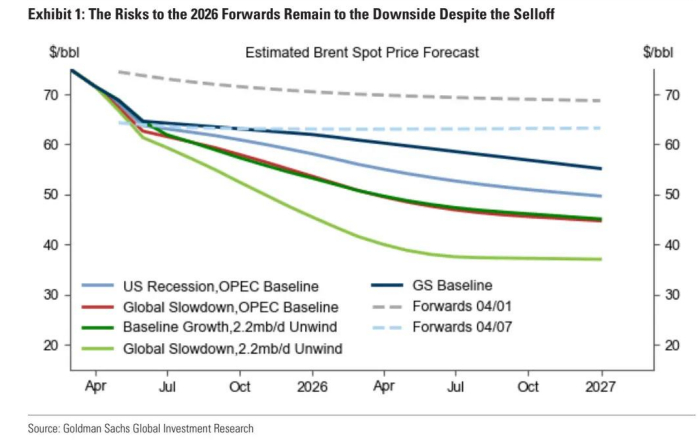
Core Viewpoint - Goldman Sachs has lowered its oil price forecasts, incorporating further downward adjustments to GDP expectations, predicting Brent crude prices to drop to $62 and WTI prices to $58 per barrel by December 2025, and further to $55 and $51 by December 2026 [1] Group 1: Economic Assumptions - The forecast assumes that the U.S. economy will avoid a recession, with a projected mild increase in oil demand of 300,000 barrels per day in 2025 and 400,000 barrels per day in 2026, based on a 0.5% GDP growth in Q4 2025 and a global GDP growth of 1.7% [1] - OPEC+ supply is expected to increase moderately, with a total production increase of approximately 700,000 barrels per day over four months, following a 411,000 barrels per day increase in May [1] Group 2: Price Downside Risks - Three potential shocks could lead to downward pressure on oil prices: a typical U.S. economic recession, a global economic slowdown, and the cancellation of OPEC+ voluntary production cuts of 2.2 million barrels per day [2] - In a typical U.S. recession scenario, Brent crude prices are expected to fall to $58 and $50 per barrel by December 2025 and December 2026, respectively [5] - In a global GDP slowdown scenario, Brent prices could drop to $54 and $45 per barrel by the same dates, while the complete cancellation of OPEC+ cuts could see prices at $53 and $45 per barrel [6] Group 3: Trading Strategy Recommendations - Goldman Sachs recommends a new three-way trading strategy for macro investors and oil producers to hedge against recession and oil price decline risks [10] - The strategy involves selling Brent crude call options with a strike price of $75 per barrel for June 2026 and using the proceeds to buy put options with strike prices of $55 and $45 per barrel [10][13] - This approach is based on the premise that idle capacity limits the upside potential for oil prices, while U.S. shale oil provides a solid price support at lower levels [10]