
湿地生态保护

Search documents
12万余只候鸟是怎么数出来的
Xin Lang Cai Jing· 2025-12-26 22:03
Core Insights - The total number of migratory birds arriving at the Cangzhou Nandagang Wetland has exceeded 120,000 this autumn, raising questions about the counting methods used [1][2]. Group 1: Counting Methods - The primary counting methods employed are direct counting and group counting, chosen based on the situation [1]. - For small, stationary groups of a single bird species, direct counting is used, while group counting is applied for larger flocks [1][3]. - Experienced patrollers conduct mobile surveys along five designated observation lines, maintaining a speed of 8 to 10 km/h by vehicle and 2 to 3 km/h on foot to cover all bird habitats [2]. Group 2: Observation Techniques - In areas with dense bird populations, patrollers stop for fixed observations, using direct counting for smaller numbers and group counting for larger flocks [3]. - Group counting involves dividing the visible area into sections and multiplying the number of birds in one section by the total number of sections [3]. - To enhance monitoring, 11 AI cameras and 3 sound monitoring devices have been installed, collecting over 250,000 valid data points since their implementation [3]. Group 3: Future Plans - The wetland's status as a bird sanctuary necessitates improved monitoring accuracy and comprehensiveness, prompting plans to refine patrol routes and observation points [3].
白天鹅“回家”过冬
Xin Lang Cai Jing· 2025-12-21 19:38
Group 1 - The core viewpoint of the article highlights the increase in the population of swans in the Yellow River wetland area of Sanmenxia City, Henan Province, due to enhanced ecological protection efforts [3] - The wetland area along the Yellow River has expanded to over 400,000 acres, attracting more than 10,000 swans for wintering [3] - The article mentions that the swan population has been growing year by year as a result of ongoing ecological conservation initiatives in the region [3]


12月18日晚间央视新闻联播要闻集锦
Yang Shi Xin Wen Ke Hu Duan· 2025-12-18 14:03
Group 1 - The Hainan Free Trade Port officially launched its full island closure on December 18, marking a significant step in China's commitment to high-level opening-up and the construction of an open world economy [1][4][5] - The closure is expected to enhance Hainan's connectivity with the international market, attract global quality resources, and promote high-quality development of the Hainan Free Trade Port [1][4][5] Group 2 - During the 14th Five-Year Plan period, China's wetland area is stabilized at over 80 million acres, with over 1,000 wetland protection projects implemented and 4.34 million acres of wetlands scientifically restored [6] - The government is actively promoting future industries such as quantum technology, biomanufacturing, hydrogen energy, and nuclear fusion, with multiple policies introduced to facilitate the transition from laboratory research to practical applications [7] Group 3 - Various regions are implementing measures to stimulate ice and snow consumption, creating new models and scenarios centered around "ice and snow+" to invigorate market activity [10]
广东湿地迎来越冬候鸟飞临高峰期
Nan Fang Ri Bao Wang Luo Ban· 2025-12-08 07:41
Core Insights - The number of wintering waterbirds in Guangdong Province has reached approximately 129,000 this year, an increase of nearly 15,000 compared to the previous year [1] - Key protected bird species such as the Oriental Stork, Black-faced Spoonbill, and Chinese Merganser have seen their populations increase to over three times that of 2024 [1] - The Nansha Wetland serves as a crucial stopover for migratory birds along the East Asia-Australasia flyway, providing abundant food resources due to its unique ecological environment [1] Group 1 - The Nansha Wetland has expanded its mangrove area to 198.18 hectares, making it the largest distribution area for mangroves in Guangzhou, which enhances biodiversity and attracts more migratory birds [2] - Guangdong's coastal ecosystem, with a coastline of 4,114 kilometers and extensive mudflats, plays a vital role as a key stopover and wintering site for migratory birds along the East Asia-Australasia route [2] - The province has implemented the "Guangdong Province Migratory Bird and Migration Route Protection Action Plan (2023-2035)" to strengthen the protection of bird species and their habitats [2] Group 2 - The historical record of wild bird species in Guangdong has increased from 507 species in 2001 to 584 species currently, with migratory birds accounting for 412 species, indicating a positive trend in wetland ecological conditions [2]
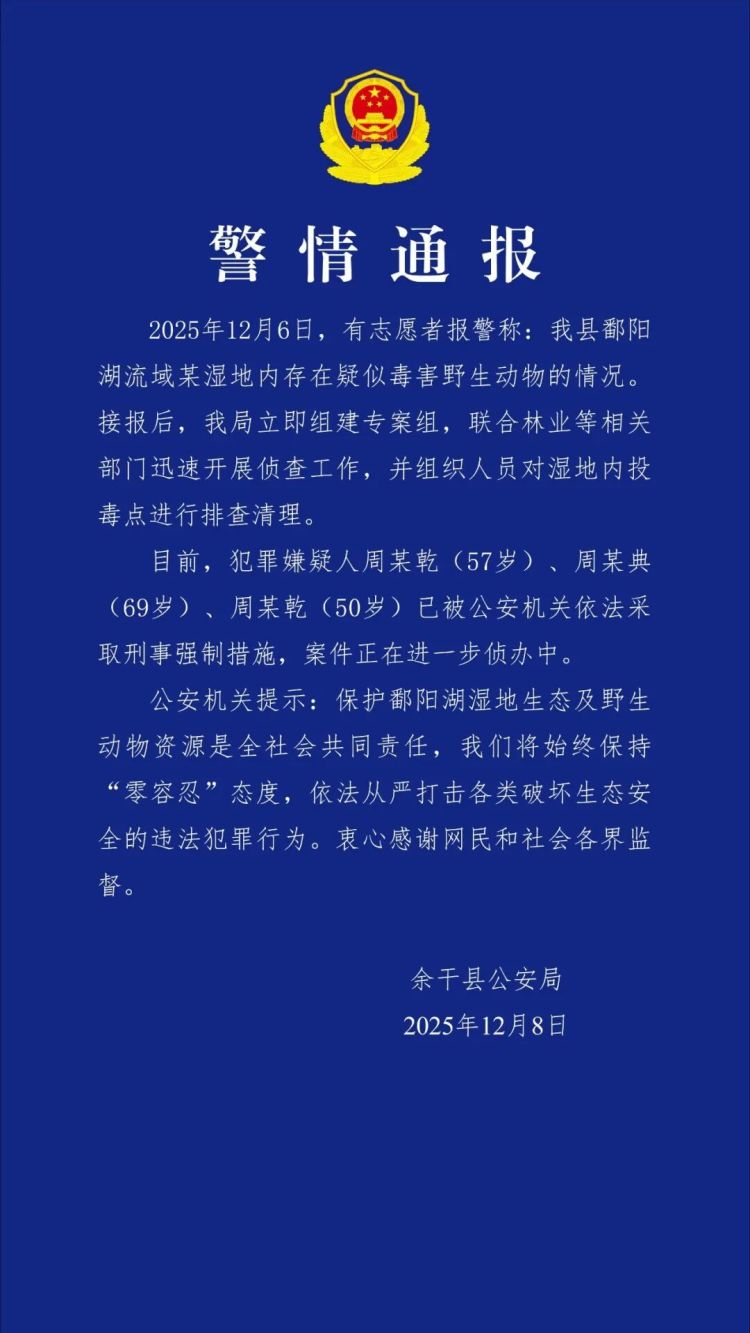
鄱阳湖流域疑有人毒害候鸟,警方通报:3人落网!
Huan Qiu Shi Bao· 2025-12-08 02:17
Group 1 - The core issue involves allegations of poisoning in the Poyang Lake area of Yugan County, leading to the death of migratory birds, with reports indicating that the poisoning occurred in their habitat [1][2] - Local authorities, specifically the Yugan County Public Security Bureau, have initiated an investigation following a report from volunteers about suspected wildlife poisoning, forming a special task force to address the situation [2] - Three suspects, identified as Zhou Mouqian (57), Zhou Moudian (69), and Zhou Mouqian (50), have been taken into custody under criminal coercive measures, with the case currently under further investigation [2] Group 2 - The Public Security Bureau emphasizes the collective responsibility of society to protect the ecological and wildlife resources of the Poyang Lake wetland, maintaining a "zero tolerance" stance against ecological crimes [2][4]
东方白鹳、黑脸琵鹭出没!广东湿地成为候鸟栖息天堂
Nan Fang Nong Cun Bao· 2025-12-07 06:01
Core Viewpoint - Guangdong wetlands have become a haven for migratory birds, with significant increases in various protected species, showcasing the region's ecological improvements and biodiversity efforts [3][5][24]. Group 1: Migratory Bird Population - The peak wintering period for migratory birds has been observed in Guangzhou Nansha Wetland, with thousands of birds including cormorants, herons, and ducks present [2][3]. - A total of 88 species of wintering waterbirds have been monitored across the province, amounting to approximately 129,000 individuals, an increase of nearly 15,000 from the previous year [4][35]. - The populations of key protected species such as the Eastern White Stork, Black-faced Spoonbill, and Chinese Merganser have tripled compared to 2024 [5][35]. Group 2: Ecological Environment - Nansha Wetland serves as a crucial stopover for migratory birds along the East Asia-Australasia flyway, providing a rich ecological environment with abundant food sources [9][10]. - The wetland is home to over 30,000 resident birds year-round, with wintering migratory birds exceeding 100,000, representing more than half of Guangzhou's total migratory bird population [10][11]. - The unique geographical and ecological conditions of Nansha Wetland have led to the establishment of a comprehensive habitat for migratory birds, including areas for feeding, nesting, and recreation [14][15]. Group 3: Conservation Efforts - The Nansha Wetland has implemented a scientific zoning plan to enhance the living conditions for migratory birds, focusing on food, shelter, and recreational areas [14][15]. - A specialized plan for the protection and restoration of mangroves has been established, expanding the total area of mangroves to 198.18 hectares, making it the largest distribution area in Guangzhou [19][20]. - Guangdong has launched the "Guangdong Migratory Bird and Migration Corridor Protection Action Plan (2023-2035)" to strengthen the protection of bird species and their habitats, resulting in an increase in recorded wild bird species from 507 in 2001 to 584 today [33][34].

候鸟翩跹彰显生态之美 描绘出和谐优美的鸟类交替生态图景
Yang Shi Wang· 2025-11-29 09:50
Core Viewpoint - The black-necked crane, the only crane species that breeds and lives in high-altitude areas, has successfully completed its migration to wintering grounds in Yunnan and Guizhou, while also welcoming a large number of swans from Siberia, indicating a healthy ecological exchange in the region [1][3][4]. Group 1: Migration and Population - The black-necked crane population in the Ruoergai Wetland National Nature Reserve is approximately 1,100 individuals, which have migrated successfully over a distance of 600 to 1,000 kilometers, taking 3 to 6 days to reach their wintering sites [4]. - The migration route of the black-necked crane serves as an important indicator of the ecological health of the Ruoergai wetland ecosystem, with migrations occurring annually from early November to the following spring [3]. Group 2: Conservation Efforts - The reserve has established a comprehensive protection system to ensure the survival and safe migration of black-necked cranes, implementing ecological measures such as grazing restrictions and habitat restoration [6]. - A smart monitoring system has been developed to track environmental factors and biodiversity, enhancing the protection of habitats for black-necked cranes and other bird species [6]. Group 3: Wintering Birds - The Ruoergai Wetland serves as both a departure point and a transit station for migratory birds, with around 200 swans currently wintering in the area, expected to stay until April of the following year [8]. - Recent arrivals from Siberia, including swans and white-tailed eagles, will be monitored for their population dynamics and health as part of ongoing winter bird monitoring efforts [10].
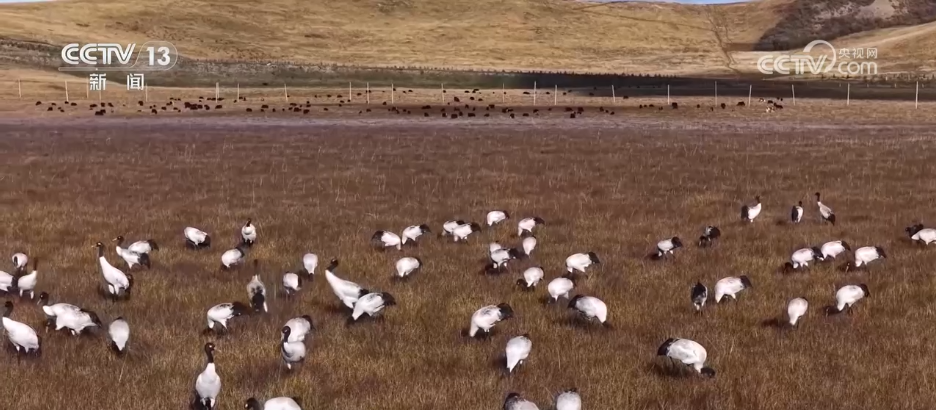
“鹤然”心动 国家二级保护动物灰鹤翩跹飞舞
Yang Shi Xin Wen· 2025-11-29 03:07
Core Viewpoint - The article highlights the arrival of over a thousand national second-class protected animals, the gray cranes, at the Qiachuan Wetland in Heyang County, Shaanxi Province, as temperatures drop, emphasizing the ecological significance of this wetland as a habitat for migratory birds [1] Group 1 - The Qiachuan Wetland is described as a lake-type wetland in the Yellow River basin, serving as an ecological corridor [1] - The diverse topography of the wetland provides abundant food and a peaceful habitat for migratory birds [1] - The sight of gray cranes taking flight and the accompanying sounds create a picturesque winter scene [1]
数千只大天鹅飞抵山西平陆黄河湿地越冬
Xin Hua She· 2025-11-17 04:44
Core Viewpoint - The arrival of thousands of wild swans from Siberia to the Huanghe Wetland in Pinglu County, Shanxi Province, highlights the ecological significance of the area as a winter habitat for swans, with ongoing efforts to support their survival during the colder months [1][2]. Group 1: Ecological Significance - The Huanghe Wetland covers over 6,000 hectares and is located at the junction of Shanxi and Henan provinces, providing a warm climate and abundant food, making it one of the important winter habitats for swans in China [2]. - The number of swans wintering in the wetland has stabilized at around 10,000 annually due to continuous ecological improvements in the area [2]. Group 2: Current Situation - As of now, there are approximately 3,000 to 4,000 swans present in the wetland, with expectations for this number to increase as temperatures continue to drop [2]. - Local forestry departments have prepared a significant amount of cabbage and corn to supplement the swans' food supply and have arranged for patrols to ensure their safety throughout the winter [2].
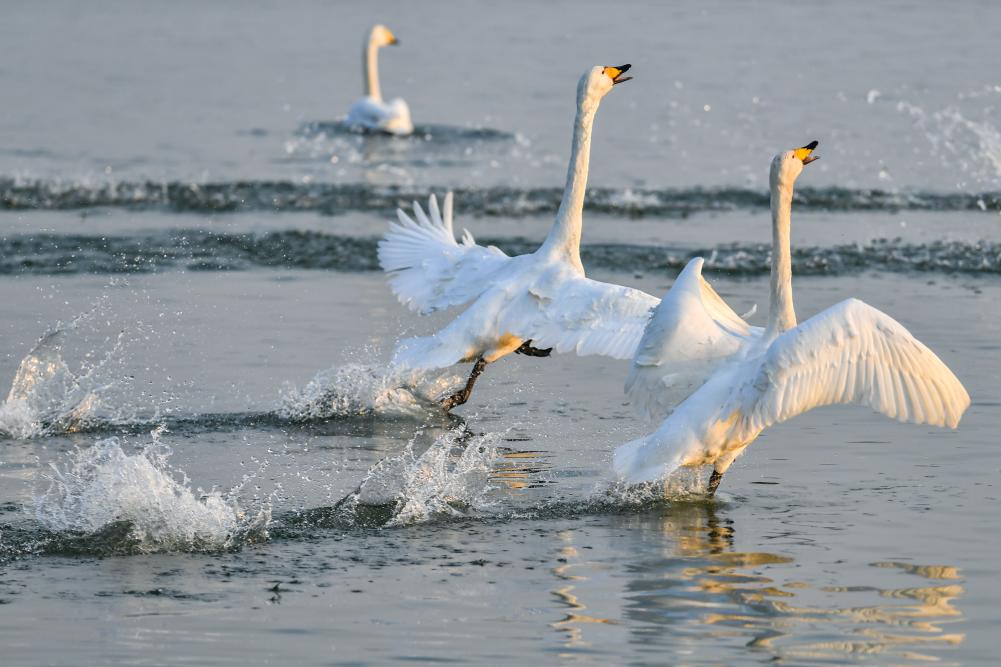
湿地生态持续改善 珍稀候鸟齐“做客”
Xin Hua She· 2025-11-11 12:28
Core Viewpoint - The article highlights the recent arrival of rare migratory birds at the Shanxi Zezhou Danhe National Wetland Park, showcasing the ecological improvements in the area that have made it a vital stopover and habitat for various migratory bird species [1] Summary by Categories Ecological Improvement - The local ecological environment has significantly improved in recent years, contributing to the park becoming a crucial stopover for long-distance migratory birds [1] Bird Species Diversity - The wetland park has seen an increase in the diversity of migratory bird species, with over 170 types of water birds currently monitored [1]