
疫苗犹豫

Search documents
38.5%儿童肺炎“元凶”是肺炎球菌,专家呼吁强化疫苗预防
Di Yi Cai Jing· 2025-09-14 08:02
Core Insights - The vaccination rate for the pneumococcal conjugate vaccine (PCV) in China is significantly low at 7.3%, compared to the global average of 47.9% in 2019, leading to a high incidence of invasive pneumococcal disease (IPD) among children [1][4] - Pneumonia remains a major health threat, particularly for children under five, with China accounting for 12% of global cases, indicating a severe public health challenge [3][4] Vaccination and Disease Statistics - A national study indicated that from 2009 to 2019, pneumococcus accounted for 38.5% of acute respiratory infections in children under five in China [1] - Approximately 8,000 children under five die annually from pneumococcal diseases, with a mortality rate of 25% among those with pneumococcal meningitis [3] Challenges in Vaccination - The "six highs and one low" phenomenon describes the high rates of pneumococcal carriage, cases, complications, antibiotic resistance, and mortality, contrasted with the low vaccination rate [3] - Key challenges include inappropriate antibiotic use, high antibiotic resistance rates (46.1% multi-drug resistance among IPD patients), and the economic burden of treatment [3][4] Vaccine Hesitancy and Public Awareness - Vaccine hesitancy is identified as a significant barrier to increasing vaccination rates, stemming from a lack of scientific understanding regarding safety and efficacy [5][6] - Recommendations to address vaccine hesitancy include transparent communication, personalized education, and authoritative sources of information [6] Regional Disparities - There is a notable regional disparity in vaccination rates, with over 50% of PCV13 vaccinations reported from eastern regions, while central and western regions account for only 36.8% [7] - Improving vaccine accessibility in rural and remote areas is essential, with calls for enhanced public health infrastructure and education [7]
疫苗降到蜜雪冰城价,企业集体亏损
Jing Ji Guan Cha Bao· 2025-09-11 11:34
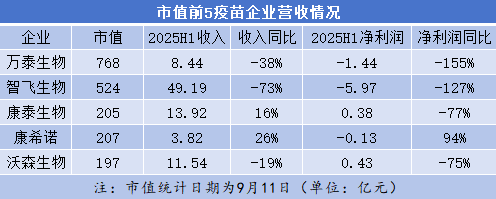
Core Insights - The vaccine industry is experiencing significant challenges, with many companies reporting substantial losses and declining revenues in 2025 [4][20][21] - Price wars and vaccine hesitancy are identified as major factors contributing to the industry's downturn [4][12][14] Financial Performance - In the first half of 2025, major vaccine companies like Zhifei Biological and Wantai Biological reported their first-ever half-year losses, with net profits dropping by 127% and 155% respectively [4][5] - Overall, vaccine revenue for listed companies in China decreased by 60% year-on-year, with net profits down by 113% [4] - Among 17 listed vaccine companies, only 6 reported profits, with the highest profit being 1.22 billion yuan from Chengda Biological [4] Market Dynamics - The top five vaccine companies by market capitalization are Wantai Biological, Zhifei Biological, CanSino, Kangtai Biological, and Watson Biological, with only CanSino showing a profit increase due to its innovative four-valent meningococcal vaccine [4][5] - A significant price drop in flu vaccines has been noted, with prices falling to as low as 5.5 yuan per dose, leading to intense competition [6][7][8] Price Wars - The price of various vaccines, including flu and HPV vaccines, has been driven down due to aggressive competition, with some prices dropping to a fraction of their previous levels [9][10][11] - Wantai Biological's entry into the nine-valent HPV vaccine market has intensified competition, leading to significant price reductions across the sector [9][10] Vaccine Hesitancy - Vaccine hesitancy has become a critical issue, particularly for non-mandatory vaccines, with many individuals expressing doubts about vaccine efficacy [14][15][16] - The overall vaccination rates for flu vaccines remain low in China, with annual rates below 4%, compared to over 50% in developed countries [16] Industry Outlook - The vaccine industry is facing a prolonged period of challenges, with experts predicting that the current downturn may last five to ten years unless significant changes occur in public perception and market dynamics [20][21] - The industry is expected to undergo consolidation, with weaker companies likely to be eliminated as competition intensifies [21]







疫苗降到蜜雪冰城价 企业集体亏损
经济观察报· 2025-09-11 11:16
Core Viewpoint - The vaccine industry is experiencing significant challenges, including price wars, vaccine hesitancy, and intense competition, leading to substantial declines in revenue and profits for major companies [4][10][19]. Group 1: Industry Performance - In the first half of 2025, the overall vaccine revenue for Chinese listed companies decreased by 60% year-on-year, with net profits dropping by 113% [4]. - Major companies like Zhifei Biological and Wantai Biological reported their first half-year losses since going public, with net profits declining by 127% and 155% respectively [4][12]. - Only six out of 17 listed vaccine companies achieved profitability, with the highest profit being 1.22 billion yuan from Chengda Biological [4]. Group 2: Price Wars - The price of flu vaccines has significantly dropped, with some prices reaching as low as 5.5 yuan per dose, marking a new low for public flu vaccine prices [7]. - The price competition has extended beyond flu vaccines to include HPV, shingles, and pneumonia vaccines, with prices for HPV vaccines dropping dramatically [8][9]. - Wantai Biological's revenue fell by 38% to 8.44 billion yuan in the first half of 2025, primarily due to aggressive price competition [9]. Group 3: Vaccine Hesitancy - Vaccine hesitancy has become a significant issue, with many individuals expressing doubts about vaccine efficacy, particularly for non-mandatory vaccines like HPV and flu vaccines [13][15]. - The average flu vaccine coverage in China remains below 4%, significantly lower than in developed countries where it is around 50% [15]. - Factors contributing to vaccine hesitancy include dissatisfaction with COVID-19 vaccine outcomes and the spread of misinformation [15]. Group 4: Market Dynamics - The vaccine market is characterized by increasing competition and product homogeneity, leading to a challenging environment for companies [18][19]. - Experts suggest that the current state of the vaccine industry resembles a "deep winter," with potential for consolidation and elimination of weaker players [19]. - The long-term outlook for the vaccine industry remains uncertain, with expectations of a prolonged period of challenges lasting five to ten years [19].

疫苗降到蜜雪冰城价 企业集体亏损
Jing Ji Guan Cha Wang· 2025-09-11 07:55
Core Viewpoint - The vaccine industry in China is experiencing significant challenges, with many companies reporting substantial losses and a decline in revenue due to price wars, vaccine hesitancy, and intense competition [1][4][15]. Group 1: Financial Performance of Vaccine Companies - In the first half of 2025, major vaccine companies like Zhifei Biological and Wantai Biological reported their first-ever half-year losses, with net profits dropping by 127% and 155% respectively [1][3]. - Overall, the revenue of Chinese vaccine listed companies decreased by 60% year-on-year, and net profits fell by 113% in the first half of 2025 [1]. - Among the top five vaccine companies by market capitalization, only CanSino reported a year-on-year net profit increase, attributed to its innovative four-valent meningococcal vaccine [2][3]. Group 2: Price Wars and Market Dynamics - The price of flu vaccines has significantly dropped, with some prices reaching as low as 5.5 yuan per dose, leading to a price war that has affected various vaccine types including HPV and pneumonia vaccines [4][5]. - Wantai Biological's revenue from its main product, the bivalent HPV vaccine, fell by 38% to 8.44 billion yuan, marking its first loss since going public [5][8]. - The industry is facing a normalization of price competition, with companies engaging in various promotional strategies to capture market share, further compressing product pricing [8][15]. Group 3: Vaccine Hesitancy - Vaccine hesitancy has become a significant issue, with many individuals expressing doubts about vaccine efficacy, particularly for non-mandatory vaccines like HPV and flu vaccines [10][12]. - The average flu vaccine coverage in China remains below 4%, significantly lower than in developed countries where it can reach 50% [12]. - Factors contributing to vaccine hesitancy include dissatisfaction with COVID-19 vaccine outcomes, misinformation, and a lack of awareness regarding the importance of adult vaccinations [12][13]. Group 4: Future Outlook and Industry Challenges - The vaccine industry is expected to face prolonged challenges, with experts predicting that the current competitive landscape will lead to consolidation and potential elimination of weaker players [15][16]. - The market for adult vaccines is particularly underdeveloped, and significant efforts are needed to improve public awareness and acceptance [12][16]. - The industry consensus suggests that without substantial changes in public perception and a more robust adult vaccination framework, the market will continue to struggle [16].
美国“消除”麻疹后再现疫情 专家:恐是“疫苗犹豫”惹的祸
Ke Ji Ri Bao· 2025-07-10 23:53
Core Viewpoint - The resurgence of measles in the United States, which was declared eliminated in 2000, is attributed to a decline in vaccination rates and the highly contagious nature of the virus [1][2]. Group 1: Measles Resurgence - In 2025, the U.S. reported 1,284 confirmed measles cases, a significant increase from the average of 180 cases per year [1]. - The basic reproduction number (R0) of measles is estimated to be 18, meaning one infected person can infect 18 susceptible individuals [2]. - The likelihood of infection for unvaccinated individuals who come into contact with a measles patient is approximately 90% [2]. Group 2: Vaccine Hesitancy - Vaccine hesitancy has emerged as a major barrier to maintaining herd immunity, particularly in developed countries where anti-vaccine movements have gained traction [3][4]. - The global death toll from measles has decreased by about 79% due to widespread vaccination, affecting approximately 171 million people [3]. - The decline in vaccination rates in developed countries has led to the resurgence of previously controlled infectious diseases [4]. Group 3: Health Risks and Responses - Measles can lead to severe complications such as laryngitis, pneumonia, myocarditis, and encephalitis, with at least three reported deaths in the recent U.S. outbreak [5]. - It is crucial for individuals, especially those in vulnerable groups, to consult healthcare professionals regarding vaccination to prevent severe outcomes [5]. - Continuous monitoring and effective response strategies are essential to maintain low measles incidence rates and manage outbreaks effectively [6].