
纪检监察工作高质量发展

Search documents
中国共产党梧州市第十四届纪律检查委员会第六次全体会议公报
Xin Lang Cai Jing· 2026-01-21 12:20
Core Viewpoint - The sixth plenary session of the Wuzhou Municipal Discipline Inspection Commission emphasizes the importance of advancing strict governance of the Party and anti-corruption efforts to ensure the successful implementation of the "14th Five-Year Plan" and contribute to the modernization of Wuzhou [1][4]. Group 1: Meeting Overview - The plenary session was held from January 20 to 21, 2026, with 32 members and 168 attendees [1]. - The meeting focused on studying and implementing the spirit of the 20th Central Commission for Discipline Inspection's fifth plenary session and the 12th Sixth Plenary Session of the Autonomous Region [2]. Group 2: Key Reports and Tasks - The work report presented by Yang Zanbin outlines the tasks for 2026, emphasizing high standards and practical measures for strict governance of the Party [2][3]. - The meeting highlighted the need for political supervision to ensure the correct direction of development during the "14th Five-Year Plan" period [4][5]. Group 3: Strategic Focus Areas - The session identified several strategic areas for 2026, including enhancing political supervision, deepening anti-corruption measures, and promoting a clean political environment [6][7][8]. - Emphasis was placed on the importance of addressing corruption in key sectors such as finance, education, and healthcare [8][9]. Group 4: Implementation Measures - The meeting called for a focus on the "three no-corruption" strategy to eliminate the conditions that foster corruption [8][9]. - It was stressed that the discipline inspection agencies must strengthen their capabilities and ensure effective implementation of anti-corruption measures [10][11]. Group 5: Community Engagement and Oversight - The session underscored the importance of community involvement in monitoring and addressing corruption at the grassroots level [9][10]. - Political inspections were highlighted as a critical tool for enhancing accountability and ensuring compliance with Party directives [10][11]. Group 6: Commitment to Continuous Improvement - The meeting concluded with a call for ongoing commitment to high-quality development in discipline inspection work, emphasizing the need for innovation and practical results [11].
中国共产党辽宁省第十三届纪律检查委员会第六次全体会议公报
Liao Ning Ri Bao· 2026-01-20 00:58
Core Viewpoint - The sixth plenary session of the 13th Discipline Inspection Commission of the Liaoning Provincial Committee emphasizes the importance of deepening the high-quality development of discipline inspection and supervision work to provide strong support for the comprehensive revitalization of Liaoning during the "14th Five-Year Plan" period [1][2]. Group 1: Meeting Overview - The plenary session was attended by 46 members of the Provincial Discipline Inspection Commission and 166 attendees, with key speeches from provincial leaders [1]. - The meeting focused on implementing Xi Jinping's thoughts and the spirit of the 20th National Congress, summarizing the work of 2025 and setting tasks for 2026 [1][2]. Group 2: Key Themes and Reports - The session highlighted the significant achievements in strict party governance over the past year and outlined strategic deployments for further advancing the party's self-revolution [2]. - The work report presented by Li Meng emphasized the need for high-quality development in discipline inspection and supervision, providing a clear roadmap for future tasks [2][3]. Group 3: Strategic Goals for 2026 - The year 2026 is identified as crucial for the start of the "14th Five-Year Plan" and the 105th anniversary of the party, necessitating a strong focus on discipline inspection work [4][5]. - The session called for unity in thought and action around Xi Jinping's important speeches, emphasizing the need for effective supervision and adherence to party regulations [4][5]. Group 4: Specific Initiatives - The session outlined several initiatives, including enhancing political supervision, improving the business environment, and addressing corruption at the grassroots level [6][7][8]. - A focus on discipline and work style construction was emphasized, aiming to consolidate educational outcomes and address issues like formalism and bureaucratism [7]. Group 5: Anti-Corruption Measures - The session stressed the importance of a comprehensive approach to anti-corruption, including the "three no-corruption" strategy and enhancing the effectiveness of supervision [8][9]. - Specific measures were proposed to tackle corruption in various sectors, including finance, education, and public services, with a focus on accountability and transparency [8][9]. Group 6: Institutional Reforms - The meeting discussed the need for reforms in the discipline inspection system to improve the overall effectiveness of supervision and enforcement [9][10]. - Emphasis was placed on integrating data and technology into the discipline inspection process to enhance operational efficiency and accountability [10].
中国共产党广东省第十三届纪律检查委员会第五次全体会议决议(2026年1月17日中国共产党广东省第十三届纪律检查委员会第五次全体会议通过)
Nan Fang Ri Bao Wang Luo Ban· 2026-01-19 01:59
Core Viewpoint - The Guangdong Provincial Discipline Inspection Commission's fifth plenary session emphasizes the importance of strengthening party discipline and anti-corruption efforts to ensure the successful implementation of the "14th Five-Year Plan" and to contribute to the modernization of China [1][2][12] Group 1: Meeting Overview - The plenary session was attended by 49 members of the Provincial Discipline Inspection Commission and 136 attendees, with key speeches from provincial leaders [1] - The meeting was guided by Xi Jinping's thoughts and aimed to summarize the achievements of 2025 and set tasks for 2026 [1][2] Group 2: Key Messages from Leadership - Xi Jinping's speech at the Central Commission for Discipline Inspection's fifth plenary session was recognized for affirming the achievements in strict party governance and providing strategic direction for future tasks [2][3] - Huang Kunming's address highlighted the need for effective implementation of central decisions and emphasized the importance of anti-corruption measures [3][4] Group 3: Focus Areas for 2026 - The meeting outlined several key focus areas for 2026, including enhancing political supervision, promoting high-quality development, and ensuring compliance with the central eight regulations [5][8] - Emphasis was placed on the integration of anti-corruption strategies and the need for a robust political ecosystem to support economic and social stability [4][9] Group 4: Implementation Strategies - The session called for a systematic approach to governance, focusing on the modernization of governance capabilities and addressing corruption at grassroots levels [10][11] - It was noted that the use of technology and information systems would be crucial in regulating power and enhancing transparency [10] Group 5: Call to Action - The plenary session urged all members to unite under the leadership of Xi Jinping, emphasizing the need for practical actions to advance high-quality development in the new era [12]
中国共产党新疆生产建设兵团第八届纪律检查委员会第五次全体会议公报
Xin Lang Cai Jing· 2026-01-18 18:28
Core Viewpoint - The Fifth Plenary Session of the Eighth Discipline Inspection Commission of the Xinjiang Production and Construction Corps emphasizes the importance of strict party governance and anti-corruption efforts, aligning with the strategic goals set for the "15th Five-Year Plan" period, which is crucial for achieving socialist modernization [1][4]. Group 1: Meeting Overview - The meeting was held from January 17 to 18, 2026, in Urumqi, attended by 33 members of the Discipline Inspection Commission and 89 attendees [1]. - The session was presided over by the Standing Committee of the Discipline Inspection Commission, focusing on implementing Xi Jinping's thoughts and the spirit of the 20th National Congress [1][2]. Group 2: Key Discussions - The meeting highlighted the significant achievements in strict party governance over the past year and outlined strategic deployments for the upcoming year [2]. - It discussed the importance of political supervision and the need to strengthen the party's leadership and anti-corruption measures [3][4]. Group 3: 2026 Work Focus - The year 2026 is identified as the starting year for the "15th Five-Year Plan" and the 105th anniversary of the party, necessitating a commitment to Xi Jinping's thoughts and the implementation of the 20th Central Committee's directives [5]. - The focus will be on deepening anti-corruption efforts, enhancing the regulatory framework, and promoting a culture of integrity [5][8]. Group 4: Specific Initiatives - The meeting outlined specific initiatives to strengthen political supervision, including enhancing the ideological foundation for modernization and addressing issues of political discipline [6]. - It emphasized the need to combat extravagance and formalism, ensuring strict adherence to the Central Eight Regulations [7]. Group 5: Anti-Corruption Measures - The session called for a comprehensive approach to anti-corruption, focusing on preventing corruption through systemic reforms and enhancing the effectiveness of oversight mechanisms [8][9]. - It highlighted the importance of addressing corruption in key sectors such as finance, education, and state-owned enterprises [8]. Group 6: Strengthening Oversight - The meeting stressed the need for enhanced political inspections and the establishment of a robust mechanism for addressing issues identified during inspections [9][10]. - It called for a year dedicated to the standardization and legalization of discipline inspection work, aiming to build a competent and loyal inspection team [10].
中国共产党广西壮族自治区第十二届 纪律检查委员会第六次全体会议公报
Xin Lang Cai Jing· 2026-01-18 00:56
Core Viewpoint - The meeting emphasizes the importance of strengthening party discipline and anti-corruption efforts in Guangxi, aligning with the broader goals of achieving socialist modernization during the "15th Five-Year Plan" period [1][4]. Group 1: Meeting Overview - The 6th Plenary Session of the 12th Discipline Inspection Commission of the Guangxi Zhuang Autonomous Region was held on January 16-17, 2026, in Nanning, attended by 40 members and 346 attendees [1]. - The meeting was presided over by the Standing Committee of the Discipline Inspection Commission, focusing on implementing Xi Jinping's thoughts and the spirit of the 20th National Congress [1][2]. Group 2: Key Themes and Goals - The meeting highlighted the need for higher standards and practical measures to advance strict governance of the party, ensuring a strong foundation for the "15th Five-Year Plan" [2][4]. - It was noted that 2026 marks the beginning of the "15th Five-Year Plan" and the 105th anniversary of the party, necessitating a commitment to Xi Jinping's thoughts and the implementation of the 20th Central Commission's directives [5][6]. Group 3: Strategic Focus Areas - The meeting outlined several strategic areas for 2026, including deepening political supervision, enhancing the implementation of the Central Eight Regulations, and addressing corruption in key sectors such as finance and state-owned enterprises [7][9]. - Emphasis was placed on the importance of a unified approach to governance, ensuring that anti-corruption measures are integrated across various sectors and levels of government [10][11]. Group 4: Implementation and Accountability - The meeting called for a robust accountability system to ensure that party organizations at all levels are responsible for implementing the decisions made [10][13]. - It was stressed that the political ecology must be maintained, with a focus on rectifying issues related to corruption and misconduct within the party [8][12].
持之以恒 推进纪检监察工作高质量发展
Xin Lang Cai Jing· 2026-01-15 22:30
Core Viewpoint - The meeting emphasized the need for provincial disciplinary inspection and supervision agencies to deeply understand and implement the spirit of the 20th Central Commission for Discipline Inspection's fifth plenary session, focusing on high-quality development in anti-corruption efforts [1][2] Group 1 - The meeting highlighted the importance of strengthening political supervision, particularly in relation to major deployments and projects outlined in the "14th Five-Year Plan," ensuring adherence to political and election discipline [1] - There is a commitment to deepen the integrated approach of "three no-corruption," focusing on key areas, issues, and targets to maintain a high-pressure deterrent against corruption [1] - The use of digital empowerment is emphasized to enhance the effectiveness of case handling and supervision, promoting a comprehensive approach to corruption governance [1] Group 2 - The meeting called for practical measures to align with the "three more" important requirements and the key tasks outlined in the work report, ensuring that every deployment has corresponding implementation [2] - There is a focus on creatively implementing these measures in accordance with local conditions in Sichuan, aiming for a more systematic and sustainable approach to disciplinary inspection and supervision [2]
中国共产党第二十届中央纪律检查委员会第五次全体会议公报
中国基金报· 2026-01-14 08:09
Core Viewpoint - The meeting emphasizes the importance of strengthening the Party's self-revolution and advancing strict governance to ensure the successful achievement of the "15th Five-Year Plan" goals, while also addressing the challenges and tasks ahead [1][3][5]. Group 1: Achievements and Future Tasks - The meeting acknowledges significant achievements in strict governance over the past year and outlines strategic deployments for the future, focusing on higher standards and practical measures to support the "15th Five-Year Plan" [2][3]. - The central leadership aims to enhance political supervision and ensure the implementation of the Party's policies, reinforcing the commitment to the Party's unity and integrity [3][4]. Group 2: Anti-Corruption Efforts - The meeting highlights the need for a robust anti-corruption strategy, targeting key sectors such as finance, state-owned enterprises, and education, while also addressing new forms of corruption [3][9]. - It emphasizes the importance of maintaining a high-pressure environment to deter corruption and the need for comprehensive reforms in the anti-corruption framework [9][10]. Group 3: Political Supervision and Discipline - The meeting calls for strengthening political discipline and correcting issues related to bureaucratic behavior and formalism, ensuring that Party members adhere to the correct political conduct [6][7]. - It stresses the necessity of enhancing the effectiveness of political supervision to support the implementation of the "15th Five-Year Plan" [6][10]. Group 4: Institutional Reforms and Capacity Building - The meeting outlines plans for deepening institutional reforms within the disciplinary inspection system, aiming for a more standardized and law-based approach to governance [4][11]. - It emphasizes the importance of training and capacity building for disciplinary inspection personnel to ensure they are equipped to handle their responsibilities effectively [11].

以高质量监督推动高质量发展高效能治理
He Nan Ri Bao· 2026-01-12 23:22
Core Viewpoint - The article emphasizes the high-quality development of disciplinary inspection and supervision in Henan Province, focusing on political supervision to ensure the implementation of the Central Committee's decisions and the provincial government's arrangements [1]. Group 1: Political Supervision - The provincial disciplinary inspection and supervision agencies are committed to enhancing political supervision, ensuring that the Central Committee's decisions are effectively implemented [1]. - A political supervision work guideline has been established, including a list of 37 key annual tasks to create a closed-loop mechanism for accountability and problem rectification [2]. - Supervision efforts have led to the resolution of 19,000 issues related to key tasks such as farmland protection and ecological conservation [2]. Group 2: Economic Development and Business Environment - The article highlights a zero-tolerance approach towards behaviors that harm the business environment, with a focus on optimizing services for enterprises [3]. - Continuous efforts are being made to improve the business environment through targeted supervision, addressing issues like improper law enforcement and delays in responding to business needs [3]. - The establishment of a new ecosystem for government-business relations aims to ensure that officials do not interfere unnecessarily while providing support when needed [4]. Group 3: Supervision System and Data Utilization - The use of big data has been pivotal in enhancing the effectiveness of disciplinary inspection and supervision, allowing for better oversight of public reception activities [5]. - A collaborative mechanism for supervision has been developed, integrating various forms of oversight to improve governance efficiency [5]. - Innovative supervision methods have been introduced, including nine different approaches tailored to specific tasks and subjects, ensuring that supervision leads to actionable outcomes [5]. Group 4: Future Directions - The province aims to continue advancing political supervision in a more specific, precise, and regular manner, maintaining a strict atmosphere for governance [6]. - The focus remains on high-quality supervision to support high-quality development and effective governance in Henan [6].
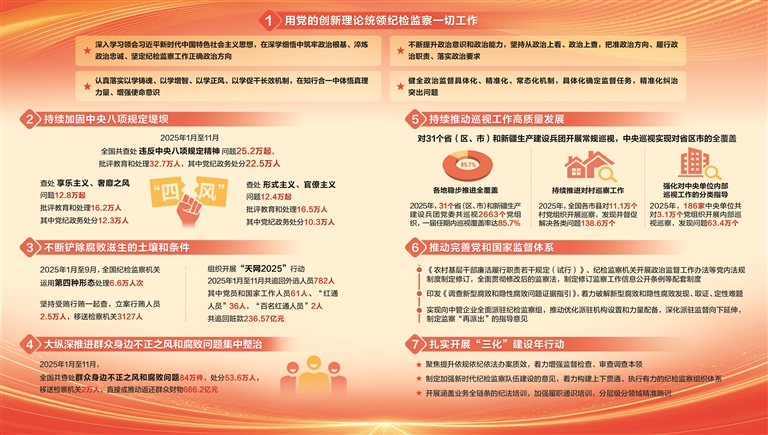
特别报道|2025:纪检监察工作高质量发展取得新进展新成效
Zhong Yang Ji Wei Guo Jia Jian Wei Wang Zhan· 2026-01-11 01:58
Core Viewpoint - The article emphasizes the importance of political supervision in ensuring the implementation of the Party's political line and maintaining a high-pressure stance against corruption and misconduct within the Party and government institutions [3][20]. Group 1: Political Supervision - Political supervision is crucial for maintaining the centralized leadership of the Party and ensuring that major decisions and directives from the Party are implemented effectively [3][4]. - The focus of political supervision should be on specific tasks and responsibilities, ensuring that the directives from the Party are translated into actionable plans [4][6]. - Various regions, such as Beijing and Zhejiang, have implemented targeted political supervision measures to ensure compliance with Party directives and enhance governance [5][6]. Group 2: Anti-Corruption Efforts - The article highlights the ongoing efforts to combat corruption, particularly in local governance, by addressing both minor and major corruption issues [20][28]. - There is a strong emphasis on the need for collaboration among different departments to effectively tackle corruption and misconduct [24][29]. - The article notes that significant progress has been made in addressing corruption linked to public services, with various regions reporting successful interventions [32][33]. Group 3: Integration of Supervision Mechanisms - The integration of various supervisory mechanisms is essential for enhancing the effectiveness of anti-corruption efforts, with a focus on collaboration between different supervisory bodies [39][40]. - The establishment of clear communication and coordination among supervisory entities is emphasized to ensure a unified approach to governance and oversight [41][42]. - The article discusses the importance of grassroots supervision in extending the reach of anti-corruption measures and ensuring accountability at all levels of government [43][44]. Group 4: Continuous Improvement and Education - Continuous education and training for supervisory personnel are highlighted as vital for maintaining high standards of governance and accountability [45][46]. - The article stresses the need for ongoing learning and adaptation of supervisory practices to meet the evolving challenges in governance and corruption prevention [47].
纪检监察工作高质量发展取得新进展新成效丨强化理论武装 做实做细政治监督
Zhong Yang Ji Wei Guo Jia Jian Wei Wang Zhan· 2026-01-04 00:33
Group 1 - The year 2025 is crucial for the completion of the 14th Five-Year Plan and the planning of the 15th Five-Year Plan, emphasizing the need for political unity and action aligned with the central leadership [1] - The Central Commission for Discipline Inspection (CCDI) and various disciplinary inspection agencies have focused on deepening the understanding of Xi Jinping's thoughts, particularly regarding party construction and self-revolution [2][3] - The CCDI has implemented a series of measures to enhance political supervision, ensuring that the party's centralized leadership is firmly upheld [6][7] Group 2 - The CCDI has prioritized the study and implementation of the Central Eight Regulations, which are seen as a significant political task for 2025, aiming to translate educational outcomes into practical results for high-quality development [3][4] - The CCDI has emphasized the importance of political responsibility and accountability, particularly in addressing issues related to ecological protection and agricultural land violations [8][9] - The CCDI has initiated a "supervision guarantee year" for the Hainan Free Trade Port, focusing on comprehensive supervision of the implementation of central directives [9][10] Group 3 - The CCDI has developed mechanisms for specific, precise, and regular political supervision, aligning with the strategic tasks of promoting high-quality development and modern industrial systems [10][11] - The CCDI has focused on addressing formalism and bureaucratism in the implementation of central policies, ensuring that supervision is effective and responsive to emerging issues [11][12] - The CCDI aims to deepen political supervision, reinforcing the commitment to the "two establishments" and "two safeguards" to support the modernization and national rejuvenation efforts [12]