
廉洁文化建设

Search documents
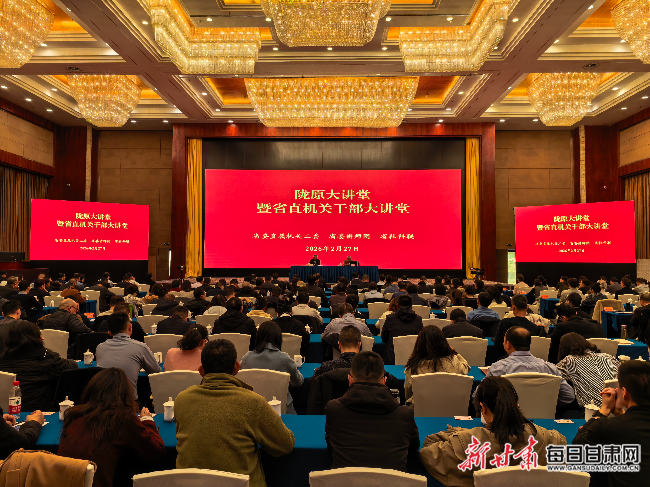
陇原大讲堂暨省直机关干部大讲堂举办廉洁文化专题辅导
Xin Lang Cai Jing· 2026-02-27 14:18
Core Viewpoint - The lecture on clean culture construction emphasizes the importance of integrating clean culture into daily work and enhancing governance efficiency for high-quality development in Gansu province [2]. Group 1: Event Overview - The "Lanzhou Lecture Hall" and "Provincial Direct Agency Cadre Lecture Hall" were held in Lanzhou, featuring a talk by Zheng Jiaming, former Deputy Minister of the Hunan Provincial Propaganda Department [2]. - The lecture focused on the construction of clean culture, using historical cases of corruption and integrity to illustrate its value and practical pathways [2]. Group 2: Audience Response - Attendees, including party members from provincial agencies, expressed that the clean culture of the new era is a synthesis of traditional Chinese culture, revolutionary culture, and the essence of socialist advanced culture [2]. - The participants aim to use the lecture as an opportunity to promote the integration of clean culture with party building and business work, enhancing governance effectiveness and service quality [2].

达州启用廉洁文化地图
Xin Lang Cai Jing· 2026-02-26 22:50
Core Viewpoint - The establishment of the "Integrity Culture Map" in Dazhou represents a significant step in promoting a systematic approach to integrity culture, transitioning from scattered educational sites to a more integrated framework [1] Group 1: Integrity Culture Map - The map includes six thematic matrices: "Integrity Rhythm of Bafeng," "Integrity Movement of Red Veins," "Integrity Fulfillment in Villages," "Integrity in Family Management," "Integrity in Law Enforcement," and "Integrity in Administrative Communication" [1] - It features various cultural sites, including the Feng Family Cultural Museum, which embodies traditional family values, and the former site of the Red 30th Army Political Department, highlighting revolutionary history [1] - The map also encompasses modern cultural sites like the teaching points for poverty alleviation in the Ba Mountain Grand Canyon, reflecting the spirit of contemporary socialist advancement [1] Group 2: Implementation and Future Plans - The Dazhou Discipline Inspection Commission plans to utilize the map in various areas such as cadre training, ideological education, family values, and cultural tourism integration [1] - The initiative aims to foster a positive political ecology and support high-quality development through the promotion of integrity culture [1]
湟源因地制宜加强廉政教育
Xin Lang Cai Jing· 2026-02-13 18:33
Group 1 - The core viewpoint of the articles emphasizes the establishment of a clean governance culture in Huangyuan County, aiming to enhance the awareness of integrity among party leaders and create a positive festive atmosphere [1][2] - The newly inaugurated integrity education base is designed to integrate local cultural resources and typical cases of disciplinary violations to provide both positive guidance and warnings, making the education more relevant and impactful for local officials [2] - Huangyuan County's approach to building a multi-layered and widely accessible integrity education system is based on the principles of adapting to local conditions, resource integration, and highlighting local characteristics [2] Group 2 - The county's efforts in promoting integrity culture are part of a broader initiative to create a political ecology characterized by clean governance and social clarity, aligning with the "Clear Wind Dan City" construction goal [1] - The integration of traditional cultural elements and red resources into the integrity education framework aims to strengthen the foundation of integrity culture while fostering innovation and preservation in non-heritage transmission [2]
中国移动:立体化建设推动廉洁文化深入人心
Zhong Yang Ji Wei Guo Jia Jian Wei Wang Zhan· 2026-02-12 03:16
Core Viewpoint - China Mobile emphasizes the importance of strengthening integrity culture as a foundational project to promote a corruption-free environment, aiming to create a "Clean Mobile" brand through systematic education and innovative activities [1][2][3] Group 1: Education and Awareness - The company implements a comprehensive education model that includes various learning methods such as "guided learning" by the party committee and "in-depth learning" by party members to build a strong foundation against corruption [1] - Annual themed anti-corruption education activities have been conducted for 14 consecutive years, enhancing the integrity awareness of all employees through systematic and continuous education [2] Group 2: Cultural Integration and Resources - The company aims to create local integrity culture brands by integrating regional cultural heritage with red education resources, establishing physical venues for integrity culture education [3] - An online platform called "Red Cloud Collection" is being developed to consolidate resources from national red culture bases, providing quality digital content related to integrity themes [3] Group 3: Innovation in Education - The company promotes advanced models of integrity culture by leveraging its strengths in technology, such as 5G and big data, to enhance the visibility and impact of integrity culture [3] - Various communication channels, including WeChat and online university platforms, are utilized to disseminate integrity culture effectively to grassroots levels [3]

以“廉韵松央”品牌为驱动 构建“六廉”文化体系 基层央行廉洁文化建设的松原实践
Jin Rong Shi Bao· 2026-02-12 02:06
Core Viewpoint - The construction of a clean culture in grassroots central banks is essential for enhancing financial governance capabilities, with the People's Bank of China (PBOC) in Songyuan City exploring a new path through the "Lianyun Songyang" brand, focusing on six systems to transform clean culture from a "document requirement" to an "internal driving force" [1] Group 1: Political Foundation - The PBOC in Songyuan City emphasizes the political nature of clean culture construction, integrating it into the overall planning of strict party governance and civil unit creation, thereby establishing its strategic position [1] - A five-level learning system is implemented to strengthen theoretical education, ensuring that staff understand the importance of clean culture for financial security and central bank responsibilities [1] Group 2: Innovative Education - The PBOC has developed a multi-dimensional education system to address the limitations of traditional clean governance education, aiming to instill a culture of "not daring to corrupt, not being able to corrupt, and not wanting to corrupt" [2] - Innovative methods such as immersive role-playing scenarios are introduced to enhance risk recognition and resistance capabilities among staff, moving beyond traditional educational formats [2] Group 3: Regional Integration - The PBOC integrates local cultural elements into clean culture construction, utilizing local red resources and oil industry culture to enhance the educational experience [3] - Family values are promoted as part of the clean culture, with activities designed to extend the culture into family settings, creating a dual approach to governance [3] Group 4: Supervision and Risk Control - The PBOC has established comprehensive internal management systems and identified 1,540 positions with potential integrity risks, implementing 934 preventive measures [3] - Various supervisory methods are employed to ensure thorough oversight of key decision-making processes and compliance with regulations [3] Group 5: Cultural Infrastructure - The PBOC has created a multi-faceted clean culture environment through both online and offline initiatives, making clean culture a tangible part of daily work life [4] - The organization emphasizes the integration of clean culture with practical work, achieving zero records of violations while maintaining high performance across multiple sectors [4]
让守好“廉关”成为党员干部的“标配”
Xin Lang Cai Jing· 2026-02-11 06:24
Core Viewpoint - The recent public notifications by various disciplinary inspection and supervision agencies regarding violations of the Central Eight Regulations signal a strong commitment to addressing "Four Winds" issues during the critical period of the Spring Festival [1][2]. Group 1: Importance of the Spring Festival - The Spring Festival is a time for family gatherings and social interactions, which also serves as a test for the integrity and conduct of party members and officials [1]. - The emphasis on maintaining a "clean and happy year" during this festive period acts as a preventive measure against corruption, akin to giving party members a "preventive shot" [1]. Group 2: Party Discipline and Supervision - The Central Committee and State Council have issued notifications to ensure the continuation of efforts to correct "Four Winds" and promote new customs during the 2026 New Year and Spring Festival [2]. - Party members are urged to prioritize legal and disciplinary awareness, maintaining a respectful attitude towards party discipline and national laws to avoid temptations and misconduct [2][3]. Group 3: Leadership and Self-Discipline - Leaders, especially those in key positions, are expected to set an example by strictly adhering to self-discipline regulations and resisting corrupt practices [3]. - Ordinary party members must uphold their moral standards and remain unaffected by external influences, ensuring their integrity in all circumstances [3]. Group 4: Organizational Responsibilities - Party organizations are tasked with implementing strict party governance responsibilities, including pre-festival education, mid-festival supervision, and post-festival reflection [4]. - Efforts should be made to enhance awareness of integrity through various educational methods, such as warning education and communication sessions, to reinforce the importance of maintaining a clean festive atmosphere [4]. Group 5: Cultural and Ethical Implications - The concept of "nodes" as "examination points" emphasizes the need for party members to maintain a clear mindset and adhere to integrity, especially during critical periods [4]. - A commitment to integrity at every key moment is essential for fostering a positive party culture and ensuring that the festive season is filled with both familial warmth and a spirit of integrity [4].
深化系统整治 夯实立德树人根基
Zhong Yang Ji Wei Guo Jia Jian Wei Wang Zhan· 2026-02-11 00:06
Core Viewpoint - The article emphasizes the importance of strict governance and integrity in higher education institutions, particularly at Anhui Medical University, to foster a positive educational environment and uphold the mission of nurturing talent for the country and the Party [1]. Group 1: Responsibility and Accountability - Anhui Medical University’s discipline inspection committee focuses on implementing the "two responsibilities" framework, ensuring that the school’s Party committee, discipline inspection, and functional departments work collaboratively to fulfill their roles [2]. - The university has identified 75 issues and developed 117 corrective measures, all of which have been completed, demonstrating a commitment to accountability [2]. - A new annual assessment method for leadership positions has been established, incorporating indicators related to ideological awareness and professional ethics into the evaluation system [2]. Group 2: Problem Rectification - The university is conducting a comprehensive review of eight key areas, including admissions and hospital ethics, to identify and address significant issues [3]. - A closed-loop system for supervision, feedback, and rectification has been established, focusing on critical tasks such as the management of research funding, with 25 issues identified during inspections [3]. - The institution is committed to both immediate corrections and long-term institutional improvements, particularly in enhancing the teacher ethics assessment mechanism [3]. Group 3: Continuous Improvement in Conduct - The article highlights the necessity of ongoing supervision and checks to ensure the effectiveness of the integrity initiatives, with dynamic problem resolution being a priority [4]. - Educational materials and warning cases are being utilized to promote self-discipline among faculty and staff, reinforcing the importance of integrity [4]. - The construction of a "clean school" culture is being integrated into the overall educational framework, encouraging students to actively participate in promoting integrity [5].
以高质量纪检监察工作保障和推动成都经济社会高质量发展
Xin Lang Cai Jing· 2026-02-08 19:33
Core Viewpoint - The article emphasizes the importance of high-quality disciplinary inspection and supervision work in promoting the high-quality development of Chengdu's economy and society, aligning with the Party's self-revolution and economic growth [1]. Group 1: Political Supervision and Economic Development - The Chengdu-Chongqing economic circle has seen its GDP cross two trillion yuan thresholds, significantly enhancing its role in supporting the new era of western development and national high-quality growth [2]. - The city has established over 1,500 urban parks and 9,800 kilometers of greenways, contributing to its recognition as an "excellent park city" and exploring new paths for urban modernization with Chinese characteristics [2]. - The city has seen a rapid innovation rate, with 8 patents granted every hour and 4 high-tech enterprises established daily, accelerating the construction of a "3+22+N" industrial system [2]. Group 2: Political Responsibility and Discipline - In 2025, the city will deepen the application of the "Nine Responsibility Method," conducting over 340,000 political talks and addressing issues of political discipline violations [4][5]. - The city has implemented a "clean and clear" business environment initiative, visiting over 170,000 enterprises and resolving over 40,000 business-related issues [3]. Group 3: Anti-Corruption and Governance - The city has received 3,444 complaints, initiated 7,171 cases, and disciplined 6,254 individuals, demonstrating a strong commitment to anti-corruption efforts [9]. - The city has focused on the "key minority" in its anti-corruption strategy, leading to the investigation of several high-profile cases [9]. Group 4: Cultural and Educational Initiatives - The city has launched various educational initiatives to promote clean governance, including the production of warning education materials and the organization of numerous training sessions [11][12]. - The city has emphasized the importance of integrating discipline education into daily practices, conducting over 37,000 educational activities that reached more than 1.75 million participants [12]. Group 5: Community Engagement and Public Services - The city has implemented community service initiatives, such as the "sunshine trading" of rural property rights, enhancing public services and addressing local needs [15][16]. - The city has established a three-network integration platform for public complaints, effectively addressing over 1.44 million public issues [16]. Group 6: Future Directions - The city aims to continue enhancing its disciplinary inspection and supervision work, ensuring it supports the high-quality development goals set for the 14th Five-Year Plan [21].
清风正气润星城|“清廉长沙”专栏——2025年长沙市纪检监察工作回眸
Chang Sha Wan Bao· 2026-02-08 01:36
Group 1 - The year 2025 marks a significant transition for the planning phases of the "14th Five-Year Plan" and the "15th Five-Year Plan" in Changsha, emphasizing the importance of political supervision and anti-corruption efforts [1] - The municipal disciplinary inspection and supervision agencies have been actively implementing the directives of the central government and local authorities, focusing on political education and the enforcement of anti-corruption measures [2][3] - In 2025, the city aims to enhance the political supervision framework, ensuring that major decisions from the central government are effectively monitored and implemented [3] Group 2 - The municipal disciplinary inspection agencies have reported a total of 2,464 cases, with 2,415 individuals disciplined, including 75 county-level officials, recovering direct economic losses of 5.1 billion [16] - The city has established a robust mechanism for monitoring and addressing issues related to public welfare, with a focus on resolving 16+3 key livelihood projects [9] - A total of 477 new specialized small and medium-sized enterprises and 42 "little giant" enterprises were added in 2025, leading the province in this category [5] Group 3 - The city has intensified efforts to combat corruption and improve governance, with 692 violations of the central eight regulations reported and 784 individuals disciplined [7] - The municipal government has implemented a series of measures to enhance the management of public resources, including a closed-loop management mechanism for property maintenance funds [10] - The establishment of a smart cafeteria management system has improved procurement efficiency in schools, reflecting the city's commitment to enhancing public service delivery [12] Group 4 - The city has focused on enhancing the quality of its disciplinary inspection workforce through training programs and the integration of technology in monitoring efforts [19][20] - The integration of multiple supervisory bodies has been undertaken to strengthen collective operational capabilities and improve the effectiveness of oversight [21] - The ongoing commitment to learning and implementing Xi Jinping's thoughts on socialism with Chinese characteristics is expected to guide the city's governance and anti-corruption strategies in the coming years [22]
在创新中狠抓落实丨着力增强腐败治理综合效能
Zhong Yang Ji Wei Guo Jia Jian Wei Wang Zhan· 2026-02-08 00:31
Core Viewpoint - Guizhou Zunyi is intensifying its anti-corruption efforts by integrating punishment, governance, and prevention to enhance the overall effectiveness of corruption management [2][3]. Group 1: Anti-Corruption Measures - Zunyi City maintains a zero-tolerance approach towards corruption, focusing on key areas such as state-owned enterprises, healthcare, and finance, with a particular emphasis on high-ranking officials [2][3]. - In 2025, Zunyi's disciplinary inspection and supervision agencies filed 3,673 cases and detained 235 individuals, including 21 city-level and 57 county-level officials [2]. - Notable cases include the former deputy secretary of the New Pu New District and the former chairman of the municipal political consultative conference, among others [2]. Group 2: Preventive Strategies - The city emphasizes preventive measures by reforming systems and regulating power operations to reduce opportunities for corruption [3]. - In 2025, 81 disciplinary inspection recommendations were issued to promote reform and accountability in response to identified issues [3]. - Following the investigation of a former hospital director, a comprehensive analysis of corruption in the healthcare sector was conducted, leading to the development of a corrective action plan [3]. Group 3: Educational Initiatives - Zunyi's disciplinary inspection and supervision agencies utilize warning education as a key strategy to promote integrity and prevent corruption [4][5]. - The city organizes educational sessions for key personnel in critical sectors, focusing on self-examination and awareness [4]. - A series of educational videos and materials are produced to illustrate the consequences of corruption, targeting both officials and their families [5].