资产结构调整

Search documents
宏信建发(09930)前三季度的归属于普通股股东溢利同比下降幅度超过70%
智通财经网· 2025-10-21 10:23
Core Viewpoint - The company is experiencing a significant decline in total revenue and profit due to domestic market oversupply and falling rental prices, while making strategic adjustments to its asset structure and expanding its overseas operations [1][2] Group 1: Domestic Market Performance - The rental rate for major equipment categories remains high, with the aerial work platform rental rate at approximately 80% by the end of the third quarter [1] - Total revenue for the first three quarters has decreased by over 10% year-on-year, primarily due to ongoing oversupply in the domestic market and declining rental prices for aerial work platforms [1] - Profit attributable to ordinary shareholders has decreased by more than 70% year-on-year, although the rate of decline has slightly narrowed compared to the first half of the year [1] Group 2: Overseas Market Strategy - The company is adopting a balanced approach to business expansion and risk management in overseas markets, focusing on increasing asset management scale and optimizing asset structure [1] - As of the end of the third quarter, overseas revenue accounted for over 15% of total revenue, while overseas gross profit represented more than 25% of total gross profit [1] Group 3: Financial Management - The company maintains a prudent approach to new capital expenditures and continues to enhance the value of assets throughout their lifecycle through its domestic and international networks [1] - The financing cost rate is on a downward trend, and the overall financial situation remains safe and stable [1]
药明康德再度“瘦身”:四度减持药明合联,累计变现70亿港元,投资收益对今年净利润贡献逾43亿元
Xin Lang Zheng Quan· 2025-10-11 10:17
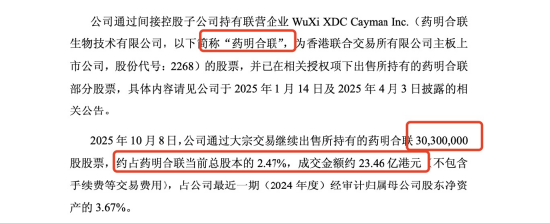
Core Viewpoint - WuXi AppTec (603259.SH) has completed a block trade selling shares of its associate WuXi AppTec (2268.HK) for approximately HKD 2.346 billion, marking the fourth sale of its shares this year, which has contributed a total of RMB 4.351 billion to the company's net profit [1][2]. Group 1 - On October 8, WuXi AppTec sold 30.3 million shares of WuXi AppTec, representing 2.47% of the latter's total share capital [2]. - The net investment gain from this sale is expected to impact the company's after-tax net profit for the fiscal year 2025 by approximately RMB 1.679 billion, accounting for over 10% of the latest audited net profit attributable to shareholders for the fiscal year 2024 [2]. - This divestment aligns with a previously authorized strategy from a shareholder meeting on September 23, allowing the investment department to dispose of listed domestic and foreign stocks when market conditions are favorable, with a total limit of 15% of net assets attributable to shareholders [2][3]. Group 2 - WuXi AppTec has strategically timed its stock sales, having previously sold a total of 137 million shares of WuXi AppTec this year, generating approximately HKD 4.604 billion, bringing the total cash realized to nearly HKD 7 billion, significantly boosting the company's profit performance [2]. - The proceeds from this sale will be reinvested into global capacity expansion and capability building, enhancing its integrated CRDMO business model, and attracting top-tier research talent to support long-term growth [3]. - As of October 10, WuXi AppTec's stock closed at RMB 104.72 per share, reflecting a year-to-date increase of 95.02%, while WuXi AppTec's stock closed at HKD 71.85 per share, with a year-to-date increase of 134.42% [3].


美克家居欠薪欠款风波不断 回应称正采取举措优化现金流
Xi Niu Cai Jing· 2025-09-28 06:09
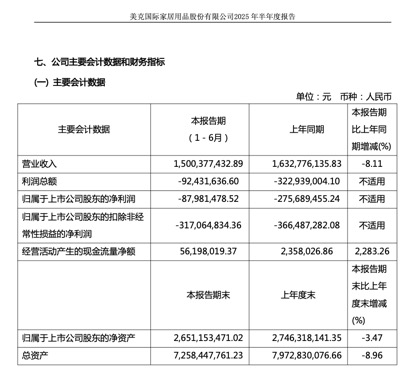
Core Insights - Meike Home is facing significant financial difficulties, including delayed salary payments to employees and outstanding debts to suppliers [1][3] - The company's revenue has declined for three consecutive years, with a total loss exceeding 1.6 billion yuan, and a loss of 87.98 million yuan reported in the first half of 2025 [2][3] - Meike Home's asset-liability ratio has risen to 63.1%, indicating substantial short-term repayment pressure [3] Financial Performance - Revenue for the first half of 2025 was approximately 1.5 billion yuan, down 8.11% from the same period last year [2] - Total profit for the same period was a loss of approximately 92.43 million yuan, an improvement from a loss of 322.94 million yuan in the previous year [2] - The net cash flow from operating activities was approximately 56.20 million yuan, a significant increase from 2.36 million yuan in the previous year [2] Legal and Operational Challenges - Multiple lawsuits have been filed against Meike Home, with over ten contract dispute cases since 2025 [3] - Suppliers have reported unpaid renovation fees from 2022, with Meike Home only able to pay one-third of the awarded amounts in court [3] - The company has acknowledged the need to optimize cash flow and adjust its asset structure to stabilize operations and protect stakeholder interests [3]

中国大规模减持美债,单月抛售超1800亿,央行连买黄金稳美元风险
Sou Hu Cai Jing· 2025-09-22 20:59
Core Insights - A global asset reshaping is occurring, with a notable decline in the allocation of dollar assets despite the emphasis on stable foreign exchange reserves [2] - Concerns regarding the sustainability of U.S. fiscal health and the long-term credibility of the dollar are growing due to potential tax reforms and trade tariffs under the Trump administration [2] - The U.S. federal debt is nearing dangerous levels, raising alarms about future interest burdens and policy constraints [2] Group 1: Market Reactions - Traders are engaging in discussions about the selling of European long-term bonds and the contrasting behavior of Japan and the UK, which increased their holdings in U.S. Treasuries [4][5] - The divergence in asset allocation strategies among countries indicates a lack of uniformity in foreign investment behavior, with China actively adjusting its asset structure for long-term resilience [5] Group 2: Gold as an Alternative - China has been increasing its gold reserves for ten consecutive months, reaching 74.02 million ounces by the end of August, reflecting a strategic shift towards diversifying foreign exchange reserves [5][7] - The global central banks collectively increased their gold reserves by 166 tons in Q2, marking a historical high, indicating a broader trend towards gold accumulation as a hedge against potential crises [7] Group 3: Strategic Asset Allocation - The shift from U.S. dollar assets to gold is seen as a gradual rebalancing rather than a complete decoupling, aimed at enhancing reserve flexibility [11][14] - The adjustments in asset allocation are influenced by both strategic policy intentions and market-driven risk aversion, highlighting a complex interplay of factors shaping current asset flows [14][16] Group 4: Future Implications - The ongoing adjustments in asset allocation are not revolutionary but represent an evolution towards a more resilient foreign exchange reserve structure [16][18] - The effectiveness of this strategy in mitigating risks associated with dollar volatility and geopolitical tensions remains uncertain, with market sentiment often diverging from rational decision-making [18]
金价突破1980年通胀调整峰值
第一财经· 2025-09-12 00:24
Core Viewpoint - The article highlights the recent surge in gold prices, reaching a historical high of $3674.27 per ounce, driven by macroeconomic uncertainties and inflation concerns, reinforcing gold's status as a safe-haven asset [3][4]. Economic Slowdown and Monetary Easing Expectations - Recent data indicates a cooling U.S. economy, with the August Consumer Price Index (CPI) rising by 2.9%, the largest increase in seven months, while the Producer Price Index (PPI) unexpectedly declined [5]. - Non-farm payrolls added only 22,000 jobs in August, with the unemployment rate rising to 4.3%, and the annual employment data was revised down by 911,000 jobs [5]. - These signals of a weakening labor market alongside persistent inflation have heightened concerns about stagflation, leading traders to fully price in a 25 basis point rate cut by the Federal Reserve [5]. Multiple Factors Driving Gold Prices - Policies from the Trump administration, including tax cuts and tariffs, have diminished the attractiveness of the U.S. dollar and Treasury bonds, accelerating capital inflow into gold [6]. - Gold has historically served as a hedge against inflation and currency devaluation, a role that is being reinforced amid current economic conditions [6]. - Analysts note that unlike the volatile spikes in gold prices seen in 1980, the current price increase is characterized by reduced volatility due to enhanced market liquidity and the accessibility of gold through ETFs [6][7]. - Goldman Sachs projects that gold prices could reach $3700 by the end of 2025 and potentially exceed $4000 by mid-2026, with scenarios suggesting prices could touch $4500 to $5000 if there is a significant outflow from dollar assets [7]. Central Bank Diversification and Long-term Support for Gold - Since the onset of the Russia-Ukraine conflict, the proportion of gold in central bank reserves has increased, surpassing that of the euro, making gold the second-largest reserve asset globally [8]. - Future gold price movements are expected to depend on the Federal Reserve's policy direction and global risk events, with historical trends indicating that rate-cutting cycles tend to enhance gold's appeal [8]. Broader Investor Base and Policy Uncertainty - The sustainability of the current gold market is attributed to a broad base of investors and ongoing policy uncertainties, positioning gold not only as an inflation hedge but also as a beneficiary of global asset reallocation [9].

调整资产结构 推动金融与实体经济深度融合
Zheng Quan Shi Bao· 2025-08-04 18:42
Core Insights - The banking sector is actively implementing the core objectives of the "Five Major Articles" in finance, focusing on adjusting asset structures to strengthen the foundation for a financial powerhouse, with emphasis on technology, green finance, inclusive finance, pension, and digital sectors [1][4] - Major banks, including state-owned and joint-stock banks, are leading efforts by providing substantial long-term funding support for key national projects and core links in industrial chains [1][4] - Smaller banks are also making contributions by focusing on regional needs, with significant growth in loans for technology enterprises and green finance [2] Summary by Categories Major Banks - ICBC has seen its strategic emerging industry loan balance exceed 3.1 trillion yuan, with technology enterprise loans nearing 2 trillion yuan, green loans surpassing 6 trillion yuan, and inclusive loans reaching 2.9 trillion yuan by the end of 2024 [1] - Other major banks are also focusing on the five key areas, with notable loan growth in technology and green sectors [1] Small and Medium Banks - Guilin Bank's loans in the "Five Major Articles" reached 117.68 billion yuan, with technology enterprise loans growing over 30% year-on-year [2] - Shanghai Rural Commercial Bank's technology enterprise loan balance is nearly 115 billion yuan, up 24.29% from the previous year [2] - Huishang Bank's green loan balance is close to 116 billion yuan, increasing over 40% year-on-year, while its inclusive small and micro enterprise loans exceed 150 billion yuan [2] Challenges - Some banks face challenges in data and business practices, with discrepancies in loan balances compared to similar-sized institutions, such as Ningbo Bank's green loan balance of 50.54 billion yuan being below the average for A-share city commercial banks [3] - There is a notable gap in technology investment between domestic banks and international peers, with only 4 out of 20 banks investing over 5% of revenue in technology by 2024 [3] - The pension finance sector requires enhanced product innovation, as the current pension system heavily relies on the first pillar, with low coverage in the second pillar and slow development in the third pillar [3] Data Governance - The banking industry faces issues with inconsistent data standards, naming conventions, and data discrepancies, which affect the objectivity of assessments [4] - There is an urgent need for unified data standards and improved data governance within the banking sector [4]
卖掉唯一住房的人
Hu Xiu· 2025-07-30 01:05
Core Insights - The article discusses the changing perceptions of homeownership in China, highlighting how individuals are selling their only homes due to financial pressures and shifting beliefs about real estate as a secure investment [2][10]. Group 1: Reasons for Selling Homes - Many individuals are selling their only homes to prevent wealth erosion and to access cash for essential expenses like medical and educational costs [1][13]. - Some are actively restructuring their asset portfolios to seek more liquid and safer investments amid market volatility [1][10]. Group 2: Personal Experiences - The stories of individuals like Dafu and Cao Mei illustrate the emotional and financial struggles associated with selling homes at a loss, with Dafu selling her home for 300 million after purchasing it for 360 million, resulting in a loss exceeding 100 million [4][10][16]. - Cao Mei sold her newly purchased home for 240 million, incurring a loss of over 30 million, reflecting the drastic changes in the housing market within a few years [7][9][10]. Group 3: Market Conditions - The article notes that the real estate market in China has experienced significant fluctuations, with many homeowners facing losses due to declining property values [10][18]. - The narrative emphasizes the shift from viewing real estate as a guaranteed investment to a more cautious approach, where individuals are reconsidering the necessity of homeownership [2][10]. Group 4: Emotional and Psychological Impact - The emotional toll of selling homes is evident, with individuals experiencing feelings of failure and loss of identity tied to their homes [3][5][14]. - The article highlights the struggle of adapting to rental living after selling homes, with individuals like Cao Mei and Dafu grappling with feelings of displacement and the challenge of creating a new sense of home [28][29]. Group 5: Future Perspectives - Some individuals, like Lin Qing, have found new opportunities and perspectives after selling their homes, leading to a reevaluation of what constitutes security and happiness in life [22][36]. - The article suggests a growing acceptance of renting as a viable alternative to homeownership, with individuals prioritizing flexibility and reduced financial burdens over traditional notions of stability [34][36].
浙商银行一季报:资负结构继续调整,客户存款规模首破2万亿元
2 1 Shi Ji Jing Ji Bao Dao· 2025-04-30 07:42
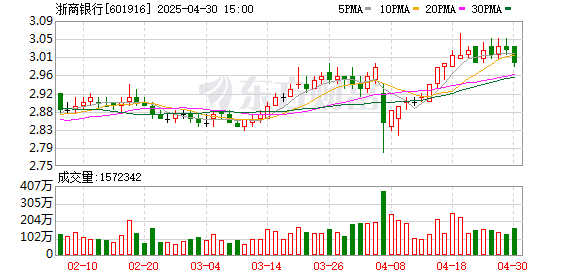
Core Viewpoint - Zhejiang Commercial Bank has achieved significant growth in customer deposits, surpassing 2 trillion yuan for the first time, indicating a strategic shift towards liability-driven operations [2][3]. Financial Performance - As of the end of Q1 2025, Zhejiang Commercial Bank reported total assets of 3.44 trillion yuan, a 3.54% increase from the previous year [2]. - The bank's total liabilities reached 3.24 trillion yuan, reflecting a 3.67% growth year-on-year [2]. - The bank's operating income for Q1 2025 was 17.105 billion yuan, a decrease of 1.302 billion yuan or 7.07% compared to the previous year [3]. - Net interest income increased to 11.981 billion yuan, up 1.38% year-on-year, while non-interest income fell to 5.124 billion yuan, down 22.23% [3]. Profitability - The net profit attributable to shareholders was 5.949 billion yuan, a slight increase of 0.36 billion yuan or 0.61% year-on-year [4]. Asset Quality - As of March 2025, the non-performing loan balance was 25.955 billion yuan, up 1.81% from the previous year, with a non-performing loan ratio of 1.38%, unchanged from the end of the previous year [4]. - The provision coverage ratio decreased to 171.21%, down 7.46 percentage points from the previous year [4]. Capital Adequacy - The capital adequacy ratio stood at 12.18%, a decrease of 0.43 percentage points from the previous year, while the core tier 1 capital ratio remained stable at 8.38% [4].
晋商银行投资债券基金规模年增187亿 加大拨备计提上市五年净利首降12%
Chang Jiang Shang Bao· 2025-04-21 00:11
Core Insights - Jincheng Bank reported a decline in both revenue and net profit for the first time since its Hong Kong listing, with revenue of 5.791 billion yuan, down 0.2% year-on-year, and net profit of 1.75 billion yuan, down 12.6% [1][3] Financial Performance - In 2024, Jincheng Bank's net interest income decreased to 4.189 billion yuan, a decline of 1.1% year-on-year, with net interest margin and net interest yield dropping to 1.07% and 1.2%, respectively [3][4] - The bank's fee and commission income fell to 627 million yuan, a decrease of 10.8%, primarily due to adjustments in trade financing business [4] - Credit impairment losses increased to 1.675 billion yuan, up 17% year-on-year, with loan impairment losses reaching 1.783 billion yuan, a significant increase of 85.9% [4] Asset Quality and Structure - As of the end of 2024, Jincheng Bank's total assets reached 376.306 billion yuan, with net loans and advances of 195.104 billion yuan, reflecting increases of 4.2% and 5.1% year-on-year, respectively [1][6] - The non-performing loan (NPL) balance was 356.6 million yuan, up 15.3 million yuan from the previous year, with an NPL ratio of 1.77%, a slight decrease of 0.01 percentage points [6] - The bank's financial investment assets increased by 17.6% to 106.796 billion yuan, with bond and fund investments totaling 98.359 billion yuan, an increase of 187.34 million yuan [1][8] Investment Strategy - Jincheng Bank has adjusted its asset structure by increasing investments in bonds and funds, with bond investments totaling 77.993 billion yuan, up 9% year-on-year, and fund investments reaching 20.366 billion yuan, a significant increase of 152.6% [7][8] - The bank's trading income and net investment securities income combined reached 930 million yuan, an increase of approximately 122 million yuan year-on-year [2][9]

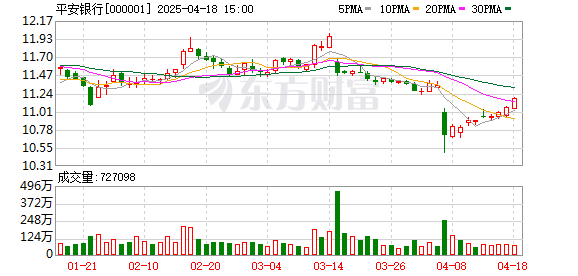
首份上市银行一季报披露 平安银行拟未来两年发行最高1000亿资本债
2 1 Shi Ji Jing Ji Bao Dao· 2025-04-18 14:09
Core Viewpoint - Ping An Bank reported a decline in both revenue and net profit for Q1 2025, while also announcing plans to issue capital bonds totaling up to RMB 100 billion to strengthen its capital structure [2][3]. Financial Performance - For Q1 2025, Ping An Bank achieved operating revenue of RMB 33.709 billion, a year-on-year decrease of 13.1%, and a net profit of RMB 14.096 billion, down 5.6% year-on-year [2]. - The net interest margin fell to 1.83%, a decrease of 18 basis points compared to the same period last year [2]. - The non-performing loan ratio remained stable at 1.06%, unchanged from the end of the previous year [2]. Retail Business Adjustments - The bank's retail loan scale continued to shrink, with personal loan balances at RMB 1,729.046 billion, down 2.2% from the end of the previous year [3]. - High-risk loans decreased, with credit card receivables down 7.9% to RMB 400.638 billion and consumer loans down 3.2% to RMB 459.315 billion [3]. - The quality of retail assets improved, with the personal loan non-performing rate at 1.32%, a decrease of 0.07 percentage points from the end of the previous year [3]. Corporate Lending Growth - Corporate loans increased to RMB 1,682.667 billion, a growth of 4.7% from the end of the previous year [4]. - The bank's focus on four major industries (infrastructure, automotive ecosystem, public utilities, and real estate) resulted in new corporate loans of RMB 123.571 billion, a year-on-year increase of 13.3% [5]. - New loans in emerging industries reached RMB 73.956 billion, growing by 32.7% year-on-year [5]. Cost Management and Efficiency - The bank's operating costs decreased, with business and management expenses at RMB 9.055 billion, down 13.2% year-on-year [5]. - Credit and other asset impairment losses were RMB 7.430 billion, a reduction of 20.9% compared to the previous year [5].