AI原生组织

Search documents
一文读懂鲸智百应:驱动组织进化的企业AI操作系统,让企业从「用AI」到「是AI」
机器之心· 2025-09-28 04:50
Core Insights - The article emphasizes the transformation of enterprises into "AI native organizations" through six dimensions: unified cognition, intelligent execution, decision-making hub, memory evolution, intelligent agent factory, and AI governance [1][3][23] - It highlights the limitations of traditional AI tools, which often remain as passive assistants rather than active participants in business processes [8][10] Unified Cognition - The first step towards an AI native organization is addressing the issue of scattered knowledge, enabling real-time, complete, and callable information [5] - The "intelligent knowledge hub" of Whale Intelligence allows AI to understand the entire business context, facilitating automatic report generation without manual data gathering [5] Intelligent Execution - The goal is to transition AI from a passive role to an active participant in business processes, enabling it to autonomously complete tasks [8] - Whale Intelligence's multi-agent collaborative engine allows for dynamic task orchestration and integration without disrupting existing systems, significantly reducing HR's administrative workload [8] Decision-Making Hub - AI is positioned as a strategic partner in core decision-making processes, moving away from reliance on experience-based decision-making [10][11] - The system can autonomously understand complex directives and break them down into actionable tasks, improving decision-making efficiency and accuracy [11] Memory Engine - The memory engine enables organizations to accumulate knowledge and experience over time, transforming each task execution into a learning opportunity [14][15] - This creates a knowledge compounding effect, enhancing the organization's capabilities with each completed task [15] Intelligent Agent Factory - The intelligent agent factory allows for rapid development of digital employees through low-code solutions, enabling business personnel to create tailored AI solutions without programming knowledge [17] - This flexibility supports both general and specialized business needs, ensuring that AI capabilities evolve alongside organizational requirements [17] AI Governance - The governance framework ensures that AI operations are secure, compliant, and accountable, addressing potential risks associated with AI usage [19][20] - The system includes features for permission management and audit trails, ensuring that AI actions are traceable and compliant with regulations [20] Industry Observation - Whale Intelligence distinguishes itself by positioning its solution as an "enterprise AI operating system," addressing systemic issues in AI integration within organizations [23] - This approach signifies a shift from merely using AI tools to fundamentally transforming organizations into entities that inherently possess AI capabilities [23]


深度|被字节收购后再创业:硅谷100天,写在Aibrary正式上线前
Z Potentials· 2025-08-07 03:12
Core Viewpoint - The article discusses the challenges and opportunities in the AI startup landscape, emphasizing the need for a shift from traditional metrics like Product-Market Fit (PMF) to a focus on continuous value delivery and user outcomes in the AI tools sector [4][5][9]. Group 1: Product-Market Fit and Value Creation - The concept of PMF is being misused in the AI tools market, where subscription models do not equate to actual value realization for users [5][6]. - Many AI tools are currently catering to early adopters, leading to a potential revenue decline as user budgets stabilize [6]. - A new model of value creation is emerging, where continuous value delivery is essential for long-term user retention and growth [7]. Group 2: Outcome vs. Output - The traditional B2B model focuses on selling products, while the new paradigm emphasizes creating outcomes for customers [9]. - AI products should not just provide capabilities but should ensure users achieve tangible results, integrating customer success mechanisms into the product [9][10]. Group 3: AI Evaluation Systems - Finding PMF is just the beginning; the real challenge lies in building effective AI evaluation systems that understand user behavior and measure performance [10]. - The shift from a waterfall model to a discovery-based approach allows for rapid iteration and testing, enhancing collaboration and reducing development time [12][13]. Group 4: AI-Native Organizations - AI-native organizations are reshaping management paradigms, reducing the need for middle management and promoting a flatter organizational structure [14]. - The traditional management theories are becoming obsolete as AI tools enhance decision-making and execution efficiency [14]. Group 5: Human-AI Collaboration - The "1+N" model promotes collaboration between humans and multiple AI agents, enhancing productivity and efficiency [17]. - New roles are emerging within teams, such as "Product Owners" and "Infrastructure Builders," to better leverage AI capabilities [18]. Group 6: Lifelong Learning in the AI Era - The future of education is shifting from content delivery to feedback-driven learning, emphasizing continuous improvement and personal growth [22][25]. - The design of effective feedback mechanisms is crucial for creating a closed-loop learning system that fosters individual development [25]. Group 7: The Unique Value of Humans - In a world where AI can replicate knowledge and skills, the unique human perspective and creativity become invaluable [26]. - The ultimate goal of education should be to help individuals become unique and irreplaceable, leveraging their personal experiences and insights [26].
马上消费赵国庆:创新产品开拓场景,技术精准对接消费新需求
Nan Fang Du Shi Bao· 2025-06-13 10:10
Group 1 - The consumption finance industry is facing new opportunities and challenges amid a backdrop of increased consumer spending and regulatory policies [2] - The industry is experiencing a "Matthew effect," where leading companies gain more advantages, prompting smaller institutions to seek ways to break through [2] - The focus is on balancing compliance operations with innovative development to unlock a new landscape in the consumption finance ecosystem [2] Group 2 - The chairman of the leading consumption finance company, Ma Shang Consumption, emphasizes the need for product innovation and technology to expand service scenarios and accurately identify user needs [3][4] - The company plans to increase AI investments to better identify user demands and enhance service precision, particularly in the context of building an international consumption finance center in Chongqing [3][4] - Ma Shang Consumption has a significant portion of its workforce in R&D, with nearly 3,000 out of 4,100 employees dedicated to technology [3] Group 3 - The current economic environment is leading to structural changes in consumer credit demand, with an increase in rigid demand and a decline in improvement demand due to changing consumption habits among high-income groups [4] - The company has applied for over 2,500 patents and established more than 100 standards, positioning itself as a leader in industry standards and institutional innovation [4] Group 4 - Ma Shang Consumption is addressing industry challenges such as high service costs and low data decision efficiency through digital intelligence [4][7] - The company is focusing on three main areas for technology investment: improving service efficiency, enhancing data decision-making capabilities, and building an open platform for various consumption scenarios [7] - The deployment of a retail finance large model has significantly improved customer service response times and risk identification accuracy [7][8] Group 5 - The company emphasizes the importance of multi-dimensional collaboration in building competitive advantages in digital intelligence, integrating strategy, talent, organization, management, and technology [8] - The AI platform developed by the company has lowered the barriers to using large models, allowing business personnel to independently access AI capabilities [8]

AI原生浪潮冲击下,互联网大厂的组织如何进化?
3 6 Ke· 2025-04-11 10:20
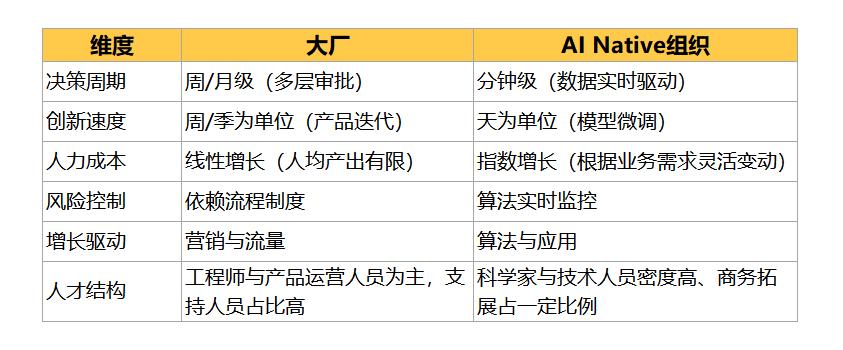
Core Insights - The rise of AI-native organizations represents a dual revolution in technology and organizational structure, posing significant challenges to traditional internet giants [1][2] - The competition is not only about technological capabilities but also about organizational forms, cultural genes, and talent strategies [2][3] Group 1: Characteristics of AI-native Organizations - AI-native organizations integrate AI as a core driver of products, services, and business processes, rather than as an added feature [2] - They possess self-developed core technologies, with rapid iteration speeds that outpace traditional companies, exemplified by OpenAI's swift transition from GPT-3 to GPT-4 within two years [2] - Product design inherently relies on AI capabilities, making it impossible for products to exist independently of AI [3] - The focus has shifted from "data and computing power" to "algorithms and community," emphasizing algorithm breakthroughs and scenario innovations as keys to market recognition [4] - Organizational structures are fluid, with flat, self-organizing teams that enable rapid decision-making and resource responsiveness [5] - A geek culture and strong founder cohesion drive these organizations, emphasizing technical idealism and long-term value [6] Group 2: Challenges for Traditional Internet Giants - Traditional tech giants face a core issue: how to evolve their organizations to maintain competitiveness in the AI-native wave [2][9] - Despite having significantly more resources, traditional companies struggle to replicate the technical sharpness of AI-native organizations like DeepSeek [1][9] - The lack of visionary leadership and a clear pursuit of algorithmic efficiency hampers traditional firms' ability to compete effectively [9] - The user engagement battle is intensifying, with AI-native applications rapidly gaining traction and threatening traditional applications' user time [10] Group 3: Strategic Responses from Major Companies - Major companies are attempting to integrate AI-native capabilities into their core businesses, recognizing the potential for scalable applications [11][21] - ByteDance is restructuring its AI organization to enhance agility and innovation, with a focus on AI-native talent [19][20] - Tencent is migrating its AI product lines to a more integrated structure, emphasizing collaboration with AI-native models [21] - Alibaba plans to invest over 380 billion yuan in AI infrastructure and aims for a comprehensive transformation across its core businesses [22] Group 4: Future Directions and Organizational Evolution - The evolution of organizational forms will be crucial as companies transition from traditional data-algorithm-traffic models to a model-data-agent framework [27] - Companies must focus on enhancing their organizational learning speed to convert technological breakthroughs into business cycles effectively [27] - The historical challenges of organizational inertia must be addressed to facilitate meaningful transformation in response to AI-native competition [25][26]