AI旅游

Search documents
马蜂窝旅游AI商业化副总经理陆蕾:AI旅游平台的核心竞争力在于“技术温度”
Bei Jing Shang Bao· 2025-05-28 10:15
Core Insights - The 2025 Tourism High-Quality Development Forum highlighted the role of AI in transforming the tourism industry, emphasizing the emergence of platforms with three key characteristics: model innovation, differentiated services, and intelligent agent empowerment [1][3]. Group 1: Model Innovation - The transition from "content + service" to "tool + service + community" is a significant shift in the tourism sector, with companies like Mafengwo upgrading traditional "official guides" to intelligent tools [3]. - Mafengwo enhances information accuracy through "slow thinking chain technology + vertical fine-tuning model" and has launched initiatives like "AI Travel Guizhou" to create a closed loop from content seeding to service conversion [3]. Group 2: Differentiated Services - The focus is on scaling to meet personalized demands, leveraging years of tourism content data and industry internet accumulation [3]. - The "small vehicle small group + guide" service model has been piloted in Guizhou, achieving a scale effect that retains customization while reducing user decision-making costs [3]. Group 3: Intelligent Agent Empowerment - AI intelligent agents are being integrated into hardware, such as robotic companions, to provide services like museum tours and translation in tourist areas [3]. - The collaboration with Singapore's Merlion IP aims to expand international scenarios, while intelligent agents empower both scenic spots and "small B" operators by organizing destination maps and facilitating resource integration [3]. Group 4: Core Competitiveness - The core competitiveness of AI tourism platforms lies in "technical warmth," which combines data and algorithmic support with a focus on the experiential essence of the cultural tourism industry [4]. - The threefold value of "tool convenience + service humanization + community belonging" is redefining the connection between tourists and destinations [4].


第一批AI旅游的「受害者」,已经出现了
3 6 Ke· 2025-05-15 03:58
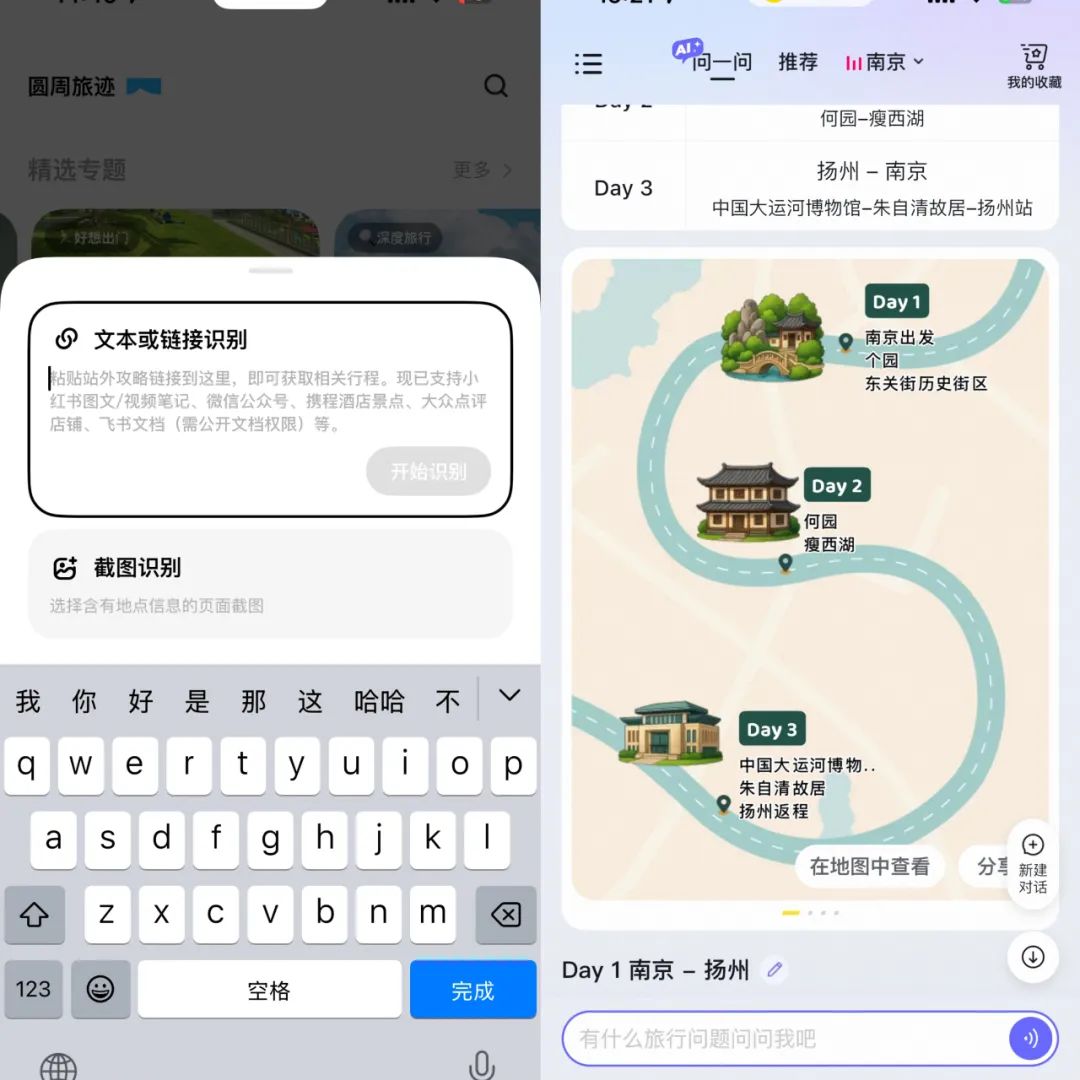
Core Insights - The article discusses the challenges and opportunities in the AI travel planning sector, highlighting user experiences and the current state of AI travel products [1][2][3]. Group 1: User Experiences and Challenges - Users like Wendy have faced issues with AI travel planners, such as inaccurate time predictions due to unpredictable travel conditions, leading them to revert to traditional methods like Excel [1]. - Many users express skepticism about fully relying on AI for travel planning, often seeking advice from human travel planners to validate AI-generated itineraries [9][21]. - The reliability of AI travel products is still a concern, with users reporting that while usability has improved, the accuracy and richness of information remain inadequate [15][16]. Group 2: Market Dynamics and Product Landscape - The AI travel product landscape is crowded, with various offerings including chatbot products, traditional OTA integrations, general AI tools, and niche travel-specific applications [5][6][4]. - The market is experiencing consolidation, with larger players acquiring smaller startups, indicating a competitive environment where "big fish eat small fish" [18][21]. - Traditional OTA giants remain cautious about AI's role in travel planning, with leaders from companies like Airbnb and Booking expressing uncertainty about the future impact of AI [22]. Group 3: Entrepreneurial Landscape - The AI travel sector has attracted a diverse group of entrepreneurs, including those from major tech companies and seasoned travel industry experts, who are motivated by the potential to address unmet needs in the market [23][25]. - There are two primary business models emerging among AI travel startups: one focused on rapid commercialization and the other prioritizing community engagement and slower growth [26]. - The window for success in the AI travel space is narrowing, with a shift in focus from selling tools to generating revenue, as noted by industry experts [26].