Domestic Manufacturing

Search documents
GlobalFoundries' executive chair on domestic chip manufacturing
CNBC Television· 2025-10-02 17:19
Government Initiatives & Industry Support - The US government, through the Trump administration and Secretary Lethnik, aimed to bring domestic semiconductor manufacturing back to the US for economic, supply chain, and national security reasons [2][3][5] - The CHIPS Act and tariff proposals are complementary, with the CHIPS Act providing economic tools for capacity building and tariffs shifting demand to fill that capacity [4] - Government involvement is seen as necessary to bolster the semiconductor industry, although discussions with GlobalFoundries (GF) have not included the government taking an equity stake [6][7] Business Strategy & Market Dynamics - Businesses have the autonomy to choose how they satisfy customers based on their business and financial models [2][6] - GlobalFoundries (GF) is prepared to expand its manufacturing scale in the US [2] - Customers are recognizing the need to pull back from globalization to create a more balanced and resilient supply chain, with the US playing a more significant role [8] - GlobalFoundries (GF) will build at the rate and pace that customers need to bring domestic supply home [9] Capital Expenditure & Investment - GlobalFoundries (GF) has discussed a $16 billion capital expansion leveraging CHIPS funding and investment tax credits [10] - The pace of capital deployment is dependent on securing customer commitments to bring more supply back to the US [10]

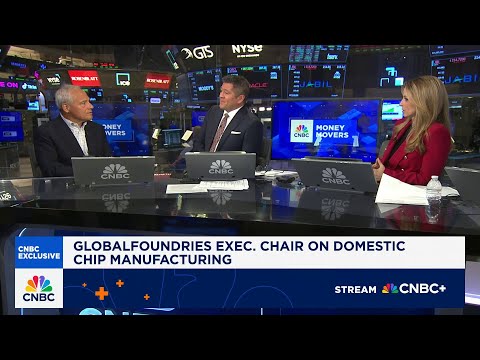
Ferguson CEO Kevin Murphy on domestic manufacturing and tailwinds for the HVAC and plumbing giant
CNBC Television· 2025-10-02 09:23
Business Overview & Growth Drivers - Ferguson's business is largely unaffected by the government shutdown due to its focus on private capital construction projects like data centers, pharmaceutical production, and chip manufacturing [3] - The company is experiencing a renaissance in US production, driven by large projects, data center activity, onshoring/reshoring trends, and a desire to bring supply chains closer to the US [5][6] - Ferguson sees continued acceleration in data center construction, with growing open order volumes and bidding activity [15][16] - Large capital construction projects (>$400 million) are driving growth for Ferguson [17] Macroeconomic Factors - Rate cuts could positively impact both residential and non-residential construction, particularly hospitality and multifamily construction [8] - A reduction in 30-year mortgage rates is desired to improve housing affordability and stimulate remodel activity, with a target of sub-6% mortgage rates to trigger increased activity [9][11] - The US has a housing deficit of 3 to 5 million units, requiring increased construction to improve affordability [10] Challenges & Opportunities - A worker shortage in the trades is a concern, and Ferguson is actively involved in encouraging and developing the trades through its "Ferguson Cares" philanthropic program [19][20][22] - Ferguson aims to improve the productivity of trade professionals to mitigate the impact of the worker shortage [12][13][22] M&A Strategy - Ferguson, a $30 billion revenue company in a $340 billion market, competes with roughly 10,000 small to medium-sized businesses [23] - The company pursues acquisitions to consolidate the industry and provide succession plans for independent owners, aiming for 1-3% annual revenue growth through this strategy [23][24]

Trump’s Tariff Tango: Markets Brace for Another Round of Economic ‘Surprises’
Stock Market News· 2025-09-26 18:00
Tariff Announcements - Former President Donald Trump announced new tariffs, including a 100% tariff on imported branded and patented pharmaceutical products, a 50% tariff on kitchen cabinets and bathroom vanities, a 30% tax on upholstered furniture, and a 25% levy on heavy trucks, effective October 1st [2][3][4] Pharmaceutical Sector Impact - Asian pharmaceutical stocks experienced declines, with Japan's Topix pharmaceutical index down 1% to 1.2%, and South Korea's SK Biopharmaceuticals shares falling 2.7% to 3.6% [3][4] - In India, the Nifty Pharma index plunged 1.81% to 2.45%, with Sun Pharma losing 2% to 2.55% and Wockhardt tumbling over 9% [4] - European pharmaceutical shares had a muted reaction, with Novo Nordisk slipping 1.9% to 3.49%, while Novartis stated the tariffs would have "no impact" due to a $23 billion investment in U.S. infrastructure [5] U.S. Pharmaceutical Companies - American pharmaceutical companies saw gains, with Eli Lilly rising 0.9% to 1.3% and Pfizer adding 0.2%, benefiting from the 100% tariff on imported drugs [6] Home Goods Sector Reaction - The home furnishings sector reacted negatively, with RH shares falling 2.6% to 5.4% and Wayfair initially slipping 3.5% to 6% but later recovering to a 0.9% gain [7][8] - American-based furniture manufacturers like La-Z-Boy and Ethan Allen Interiors saw gains due to the tariffs [8] Heavy Trucks Sector - The 25% tariff on heavy truck imports benefited American truck maker Paccar, whose shares surged 5% to 6%, while European counterparts like Daimler Truck and Traton saw declines [9] Broader Market Reaction - Despite the tariff news, the broader U.S. markets showed resilience, with the Dow Jones Industrial Average gaining 369 points (+0.8%) and the S&P 500 rising 36 points (+0.56%) [11] - The overall market reaction was described as "modest," indicating that markets have adapted to tariff announcements over time [11][12]


X @The Wall Street Journal
The Wall Street Journal· 2025-09-26 12:54
Industry Trend - The Trump administration is considering a new plan to significantly reduce the U_S_'s dependence on overseas semiconductors [1] - The plan aims to stimulate domestic manufacturing and reshape global supply chains [1]
Advisors Capital's Feeney Isn't Enthusiastic About Intel
Youtube· 2025-09-25 20:16
Group 1: Investment Potential of Intel - The government is significantly backing Intel, which may change the investment landscape, but challenges in innovation and market share loss to AMD remain [1][3][9] - Government investment alone will not enhance the intelligence of Intel's engineers or speed up innovation, indicating that hiring better talent is crucial [2] - There is potential for improved innovation pace, but Intel has a long way to go to attract major customers like Nvidia and Apple [3][10] Group 2: Strategic Moves and Partnerships - Intel is actively seeking customers for its foundry plans, indicating a strategic effort to secure partnerships and build manufacturing capabilities [5][6] - The U.S. government’s involvement is seen as a way to bridge the gap between Intel's manufacturing capabilities and customer needs [6][17] - Apple may consider diversifying its supply chain away from TSMC by potentially collaborating with Intel, which could be beneficial if Intel can ramp up its manufacturing capacity [14][15] Group 3: Market Dynamics and Competition - The semiconductor industry is experiencing shifts, with Intel needing to adapt to regain its competitive edge against TSMC and other players [9][19] - The market for AI compute is expanding, with companies like Nvidia and AMD positioned to capture significant market share [22][24] - There is a growing need for diversified suppliers in the semiconductor space, as companies look to mitigate risks associated with reliance on a single manufacturer [15][25] Group 4: Broader Industry Trends - The U.S. is aiming to become a domestic chipmaking champion, but the outcome without TSMC and Samsung remains uncertain [8][19] - Significant investments are being made in data centers globally, with hundreds of billions committed, indicating a robust growth trajectory for the semiconductor industry [27][29] - The expansion of AI applications is driving investment beyond traditional tech sectors, impacting utilities and infrastructure as well [29][30]

Lithium Americas soars on report Trump administration seeking equity stake
Yahoo Finance· 2025-09-24 10:50
Core Insights - U.S.-listed shares of Lithium Americas surged over 70% in premarket trading due to reports of the Trump administration seeking a 10% equity stake in the company, highlighting government interest in critical industries for national security [1][2] Company Developments - The Trump administration is negotiating a $2.26 billion government loan for Lithium Americas' Thacker Pass lithium mine, which is a joint venture with General Motors [2][3] - The Thacker Pass project is expected to become the largest source of lithium in the Western Hemisphere by 2028, potentially surpassing Albemarle's facility [3] - Lithium Americas recently split its operations into North American and Argentine segments to focus on the Thacker Pass project [5] Industry Context - The Thacker Pass project is seen as a strategic move to enhance U.S. production of critical minerals and reduce dependence on China, the largest lithium processor [4] - The Trump administration's interest in equity stakes extends to other sectors, including a stake in chipmaker Intel and mining company MP Materials, aimed at boosting domestic manufacturing and supply chains [4] - The positive news surrounding Lithium Americas also positively impacted other lithium miners, with Albemarle and Sigma Lithium seeing gains of 5.2% and 5.3%, respectively [6]
Tim Cook explains why Apple is investing heavily in Corning's glass factory
CNBC· 2025-09-12 22:41
Core Insights - Apple is investing $2.5 billion in Corning's Kentucky factory to manufacture glass for iPhones and Apple Watches, emphasizing the importance of innovation, cost, and quality in their decision-making process [1] - Corning's "ceramic shield" technology is highlighted for its thin, light, and durable properties, with the new version being 50% stronger than the previous one [2] - The investment is expected to increase the factory's workforce by 50% and triple production capacity, positioning it as a leading site for specialized glass manufacturing [2][3] Company and Industry Impact - Domestic manufacturing is seen as a way to create economic activity and jobs, benefiting local businesses and communities [3] - Corning views its operations as a "social contract" with the community, reflecting a long-standing relationship with the area since the factory's opening in 1952 [3] - The workforce at the Kentucky plant includes third-generation employees, indicating a strong legacy and commitment to innovation in glass production [4]



Bessent defends Trump's tariffs against claims they harm US businesses
Fox Business· 2025-09-07 18:56
Core Viewpoint - Treasury Secretary Scott Bessent emphasized that the short-term costs of tariffs are outweighed by long-term benefits to U.S. competitiveness, arguing for more time to assess the impact of President Trump's economic agenda [1][4]. Tariff Revenue - The U.S. collected over $31 billion in tariff revenues in August, marking the highest monthly total for 2025, with total tariff revenue for the year exceeding $183 billion [5]. - Bessent indicated that tariff revenue could be utilized to help reduce the national debt, which is currently at $37.4 trillion as of September 5 [5]. Economic Impact - Bessent stated that the Trump administration anticipates a "substantial acceleration" in economic activity in the fourth quarter, highlighting the need for time to build factories and create jobs [4]. - The administration is committed to maintaining global tariff rates, despite a recent appeals court ruling that the power to set tariffs lies with Congress [7][8].
Electrovaya (ELVA) Earnings Call Presentation
2025-08-13 20:00
Safe Harbor Statement Corporate Overview August - 2025 (All figures in USD) NASDAQ : ELVA TSX : ELVA Forward-looking statements: This presentation contains forward-looking statements and forward looking information (collectively, "forward-looking statements"), including statements that relate to, among other things, the size of the Company's addressable market and target verticals and applications, margin performance capabilities of new target operating segments, future operating jurisdictions including pla ...

Apple to hike investment in US to $600 bn over four years
TechXplore· 2025-08-07 09:01
Core Points - Apple will invest an additional $100 billion in the United States, raising its total commitment to $600 billion over the next four years [3][4] - This investment includes a significant increase in spending on the domestic supply chain, with a new production facility for iPhone screen glass in Kentucky [3][4] - Apple previously announced plans to invest $430 billion and create 20,000 jobs in the U.S. [4] Investment Details - The new investment builds on Apple's earlier commitment of over $500 billion and the creation of 20,000 jobs, which was announced in February [4] - In 2021, Apple had already pledged to invest $430 billion in the U.S. [4] - Apple is on track to have American manufacturers produce 19 billion chips across 24 factories in 12 states this year [4] Manufacturing and Tariffs - President Trump emphasized the importance of bringing manufacturing back to the U.S., stating that iPhones sold in the U.S. should also be made domestically [5] - While many components will be manufactured in the U.S., complete assembly of iPhones will still occur overseas [5] - Trump plans to impose a "100%" tariff on imported semiconductors, but TSMC will be exempt due to its U.S. factories [8] Future Plans - Apple will assist in developing and manufacturing semiconductors and semiconductor equipment in Texas, Utah, Arizona, and New York [9] - The company reported a quarterly profit of $23.4 billion, exceeding forecasts despite facing higher costs from tariffs [9]