Mixed Reality

Search documents
Samsung, Google Launch $1,800 Mixed-Reality Headset
Youtube· 2025-10-22 19:14
Mixed Reality Developments - Samsung is developing mixed reality capabilities to compete with Apple's Envision Pro headset, indicating a significant investment in this technology [1] - The device offers a pass-through experience for interacting with home screen apps and a more immersive experience for activities like watching movies or sports [2] - Google Maps integration allows users to explore locations in a new way, enhancing the functionality of the headset with AI capabilities [3] Apple's Foldable iPad Plans - Apple has been working on a foldable iPad, initially projected for release in 2028, but now expected to be delayed until 2029 or later due to engineering challenges [4] - The design aims to create a device that resembles a MacBook when folded, but issues with display engineering and weight management are complicating development [5] - This delay comes as Apple seeks to boost iPad sales and innovate within its product lines, including the recent launch of the iPhone Air [5]




Samsung and Google attempt to one-up Apple with AI-powered headset, Galaxy XR
CNBC Television· 2025-10-22 17:07
Product Comparison & Market Positioning - Samsung's Galaxy XR headset closely resembles Apple's Vision Pro in design and functionality, including a similar battery pack [1] - Galaxy XR differentiates itself by integrating Google's Gemini AI chatbot, offering features like window organization and contextual information from Google Maps, a capability absent in Vision Pro [2] - The industry views current bulky headsets as potentially too expensive and cumbersome for mass adoption [3][4] - The industry anticipates that the future of mixed reality lies in more compact, glasses-like devices with integrated AI, similar to Google's vision and Meta's early success [2][3] AI Integration & Future Trends - Google's Gemini AI powers key functionalities within the Galaxy XR, enabling features not available on competing devices [2] - The industry sees the development of these headsets as a stepping stone towards AI-powered glasses [2]

Samsung looks to take on Apple Vision Pro with new Galaxy XR headset (SSNLF:OTCMKTS)
Seeking Alpha· 2025-10-22 02:00
Core Insights - Samsung has officially launched its Galaxy XR mixed reality headset, positioning it as a competitor to Apple's Vision Pro [2] - The Galaxy XR is priced at $1,800, which is nearly half the cost of Apple's offering [2] Company Summary - Samsung's Galaxy XR device is now available in the U.S. and Korea, marking a significant entry into the mixed reality market [2] - The launch follows months of speculation regarding Samsung's plans to compete in the mixed reality space [2]
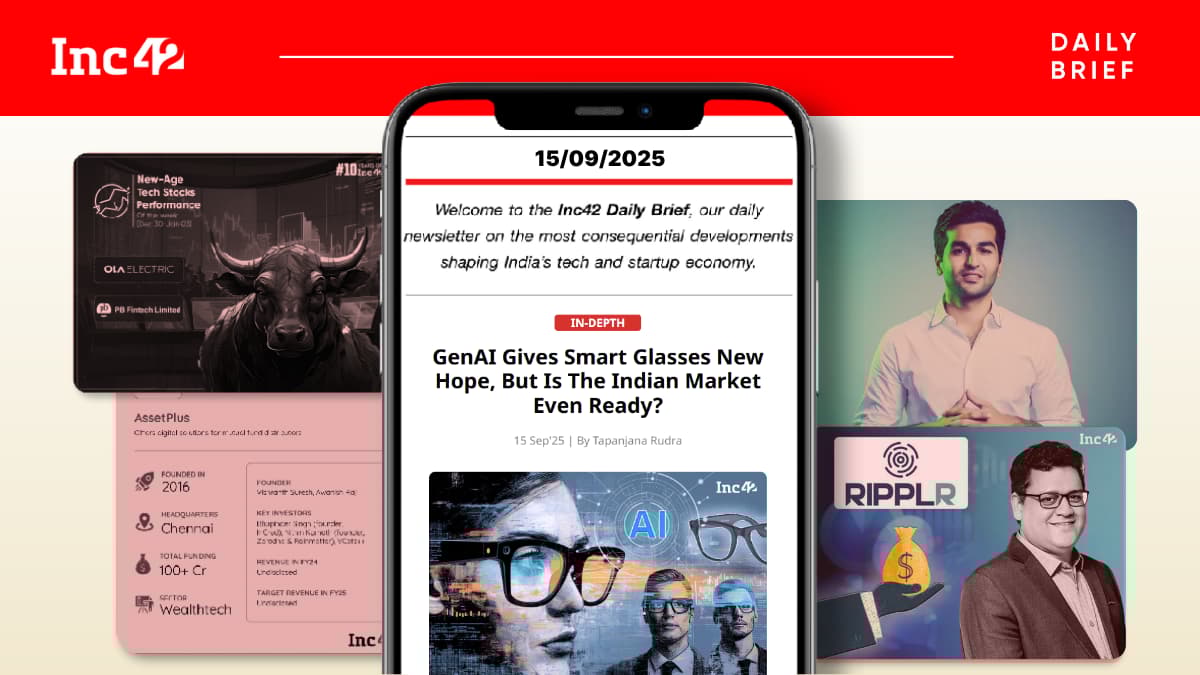
The Return Of Smart Glasses, Hike Shuts Shop & More
Inc42 Media· 2025-09-15 02:30
Mixed Reality and Smart Glasses - Smart glasses are experiencing a resurgence in India, with major players like Reliance and Lenskart entering the market, driven by advancements in technology and design [1][2] - Today's smart glasses are lighter and more compact compared to earlier models, featuring improved processors that enhance image quality and power efficiency [1] - Generative AI has transformed smart glasses into practical assistants, allowing users to perform about 35% of typical smartphone functions through voice commands [2] Competitive Landscape - Homegrown companies are differentiating themselves from global giants by focusing on vernacular capabilities and affordability, with products like QWR's Humbl glasses supporting Indic languages [3] - Jio Frames are expected to offer multi-language support and cloud storage integration, enhancing their appeal in the Indian market [3] Market Challenges - Premium pricing remains a significant barrier, positioning smart glasses as luxury items rather than mass-market products [4] - Privacy concerns are prevalent, as smart glasses operate in a gray area between everyday eyewear and potential surveillance tools, compounded by the lack of robust AI regulations in India [4] Future Outlook - The potential for smart glasses to become a billion-dollar wearable category hinges on overcoming privacy concerns, proving their AI capabilities, and delivering value for their premium pricing [5]
虚拟空间服务赛道初现集中化趋势,头部厂商市占率47%
QYResearch· 2025-08-12 09:39
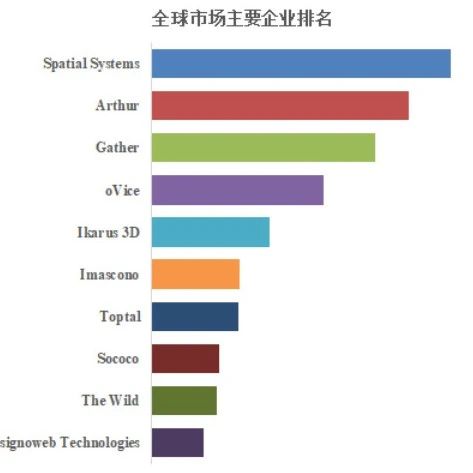
Core Viewpoint - The virtual space service market is expected to grow significantly, with a projected increase from $97.55 million in 2024 to $1.81 billion by 2031, reflecting a compound annual growth rate (CAGR) of 8.64% [1][8]. Market Overview - The global virtual space service market is primarily driven by the increasing demand for remote work solutions and the popularity of immersive gaming experiences [8]. - Major players in the market include Spatial Systems, Arthur, Gather, oVice, and Ikarus 3D, with the top four companies holding approximately 47% of the market share in 2024 [5]. Product Segmentation - Cloud-based services dominate the market, accounting for about 75% of the total share [6]. - Small and medium-sized enterprises (SMEs) represent the largest demand source, making up around 80% of the market [11]. Industry Trends - The market is witnessing significant growth in virtual office services, driven by the rise of remote work and the need for flexible, cost-effective office solutions [8]. - The integration of artificial intelligence and machine learning is becoming a key trend, enabling personalized user experiences through data analysis of user behavior in virtual spaces [12]. - Companies are developing virtual reality-based educational solutions to gain competitive advantages, enhancing understanding and retention of educational content [12]. Future Outlook - The virtual space service market is expected to continue evolving, with advancements in hardware and software blurring the lines between the physical and virtual worlds [12].
全球虚拟空间服务市场复合年增长率为8.64%
Sou Hu Cai Jing· 2025-08-12 09:27
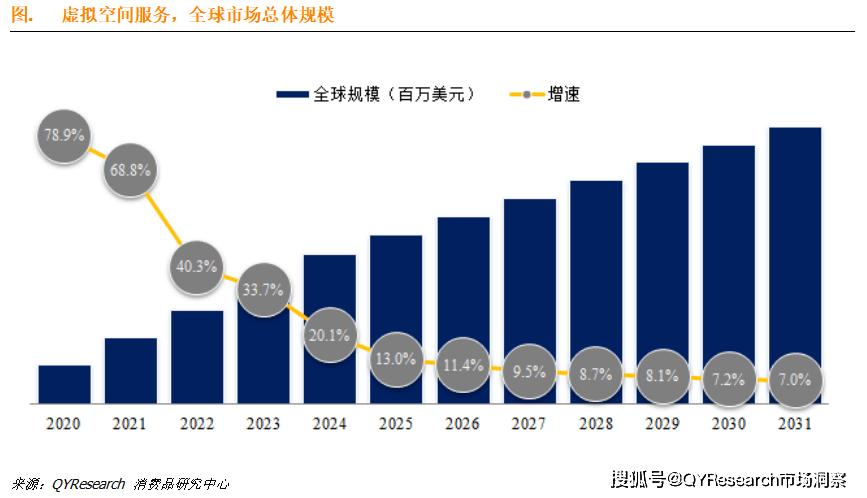
Core Insights - The global virtual space service market is projected to grow from $97.55 million in 2024 to $1.81 billion by 2031, with a compound annual growth rate (CAGR) of 8.64% from 2024 to 2031 [2] - The market is experiencing significant growth due to the increasing prevalence of remote work and the demand for flexible and cost-effective office space solutions [2] - The gaming and entertainment sectors are early adopters of virtual space services, with a surge in popularity for immersive VR gaming experiences and new entertainment formats like virtual concerts [2] - Major companies in the virtual space service market are developing VR-based educational solutions to gain competitive advantages [2][3] - The integration of artificial intelligence and machine learning in virtual space services is a key trend, enabling personalized user experiences through data analysis [3] Market Overview - The leading product type in the virtual space service market is cloud-based solutions, which account for approximately 75% of the market share [12] - Small and medium-sized enterprises (SMEs) represent the primary source of demand, holding about 80% of the market share [15] - The top four manufacturers in the global virtual space service market hold around 47% of the market share [9] Industry Trends - The trend is towards creating more social and interactive gaming experiences, allowing players from around the world to connect and play together in shared virtual spaces [2] - Advancements in hardware and software are expected to blur the lines between the physical and virtual worlds, enhancing user experiences [3]
又是浙大校友,AI眼镜“隔空取物”,戴上即可随心选中现实世界任意物体
3 6 Ke· 2025-08-07 10:46
Core Insights - The article discusses the introduction of a new technology called Reality Proxy, which enhances human-computer interaction by allowing users to manipulate real-world objects through a digital interface, effectively bridging the gap between physical and digital realms [5][7][12]. Group 1: Technology Overview - Reality Proxy enables users to select and interact with real-world objects seamlessly by using a digital representation, overcoming limitations related to distance and size [5][7]. - The technology involves three main steps: activating proxies, generating proxies, and interacting with proxies, which allows for a more intuitive user experience [8][9][10]. - The system retains spatial relationships between objects, allowing users to manipulate them without the need for precise physical interaction [10][12]. Group 2: Interaction Features - Users can browse object information quickly, select multiple objects, filter by attributes, and create custom groups, enhancing the flexibility of interactions with real-world items [14][18][25]. - The technology supports intuitive interactions by utilizing physical surfaces as touchpads, allowing users to engage with objects using familiar gestures [20]. - Visual feedback is provided to users during interactions, ensuring they remain focused on the real-world objects while engaging with their digital counterparts [12][14]. Group 3: Practical Applications - Reality Proxy has practical applications in various scenarios, such as quickly locating specific books in an office or interacting with kitchen appliances [28][30]. - The technology also extends to controlling dynamic real-world objects, demonstrated through a mixed-reality drone control application [33]. - User evaluations indicate that Reality Proxy effectively addresses challenges related to interacting with distant or hard-to-reach objects, making it particularly beneficial for users with mobility issues [36].

Sphere Brings Its AI-Powered Mixed Reality to Vuzix Smart Glasses
Prnewswire· 2025-06-24 14:00
Core Insights - Vuzix Corporation has partnered with Sphere Technology Holdings to integrate Sphere's mixed reality and AI platform with Vuzix M400 and M4000 AR smart glasses, enhancing capabilities for frontline workers [1][3] - The collaboration aims to improve operational efficiency, reduce downtime, and enhance worker safety across various industries including manufacturing, healthcare, automotive, and defense [3] Company Overview - Vuzix is a leading designer and manufacturer of AI-powered smart glasses and AR technologies, holding over 425 patents and numerous IP licenses in optics and wearable displays [5] - The company has received multiple innovation awards at the Consumer Electronics Show from 2005 to 2024, highlighting its commitment to technological advancement [5] Sphere Technology Overview - Sphere Technology specializes in spatial intelligence solutions, utilizing mixed reality and AI to enhance collaboration, training, and operational efficiency for businesses [4] - The platform supports integration with existing enterprise systems such as PLM, ERP, CAD, and IoT, making it suitable for high-precision industry applications [2]