Natural Language Processing

Search documents
The Future We Build With AI | KASHIKA JAIN | TEDxShiva Shiksha Sadan Youth
TEDx Talks· 2025-10-27 16:55
AI Fundamentals & Applications - AI is an umbrella term encompassing machine learning algorithms, including supervised learning for prediction and unsupervised learning for data classification [2][3] - Deep reinforcement learning combines cognitive ability and reinforcement learning, enabling AI agents to learn complex behaviors through trial and error to maximize rewards [4] - Generative AI, such as chatbots and LLMs, utilizes transformers with billions of tokens to understand and differentiate between sentences by assigning attention to specific words [9][10] - Natural Language Processing (NLP) is used to teach machines to understand human language, including tonality and emotions, by building lexicons that associate words with feelings [11][12] Future Trends & Challenges - Quantum computing will enhance AI capabilities by replacing bits with qubits, increasing speed and accuracy in solving complex mathematical equations [14][15] - AI systems can inherit stereotypes, biases, and racisms from the data they are trained on, reflecting real-world biases present in historical data [16] Societal Impact & Ethical Considerations - The focus should be on coexisting and collaborating with AI, utilizing it as a tool to build a new world and solve global issues [1][18][19] - The younger generation has a responsibility to ensure that the future of AI is ethical, responsible, and fair to everyone [16] - The key question is not whether AI will take over, but how humans want to grow up with AI, daring to dream bigger with this powerful tool [20]


全球首个「百万引用」学者诞生,Bengio封神,辛顿、何恺明紧跟
3 6 Ke· 2025-10-26 01:49
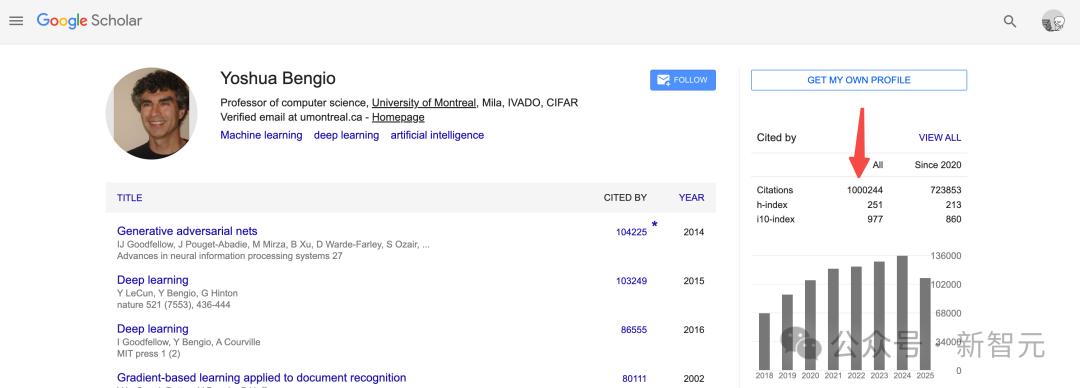
Core Insights - Yoshua Bengio is recognized as the most cited computer scientist globally, with a total citation count of 987,920, and has seen a significant increase in citations since winning the Turing Award in 2018 [5][6][29] - Geoffrey Hinton, another prominent figure in AI, is approaching 1 million citations, currently at 972,944, and is expected to become the second individual to surpass this milestone [2][5] - The rise in citations for these AI pioneers reflects the explosive growth of AI research and its integration into various fields, particularly since the introduction of deep learning techniques [14][17][26] Group 1 - Yoshua Bengio's citation metrics include an h-index of 251 and a 110-index of 977, indicating his significant impact in the field of machine learning and deep learning [1][5] - The citation growth for Bengio and Hinton aligns with the overall increase in AI-related publications, which have tripled from 2010 to 2022, highlighting the growing importance of AI in computer science [26][14] - The deep learning community is dominated by a few key figures, with Bengio, Hinton, and Yann LeCun being recognized as the "three giants" of deep learning, all of whom received the Turing Award in 2018 [3][29] Group 2 - The AI research landscape has seen a dramatic increase in the number of papers published, with AI papers constituting 41.8% of all computer science papers by 2023, up from 21.6% in 2013 [26][14] - The introduction of the Transformer model in 2017 and subsequent advancements in generative AI have further accelerated the citation rates of foundational papers in the field [21][23] - The citation counts of leading researchers like Ilya Sutskever and Kaiming He also reflect the growing influence of deep learning, with Sutskever exceeding 700,000 citations and He surpassing 750,000 [34][31]
CorVel Corporation to Host Live Earnings Release Webcast
Globenewswire· 2025-10-21 13:13
Core Insights - CorVel Corporation will host a live webcast on November 4, 2025, at 11:30 AM Eastern Time to discuss its upcoming quarterly earnings results and introduce its new Chief Financial Officer, Brian Nichols [1][2]. Financial Performance and Strategic Initiatives - The webcast will include discussions on CorVel's financial performance, strategic initiatives, and future outlook, led by President and CEO Michael Combs and CFO Brian Nichols [2]. Webcast Details - Investors, analysts, and interested parties are encouraged to join the webcast for insights into CorVel's performance, with a dedicated question-and-answer session available for attendees [3][6].


Quad makes audience creation easier, faster and more precise with natural language AI prompts powered by Snowflake
Prnewswire· 2025-10-09 13:00
Core Insights - Quad/Graphics Inc. is enhancing its Audience Builder platform with natural language prompting capabilities powered by Snowflake's Cortex AI, allowing for faster and more efficient audience segmentation [1][2][3] Company Overview - Quad is a marketing experience company that integrates creative, production, and media solutions across online and offline channels, aiming to simplify marketing complexities for its clients [4] - The company employs approximately 11,000 people across 11 countries and serves around 2,100 clients, including major blue-chip companies in various industries [5][6] Technology and Innovation - The new natural language feature enables users to create sophisticated audience segments using simple conversational commands, eliminating the need for technical expertise [2][3] - Quad's Audience Builder utilizes a data stack that covers 92% of U.S. households and nearly 97% of the adult U.S. population, providing stable and resilient data sources for audience insights [3] Marketing Solutions - Quad's Audience Builder helps advertisers identify and engage with consumers more effectively, enhancing personalization and engagement across multiple marketing channels [3][4] - The platform allows for the creation of audience profiles that improve marketing mix measurement and incrementality, streamlining the audience targeting process [3]


Is High-Speed Internet Boosting Data Analytics Market Growth in the Region?
Medium· 2025-09-23 07:07
Market Overview - The global data analytics market was valued at USD 74.26 Billion in 2024 and is projected to reach USD 482.61 Billion by 2033, with a CAGR of 23.12% from 2025 to 2033 [3][4] - North America currently holds a significant market share of over 37.6% in 2024 [3] Industry Trends - Organizations are increasingly investing in analytics solutions to improve efficiency, reduce costs, and maintain competitiveness, with small and medium-sized businesses also adopting these tools [4] - Self-service analytics platforms are empowering non-technical users to analyze data easily, driven by advancements in AI, machine learning, and natural language processing [5] - The demand for real-time analytics is rising in sectors such as e-commerce, healthcare, and logistics, as quick decision-making enhances customer satisfaction and operational efficiency [6] Regulatory and Compliance Factors - Stricter data privacy regulations are pushing firms to invest in secure analytics platforms to ensure compliance [6] Innovation and Digitalization - Digitalization is fueling the data analytics market, as organizations need to transform raw data into actionable strategies [6] Key Players - Major market players include Alteryx Inc., Amazon Web Services Inc., Dell Technologies Inc., IBM, Looker Data Sciences Inc. (Google LLC), Microsoft Corporation, Mu Sigma Inc., and Oracle Corporation [8]

Nvidia Announces £2B Investment into UK’s AI Sector
Crowdfund Insider· 2025-09-22 12:25
Investment Overview - Nvidia Corporation has committed £2 billion to enhance the UK's AI ecosystem, aiming to foster innovation and development across various sectors [1][2] - This investment is expected to invigorate AI-driven companies, fintech enterprises, and emerging startups in the UK [1][2] Strategic Focus - The investment underscores Nvidia's strategic focus on advancing AI technologies and reinforces the UK's position as a global tech hub [2][9] - Nvidia's pledge reflects confidence in the UK's potential to lead in AI and related fields [2] Beneficiaries - Notable beneficiaries include UK-based companies like Revolut, a leading fintech platform, and Nscale, specializing in scalable AI infrastructure [3][5] - Nvidia's support aims to bolster both established companies and innovative startups within the UK's tech landscape [3][6] Impact on Revolut - Revolut is positioned to leverage Nvidia's investment to enhance user experiences and streamline operations [4] - The integration of Nvidia's AI tools could improve Revolut's algorithms for fraud detection and personalized financial services, strengthening its competitive edge [4] Importance of Nscale - Nscale's inclusion in Nvidia's investment portfolio highlights the growing significance of scalable AI infrastructure [5] - Nvidia's support could enable Nscale to expand its capabilities, facilitating AI adoption across various sectors [6] Broader Ecosystem Support - Nvidia's £2 billion commitment extends to a wider ecosystem of UK startups and AI-focused enterprises, nurturing early-stage companies [6] - This investment is expected to spur advancements in machine learning, natural language processing, and autonomous systems [7] Economic Implications - The funding is anticipated to create high-skill jobs, attract global talent, and stimulate further investment in the UK's tech sector [8] - Nvidia's commitment could catalyze a cycle of innovation, drawing additional private and public investment for sustained growth [8] Global Positioning - This investment strengthens the UK's appeal as a destination for tech investment amid intensifying global competition for AI leadership [9] - Nvidia's strategy includes fostering AI ecosystems worldwide and building strategic alliances to enhance its global impact [9] Long-term Vision - For the UK, this investment represents a pivotal moment in its journey to become a global AI enabler, with significant implications for its economy and tech ecosystem [10]


财富专业洞察:从市场噪音到投资逻辑,AI在智能投资中的角色
Refinitiv路孚特· 2025-09-19 06:03
Core Insights - The wealth management industry is undergoing a significant transformation driven by the rise of artificial intelligence (AI) and increasingly complex investor behavior [1][2][4] Group 1: Impact of AI on Wealth Management - AI will play a crucial role in enhancing advisor-client relationships by taking over tedious tasks such as tax planning, legal matters, and portfolio management, allowing advisors to focus more on client interactions [2][4] - The use of AI tools can help advisors and portfolio managers gain insights into market dynamics, including trending topics and sentiment analysis, which is essential for understanding market events [3][4] Group 2: Importance of Narrative Intelligence - Narrative intelligence is becoming a key differentiator, helping advisors interpret market sentiment and guide clients through emotional decision-making [4][7] - By leveraging sentiment analysis and natural language processing, advisors can help clients understand market events, reducing the likelihood of panic selling or irrational investment decisions [5][6] Group 3: Ensuring Trust in AI Tools - Trust in AI tools depends on transparency and multi-layered validation, with companies needing to adopt best practices to ensure the reliability and relevance of insights [4][6] - Practical measures include ensuring AI tools can trace information sources and employing prompt engineering to improve the quality of outputs from AI systems [6][7]

Three CorVel Partners Recognized as 2025 Theo Award Winners for Excellence in Workers' Compensation
Globenewswire· 2025-09-10 11:22
Core Insights - CorVel Corporation announced the winners of the 2025 Theo Awards, recognizing Sharp HealthCare, the State of North Carolina, and The Save Mart Companies for their achievements in workers' compensation [1][6] - The awards highlight organizations that have innovatively transformed workplace safety, claims management, and employee care, leading to reduced costs and new industry standards [2] Group 1: Sharp HealthCare - Sharp HealthCare was recognized for its biopsychosocial transdisciplinary model, which effectively addresses complex claims related to traumatic brain injuries, chronic pain, PTSD, and substance abuse [3] - The model focuses on early identification of psychosocial risk factors, resulting in accelerated recovery timelines and reduced prescription drug dependency [3] Group 2: State of North Carolina - The State of North Carolina demonstrated exceptional crisis management following Hurricane Helene, ensuring access to medical care and wage replacement for injured workers in the disaster area [4] - The partnership with CorVel involved expanding provider search efforts and coordinating care during significant infrastructure damage and communication outages [4] Group 3: The Save Mart Companies - The Save Mart Companies implemented a comprehensive workers' compensation strategy focusing on prevention, early intervention, efficient claim resolution, and collaborative execution [5] - This strategy has led to fewer claims, faster settlements, and reduced overall program costs while enhancing workplace safety [5] Group 4: CorVel Corporation - CorVel applies advanced technology, including AI and machine learning, to improve the management of care episodes and related healthcare costs [7] - The company partners with various stakeholders, including employers and government agencies, to manage workers' compensation and health services [7]
陈丹琦和翁荔成为同事了
3 6 Ke· 2025-08-28 07:47
Core Insights - Renowned AI scientist Chen Danqi has updated her GitHub email to a domain associated with Thinking Machines Lab, a startup co-founded by former OpenAI executives, indicating her potential involvement with the company [2][4] - Thinking Machines Lab, established only five months ago, has raised $2 billion in the largest seed funding round in history, achieving a post-money valuation of $12 billion [6] - The company boasts a strong team, including several former key members from OpenAI, enhancing its credibility and potential in the AI sector [6] Group 1: Company Overview - Thinking Machines Lab is a newly established AI startup that has quickly gained significant financial backing and a high valuation [6] - The company is led by a team of experienced professionals from OpenAI, which may provide a competitive advantage in the AI landscape [6] Group 2: Chen Danqi's Background - Chen Danqi has an impressive academic background, having graduated from Tsinghua University and Stanford University, where she earned her PhD in computer science [6][14] - She has received multiple awards for her research in natural language processing (NLP), including two outstanding paper awards at the ACL conference [10][12] - Her influential work includes significant contributions to the understanding of machine reading comprehension and the development of neural network models for NLP tasks [14][19] Group 3: Industry Trends - There is a growing trend of AI scholars transitioning to industry roles, driven by the substantial resources and funding available in the private sector [28] - This shift may allow researchers to better realize their innovative ideas and contribute to advancements in AI technology [28]

陈丹琦,入职Thinking Machines Lab了?
机器之心· 2025-08-28 00:55
Core Viewpoint - The article speculates that Chen Danqi has joined Thinking Machines Lab, a company founded by former OpenAI CTO Mira Murati, which focuses on advanced multimodal AI model and technology development [1][10]. Group 1: Evidence of Transition - Chen Danqi's GitHub email has changed to thinkingmachines.ai, suggesting a possible affiliation with Thinking Machines Lab [2][4]. - The email format used by Thinking Machines Lab employees aligns with Chen Danqi's new email, further supporting the speculation [4]. - The Chief Scientist of Thinking Machines Lab, John Schulman, also uses an email ending with thinkingmachines.ai, indicating a consistent naming convention within the company [5]. Group 2: Professional Background - Chen Danqi is currently an associate professor at Princeton University, leading the NLP research group and serving as the deputy director of the Princeton Language and Intelligence Research Program [16]. - She has a significant academic impact, with a total citation count of 75,149, and her paper on RoBERTa has been cited 36,574 times [16][19]. - Chen Danqi graduated from Tsinghua University in 2012 and obtained her PhD from Stanford University in 2018, where she was advised by Christopher Manning [18]. Group 3: Recognition and Awards - Chen Danqi has received multiple prestigious awards in the NLP field, including the ACL 2022 Outstanding Paper Award and the 2016 ACL Outstanding Paper Award [19]. - She has also been supported by research grants from leading companies and institutions, such as the Amazon Research Award and the Google Research Scholar Award [19].