O2O模式

Search documents
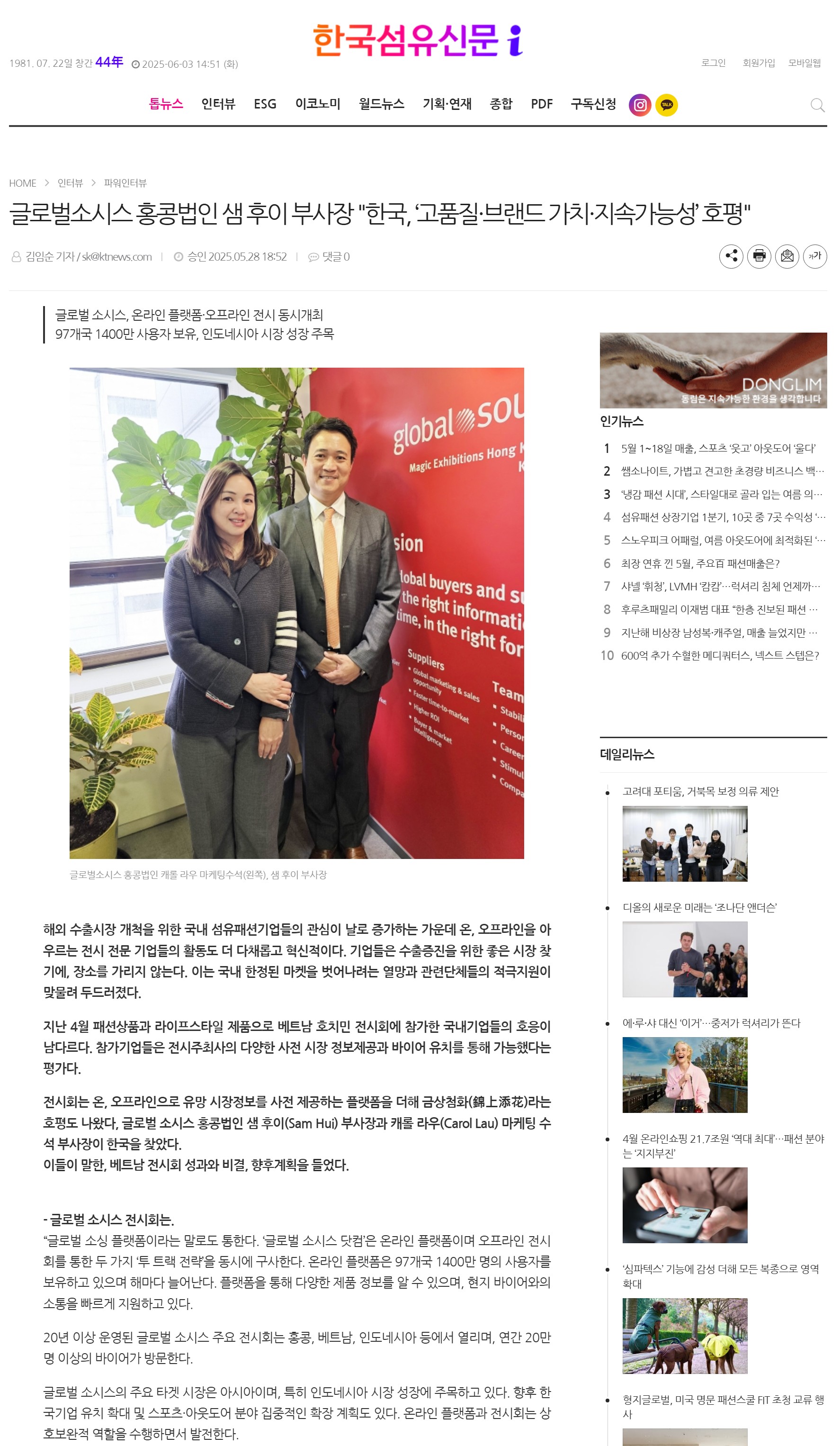
韩国媒体聚焦环球资源:O2O 服务赋能韩企越南拓市
Jin Tou Wang· 2025-06-05 04:14
Core Insights - Global Sources shared insights on its industry and service advantages at the KITA 2025 Annual Forum, highlighting its role in helping Korean companies expand into emerging markets like Vietnam [1][8] - The O2O (Online to Offline) model of Global Sources has been instrumental in assisting Korean enterprises in tapping into the Vietnamese market, with positive feedback from participants at a recent trade show [2][10] Industry Trends - There is a growing interest among domestic textile and fashion companies in South Korea to explore overseas export markets, particularly in Vietnam, as they seek to break free from limited domestic markets [6] - The trade show in Ho Chi Minh City showcased fashion and lifestyle products, with participating companies praising the organizer's provision of market insights and buyer invitations as key factors for success [2][6] Company Strategy - Global Sources operates a dual-track strategy combining online platforms and offline exhibitions, with its online platform boasting 14 million users across 97 countries, facilitating efficient connections between buyers and suppliers [7][9] - The company has over 20 years of experience in organizing exhibitions in regions like Hong Kong, Vietnam, and Indonesia, attracting more than 200,000 buyers annually, focusing on the Asian market's growth potential [10] Recommendations for Korean Companies - Korean fashion companies are advised to conduct market research and localize products to meet Vietnamese consumer preferences, such as breathable fabrics and vibrant styles [11] - Participation in trade exhibitions and collaboration with e-commerce platforms like globalsources.com is recommended to enhance brand visibility and market penetration [11] - Building a strong brand image through diverse marketing strategies, including social media engagement and offline events, is crucial for establishing a presence in the Vietnamese market [11]

孩子王:2024年业绩增长过度依赖乐友国际、业绩增长可持续性存疑
Xin Lang Zheng Quan· 2025-04-15 06:16
Core Viewpoint - The financial performance of the company in 2024 shows growth in revenue and net profit, but the sustainability of this growth is questionable due to heavy reliance on a single subsidiary, Leyou International [1][2]. Financial Performance - In 2024, the company achieved a revenue of 9.337 billion yuan, representing a year-on-year increase of 6.68% [1]. - The net profit attributable to shareholders was 181 million yuan, with a significant year-on-year growth of 72.44% [1]. - The company plans to distribute a cash dividend of 0.5 yuan per 10 shares (tax included) [1]. Dependency on Leyou International - Leyou International contributed 1.0454 billion yuan to the net profit, accounting for 57.7% of the total [1]. - Excluding Leyou International, the company's original business net profit was only 76.72 million yuan, a decline of 36% compared to 2022 [1]. - Leyou International's profit commitment for 2024 was 100 million yuan, with an actual completion of 1.0454 billion yuan, indicating a completion rate of 104.4% [1]. Industry Challenges - The mother and baby retail industry is facing intense competition from traditional offline retailers and e-commerce platforms, leading to price wars and traffic competition [2]. - The overall industry is experiencing a decline in newborn birth rates, with 1.079 million related businesses being deregistered in 2023, indicating a downward trend in industry prosperity [2]. Strategic Recommendations - Optimize store structure and enhance single-store efficiency through refined operations, such as site selection and membership data analysis [3]. - Strengthen online and offline integration capabilities, exploring O2O models to reduce logistics costs and enhance repurchase rates through private traffic operations [3]. - Deepen supply chain and brand building by increasing the proportion of proprietary brands and collaborating with international brands to develop exclusive products [3]. - Monitor policy and market risks closely, preparing for potential policy benefits and enhancing ESG investments to align with changing consumer values [3]. Conclusion - The company's 2024 performance reflects initial success in strategic acquisitions and digital transformation, but challenges such as store efficiency, margin pressure, and intensified competition remain [4]. - Future strategies should focus on balancing expansion and profitability through innovative service models and supply chain optimization to solidify industry position [4].
商城究竟有哪些优缺点?怎样选择安全的商城购物平台?
Sou Hu Cai Jing· 2025-04-04 03:53
Core Viewpoint - The article discusses the rise of e-commerce and online shopping malls, highlighting their advantages and disadvantages in the context of modern consumer behavior and technological advancements [4][17]. Group 1: Types of Online Malls - Comprehensive malls offer a wide range of products, including clothing and electronics, exemplified by platforms like Taobao and JD [4]. - Vertical malls focus on specific categories, such as beauty products or home goods [5]. - Group-buying malls, like Meituan and Pinduoduo, attract consumers with discounted prices through collective purchasing [6]. - Second-hand trading malls, such as Xianyu and Zhuanzhuan, cater to consumers' needs for sustainability and cost-effectiveness [7]. Group 2: Advantages of Online Malls - Convenience allows consumers to shop anytime and anywhere via mobile devices or computers [8]. - A wider selection of products compared to traditional stores enables consumers to find various brands and styles [9]. - Price transparency facilitates easy comparison of prices across different vendors, often leading to promotional discounts [10]. - User review systems provide valuable feedback for consumers before making purchases [11]. - 24-hour service ensures that consumers can shop and receive support at any time [12]. Group 3: Disadvantages of Online Malls - Lack of physical experience may lead to dissatisfaction with products, especially in categories like clothing and footwear [12]. - Logistics and delivery issues can affect the timeliness and safety of product delivery [12]. - Network security risks arise from the need to provide personal and payment information [12]. - Complicated return and exchange processes can increase shopping costs for consumers [12]. - The convenience of online shopping may lead to impulsive buying, resulting in financial strain [13]. Group 4: Future Trends in Online Malls - Intelligent services utilizing AI and big data will enhance personalized recommendations and improve shopping experiences [14]. - Social e-commerce will grow as consumers share and purchase products through social media platforms [15]. - The O2O (Online to Offline) model will become more popular, allowing consumers to experience products in physical stores after selecting them online [15]. - Sustainable development will gain traction, with more malls focusing on eco-friendly products and packaging [16]. - Global shopping will expand as international logistics improve, enabling consumers to access quality products from around the world [16].

啄木鸟多次道歉!雷军、姚劲波“押重宝”,想上市更难了 | BUG
新浪财经· 2025-03-17 01:00
Core Viewpoint - The article highlights the issues faced by the Woodpecker Home Repair platform, including overcharging and poor service quality, which have been exacerbated by its high commission model of 40% on repairs. This has led to a significant impact on its upcoming IPO process due to negative media exposure [1][2][14]. Summary by Sections Company Overview - Woodpecker Home Repair is currently the largest home appliance repair platform in China, operating in over 300 cities with around 100,000 repair technicians [11]. - The company has attracted significant investment, with a total of over 600 million yuan raised since its inception in 2014, leading to a valuation of approximately 1.7 billion yuan [12][19]. Financial Performance - Revenue figures from 2021 to the first half of 2024 show a growth trend: 401 million yuan, 595 million yuan, 1.011 billion yuan, and 623 million yuan respectively [14]. - Despite rising revenues, net profits have fluctuated, with figures of 33.4 million yuan, 6.2 million yuan, 48.9 million yuan, and 38.9 million yuan during the same period, indicating a decline of 6.3% in the first half of 2024 compared to the previous year [14]. Business Model and Issues - The platform's commission structure, which is as high as 40%, has been identified as a root cause of the overcharging practices by repair technicians [1][14]. - Reports indicate that technicians often inflate repair costs to meet income needs, leading to practices such as charging 659 yuan for a part that costs only 91 yuan [4][5]. Regulatory and Consumer Response - Following the exposure of these issues during the CCTV 315 Gala, the company has faced increased scrutiny from regulatory bodies, including investigations into its pricing practices [7][8]. - The company has acknowledged its responsibility for the reported issues and has initiated a series of corrective measures, including a commitment to refund affected customers [7][8]. Founder Background - The founder, Wang Guowei, started as a repair worker and aimed to create a fair platform for both technicians and consumers. However, the current business practices have led to accusations of betraying this original vision [18][19].