ROIC

Search documents
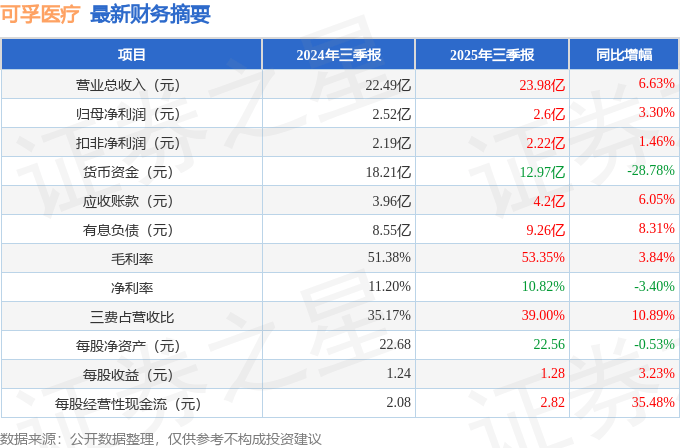
可孚医疗(301087)2025年三季报简析:营收净利润同比双双增长,公司应收账款体量较大
Sou Hu Cai Jing· 2025-10-30 23:01
Core Viewpoint - Kefu Medical (301087) reported a year-on-year increase in total revenue and net profit for Q3 2025, indicating a positive growth trend despite challenges in accounts receivable management [1][3]. Financial Performance - Total revenue for Q3 2025 reached 900.2 million yuan, a 30.72% increase year-on-year, while net profit for the same period was 92.83 million yuan, up 38.68% year-on-year [1]. - For the first three quarters of 2025, total revenue was 2.398 billion yuan, reflecting a 6.63% increase compared to the same period in 2024, with net profit rising to 260 million yuan, a 3.3% increase [1]. - The gross profit margin improved to 53.35%, up 3.84% year-on-year, while the net profit margin decreased to 10.82%, down 3.4% year-on-year [1]. Accounts Receivable and Financial Ratios - The accounts receivable amount was significant, with accounts receivable accounting for 134.59% of the net profit, indicating potential liquidity concerns [1][3]. - Total expenses (sales, management, and financial) amounted to 935 million yuan, representing 39.0% of revenue, which is a 10.89% increase year-on-year [1]. Earnings and Cash Flow - Earnings per share (EPS) for Q3 2025 was 1.28 yuan, a 3.23% increase year-on-year, while operating cash flow per share improved significantly by 35.48% to 2.82 yuan [1]. - The company’s net assets per share slightly decreased to 22.56 yuan, down 0.53% year-on-year [1]. Business Model and Market Outlook - The company relies heavily on marketing-driven performance, which necessitates careful analysis of the underlying factors driving this model [4]. - Kefu Medical is optimistic about the long-term growth prospects of the hearing aid market in China and plans to enhance its service capabilities while addressing short-term pressures [6].

Banco Santander(SAN) - 2025 Q3 - Earnings Call Transcript
2025-10-29 10:02
Financial Data and Key Metrics Changes - Quarterly profit reached a record EUR 3.5 billion, marking the best nine-month period ever, with a customer base increase of EUR 7 million year-on-year to EUR 178 million [4][5] - Return on Invested Capital (ROIC) increased by 70 basis points to 16.1%, with a strong capital ratio of 13.1% [4][5][20] - Earnings per share rose by 16%, supported by solid profit generation and share buybacks, leading to a 15% increase in TNF plus cash dividend per share [20][21] Business Line Data and Key Metrics Changes - Net Interest Income (NII) grew by 2%, while fees reached a new record, increasing by 8% [6][7] - Consumer business NII increased by 6% year-on-year, with retail NII growing by 1% excluding Argentina [9][11] - Payments revenue surged by 19%, with double-digit growth in both PagoNxt and cards [24][19] Market Data and Key Metrics Changes - CIB (Corporate and Investment Banking) revenue rose by 6% year-on-year, driven by global markets and growth initiatives in the U.S. [24][16] - Wealth management revenue increased by 13%, supported by record assets under management [24][18] - Retail revenue grew even in a less favorable interest rate environment, aided by active margin management [24][11] Company Strategy and Development Direction - The company is on track to meet its 2023/2025 strategic plan targets, with a focus on profitability and disciplined capital allocation [5][34] - The transformation strategy aims to simplify operations and enhance customer experience, with a significant emphasis on digitalization [10][12] - The integration of Santander Consumer Finance and Openbank in Europe is expected to reduce costs and improve product offerings [12] Management's Comments on Operating Environment and Future Outlook - Management expressed confidence in achieving 2025 targets despite a challenging environment, citing strong business dynamics and revenue growth [34][35] - The outlook for 2026 is promising, with expectations of continued improvement in ROIC and profitability [39][41] - Credit quality is improving, with a stable cost of risk and a low NPL ratio of 2.92% [30][31] Other Important Information - The company plans to distribute at least EUR 10 billion to shareholders through share buybacks for 2025/2026, subject to regulatory approvals [5][20] - The CET1 capital ratio is expected to increase further in Q4, with regulatory headwinds being lower than initially anticipated [50] Q&A Session Summary Question: What are the main drivers for achieving the ROIC target of 16.5%? - Management expects strong performance in Q4 driven by seasonality, higher fees, and execution of the transformation strategy [38] Question: How should we think about credit quality in Brazil? - Credit quality is improving, with a stable cost of risk and a reduction in loan loss provisions [43][45] Question: Can you provide an update on capital and regulatory headwinds? - Regulatory charges are expected to be lower than anticipated, with capital generation projected to increase in Q4 [49][50] Question: What is the outlook for NII in Spain? - NII in Spain has improved, with expectations for continued growth in Q4 and a positive outlook for 2026 [53][54] Question: What is the status of litigation provisions? - The impact of litigation provisions is not expected to be material for the group, with ongoing reviews of the U.K. Motor Finance situation [63][64] Question: How does the company view NII outlook in Brazil? - The company anticipates stable NII in Brazil as interest rates are expected to come down, improving margins [65][66]

Banco Santander(SAN) - 2025 Q3 - Earnings Call Transcript
2025-10-29 10:00
Financial Data and Key Metrics Changes - The quarterly profit reached a record €3.5 billion, marking the best nine-month period ever for the company [3] - Return on Invested Capital (ROIC) increased by 70 basis points to 16.1% [3] - The capital ratio ended the quarter at an all-time high of 13.1% [3][30] - Earnings per share rose by 16%, supported by solid profit generation and fewer shares due to buybacks [19] Business Line Data and Key Metrics Changes - Revenue grew by 4% in euros, with Net Interest Income (NII) increasing by 2% and fees rising by 8% [5] - Corporate and Investment Banking (CIB) revenue rose by 6%, driven by global markets and growth initiatives in the U.S. [23] - Wealth management revenue increased by 13%, supported by record assets under management [23] - Payments revenue surged by 19%, with both PagoNext and cards delivering double-digit growth [23][18] Market Data and Key Metrics Changes - The company added 7 million new customers year on year, bringing the total to 178 million [3] - Customer activity and diversification continued to drive revenue growth, particularly in fee-driven businesses [7] - The cost of risk improved year on year, reflecting robust credit quality trends [5][28] Company Strategy and Development Direction - The company is on track to meet its 2023-2025 strategic plan targets, focusing on profitability and disciplined capital allocation [4] - The transformation strategy aims to simplify operations and enhance customer experience, with a focus on digitalization [9][11] - The integration of Santander Consumer Finance and Openbank in Europe is expected to reduce costs and improve product offerings [11] Management's Comments on Operating Environment and Future Outlook - Management expressed confidence in achieving 2025 targets despite a more challenging environment than initially anticipated [32] - The outlook for 2026 is promising, with expectations of improved credit quality and stable cost of risk [40][42] - The company anticipates a stable cost of risk in Brazil, supported by resilient labor markets [42][64] Other Important Information - The company plans to distribute at least €10 billion to shareholders through share buybacks for 2025-2026, subject to regulatory approvals [4][19] - The efficiency ratio improved to 41.3%, the best reported in over 15 years [28] Q&A Session Summary Question: ROIC target for the year of 16.5% - Management expects strong performance in Q4 driven by seasonality, higher fees, and execution of One Transformation [37] Question: Credit quality in Brazil - Provisions have decreased, and management expects stable cost of risk due to improved credit quality [41][43] Question: Capital guidance and regulatory headwinds - Regulatory charges are expected to be lower than initially anticipated, with a CET1 ratio projected to increase further in Q4 [48][49] Question: NII outlook in Spain - NII in Spain improved, with expectations for continued growth in Q4 and 2026 [51][52] Question: Litigation provisions - The impact of litigation provisions is not expected to be material for the group [60][62] Question: NII outlook in Brazil - Management expects stable NII with improved margins as interest rates decline [64][65]
中国房地产_压力点正在积聚但尚未爆发;开发商土储质量分析-China Property (H_A)_ Pressure points building up but not there yet; developers land bank quality analysis
2025-10-27 00:31
Summary of Conference Call on China Property Sector Industry Overview - The conference call focuses on the **China Property Sector**, highlighting the current market conditions and future expectations for developers and policies affecting the industry. Key Points and Arguments Market Conditions - The sector is expected to trade within a range due to sluggish fundamentals and potential policy support, with a current P/E ratio of **8.5x FY27E**, aligning with historical averages [1][2] - National inventory is projected to remain high at **24 months** through **2027**, but Tier 1 and top 15 cities may see inventory decrease to **15 months** by **2026/27** [3][4] - New home sales volume/value is forecasted to decline by **5%-7%** and **8%-10%** in **2025**, with further mid-single-digit declines in **2026** [3][4] Developer Performance - Top developers are focusing on major cities, acquiring land only in the **10-20 largest cities** since **2024**, despite generating sales from **60 cities** [4][5] - Developers with younger land banks (acquired after **2022**) tend to have higher returns on invested capital (ROIC), with **Binjiang, C&D, and COLI** having the youngest land banks [5][6] - The earnings estimates for the sector have been trimmed by single-digit percentages, reflecting minor changes in contracted sales forecasts [5][6] Policy Outlook - Policymakers are expected to emphasize quality housing in the upcoming **15th Five-Year Plan**, with no major new policy support anticipated until **March 2026** [2][24] - Potential policy tools include tax deductibility for mortgage interest, lower transaction taxes, direct subsidies to home buyers, and relaxation of urban redevelopment restrictions [2][29] - The **Fourth Plenary Session** is expected to provide preliminary guidelines for property policy over the next five years, focusing on balancing growth and risk control [24][27] Risks and Challenges - Secondary home prices have declined by **1.6% MoM** in September, nearing the steepest decline observed in the second half of **2023** [21][22] - Real estate investment fell by **20% YoY** in September, worsening from a **10%** decline in the first half of **2025** [22][23] - Home prices are expected to face significant downside risks, with estimates suggesting a potential **20%** correction for entry-level buyers in Tier 1 cities [56][58] Developer Ratings and Forecasts - Price objectives for several developers have been revised, with **Binjiang** seeing an increase from **12.8 billion** to **13.5 billion**, while **Poly** was cut from **8.0 billion** to **7.5 billion** [8][9] - The contracted sales forecast for key developers has been adjusted, with **CMSK** seeing an increase due to better-than-expected performance, while **COLI** and **Poly** have been trimmed due to deteriorating market conditions [76][79] Conclusion - The China Property Sector is currently facing a challenging environment with sluggish sales, high inventory levels, and declining prices. However, top developers are strategically focusing on major cities and improving their land bank quality, which may position them better for future recovery as policy support is anticipated in the coming years.
Plexus Announces Fiscal Fourth Quarter and Fiscal Year 2025 Financial Results
Globenewswire· 2025-10-22 20:15
Core Insights - Plexus Corp. reported strong financial results for the fiscal fourth quarter and fiscal year ended September 27, 2025, with revenue of $1.058 billion and diluted EPS of $1.87, exceeding guidance [5][7] - The company provided guidance for the fiscal first quarter of 2026, expecting revenue between $1.050 billion and $1.090 billion, with diluted EPS projected between $1.40 and $1.55 [5][7] Financial Performance - Fiscal Q4 2025 revenue was $1.058 billion, with a GAAP operating margin of 5.0% and diluted EPS of $1.87 [5][9] - For fiscal year 2025, total revenue reached $4.033 billion, maintaining a GAAP operating margin of 5.0% and diluted EPS of $6.26 [5][9] - Non-GAAP results for Q4 2025 showed an operating margin of 5.8% and diluted EPS of $2.14, excluding stock-based compensation [5][9] Cash Flow and Share Repurchase - The company generated free cash flow of $97 million in Q4 2025 and $154 million for the entire fiscal year [6][14] - Plexus repurchased $21.5 million of its shares at an average price of $134.07 per share, with $85 million remaining under its current repurchase authorization [6][8] Operational Highlights - Plexus secured 28 manufacturing programs in Q4 2025, representing $274 million in annualized revenue when fully ramped [6][7] - The company achieved a return on invested capital (ROIC) of 14.6% for fiscal 2025, exceeding its weighted average cost of capital by 570 basis points [8][13] Market Sector Performance - In Q4 2025, revenue by market sector included Aerospace/Defense at $173 million (16%), Healthcare/Life Sciences at $424 million (40%), and Industrial at $461 million (44%) [10][11] - The top 10 customers accounted for 49% of revenue in Q4 2025, consistent with the previous quarter [10]


水务运营20250905
2025-09-07 16:19
Summary of Water Industry Conference Call Industry Overview - The water industry has a stable fundamental outlook, with low correlation to economic cycles, high residential water usage, and low raw material cost proportion, leading to relatively stable profitability and defensive characteristics [2][4][6] - The pricing model in the water industry includes water supply fees and sewage treatment fees, with water supply fees primarily paid by residents, resulting in good cash flow [2][5] Key Points on Pricing and Profitability - Water price reforms are expected to enhance earnings per share (EPS) for water supply companies and improve cash flow for sewage treatment companies by increasing the proportion of resident payments [2][7] - The latest urban water supply and drainage pricing management measures are similar to the Return on Invested Capital (ROIC) concept, with equity capital return rates based on 10-year government bond rates plus a margin, and debt capital return rates based on the Loan Prime Rate (LPR) [2][8] - In 2025, several policies are anticipated to drive water price changes, with major cities like Shanghai and Guangzhou already implementing new pricing adjustments, resulting in an average increase of 0.4 CNY per ton, or an average increase of 21.3% [2][10] Impact of Price Adjustments - Adjustments in water prices are expected to significantly increase net profits after tax deductions for listed companies, with many high-quality companies seeing net profit elasticity between 10% and 21% [2][13] - The water industry’s payment model includes a significant government contribution to sewage treatment fees, with government payments around 60% in cities like Chongqing and Chengdu, while the resident payment proportion is about 40% [5][6] Dividend Potential and Valuation - Water companies have high dividend potential, with many companies having cash flow ratios of 150% to 200%, allowing for a dividend payout ratio of 70% to 80% while maintaining sufficient cash flow for development [3][14] - Notable companies in the Hong Kong market include Beikong Water Group and Yuehai Investment, both of which have stable dividend policies [3][15] Market Dynamics and Investment Logic - The investment logic in the water industry is based on its stable operating fundamentals and marginal catalysts, with core stocks still at low valuation levels despite overall market gains [4][16] - The current market environment suggests that even with high risk appetite, investments in garbage incineration and quality water assets remain valuable due to low valuations and potential for EPS growth, dividend yield, and valuation recovery [16] Conclusion - The water industry is positioned for growth through regulatory reforms and pricing adjustments, with strong cash flow and dividend potential making it an attractive investment opportunity in the current market landscape [2][3][16]
从普尔特看房地产如何走出衰退
2025-09-01 02:01
Summary of Key Points from the Conference Call Company and Industry Overview - The conference call discusses the real estate industry, specifically focusing on PulteGroup and its strategies during economic downturns, particularly the subprime mortgage crisis [1][2]. Core Insights and Arguments - PulteGroup's financial situation deteriorated rapidly during the subprime crisis, highlighting the risks of pro-cyclical leverage [1]. - Population factors significantly impact real estate unit sales, but have a lesser effect on total sales value; the real estate market is expected to outperform inflation in the long run [1][3]. - Real estate asset prices are unlikely to decline indefinitely; stabilizing these prices is crucial for macroeconomic stability [1][6]. - Investors should focus on industry and company changes that present trend-based opportunities rather than trying to time the market at extreme lows [1][7]. - PulteGroup implemented strategic measures during market downturns, such as reducing land reserves, exiting overseas markets, cutting operational costs, and ensuring cash flow stability [1][14][15]. Important but Overlooked Content - PulteGroup's merger with Centex helped repair its financial statements and integrate capacity, shifting its capital usage strategy from ROE to ROIC, emphasizing cash flow balance and investment discipline [1][16][18]. - The U.S. real estate market has been on an upward trend since 2014, influenced by the Federal Reserve's monetary policy and a reduction in production capacity due to the subprime crisis [1][17]. - The financial performance of real estate developers in 2025 shows a narrowing decline in gross and net profit margins, indicating potential recovery [1][11]. - Chinese developers can learn from PulteGroup's experiences but must consider structural differences in the economy and explore various leverage models to enhance project profitability and turnover speed [1][19]. - PulteGroup's strict control over capital allocation has led to improved debt structure and reduced financing costs, shifting focus from basic needs to high-end markets [1][22][24]. - The future of the real estate industry is expected to touch bottom in Q4 2025 and gradually rebound, with high-margin projects set to settle in 2026, indicating a likely improvement in overall industry margins [1][25].

星德胜2025年中报简析:增收不增利,公司应收账款体量较大
Zheng Quan Zhi Xing· 2025-08-30 23:28
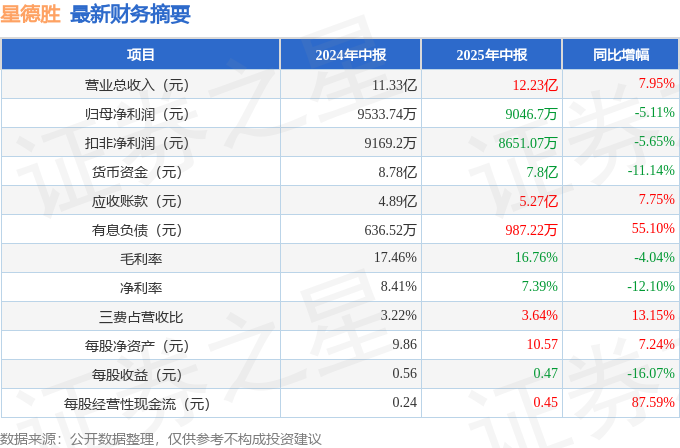
Group 1 - The core viewpoint of the article highlights that Xingdesheng (603344) reported a mixed performance in its 2025 mid-year financial results, with revenue growth but a decline in net profit [1][2] - The company's total operating revenue reached 1.223 billion yuan, an increase of 7.95% year-on-year, while the net profit attributable to shareholders was 90.467 million yuan, a decrease of 5.11% [1] - In Q2, the operating revenue was 674 million yuan, up 1.83% year-on-year, but the net profit attributable to shareholders fell by 11.9% to 48.9329 million yuan [1] Group 2 - The company's gross margin was reported at 16.76%, down 4.04% year-on-year, and the net profit margin was 7.39%, a decrease of 12.1% [1] - Total selling, administrative, and financial expenses amounted to 44.5551 million yuan, representing 3.64% of revenue, which is an increase of 13.15% year-on-year [1] - The accounts receivable level is notably high, with accounts receivable reaching 265.54% of the latest annual net profit [1][2] Group 3 - The company's return on invested capital (ROIC) for the previous year was 12.12%, indicating strong capital returns, while the historical median ROIC since listing is 25.95% [2] - The net profit margin for the previous year was 8.09%, suggesting that the added value of the company's products or services is average [2] - The company's cash assets are reported to be very healthy, indicating good debt repayment capability [2]
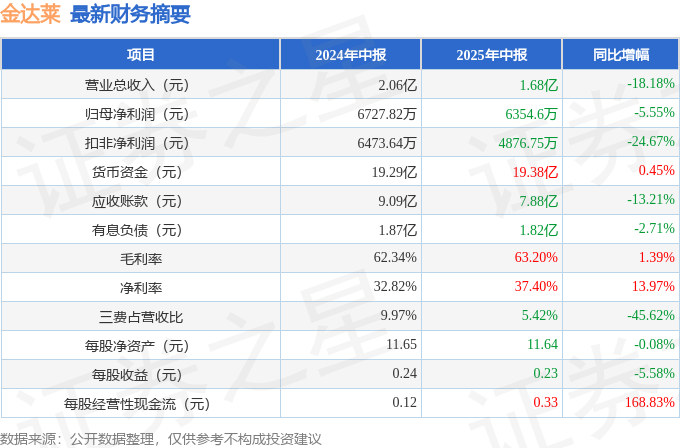
金达莱2025年中报简析:净利润同比下降5.55%,盈利能力上升
Zheng Quan Zhi Xing· 2025-08-30 23:28
Core Insights - The company Jin Dalai (688057) reported a decline in total revenue and net profit for the first half of 2025 compared to the same period in 2024, with total revenue at 168 million yuan, down 18.18%, and net profit at 63.54 million yuan, down 5.55% [1] - Despite the decline in revenue and profit, the company's profitability improved, with a gross margin increase of 1.39% to 63.2% and a net margin increase of 13.97% to 37.4% [1] Financial Performance - Total revenue for Q2 2025 was 83.62 million yuan, a decrease of 31.64% year-on-year, while net profit for the same quarter was 14.42 million yuan, down 48.79% [1] - The company's operating cash flow per share increased significantly by 168.83% to 0.33 yuan, while earnings per share decreased by 5.58% to 0.23 yuan [1] - The total of selling, administrative, and financial expenses was 9.12 million yuan, accounting for 5.42% of revenue, a decrease of 45.62% year-on-year [1] Asset and Liability Management - The company reported cash assets of 1.93 billion yuan, showing a slight increase of 0.45% year-on-year, while accounts receivable decreased by 13.21% to 788.7 million yuan [1] - The company’s interest-bearing debt was 182 million yuan, down 2.71% from the previous year [1] Investment Metrics - The company's return on invested capital (ROIC) for the previous year was 2.89%, indicating weak capital returns, while the historical median ROIC since listing is 16.53% [3] - The net profit margin for the previous year was 33.33%, suggesting high added value in products or services [3] - The company has a healthy cash position, but attention is needed on accounts receivable, which reached 576.21% of profit [3] Fund Holdings - The largest fund holding Jin Dalai is the Dachen Jingheng Mixed A fund, with a scale of 397 million yuan and a recent net value of 3.405, reflecting a 95.7% increase over the past year [4]

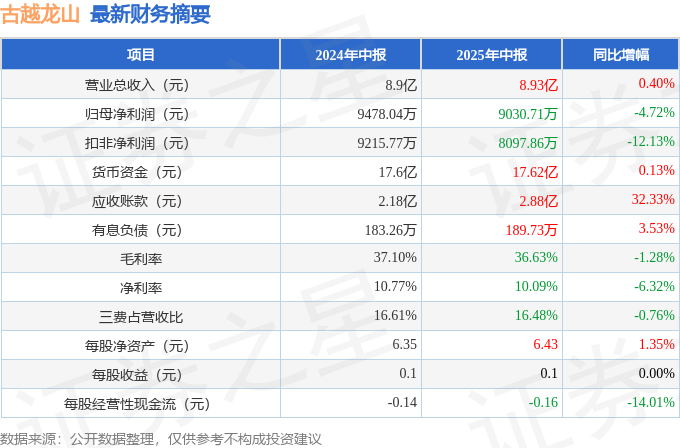
古越龙山2025年中报简析:增收不增利,应收账款上升
Zheng Quan Zhi Xing· 2025-08-30 23:27
Core Viewpoint - The recent financial report of Guyue Longshan (600059) indicates a slight increase in total revenue but a decline in net profit, highlighting challenges in profitability and cash flow management [1][3]. Financial Performance - Total revenue for the first half of 2025 reached 893 million yuan, a year-on-year increase of 0.4% [1]. - Net profit attributable to shareholders was 90.31 million yuan, down 4.72% year-on-year [1]. - In Q2 2025, total revenue was 354 million yuan, reflecting a 9.74% increase compared to the same quarter last year [1]. - The gross margin was 36.63%, a decrease of 1.28% year-on-year, while the net margin fell to 10.09%, down 6.32% [1]. Accounts Receivable and Cash Flow - Accounts receivable increased significantly, with a year-on-year growth of 32.33%, reaching 288 million yuan [1]. - Operating cash flow per share was -0.16 yuan, a decline of 14.01% year-on-year [1]. Cost Structure - Total selling, administrative, and financial expenses amounted to 147 million yuan, accounting for 16.48% of revenue, a slight decrease of 0.76% year-on-year [1]. - The company’s return on invested capital (ROIC) was reported at 2.91%, indicating weak capital returns [3]. Market Position and Investment Sentiment - The company’s performance is primarily driven by capital expenditures and marketing efforts, necessitating careful evaluation of capital spending projects [3]. - Analysts project that the company's performance for 2025 will reach 372 million yuan, with an average earnings per share of 0.4 yuan [3]. Fund Holdings - The largest fund holding Guyue Longshan is the Xin'ao Advantage Value Mixed A fund, which has recently increased its position [4]. - The fund's current scale is 678 million yuan, with a recent net value of 0.7889, reflecting a 16.47% increase over the past year [4].