
VLA技术

Search documents
王兴兴回应比赛风波:挣到钱了,但现在的机器人别指望它能干活
AI前线· 2025-06-06 11:50
Core Viewpoint - The article discusses the evolution of embodied intelligence technology and the advancements made by various humanoid robot companies, highlighting the significance of robot competitions in showcasing capabilities and driving industry growth [1][3][21]. Group 1: Recent Developments in Humanoid Robotics - Various leaders from prominent humanoid robot companies shared their recent achievements, including performances at events like the Spring Festival Gala and robot combat competitions [3][5]. - Wang Xingxing from Yushu Technology emphasized the importance of showcasing robots through performances and competitions to generate commercial value while working towards the ultimate goal of robots performing tasks in homes and factories [3][8]. - The Tian Gong 2.0 robot from the Beijing Humanoid Robot Innovation Center has been upgraded to enhance its dexterity and load-bearing capabilities, demonstrating advancements in hardware and software [12][13]. Group 2: The Role of Robot Competitions - Robot competitions are seen as valuable platforms for public engagement and knowledge dissemination about current robotic technologies, with events planned to include various athletic and service scenarios [21][22]. - These competitions serve as training grounds for improving robotic technologies and provide opportunities for communication between potential clients and robot manufacturers, potentially accelerating the commercialization of robotics [23][25]. - The upcoming World Humanoid Robot Games in Beijing is expected to further popularize robotics and enhance public understanding of the technology [22][23]. Group 3: Perspectives on Humanoid Robot Design - There is a debate on whether humanoid robots are the best embodiment of intelligence, with some experts suggesting that diversity in robot design could be more beneficial for achieving general intelligence [29][30]. - Wang Xingxing and Xiong Youjun both acknowledged the advantages of humanoid robots in terms of data collection and interaction in human-designed environments, suggesting that humanoid forms may be more readily accepted in domestic settings [30][31][32]. Group 4: VLA Technology and Its Challenges - VLA (Vision-Language-Action) technology is highlighted as a key area of research, with discussions on its potential to enhance the capabilities of robots through better data integration and algorithm improvements [34][35]. - The current limitations of VLA include the need for more advanced algorithms to handle the vast amounts of data generated, which is crucial for achieving higher performance in diverse environments [38].


深圳上新“机器人管家”!智平方发布新一代通用智能机器人
Shen Zhen Shang Bao· 2025-05-23 07:42
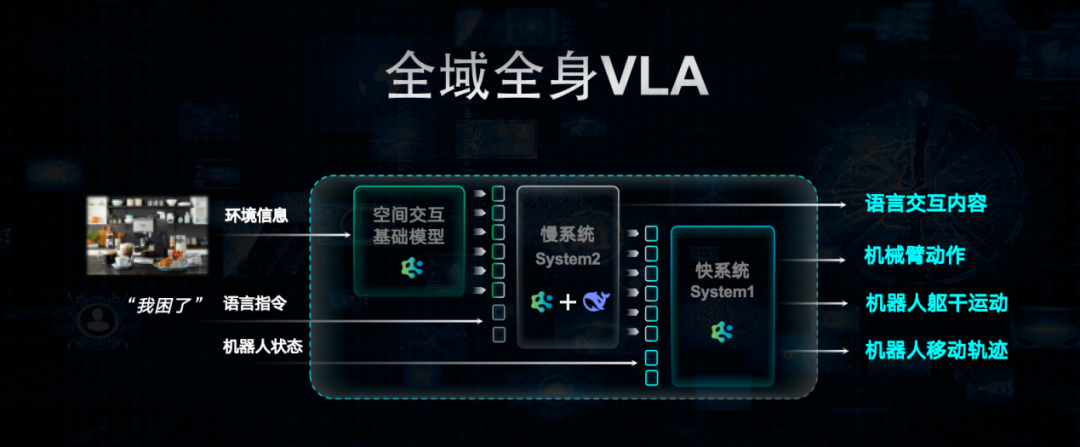
Core Insights - The company Zhi Ping Fang officially launched its next-generation general-purpose intelligent robot AlphaBot 2 and announced a comprehensive upgrade of its "AGI terminal" strategy, which includes core embodied large model technology upgrades, product iterations, self-owned production line construction, and commercialization goals [1][8] - The AlphaBot 2 is the world's first general-purpose intelligent robot equipped with the embodied large model Alpha Brain, showcasing strong generalization capabilities and adaptability in complex industrial and public service scenarios [1][2] Technology Advancements - Zhi Ping Fang is a pioneer in the development of the end-to-end Vision-Language-Action (VLA) technology paradigm, having upgraded its original embodied large model brand AI2R Brain to Alpha Brain, which features the Global & Omni-body Vision-Language-Action (GOVLA) model [2][4] - The GOVLA model consists of a spatial interaction base model, a slow system for complex logical reasoning, and a fast system for real-time responses, enabling the robot to perform tasks autonomously in various environments [4][5] Product Features - AlphaBot 2 is designed with advanced spatial intelligence and learning capabilities, allowing it to complete multiple tasks without prior training and quickly adapt to new tasks [5] - The robot features 360° spatial detection, 34+ degrees of freedom, and a vertical working range of 0-240 cm, making it highly suitable for the GOVLA model [5] Market Applications - Zhi Ping Fang has formed a strategic partnership with Huaxi Biotechnology to develop intelligent robotic solutions for the biotechnology sector, enhancing automation in material handling and reducing contamination risks [6] - The company plans to deploy its robots in various scenarios, including airports and residential communities, to provide intelligent services [6][8] Production and Growth Plans - The company announced the initiation of its self-owned production line, aiming to achieve 10,000 scene applications by 2028 and contribute 1% to the GDP of Nanshan District by 2030 [1][8] - The global humanoid robot market is projected to reach $38 billion by 2035, with Zhi Ping Fang positioning itself to meet the increasing demand through its production capabilities [8]

深度整合 吉利回归商业本质:赚钱!
Zhong Guo Qi Che Bao Wang· 2025-05-18 02:39
Core Viewpoint - Geely is undergoing a significant management restructuring and integration process to unify its operations under the "One Geely" strategy, aiming to enhance competitiveness in a challenging market environment [1][3][4]. Management Restructuring - Li Donghui has been appointed as Vice Chairman of Geely Holding Group, while An Conghui becomes CEO of Geely Holding Group, maintaining his role as CEO of Zeekr Technology Group until the merger is complete [1] - Gui Shengyue continues as CEO of Geely Automobile Holdings, and Gan Jiayue will serve as CEO of the merged Geely Automobile Group, which will include Geely Galaxy and Zeekr Technology business units [1] - Dai Qing has been appointed as rotating president of Geely Holding Group to cultivate young, versatile senior management talent [1] Integration Strategy - The integration aims to consolidate resources and eliminate the fragmented brand image of Geely, which is essential for success in a competitive market [3][4] - A shareholder meeting showed overwhelming support for the integration, with 99.99% voting in favor, indicating strong shareholder confidence in the strategy [3] Challenges in Integration - The integration process has faced challenges, particularly in efficiency and communication costs, as it involves two independent listed companies requiring board approvals for many actions [8][9] - There are inconsistencies in employee incentive mechanisms between Geely and Zeekr, leading to potential conflicts of interest during the integration [9] Financial Performance - Zeekr reported a significant reduction in net losses, down over 60% year-on-year, with a total revenue of 22 billion yuan in Q1 2025, marking a 16.1% increase in vehicle sales revenue [10] - Geely's Q1 2025 revenue reached 72.5 billion yuan, a 25% increase year-on-year, with a net profit of 5.67 billion yuan, up 264% [11] - The combined efforts of the integration are expected to save tens of billions in R&D and procurement costs annually, with management and marketing expenses also projected to decrease significantly [11] Strategic Focus - Geely is advancing its platform strategy, unifying its intelligent driving systems under a single organizational structure to meet diverse customer needs [12][13] - The company aims to enhance brand differentiation, with Zeekr positioned as a luxury brand, Lynk as trendy and sporty, Galaxy as a mainstream electric brand, and China Star focusing on energy-efficient vehicles [13][14] Future Outlook - Geely's strategic initiatives, including the "Two Horizontals and Seven Verticals" framework, will continue to drive organizational integration and efficiency improvements [14] - The overarching goal of these efforts is to enhance profitability and ensure sustainable development for the company [14]
