Consumer Spending

Search documents
Even households making $100K are now pulling back on spending and rethinking their expenses. Here’s why
Yahoo Finance· 2025-11-12 12:00
Core Insights - Inflation is affecting a wide range of income groups, with households earning six figures also feeling financial pressure [1][3] - A significant portion of consumers are adjusting their spending habits due to rising costs, with nearly 90% reporting an impact on their spending [2][3] Spending Adjustments - Nearly 30% of respondents have cut back on nonessential items, while around 20% are utilizing coupons, sales, and discounts to save money [2] - The primary areas of concern for consumers include groceries (46%), gasoline (13%), and dining out (9%) [3][4] Economic Outlook - The economic sentiment is mixed, with 40% of respondents feeling optimistic, 38% pessimistic, and 22% neutral about the economy [6] - Despite inflation concerns, 41% of respondents feel their financial situation is unchanged from six months ago, and 35% report feeling better [6] Consumer Spending Trends - Consumer spending remains robust, with the Personal Consumption Expenditures price index increasing by 2.7% year-over-year as of August 2025 [7]
Consumer spending decisions will be driven by promotions, says The Conference Board CEO Steve Odland
Youtube· 2025-11-11 19:19
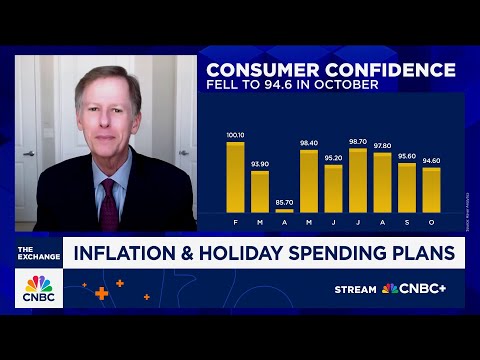
Joining me for more is Steve Oddland, president and CEO of the conference board. Steve, it's good to speak with you and that that stat takes me by surprise, especially given the NRF stat we saw where they suggested we could see the first trillion dollar Christmas or holiday season. Um, what are you seeing in your data and why.>> Yeah, well, the NRF stat is a little narrower than ours. Ours is all holiday spending on travel, on clothes, on parties, on food, the whole thing. And and it's expected to be down a ...


Consumer spending decisions will be driven by promotions, says The Conference Board CEO Steve Odland
CNBC Television· 2025-11-11 19:19
Holiday Spending Trends - Conference Board expects overall holiday spending to be slightly down, differing from NRF's narrower focus on retail [2] - Spending decrease is concentrated among younger, cash-strapped consumers [2] - Younger consumers plan to spend in November due to deals, impacting retail margins [3][4] Consumer Sentiment and Economic Factors - Consumer confidence index has been relatively stable, awaiting inflation relief and trade deal progress [5][6] - Jobs are stable and wages are rising, providing consumers with cash despite high debt levels [6] - Consumers will be selective in their purchases [7] Inflation and Travel - Tariffs are projected to impact inflation by approximately 50 basis points in the latter part of the year [11] - 70% of consumers are avoiding travel, similar to last year, due to inflation and travel difficulties [11] - Easing travel restrictions could lead to increased spending [12] Consumer Behavior - Consumers may spend more than surveys indicate if they have cash or access to debt [9] - A spending bump is expected in January when sales begin [10]
Trade Tracker: Stephanie Link buys Starbucks and trims Target
CNBC Television· 2025-11-11 18:18
All right, pretty nice day. Uh, at least for the Dow, up 370 as you saw. And Stephanie Link, let's get to these moves.The Linkster looked at Starbucks down 26% from its March high and said, "I want some lattes." >> Yes, >> you bought it. >> A little caffeine for the portfolio. >> Okay.So when Brian Nickel was announced to be the new CEO from Chipotle to this company, the stock went up 49%. It has roundt. It's given it all back.And we know what Brian Nickel did at Chipotle. Stock when he was at there went up ...


亚洲经济-资产负债表是否抑制了消费者支出-Asia Economics-The Viewpoint Is the balance sheet holding back the consumer
2025-11-11 02:47
Summary of Key Points from the Conference Call Industry Overview - The report focuses on household balance sheet dynamics across Asian economies, particularly in relation to consumer spending trends in the region, including China and India [3][5]. Core Insights - **Household Debt and Consumer Spending**: The analysis suggests that household debt is not a primary constraint on consumer spending. Instead, sluggish wage growth and weak job creation are more significant factors affecting consumption [5][19][27]. - **Wage Growth**: Wage growth is identified as the key driver for consumer spending. The expectation is that a recovery in non-tech exports will improve wage growth and subsequently boost consumer spending [5][27][37]. - **China's Economic Conditions**: In China, retail sales growth has slowed to a year-to-date low of 3% year-on-year in September, influenced by fading effects from consumption trade-in programs and weak labor market conditions [29][34]. - **India's Household Debt**: India's household debt is not considered over-leveraged. The Reserve Bank of India's measure shows household debt at 42% of GDP, but when excluding business loans, it drops to 24% of GDP, indicating a healthier balance sheet [47][52]. Important Data Points - **Household Debt to GDP Ratios**: - China: 63% [41] - Malaysia: 85% [21] - India: 24% (excluding business loans) [47] - Australia: 121% [79] - **Wage Growth Trends**: - China: 4.5% [7] - Asia ex-China: 3.1% [7] - India: 7.3% [7] Additional Insights - **Trade Tensions**: Trade tensions have negatively impacted non-tech exports, contributing to weak labor market conditions and consumption [5][27]. - **Property Market Influence**: In China, the decline in property prices has negatively affected household balance sheets, overshadowing any positive effects from equity market performance [32][33]. - **Future Expectations**: A turnaround in non-tech exports is anticipated to begin early next year, which is expected to improve labor market conditions and consumer spending [27][37][68]. Regional Analysis - **Emerging Markets (EM) Asia**: Countries like Indonesia and the Philippines have low household debt to GDP ratios, which do not constrain consumption. Malaysia shows stable household debt growth in line with nominal GDP [57]. - **Developed Markets (DM) Asia**: Japan's household debt to GDP has declined to a five-year low of 62%, with real wage growth being a significant constraint on consumption [58][59]. In Korea, while household debt growth has stabilized, weak real wage growth continues to dampen consumption [68]. Conclusion - The report emphasizes that while household balance sheets are stable across many Asian economies, the primary constraints on consumer spending are related to labor market dynamics and wage growth rather than debt levels. The expected recovery in non-tech exports could provide a much-needed boost to consumer confidence and spending in the coming months [5][27][37].
中国 AlphaWise 消费者脉搏调查(2025 年 10 月)-China Consumer Pulse -AlphaWise Consumer Pulse Survey Oct-25
2025-11-11 02:47
Summary of China Consumer Pulse Survey (October 2025) Industry Overview - The survey focuses on the consumer sentiment and spending outlook in China, particularly across different income groups and city tiers. Key Points Economic Outlook - 43% of surveyed households expect China's economy to remain stable over the next six months, an increase of 4 percentage points quarter-over-quarter (QoQ) [19][15] - The proportion of households concerned about job losses decreased by 8 percentage points QoQ to 36% [3][15] - Projected income growth for the next 12 months softened to 5.3%, down from 5.8%, primarily affecting lower-middle-income groups and residents of lower-tier cities [40][15] Consumer Spending Expectations - Consumer spending outlook remained stable, with 67% of consumers expecting flat spending, 22% anticipating an increase, and 11% predicting a decrease, resulting in a net score of 11%, unchanged from the previous quarter [61][15] - Net spending outlook improved in Tier 1 and 2 cities (net increase of 5% and 4% QoQ to 11% and 17%, respectively), while lower-tier cities saw a decline (net increase down 5% QoQ to 8%) [4][15] Spending by Category - Spending budgets for most categories remained stable, with increases in sports fashion, consumer electronics, and groceries, while freshly brewed drinks and collectibles saw slight declines [5][15] - Participation in trade-in programs dropped to 37% from 44% in the previous survey, with lower-income and younger consumers showing less interest [57][15] Investment Trends - Only 5% of surveyed households indicated increased stock holdings, significantly lower than 28% for wealth management products and 31% for gold. However, the ratio was higher among higher-income groups (19% for those earning ≥Rmb30,000/month) [6][15] - Stocks ranked as the fourth most popular investment, with 31% of consumers increasing their stock holdings this year compared to 26% who reduced them, yielding a net score of 5% [44][15] Housing Market Concerns - Only 15% of surveyed households have strong home purchase plans, with a net 42% of prospective buyers expecting prices to fall next year, up from 33% in the previous survey [7][15] - The willingness of home sellers to accept losses increased to 52%, down from 56% in July [7][15] Major Concerns for Consumers - Concerns about job loss and inflation eased, with both remaining top concerns for 36% of consumers [52][15] - The share of consumers unconcerned about any issues rose to 25%, up 10 percentage points [52][15] Travel and Lifestyle Changes - Travel intentions declined QoQ, except for same-day domestic trips, which remained flat. However, the shopping budget per traveler increased for two consecutive quarters [5][15] - Lifestyle upgrade intentions held steady at 18%, with more consumers expecting unchanged spending [74][15] Additional Insights - The survey was conducted from October 24-28, 2025, with 2,040 consumers across Tier 1 to Tier 4 cities, providing a comprehensive view of consumer sentiment in China [7][15]
Really concerned about consumer spending in Q4, says Vios Advisors' Michael Bapis
CNBC Television· 2025-11-10 21:16
Michael Bapis. I I'll hit you first here as we uh go towards the closure about two minutes, three minutes away or so. You say there's a lot of cautious optimism in markets.I'll give you there's like volatility came back last week, but do you you feel there's a lot of caution. Look, I think one of the key themes that we're looking at is the battle between, you know, consumer spending and consumer consumer sentiment being down and like you just said, strong equity markets. I mean, we're getting to more now wh ...

Overall consumer trends remain relatively stable, says Morgan Stanley's Simeon Gutman
CNBC Television· 2025-11-10 19:27
Consumer Spending - Consumer spending is a key topic of discussion [1] - Higher priced tickets are also being examined in relation to consumer behavior [1] Industry Analysis - Morgan Stanley's senior retail analyst provides insights [1]

Latest NRF Retail Monitor report shows consumer spending bounces back
CNBC Television· 2025-11-10 16:41
Despite some growing consumer concerns, some signs of strength in CNBC's latest retail monitor report. For that, we'll turn to Steve Leeman this morning. Hi, Steve.Hey, Car. Yeah, consumer spending bounced back in October after a pretty sharp fall in September with gains in the CNBC NRF retail monitor across most sectors, adding up to a strong start for retail in the fourth quarter. That could be good for the holiday season.The retail monitor, we get actual credit card spending data from Affinity Solutions. ...