京津冀协同发展

Search documents
何为首都都市圈?
Xin Lang Cai Jing· 2026-02-03 19:47
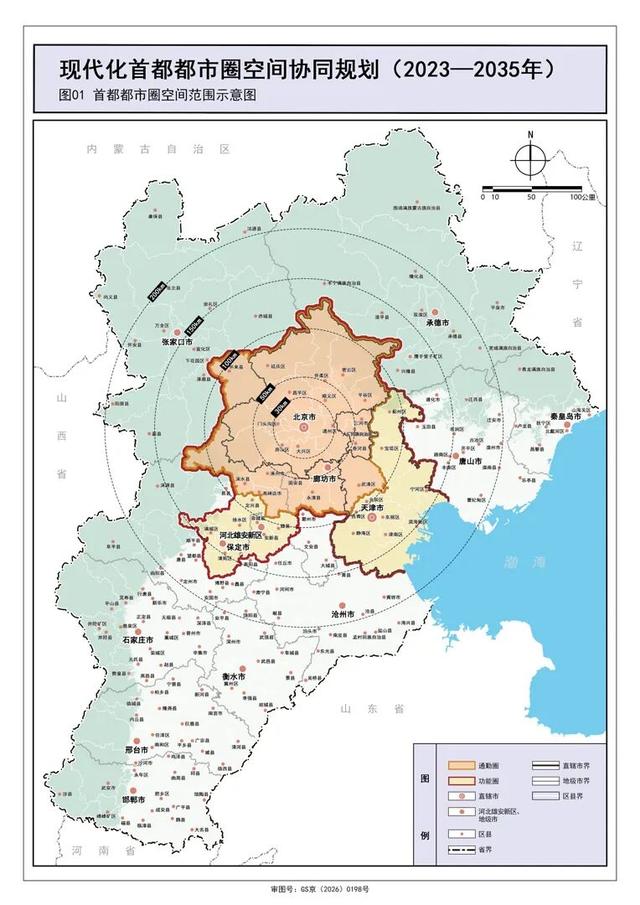
Core Viewpoint - The "Modern Capital Urban Circle Spatial Coordination Plan (2023-2035)" has been released, marking the first urban circle plan approved by the Central Committee of the Communist Party of China and the State Council, aimed at establishing a world-class urban circle centered around the capital by 2050 [1] Group 1: Spatial Structure and Development Goals - The plan outlines a spatial structure of approximately 42,000 square kilometers for the capital urban circle, proposing a framework of "one core, two wings, dual cities, multiple points, dual corridors, and multiple circles" [1] - By 2035, the modern capital urban circle framework is expected to be basically formed, with full completion aimed for 2050, serving as a model for Chinese-style modernization [1] Group 2: Commuting and Functional Circles - The commuting circle emphasizes the coordination of residence and work, covering the entire Beijing area and 12 surrounding districts, totaling about 27,000 square kilometers, promoting integrated development [2] - The functional circle focuses on enhancing the integration of Beijing's central urban area with its sub-center, as well as the collaboration between Tianjin and Hebei's Xiong'an New Area, aiming to cultivate an innovation triangle in the region [2] Group 3: Industrial Collaboration and Open Development - The industrial collaboration circle aims to promote mutual advantages and coordinated development among cities in the Beijing-Tianjin-Hebei region, fostering urban-rural integration and facilitating the flow of resources [3] - The planning process involved extensive expert consultations and field research, incorporating over 800 suggestions from various governmental and local entities, resulting in more than 1,200 modifications to the text [3]
首都都市圈擘画世界级城市群蓝图
Xin Lang Cai Jing· 2026-02-03 19:46
Core Viewpoint - The release of the "Modern Capital Urban Circle Spatial Coordination Plan (2023-2035)" marks a significant step in the coordinated development of the Beijing-Tianjin-Hebei region, aiming to establish a world-class urban circle centered around the capital by 2050 [1] Group 1: Planning and Structure - The plan delineates a spatial framework covering approximately 42,000 square kilometers, proposing a structure of "one core, two wings, dual cities, multiple points, and dual corridors" [1] - The "one core, two wings" model aims to facilitate the orderly decongestion of non-capital functions from Beijing while enhancing the region's capacity to support capital functions [2] Group 2: Urban Coordination and Development - The urban circle encompasses the entirety of Beijing, parts of Tianjin, and 11 cities in Hebei, focusing on enhancing the functions of Tianjin and the construction of the Xiong'an New Area [2] - The plan emphasizes the need for differentiated development across commuting, functional, and industrial collaboration circles to avoid homogenization [2][3] Group 3: Industrial and Economic Development - The plan aims to cultivate a "Beijing-Tianjin-Xiong'an Innovation Triangle" to enhance innovation capabilities and industrial leadership within the urban circle [3] - Key industries targeted for development include life and health, power and new energy equipment, integrated circuits, and artificial intelligence [5] Group 4: Infrastructure and Corridor Development - The plan outlines the construction of two high-quality development corridors: the Beijing-Tianjin Corridor and the Beijing-Xiong'an Corridor, focusing on innovation and resource integration [4] - The Beijing-Tianjin Corridor will span approximately 220 kilometers, while the Beijing-Xiong'an Corridor will cover about 240 kilometers, both aimed at fostering high-level openness and innovation [4] Group 5: Implementation and Future Outlook - The plan emphasizes the need for collaborative development among the three regions to optimize resource allocation and maximize efficiency [5] - As the plan's initiatives are implemented, it is expected to significantly contribute to the construction of a world-class urban cluster and support China's modernization efforts [5]
京津冀三大圈层嵌套联动协同发展
Bei Jing Qing Nian Bao· 2026-02-03 18:39
Core Viewpoint - The "Modern Capital Urban Circle Spatial Collaborative Planning (2023-2035)" has been approved, marking the first urban circle plan approved by the central government, aiming to enhance the coordinated development of the Beijing-Tianjin-Hebei region and establish a high-quality development model for urbanization [1][2]. Group 1: Planning Overview - The plan delineates an area of approximately 42,000 square kilometers and proposes a spatial structure of "one core, two wings, dual cities, multiple points, and multiple corridors" [3]. - It aims to create three major spatial layers: commuting circles, functional circles, and industrial collaboration circles, fostering an innovation triangle in the Beijing-Tianjin-Hebei region [1][3]. Group 2: Strategic Positioning - The strategic positioning of the capital urban circle includes becoming a key area for optimizing and supporting capital functions, a main engine for world-class city cluster construction, and a leading area for regional collaborative governance [3][4]. - The plan is seen as a guiding document for the next phase of development in the capital urban circle, playing a proactive role in the coordinated development of the Beijing-Tianjin-Hebei region [3][4]. Group 3: Spatial Circles - The commuting circle focuses on job-residence coordination, covering the entire Beijing area and 12 surrounding districts, totaling about 27,000 square kilometers [4][5]. - The functional circle encompasses Beijing, Tianjin, and parts of Hebei, covering approximately 42,000 square kilometers, and aims to enhance the core competitiveness of the capital urban circle [6][7]. Group 4: Key Areas of Focus - The plan integrates six key areas: industry, transportation, ecology, public services, cultural tourism, and safety resilience, consolidating collaborative measures into a unified spatial framework [8][9]. - In the industry sector, the plan emphasizes the establishment of the Beijing-Tianjin-Hebei International Science and Technology Innovation Center, promoting deep integration of innovation chains, industry chains, capital chains, and talent chains [8]. Group 5: Implementation and Collaboration - The plan includes a comprehensive implementation scheme that aligns with the "14th Five-Year Plan," ensuring coordinated efforts among the three regions [9][10]. - The planning process involved extensive consultation and collaboration among various stakeholders, resulting in over 1,200 modifications to the draft based on feedback from more than 800 suggestions [10].
2035年现代化首都都市圈构架基本形成
Bei Jing Shang Bao· 2026-02-03 15:49
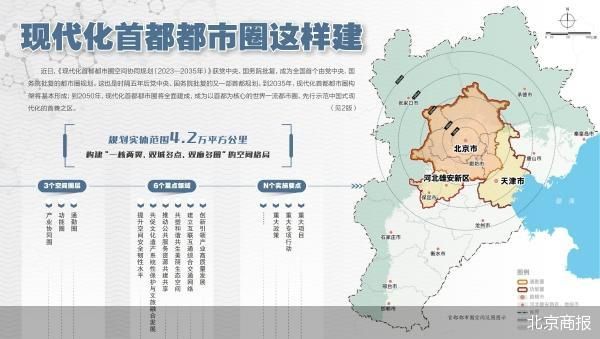
明确定位 三地共编一本规划 燕山脚下、渤海之滨、太行之畔,以首都为核心的都市圈蓝图绘就,扬帆起航。1月22日,《现代化首 都都市圈空间协同规划(2023—2035年)》正式获批。这是全国首个由党中央、国务院批复的都市圈规 划,也是时隔五年获党中央、国务院批复的又一部首都规划。 站在京津冀协同发展的新起点上,三地闻令而动,将紧紧围绕首都功能优化提升和服务保障,坚定不移 推动高质量发展,坚持一张蓝图绘到底,努力将首都都市圈建设成为以首都为核心的世界一流都市圈、 先行示范中国式现代化的首善之区,奋力谱写京津冀推进中国式现代化的新篇章。 党的十八大以来,在以习近平同志为核心的党中央集中统一领导下,各方凝心聚力、通力合作,京津冀 协同发展取得显著成效,以首都为核心的世界级城市群主干构架基本形成,首都规划体系"四梁八柱"建 立完善。 面向"中国式现代化建设的先行区、示范区"的时代使命和"建设一个什么样的首都,怎样建设首都"的时 代课题,《现代化首都都市圈空间协同规划(2023—2035年)》应运而生,由北京市、天津市、河北省 联合编制。 何为首都都市圈?《规划》科学划定约4.2万平方公里的规划实体范围,提出构建"一核两翼 ...

锚定协同新蓝图 三地聚力开新局——权威解读《现代化首都都市圈空间协同规划(2023——2035年)》批复
Xin Lang Cai Jing· 2026-02-03 14:37
【锚定协同新蓝图 三地聚力开新局——权威解读《现代化首都都市圈空间协同规划(2023——2035 年)》批复】日前,中共中央、国务院批复同意《现代化首都都市圈空间协同规划(2023——2035 年)》。批复指出,编制实施该《规划》是新起点上深入推进京津冀协同发展战略的重大举措,对进一 步优化提升首都功能、打造区域高质量发展增长极、推进中国式现代化建设具有重要意义。今天,京津 冀三地记者专访专家学者,为您解读三地落实批复、深入推进京津冀协同发展的核心方向与实践路径。 转自:河北广播电视台 (来源:河北广播电视台) ...
现代化首都都市圈怎么建?中央首提京津、京雄走廊
2 1 Shi Ji Jing Ji Bao Dao· 2026-02-03 13:47
《规划》称,北京非首都功能疏解取得显著进展,北京成为全国第一个减量发展的超大城市,发展方式 发生了深刻转型。站在京津冀协同发展新的起点上,需重点关注首都都市圈在首都功能保障、发展动 能、空间发展、安全韧性等方面的协同、优化和提升。 《规划》提出三个阶段的发展目标。到2030年,现代化首都都市圈建设取得积极进展,北京"大城市 病"治理取得新成效,京津同城化发展效应逐步显现,京津雄创新三角发展框架基本形成。到2035年, 现代化首都都市圈构架基本形成,北京"大城市病"治理取得显著成效,同城化效应不断增强,城乡规 划、建设、治理融合水平全面提高。展望到2050年,现代化首都都市圈全面建成,成为以首都为核心的 世界一流都市圈、先行示范中国式现代化的首善之区,京津同城化发展取得显著成效。 21世纪经济报道记者周慧 李莎 北京报道 近日,中共中央、国务院批复《现代化首都都市圈空间协同规划(2023—2035年)》(下称《规 划》)。2月3日,《规划》全文发布。 中国区域经济学会副会长、中国社科院研究员陈耀告诉21世纪经济报道记者,都市圈和城市群的概念不 同,虽然首都都市圈和京津冀城市群的区域范围和发展目标任务有些重合,但 ...
重磅政策锚定未来!首都都市圈规划解锁多重红利,强劲引擎助推京津冀协同发展提质提速
Xin Lang Cai Jing· 2026-02-03 12:52
Group 1 - Hailanxin (300065) benefits from the collaborative development of the capital urban area port cluster and the intelligent upgrade of shipping, leading to strong growth momentum for the company [1][34] - The company specializes in marine electronic information systems and marine engineering equipment, with a leading position in domestic navigation technology [1][34] - The demand for technology support is expected to increase due to the acceleration of intelligent transformation at key ports like Tianjin and Tangshan [1][34] Group 2 - Jingtou Development (600683) focuses on the development of rail transit properties, leveraging the construction of a cross-regional rail transit network to unlock land value along the routes [2][36] - The company has developed a mature "rail + property" model and holds multiple patents in core technologies related to rail property [2][36] - The ongoing construction in key areas like Beijing's sub-center and Xiong'an New Area aligns with the demand for residential and industrial support due to population relocation [2][36] Group 3 - Chengjian Development (600266) is positioned to benefit from the accelerated urban renewal and non-capital function relief, which creates sustained demand for urban development and infrastructure projects [3][37] - The company has extensive experience in old city renovation and affordable housing construction, participating deeply in the quality upgrade projects of core cities [3][37] - The company’s land reserves and project resources in key areas can directly meet the housing and industrial space needs arising from population relocation [3][37] Group 4 - Langfang Development (600149) is strategically positioned in the land development business in the Beijing area, benefiting from the integration of Tongzhou and the North Three Counties [4][38] - The company can leverage local resource advantages to undertake land consolidation and infrastructure construction projects [4][38] - The demand for land development is expected to be rigidly released due to the implementation of cross-regional demonstration policies [4][38] Group 5 - Julisi (002342) sees a surge in demand for engineering equipment and rigging due to large-scale infrastructure projects in the urban area [5][39] - The company specializes in engineering rigging and lifting equipment, widely used in construction scenarios such as bridges and ports [5][39] - The integration of transportation in the Beijing-Tianjin-Hebei region is expected to drive significant growth in the company's product demand [5][39] Group 6 - Huasheng Tiancai (600410) focuses on cloud computing and digital services, capitalizing on the digital infrastructure upgrade and industrial digital transformation in the urban area [6][40] - The company has a comprehensive digital technology system and rich industry service experience [6][40] - The demand for digital services is expected to grow as the region develops smart transportation and digital governance applications [6][40] Group 7 - Jinyu Group (601992) is a leading supplier of building materials in the Beijing-Tianjin-Hebei region, benefiting from the ongoing construction boom and urban renewal [7][41] - The company’s product offerings include cement, concrete, and aggregates, with a strong supply chain advantage [7][41] - The demand for building materials is expected to rise significantly due to large-scale infrastructure and housing projects [7][41] Group 8 - Jidong Equipment (000856) is positioned to benefit from the upgrade of traditional industries and the demand for equipment renewal in the building materials sector [8][42] - The company specializes in cement equipment manufacturing and engineering services, with a strong technical capability [8][42] - The demand for high-end cement equipment and environmental renovation technology is expected to grow as the region pushes for green upgrades [8][42] Group 9 - Fushi Holdings (300071) focuses on brand marketing and public relations, benefiting from the growing demand for brand promotion in the urban area [9][43] - The company has a full-chain marketing service capability and serves clients across multiple industries [9][43] - The demand for customized marketing solutions is expected to rise as many enterprises establish and upgrade their brands [9][43] Group 10 - Huaxia Happiness (600340) specializes in the development and operation of industrial new towns, benefiting from the influx of industries due to non-capital function relief [10][44] - The company has a mature operational model that integrates industrial introduction and urban support [10][44] - The value of industrial new towns is expected to increase as the region enhances transportation and public services [10][44] Group 11 - Hongqiang Co., Ltd. (002809) sees a rigid growth in demand for concrete additives due to large-scale infrastructure projects [11][45] - The company specializes in concrete additives and new building materials, with stable product performance [11][45] - The demand for concrete is expected to rise significantly, driving the growth of the additives market [11][45] Group 12 - Siwei Tuxin (002405) is positioned to benefit from the rapid development of smart transportation and the growth of the connected vehicle and autonomous driving industries [12][46] - The company specializes in navigation maps and connected vehicle services, with leading technology in high-precision mapping [12][46] - The demand for smart transportation solutions is expected to grow as the region promotes intelligent upgrades in transportation systems [12][46] Group 13 - Leike Defense (002413) focuses on radar systems and electronic countermeasures, benefiting from the dual growth in defense and civilian security demands [13][48] - The company has core technologies and intellectual property rights in the defense and civilian security sectors [13][48] - The demand for security solutions is expected to increase as the region enhances its security capabilities [13][48] Group 14 - Aerospace Technology (000901) is involved in the aerospace equipment manufacturing sector, benefiting from the integration of innovation resources and the upgrade of high-end manufacturing [14][49] - The company leverages its aerospace technology advantages to participate in regional aerospace projects [14][49] - The demand for aerospace technology applications is expected to grow as the region develops its aerospace industry [14][49] Group 15 - Keri International (300662) focuses on human resources services, benefiting from the accelerated flow of talent and the growing demand for high-end talent in the urban area [15][50] - The company provides comprehensive human resources services, covering various industries [15][50] - The demand for customized human resources solutions is expected to rise as enterprises upgrade and expand [15][50] Group 16 - Tanshijia (300005) is positioned to benefit from the growth in outdoor leisure demand and the development of ecological tourism resources [16][51] - The company specializes in outdoor apparel and equipment, with a strong brand presence in the outdoor products industry [16][51] - The demand for outdoor products is expected to grow as consumer awareness of outdoor activities increases [16][51] Group 17 - Gangyan Gaona (300034) focuses on high-temperature alloy materials, benefiting from the rapid development of aerospace and new energy sectors [17][52] - The company specializes in the research and production of high-end alloy materials, with leading technology in the field [17][52] - The demand for high-temperature alloys is expected to grow as the region promotes high-end manufacturing upgrades [17][52] Group 18 - Electronic City (600658) focuses on the development and operation of technology parks, benefiting from the demand for innovation resources and the establishment of tech enterprises [18][53] - The company has extensive experience in park operation and enterprise incubation [18][53] - The demand for technology parks is expected to grow as the region promotes innovation and collaboration [18][53] Group 19 - Shangda Co., Ltd. (301522) specializes in the processing of special steel materials, benefiting from the growing demand for high-end materials in traditional industries [19][54] - The company focuses on the deep processing of special steel, with significant advantages in material processing technology [19][54] - The demand for special steel products is expected to rise as the region promotes the upgrade of manufacturing industries [19][54] Group 20 - Jikai Co., Ltd. (002691) focuses on mining equipment and intelligent upgrades, benefiting from the demand for efficient resource development [20][55] - The company specializes in mining machinery and technical services, with a strong service network [20][55] - The demand for intelligent mining equipment is expected to grow as the region promotes equipment renewal [20][55] Group 21 - Xinhua News (603888) focuses on news dissemination and digital content services, benefiting from the growing demand for media and cultural industries [21][56] - The company has authoritative information channels and strong content creation capabilities [21][56] - The demand for customized media solutions is expected to rise as the region promotes cultural integration and digital transformation [21][56]


首博2026年展览计划!玛雅文明大展5月登场
Xin Lang Cai Jing· 2026-02-03 12:35
5月,"铸牢中华民族共同体意识系列——云南历史文化展"展出,以战国到两汉时期的云南青铜文化为 主要展示内容,汇集云南地区多次重大考古成果,通过"西南夷""古滇国""河泊所"3个部分集中展示该 地区独具特色的灿烂文化。 2月3日,首都博物馆发布2026年展览计划。其中,"玛雅与安第斯文明大展"作为年度重磅特展,将首次 打造"全馆一展",利用1万平方米的展陈和体验空间,邀观众沉浸式领略美洲风情。 2026年,首博本馆和北京大运河博物馆将陆续推出15项展览,持续打造中华文明起源、世界文明互鉴、 都城文化、京津冀协同发展等系列展览品牌。"经过两年筹划,我们将打造一场全馆一展、全域沉浸、 全程叙事的特大维度展览。"首博馆长郭京宁介绍,5月至10月,该馆本馆将推出"玛雅与安第斯文明大 展",展期横跨"国际博物馆日"、暑期、国庆等重要节点。该展览汇集800余件精美文物。展陈空间和全 场景沉浸式公共体验区各约5000平方米,总展览面积达1万平方米,带给观众沉浸式的震撼体验。 玛雅文明被誉为"美洲的希腊",此次展览既有大体量、重量级的玛雅"纪念碑",也有彩绘陶盘、兔子形 容器等题材丰富、艺术性强的特色文物。部分文物为首次来华展 ...
中共中央 国务院批复《现代化首都都市圈空间协同规划(2023—2035年)》
Yang Guang Wang· 2026-02-03 10:09
央广网北京2月3日消息 据中央广播电视总台中国之声《新闻和报纸摘要》报道,中共中央、国务 院日前批复同意《现代化首都都市圈空间协同规划(2023—2035年)》(以下简称《批复》)。 《批复》要求,创新《规划》组织实施。京津冀三省市党委和政府要认真履行主体责任,北京市要 发挥好牵头作用,以钉钉子精神抓好《规划》组织实施。有关部门要根据职责分工,加强指导支持,密 切协同配合,共同推动《规划》各项目标任务落实落地。 《批复》要求,更好服务保障首都功能。要围绕完善首都功能区域布局,统筹疏解与提升、活力与 秩序、发展与安全,增强区域整体竞争力和综合承载力,建成以首都为核心的世界一流都市圈、先行示 范中国式现代化的首善之区,支撑京津冀世界一流城市群建设。 《批复》强调,着力优化京津冀城市体系。构建"一核两翼、双城多点、双廊多圈"的首都都市圈空 间格局。要充分发挥北京"一核"的辐射带动作用,高标准高质量建设河北雄安新区,把北京城市副中心 建设成为首都发展新的增长极,高质量谱写京津"双城记",发挥河北节点城市支撑作用。 《批复》要求,促进实现重点领域功能协同。构建"两廊四带"产业协同创新格局,全面建成面向世 界的京津冀国际 ...
一图读懂!如何建设现代化首都都市圈?重磅规划解读来了
Bei Jing Qing Nian Bao· 2026-02-03 08:55
燕山脚下、渤海之滨、太行之畔,以首都为核心的都市圈蓝图绘就,扬帆起航。1月22日,《现代化首 都都市圈空间协同规划(2023—2035年)》正式获批。这是全国首个由党中央、国务院批复的都市圈规 划,也是时隔五年获党中央、国务院批复的又一部首都规划。 站在京津冀协同发展的新起点上,三地闻令而动,将紧紧围绕首都功能优化提升和服务保障,坚定不移 推动高质量发展,坚持一张蓝图绘到底,努力将首都都市圈建设成为以首都为核心的世界一流都市圈、 先行示范中国式现代化的首善之区,奋力谱写京津冀推进中国式现代化的新篇章。 明确定位 三地共编一本规划 党的十八大以来,在以习近平同志为核心的党中央集中统一领导下,各方凝心聚力、通力合作,京津冀 协同发展取得显著成效,以首都为核心的世界级城市群主干构架基本形成,首都规划体系"四梁八柱"建 立完善。 面向"中国式现代化建设的先行区、示范区"的时代使命和"建设一个什么样的首都,怎样建设首都"的时 代课题,《现代化首都都市圈空间协同规划(2023—2035年)》应运而生,由北京市、天津市、河北省 联合编制。 何为首都都市圈?《规划》科学划定约4.2万平方公里的规划实体范围,提出构建"一核两翼 ...