
首都都市圈

Search documents
北京市常务副市长:首都都市圈是目前我国唯一拥有两个直辖市的都市圈,具有独一无二的发展优势
Xin Lang Cai Jing· 2026-02-13 01:26
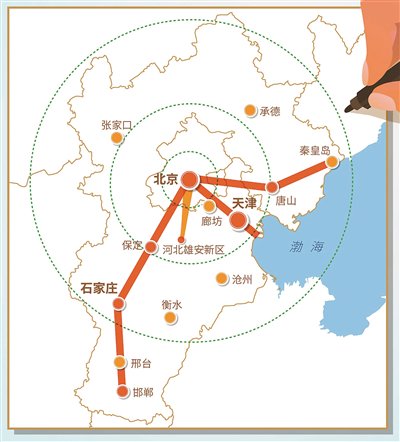
Core Viewpoint - The press conference introduced the "Modern Capital Urban Circle Spatial Collaborative Planning (2023-2035)", highlighting the unique advantages of the capital urban circle, which includes two municipalities, in various aspects such as politics, ecology, economy, and security [1][2]. Group 1: Capital Urban Circle Overview - The capital urban circle is the only urban circle in China with two municipalities, serving as a crucial support for the coordinated development of Beijing-Tianjin-Hebei [2]. - The urban circle is designed to optimize and enhance the functions of the capital, including the construction of the Xiong'an New Area in Hebei and the Beijing sub-center [2]. Group 2: Spatial Structure and Circles - The spatial range of the capital urban circle is not limited to the typical one-hour commuting area but is innovatively structured into multi-layered, nested "concentric circle" spatial divisions based on the capital's uniqueness and the strong driving force of its "four centers" [2][3]. - The commuting circle is defined with a radius of approximately 50 kilometers, covering an area of about 27,000 square kilometers, including all of Beijing and 12 surrounding districts [2]. - The functional circle, which focuses on alleviating and enhancing the core areas of the capital urban circle, has a radius of approximately 100 kilometers, encompassing an area of about 42,000 square kilometers, including parts of Beijing, Tianjin, and Hebei [2][3]. - The industrial collaboration circle is defined with a radius of 150 kilometers, extending to the entire Beijing-Tianjin-Hebei urban agglomeration and connecting with surrounding urban clusters, enhancing the integration into domestic and international dual circulation [3][6].

建设首都都市圈 三个圈层构建发展“同心圆”
Xin Lang Cai Jing· 2026-02-12 23:44
Core Viewpoint - The "Modern Capital Metropolitan Area Spatial Collaborative Planning (2023-2035)" aims to enhance the development dynamics of the capital metropolitan area through strategic planning and collaboration among Beijing, Tianjin, and Hebei [2][3]. Group 1: Spatial Structure and Planning - The planning introduces three layers: commuting circle, functional circle, and industrial collaborative circle, which are innovatively structured as nested concentric circles rather than simple rings [3][4]. - The commuting circle covers approximately 27,000 square kilometers, including all of Beijing and 12 surrounding districts, focusing on high-frequency population movement areas [3]. - The functional circle, emphasizing the core area for development, spans about 42,000 square kilometers, including parts of Beijing, Tianjin, and Hebei [3][4]. - The industrial collaborative circle extends to a radius of 150 kilometers, encompassing the entire Beijing-Tianjin-Hebei urban agglomeration and surrounding regions [4]. Group 2: Collaborative Development - The planning emphasizes the importance of collaboration among the three regions, with specific goals set for 2030, 2035, and 2050, focusing on spatial layout, innovation, and industrial synergy [4][5]. - Key tasks include enhancing the "Four Centers" in Beijing, promoting the development of Tianjin's advanced manufacturing sector, and strengthening the support role of Hebei's key cities [5][7]. - The planning aims to leverage inter-regional cooperation, particularly in areas like transportation and public services, to achieve high-quality integrated development [5][6]. Group 3: Implementation and Future Goals - The planning outlines a dynamic mechanism for spatial layout optimization, addressing issues like industrial park placement and urban integration [6]. - By 2035, the goal is to establish a high-level socialist modern city in Xiong'an, with a comprehensive modern urban system by 2050 [9]. - The planning includes initiatives to enhance the Beijing Plain New City as a key area for investment and living, with a projected population capacity of 500,000 [10][12].
官方解答首都都市圈空间范围和“三个圈层”划定相关问题
Zhong Guo Xin Wen Wang· 2026-02-12 17:13
Core Viewpoint - The first urban agglomeration plan approved by the Central Committee of the Communist Party of China and the State Council, titled "Modern Capital Urban Agglomeration Spatial Coordination Plan (2023-2035)," has been released, highlighting the unique advantages and roles of the capital urban agglomeration in various aspects such as politics, ecology, economy, and security [1][2]. Group 1: Urban Agglomeration Overview - The capital urban agglomeration is characterized by its role as the only urban agglomeration in China with two municipalities, serving as a crucial support for the coordinated development of Beijing-Tianjin-Hebei [1]. - The spatial scope of the capital urban agglomeration includes a multi-layered, nested "concentric circle" model, which is innovative compared to traditional "one-hour commuting" ranges [1]. Group 2: Commuting Circle - The commuting circle considers the current cross-border commuting rate and the comprehensive transportation reach within one hour, covering a total area of approximately 27,000 square kilometers, which includes all of Beijing and 12 surrounding districts and counties [1]. Group 3: Functional Circle - The functional circle represents the core area for the development of the capital urban agglomeration, encompassing Beijing, Tianjin, Xiong'an New Area in Hebei, and parts of Langfang, Baoding, and Zhangjiakou, with a total area of about 42,000 square kilometers [2]. Group 4: Industrial Coordination Circle - The industrial coordination circle serves as an open area for the development of the capital urban agglomeration, extending its influence across the entire Beijing-Tianjin-Hebei urban cluster and coordinating with surrounding urban clusters such as Liaoning Central South, Shandong Peninsula, and Central Plains [2]. - This circle aims to efficiently connect with major domestic urban clusters like the Yangtze River Delta, Guangdong-Hong Kong-Macao Greater Bay Area, Chengdu-Chongqing, and the middle reaches of the Yangtze River, establishing a multi-level collaborative and open pattern that reaches both nationally and globally [2].
解读首都都市圈的“三个圈”
Bei Jing Shang Bao· 2026-02-12 16:06
Core Viewpoint - The "Modern Capital Urban Circle Spatial Collaborative Planning (2023-2035)" has been officially approved, marking a significant step in the coordinated development strategy of the Beijing-Tianjin-Hebei region, focusing on three spatial layers: commuting circle, functional circle, and industrial collaborative circle [1][3]. Group 1: Development Goals - The planning emphasizes the need for coordinated development goals among Beijing, Tianjin, and Hebei, with phased targets set for 2030, 2035, and 2050 [3]. - The construction of the capital urban circle is framed within the context of the Beijing-Tianjin-Hebei coordinated development strategy, aiming to enhance high-quality development [3]. Group 2: Functional Layout - The planning outlines a collaborative functional layout, leveraging the comparative advantages of each region to foster a mutually beneficial development pattern [3]. - Beijing is tasked with enhancing its "four centers" while alleviating non-capital functions to support the development of Tianjin and Hebei [3]. Group 3: Policy Measures - The planning proposes collaborative policy measures focusing on key areas and regions, aiming for integrated high-quality development [4]. - It highlights the importance of inter-provincial cooperation, particularly in areas like the Beijing-Tianjin-Hebei border regions, to achieve integrated development [4]. Group 4: Spatial Structure - The planning defines the spatial structure of the capital urban circle, which includes the commuting circle, functional circle, and industrial collaborative circle [6]. - The commuting circle is delineated based on a radius of approximately 50 kilometers, covering a population of high-frequency movement [6][7]. - The functional circle is set at a radius of about 100 kilometers, encompassing key areas in Beijing, Tianjin, and Hebei, with an area of approximately 42,000 square kilometers [7]. - The industrial collaborative circle extends to a radius of 150 kilometers, integrating the entire Beijing-Tianjin-Hebei urban cluster and connecting with surrounding urban groups [7].
首都都市圈怎么建?权威解读来了
2 1 Shi Ji Jing Ji Bao Dao· 2026-02-12 10:49
Core Viewpoint - The "Modern Capital Urban Circle Spatial Collaborative Planning (2023-2035)" has been released, marking the first urban circle plan approved by the central government, emphasizing the strategic positioning of the capital urban circle as a core driver for regional high-quality development and modernization in China [1][2]. Group 1: Strategic Framework - The plan highlights the core role of Beijing, balancing the need for decongestion and enhancement, vitality and order, as well as development and security [1]. - The strategic positioning of the capital urban circle includes "four zones and one engine," focusing on optimizing and enhancing the functions of the capital [1][2]. Group 2: Urban Structure - The plan proposes a multi-layered structure with commuting circles, functional circles, and industrial collaboration circles, marking the first time these concepts have been introduced at the planning level [3]. - The commuting circle covers approximately 27,000 square kilometers, including all of Beijing and 12 surrounding districts, based on a one-hour commuting radius [3]. - The functional circle, which is the core area for development, spans about 42,000 square kilometers, including Beijing, Tianjin, and parts of Hebei [5]. Group 3: Development of Xiong'an New Area - Xiong'an New Area is designated as a key area for the decongestion of non-capital functions from Beijing, with goals to become a high-level socialist modern city by 2035 [6]. - The total development area of Xiong'an is nearly 215 square kilometers, with a total construction area of 58.52 million square meters and 831 kilometers of new roads [6][7]. Group 4: Collaborative Development - The plan emphasizes the need for a collaborative development framework among Beijing, Tianjin, and Hebei, focusing on optimizing the capital's functions and enhancing innovation capabilities [9]. - The establishment of a "you have me, I have you" innovation chain is crucial, with over 10,000 branches of Beijing enterprises already set up in Tianjin and Hebei [9][10].
首都都市圈规划发布,天津迎三重发展新机遇
Zhong Guo Xin Wen Wang· 2026-02-05 12:01
Core Viewpoint - The approval of the "Modern Capital Urban Circle Spatial Collaborative Planning (2023-2035)" marks a new phase in the coordinated development of the Beijing-Tianjin-Hebei region, aiming to build a world-class urban circle [1] Group 1: Strategic Goals - Tianjin aims to leverage the strategy of promoting coordinated development with Beijing as a primary focus, transitioning from a "defensive" role to a "frontline" position in enhancing its competitiveness [1] - The planning outlines a spatial structure of "one core, two wings, dual cities, multiple points, dual corridors, and multiple circles," emphasizing high-quality development in the Beijing-Tianjin urban relationship [1] Group 2: Industrial Innovation - The planning proposes a "two corridors, four belts" industrial collaborative innovation framework, positioning the "Beijing-Tianjin Corridor" as a hub for intellectual density and open innovation [2] - Tianjin is embedding itself into the innovation network centered around Beijing, accelerating the "Beijing R&D, Tianjin transformation" model, particularly in emerging industries like biomedicine and aerospace [2] Group 3: Transportation Hub - The planning emphasizes the construction of "eight corridors and two rings" for transportation, solidifying Tianjin's role as a maritime gateway and comprehensive transportation hub for the Beijing-Tianjin-Hebei region [2] - The designation of Tianjin as the "Northern International Shipping Core Area" aims to elevate Tianjin Port to a first-class smart and green port, enhancing economic activity through integrated logistics and trade [2] Group 4: Urban Functionality - The planning integrates Tianjin's central urban area and Binhai New Area into the capital urban circle's "functional circle," promoting internal and external functional collaboration [3] - Tianjin is set to enhance public services and business environments, thereby increasing its overall urban capacity and attractiveness [3] Group 5: Action Pathways - Tianjin's "14th Five-Year Plan" outlines a clear action path focused on integrating into the three major "circles" of the capital urban area, enhancing collaborative interfaces in industrial, commuting, and functional spheres [3][4] - The city aims to strengthen its unique advantages by developing a world-class smart green port and modern industrial systems, while also fostering financial services related to aircraft and ship leasing [3] Group 6: Soft Connectivity - The planning encourages "soft connectivity" with Beijing and Hebei in terms of rules, standards, and administrative services, facilitating cross-province operations [4] - The transition from "physical docking" to "institutional integration" is expected to enhance the efficiency of resource allocation within the urban circle [4]
房地产+首都都市圈概念联动2连板!京投发展10:37再度涨停,背后逻辑揭晓
Jin Rong Jie· 2026-02-04 02:55
Group 1 - The core viewpoint of the article highlights that Jingtou Development has experienced a consecutive two-day limit-up, indicating strong market interest and performance in the real estate sector [1] - The stock reached a limit-up at 10:37 AM with a trading volume of 422 million yuan and a turnover rate of 9.86%, reflecting significant trading activity [1] - The real estate sector has shown a volatile upward trend, attracting market attention, particularly in the capital metropolitan area where Jingtou Development is a key stock [1]

谱写京津冀推进中国式现代化的新篇章
Bei Jing Ri Bao Ke Hu Duan· 2026-02-03 22:06
Core Viewpoint - The "Modern Capital Urban Circle Spatial Collaborative Planning (2023-2035)" has been officially approved, marking it as the first urban circle plan approved by the central government, aimed at establishing a world-class urban circle centered around the capital and promoting high-quality development in the Beijing-Tianjin-Hebei region [1][2]. Group 1: Planning and Structure - The planning document outlines a spatial structure of "one core, two wings, dual cities, multiple points, and multiple circles," covering an area of approximately 42,000 square kilometers [2][3]. - The plan emphasizes the importance of optimizing and enhancing the capital's functions while promoting coordinated development among Beijing, Tianjin, and Hebei [2][3]. Group 2: Strategic Positioning - The "four zones and one engine" strategy positions the capital urban circle as a key area for enhancing the capital's functions, a main engine for building a world-class city cluster, and a leading area for regional collaborative governance [3][4]. - The plan serves as a significant measure for advancing the Beijing-Tianjin-Hebei collaborative development strategy and is expected to provide a model for other urban circles in China [3][4]. Group 3: Spatial Circles - The plan delineates three nested spatial circles: the commuting circle, functional circle, and industrial collaboration circle, which are designed to work together in a coordinated manner [4][5]. - The commuting circle encompasses the entirety of Beijing and 12 surrounding districts, covering about 27,000 square kilometers, focusing on job-residence coordination [4][5]. Group 4: Key Development Areas - The plan identifies six key areas for collaborative development: industry, transportation, ecology, public services, cultural tourism, and safety resilience, integrating these into a unified spatial framework [8][9]. - In the industry sector, the plan aims to accelerate the establishment of an international technology innovation center in Beijing and enhance the integration of innovation, industry, finance, and talent [8][9]. Group 5: Implementation and Future Goals - The plan includes a timeline, aiming for the basic structure of the modern capital urban circle to be formed by 2035 and fully completed by 2050, establishing it as a leading area for Chinese-style modernization [10].
何为首都都市圈?
Xin Lang Cai Jing· 2026-02-03 19:47
Core Viewpoint - The "Modern Capital Urban Circle Spatial Coordination Plan (2023-2035)" has been released, marking the first urban circle plan approved by the Central Committee of the Communist Party of China and the State Council, aimed at establishing a world-class urban circle centered around the capital by 2050 [1] Group 1: Spatial Structure and Development Goals - The plan outlines a spatial structure of approximately 42,000 square kilometers for the capital urban circle, proposing a framework of "one core, two wings, dual cities, multiple points, dual corridors, and multiple circles" [1] - By 2035, the modern capital urban circle framework is expected to be basically formed, with full completion aimed for 2050, serving as a model for Chinese-style modernization [1] Group 2: Commuting and Functional Circles - The commuting circle emphasizes the coordination of residence and work, covering the entire Beijing area and 12 surrounding districts, totaling about 27,000 square kilometers, promoting integrated development [2] - The functional circle focuses on enhancing the integration of Beijing's central urban area with its sub-center, as well as the collaboration between Tianjin and Hebei's Xiong'an New Area, aiming to cultivate an innovation triangle in the region [2] Group 3: Industrial Collaboration and Open Development - The industrial collaboration circle aims to promote mutual advantages and coordinated development among cities in the Beijing-Tianjin-Hebei region, fostering urban-rural integration and facilitating the flow of resources [3] - The planning process involved extensive expert consultations and field research, incorporating over 800 suggestions from various governmental and local entities, resulting in more than 1,200 modifications to the text [3]
首都都市圈擘画世界级城市群蓝图
Xin Lang Cai Jing· 2026-02-03 19:46
Core Viewpoint - The release of the "Modern Capital Urban Circle Spatial Coordination Plan (2023-2035)" marks a significant step in the coordinated development of the Beijing-Tianjin-Hebei region, aiming to establish a world-class urban circle centered around the capital by 2050 [1] Group 1: Planning and Structure - The plan delineates a spatial framework covering approximately 42,000 square kilometers, proposing a structure of "one core, two wings, dual cities, multiple points, and dual corridors" [1] - The "one core, two wings" model aims to facilitate the orderly decongestion of non-capital functions from Beijing while enhancing the region's capacity to support capital functions [2] Group 2: Urban Coordination and Development - The urban circle encompasses the entirety of Beijing, parts of Tianjin, and 11 cities in Hebei, focusing on enhancing the functions of Tianjin and the construction of the Xiong'an New Area [2] - The plan emphasizes the need for differentiated development across commuting, functional, and industrial collaboration circles to avoid homogenization [2][3] Group 3: Industrial and Economic Development - The plan aims to cultivate a "Beijing-Tianjin-Xiong'an Innovation Triangle" to enhance innovation capabilities and industrial leadership within the urban circle [3] - Key industries targeted for development include life and health, power and new energy equipment, integrated circuits, and artificial intelligence [5] Group 4: Infrastructure and Corridor Development - The plan outlines the construction of two high-quality development corridors: the Beijing-Tianjin Corridor and the Beijing-Xiong'an Corridor, focusing on innovation and resource integration [4] - The Beijing-Tianjin Corridor will span approximately 220 kilometers, while the Beijing-Xiong'an Corridor will cover about 240 kilometers, both aimed at fostering high-level openness and innovation [4] Group 5: Implementation and Future Outlook - The plan emphasizes the need for collaborative development among the three regions to optimize resource allocation and maximize efficiency [5] - As the plan's initiatives are implemented, it is expected to significantly contribute to the construction of a world-class urban cluster and support China's modernization efforts [5]