
Risk management

Search documents
Dynex Capital Portfolio Hits $14 Billion
The Motley Fool· 2025-07-21 20:46
Core Insights - Dynex Capital reported significant growth in its portfolio and market capitalization, with a portfolio size of $14 billion, over 50% larger than the previous year, and a market cap exceeding $1.5 billion as of June 30 [2][4] - The company increased its economic leverage to 8.3x from 7.4x, supported by a stable mortgage repo market and strong liquidity [3][4] - High-return agency mortgage-backed securities (MBS) are driving risk-adjusted returns, with ROEs on newly acquired positions ranging from the mid-teens to low 20% [5][6] Financial Performance - Dynex Capital's debt-to-equity ratio stood at 8.3, with quarter-end liquidity at $891 million, representing 55% of total equity [1] - The portfolio expanded by 25% since the end of the first quarter, increasing from $11 billion to $14 billion [2] Market Conditions - The company benefited from a supportive policy environment, allowing for increased leverage while maintaining robust liquidity [4] - Mortgage spreads remain historically wide, contributing to the attractiveness of agency MBSs [5][6] Strategic Focus - Management emphasizes continued capital deployment into agency MBSs and maintaining sufficient liquidity for further portfolio growth [7] - Long-term value creation is anchored in high-quality, liquid asset exposure and flexible leverage according to market opportunities [8]



X @IcoBeast.eth🦇🔊
IcoBeast.eth🦇🔊· 2025-07-19 19:50
Have been thinking a lot today about optimal portfolio balancing if we really are going full risk on for a little bit.Key factors:- ETH going parabolic on the back on seemingly infinite institutional bid- BTC.D crashing- Desire for exposure to alts definitely coming back with some retail bid.Outstanding question:What do you allocate to/how far out on the beta risk curve do you need to go?Example:for me, ETH alone is good enough for a decent bit of exposure for me…but what if I want exposure to other ecos?So ...
Bank of America: 8% Dividend Hike in Q2
The Motley Fool· 2025-07-16 17:25
Core Insights - Bank of America reported Q2 2025 earnings with EPS of $0.89, exceeding analyst expectations of $0.86, and net income rose to $7.1 billion, marking a year-over-year increase [1][5] - Total revenue for the quarter was $26.5 billion, slightly below consensus estimates of $26.77 billion, reflecting a 4.3% increase from the previous year [1][5] Financial Performance - EPS (GAAP) increased by 7.2% year-over-year from $0.83 to $0.89 [2] - Revenue (GAAP) rose to $26.5 billion from $25.4 billion in Q2 2024, but missed estimates by approximately 0.8% [2][5] - Net interest income grew to $14.7 billion, a 7.3% increase from $13.7 billion in the prior year [2][5] - Net income increased by 2.9% from $6.9 billion in Q2 2024 to $7.1 billion [2][5] Business Segments - Investment banking fees decreased by 9%, while Global Banking segment revenue fell by 6% [6] - Global Markets segment saw a strong performance with trading revenue up 14% and FICC revenue up 16% [6] - Wealth management asset management fees rose by 9%, with client balances exceeding $4.4 trillion [6] Operational Insights - Noninterest expenses rose by 5% to $17.2 billion, driven by higher revenue-related expenses and investments in technology and personnel [7] - The efficiency ratio improved in consumer banking, with 49 million active digital users and 65% of sales being digitally enabled [7] Risk Management - Provision for credit losses increased to $1.6 billion, consistent with previous quarters, while the net charge-off ratio remained steady at 0.55% [8] - The allowance for loan and lease losses was 1.17% of total loans for Q2 2025, down from 1.26% in Q2 2024 [8] Capital Returns - The company returned $7.3 billion to shareholders through dividends and buybacks, with an announced 8% dividend increase for Q3 2025 [9] Future Outlook - The company targets a quarterly exit rate of $15.5 billion to $15.7 billion by Q4 2025, with full-year expenses expected to rise by 2% to 3% [10] - Investors should monitor fee revenue softness in investment banking and potential challenges from expense growth due to technology and wage pressures [11]

Van Steenis: Private credit moving into retirement accounts is exciting for people looking for yield
CNBC Television· 2025-07-16 12:25
Private Credit Market Growth & Mainstreaming - Private credit is becoming mainstream, with affluent and wealthy investors increasing investments by 250% in the last 3 years [2] - Approximately $350 billion of wealth assets are now in private credit [2] - Evergreen products are growing at about 60% this year, indicating continued demand [3] - Bringing private credit into retirement portfolios with 401k reforms is considered interesting [3] Banks vs Alternative Asset Managers in Private Credit - Banks face restrictions on risk absorption, impacting their role in private credit [6] - Banks were discouraged from taking very risky, long-dated, and complicated loans after the financial crisis [8] - Private credit has grown around leveraged lending and mid-market lending, fueled by insurance companies with long-term loans [9] - Some loans fit better on a bank's balance sheet, while others are more suited for the private market [8] - Banks will be very competitive with private credit, but the key is determining the best owner of the risk for a certain type of loan [9] Regulatory Environment & Systemic Risk - Firms are concerned about litigation risk, necessitating safe harbors or clear legal guidance [4] - Central banks are asking questions about the systemic risk, the economic cycle, and the potential for bad decisions in private credit [16][18][19] - Private credit firms taking riskier pieces can make banks less risky [17] - Central banks want more data to monitor the pulse of the private credit market as it transitions from niche to mainstream [19]

Zhang: Consider buying near-term puts if you're concerned about tariff-related risk
CNBC Television· 2025-07-16 11:59
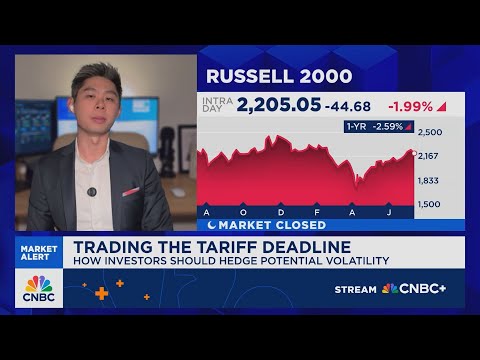
Market Volatility & Hedging Strategy - The market exhibits complacency with the VIX around 17%, presenting an opportunity for investors to hedge downside risk relatively inexpensively using out-of-the-money options [2][3] - Buying a 610 put on SPY or 6100 on SPX expiring in August would cost approximately 1% of the portfolio's value, offering significant downside protection [3][6] - Investors can offset the cost of downside protection by selling covered calls, potentially collecting close to 05% of the portfolio's value in the next 30 days [6][7] Trade War Scenarios & Options Plays - In a scenario where the EU and India don't make a deal and retaliate with tariffs, buying out-of-the-money put options is a simple way to hedge against this worst-case scenario [4][5] - If the trade deal deadline is extended, investors can roll out their options to September, continuously harvesting premium by selling upside calls and using the proceeds to buy downside put protection [8][9][10] - If countries capitulate and make a deal, the market is likely to react positively, and investors could consider selling downside puts and using the proceeds to fund buying upside calls for upside participation [11][12][13]
Mastercard's Vocalink Fined $16 Million for UK Compliance Failure
PYMNTS.com· 2025-07-09 20:51
Group 1 - The Bank of England has fined Vocalink, a Mastercard-owned company, $16.2 million for inadequate risk management and governance failures [1][2][3] - This penalty is significant as it marks the first time the Bank of England has imposed financial penalties on a financial market infrastructure company [2] - Vocalink's failure to comply with the Bank of England's governance requirements, identified in 2022, led to the fine [2][3] Group 2 - Vocalink was able to reduce its penalty from £20 million (approximately $27 million) by cooperating with the investigation and admitting to compliance failures early [4] - A spokesperson for Vocalink stated that improvements have been made since the issues were identified in 2020, and these historic issues did not impact the services provided to U.K. consumers and businesses [5] Group 3 - Recent research indicates a mismatch in how financial institutions approach real-time payments, with many enabling receipt but not instant sending capabilities [6][7] - This imbalance in real-time payment capabilities could limit the potential of advanced payment networks and may lead to financial institutions losing market share if they do not implement both sending and receiving functionalities [7]


WORLDLINE commits to robustness
Globenewswire· 2025-07-02 13:41
Core Insights - Worldline has initiated two external assessments to evaluate its risk management framework and ensure transparency regarding its High Brand Risk (HBR) portfolio [2][3] - The audit of the HBR portfolio is being conducted by Accuracy, while Oliver Wyman is tasked with assessing the overall compliance and risk framework [3][4] - The findings from these assessments will be communicated alongside the Group's earnings report on October 21, with preliminary results expected on July 30 [3][4] Group Initiatives - The initiative is led by Top Management and the Board of Directors, coordinated by Paul Hastings LLP, and overseen by a special ad hoc committee [5] - The commitment to compliance and risk prevention standards is emphasized by Worldline's leadership [5] Upcoming Events - The H1 2025 financial results will be announced on July 30, 2025 [6] Company Overview - Worldline generated a revenue of 4.6 billion euros in 2024 and aims to support sustainable economic growth through its digital payment solutions [7]

How to Invest $100,000
Bloomberg Television· 2025-06-30 13:11
Investment Strategy - Recommends a diversified portfolio to mitigate risk in a volatile economy [1] - Suggests including fixed income, equities, and a small amount of Bitcoin for speculative holdings [2] Asset Allocation - Advocates for a diversified portfolio with fixed income managed by a knowledgeable manager [2] - Proposes a small allocation to Bitcoin for speculative purposes [2] Market Outlook - Expects equity markets to remain solid, albeit with some volatility [2]

Hippo (HIPO) 2025 Investor Day Transcript
2025-06-12 14:00
Summary of Hippo (HIPO) 2025 Investor Day Company Overview - **Company**: Hippo Holdings Group - **Event**: 2025 Investor Day held on June 12, 2025 - **Key Speakers**: Andrea Collins (CMO), Rick McAthron (CEO), Stuart Ellis (Chief Strategy Officer), Torben Ostergard (CEO of Spinnaker), Guy Zeltzer (CFO), Jesse Wilmot (CFO and COO of Spinnaker) Core Industry Insights - **Industry**: Insurance, specifically focusing on home insurance and hybrid fronting platforms - **Market Position**: Hippo is positioned as a tech-enabled insurance platform with a focus on underwriting and risk management Key Financial Highlights - **Previous Targets**: In 2022, Hippo set aggressive targets to achieve cash flow positivity and increase top-line revenue by over 3.5 times by the end of 2024 - **Current Performance**: Surpassed previous financial targets, with revenue guidance raised from $420-$450 million to $465-$475 million for the current fiscal year [12][13] - **Adjusted EBITDA Improvement**: Transitioned from a loss of $55 million in Q3 2022 to a positive adjusted EBITDA of $9 million, driven by improvements in underwriting profit and operational efficiency [11][14] Strategic Initiatives - **Business Transformation**: Shifted from a monoline homeowners company to an integrated platform with diversified lines of business, including casualty and new construction [30] - **Hybrid Fronting Platform**: Spinnaker is highlighted as a leading hybrid fronting platform, with a focus on geographic and product line diversification to reduce earnings volatility [33][34] - **Partnership with Baldwin Group**: The partnership is expected to triple access to builders and enhance the Hippo Home Insurance program, focusing on builder-sourced business [46][47] Risk Management and Underwriting - **Underwriting Improvements**: Achieved a cumulative rate increase of 82% through 173 new rate filings, significantly lowering the loss ratios from 34% to 19% for catastrophic risks and from 73% to 56% for non-catastrophic risks [18][22] - **Risk Management Strategy**: Emphasizes a disciplined approach to underwriting, focusing on positive expected loss ratios and utilizing data analytics for decision-making [39][90] Technology and Operational Efficiency - **Technology Investments**: Significant investments in technology to automate onboarding processes and improve operational efficiency, enhancing the ability to manage risk and underwriting [95][96] - **Operational Excellence**: A dedicated team focuses on streamlining workflows and processes to ensure scalability and favorable results [42][92] Future Outlook - **Financial Targets for 2028**: Aiming for $2 billion in gross written premium, over $125 million in adjusted net income, and more than 18% return on equity [45] - **Market Growth**: The MGA market is projected to grow, with Hippo well-positioned to capitalize on this growth through its hybrid fronting model [72] Additional Insights - **New Construction Focus**: Emphasizing the importance of new construction in underwriting, as it generally presents lower risk compared to older homes [63][64] - **Value Chain Benefits**: The partnership with Baldwin is expected to create a more frictionless experience for builders and customers, enhancing overall outcomes [68] This summary encapsulates the key points discussed during Hippo's 2025 Investor Day, highlighting the company's strategic direction, financial performance, and market positioning within the insurance industry.

CME Group (CME) Conference Transcript
2025-06-05 18:30
CME Group Conference Summary Company Overview - **Company**: CME Group (CME) - **Industry**: Futures Exchange Key Points Industry Performance - CME Group has experienced strong trading volumes, with a record year in 2024 and a record month in May 2025 [3][4] - Open interest has significantly increased, indicating robust market activity [3] Macro Economic Concerns - There are significant macroeconomic risks, including geopolitical tensions in the Middle East and Eastern Europe, which could impact market stability [4][5] - The U.S. faces a substantial debt of $37 trillion and a $2 trillion annual deficit, raising concerns about future economic conditions [6][40] Retail Trading Dynamics - Retail trading is evolving, with a notable shift from cash equities to options and now to futures, driven by technological advancements [8][9] - The sophistication of retail traders has increased, leading to a more stable participation in the markets [10][14] - Event contracts are gaining popularity among retail participants, but CME needs to target the right audience for these products to succeed [16][17] International Growth - CME's average daily volume (ADV) overseas has grown by 19% year-over-year, driven by both macroeconomic factors and internal initiatives [19][20] - The company has expanded its sales force significantly to enhance international outreach and education about its products [20] Crypto Market Position - CME is recognized as a leading player in the crypto derivatives market, with a cautious but optimistic outlook on the future of cryptocurrencies [22][25] - The importance of stablecoins and their potential to enhance the crypto market's efficiency is emphasized [26][33] Competitive Landscape - CME remains vigilant about competition, particularly in the interest rate complex, where new challengers have emerged [34][36] - The company has achieved significant efficiencies in its operations, saving clients $60 billion daily across various asset classes [36][40] Mergers and Acquisitions (M&A) - CME is open to M&A opportunities but emphasizes the need for strategic alignment with user benefits [42][44] - The company has successfully integrated past acquisitions, enhancing its market position [42] Leadership and Succession - The current CEO, Terry Duffy, is focused on ensuring a smooth succession plan for the future leadership of CME [46][49] Additional Insights - The integration of technology and the rise of retail trading are reshaping the financial services landscape, with implications for how CME operates and competes [10][12] - The potential for marrying spot and derivatives markets in crypto is still under consideration, reflecting the evolving nature of these markets [28][30]
