东坡文化

Search documents
沉浸式夜游“遇见黄州 从此东坡”
Huan Qiu Wang· 2025-10-09 03:46
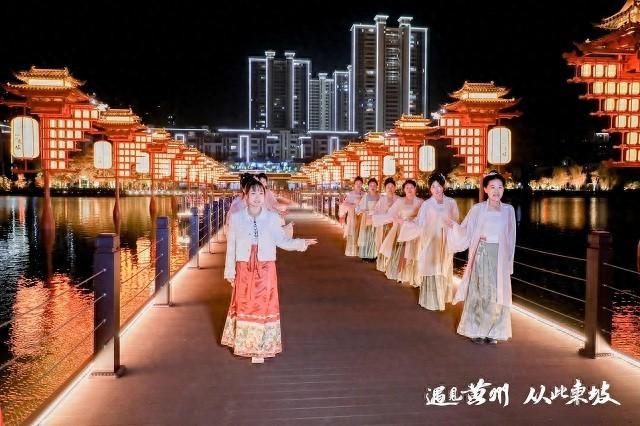
Core Insights - The "From Now On Dongpo" immersive night tour project, a collaboration between Dongpo Cultural Tourism and China Youth Travel Service, was launched on October 1 at Yiai Lake, highlighting the legendary life of Su Shi through cultural storytelling and advanced technology [1][3]. Group 1: Project Overview - The night tour project is a result of Huanggang's deep exploration and innovative expression of Dongpo culture, aiming to create a cultural IP for the city and promote the integration of cultural research and tourism development [3]. - The project features an immersive 4-kilometer tour route with eight core scenes, each representing a vivid story from Dongpo's life, including "Dreaming Back to the Song Dynasty" and "The Lonely Sandbank" [5]. Group 2: Technological Innovations - The project employs cutting-edge technologies such as the longest water light array dock in the country, a fog curtain bamboo forest, and retractable mechanical scrolls to enhance the immersive experience [5]. - A 16-meter diameter "moon" installation is designed to evoke the romantic essence of "Sharing the Moonlight Across a Thousand Miles," fully recreating Su Shi's spiritual world [5]. Group 3: Broader Cultural Experience - In addition to the night tour, the "Dongpo Market" will open during the National Day holiday, allowing visitors to experience Song Dynasty market life, while the musical "The Great River Flows East" will be performed, creating a comprehensive cultural tourism experience [7]. - The night tour serves as a benchmark product for the renovation of Yiai Lake Park and aims to establish a closed-loop cultural tourism route, positioning Huanggang as a premier destination for global Su Dongpo culture enthusiasts [7].

音乐剧《心安东坡》正式开排
Hai Nan Ri Bao· 2025-09-18 02:02
Group 1 - The musical "Heart of Su Dongpo" officially began rehearsals as a key project for the third China (Hainan) Su Dongpo Cultural Tourism Conference [2] - The premiere is scheduled for November 8 at the Fengqing Town of Coffee Culture in Chengmai, with a subsequent tour at the Hainan Provincial Song and Dance Theatre on December 18-19 [2] - The production aims to promote Su Dongpo culture and showcase the integration of culture and tourism in Hainan [2] Group 2 - The total director Zhao Jingsheng outlined the rehearsal plan, emphasizing the importance of script refinement, music creation, and stage rehearsal [2] - Key actors shared their insights on character development, with the actor portraying Su Shi drawing inspiration from Su Shi's poetry and experiences [3] - The actress playing Wang Fu highlighted her character's role as both a supportive wife and a spiritual confidante, aiming to convey deep emotional connections through her performance [3]
以沉浸式体验焕新海南文旅消费图景
Hai Nan Ri Bao· 2025-08-20 01:07
Core Insights - The immersive performance "The God of Dongpo" represents a significant attempt to revitalize cultural tourism in Hainan, addressing issues of homogenization and shallow experiences in the local tourism industry [2][3][4] - The performance has successfully transformed the cultural experience by integrating modern technology and artistic expressions, appealing particularly to younger audiences [3][4][9] Industry Overview - Hainan's cultural tourism sector faces challenges such as a lack of diverse experiences and reliance on traditional offerings like beach entertainment and seafood dining [2] - The region has rich cultural resources, including Dongpo culture, Li and Miao cultures, and marine culture, but many attractions still operate on a superficial sightseeing model [2][4] Performance Impact - "The God of Dongpo" has extended the average visitor stay in the Dongpo Cultural Tourism Area from 1.2 hours to 3.5 hours, indicating a positive impact on visitor engagement [4][5] - The performance has led to a 27% increase in occupancy rates for nearby accommodations, showcasing its economic benefits [4] Cultural Integration - The performance serves as a model for integrating cultural heritage with tourism, moving from a ticket-based economy to a comprehensive experience economy [4][9] - It has created a platform for local cultural co-creation, involving local artists and students in performances, thus enhancing community engagement [4][5] Future Development - The strategy for Hainan's cultural tourism includes expanding immersive experiences, leveraging technology for cultural expression, and fostering cross-industry collaborations [6][8][9] - Plans involve developing new cultural experiences, such as food experiences and interactive installations, to deepen visitor engagement with Dongpo culture [7][8]
一个自称俄罗斯自然科学院院士的东坡推广者
Zhong Guo Qing Nian Bao· 2025-08-19 21:24
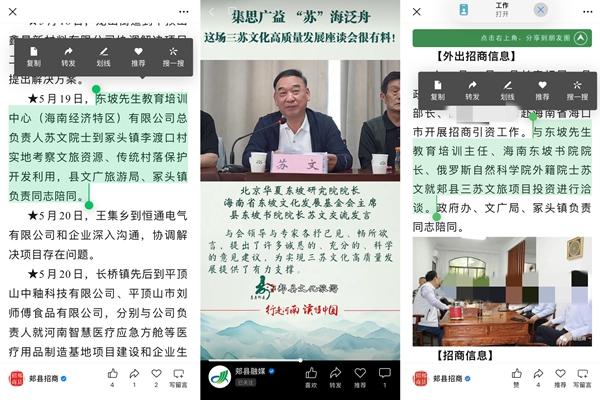
Core Viewpoint - The article discusses the questionable credentials and activities of Su Wen, who has claimed multiple prestigious titles, including "Foreign Academician of the Russian Academy of Natural Sciences," and his involvement in a failed investment project in Jiachuan County, Henan Province, which was supposed to be worth 3.3 billion yuan [5][15][20]. Group 1: Su Wen's Credentials - Su Wen has claimed various titles, including "Foreign Academician of the Russian Academy of Natural Sciences," but investigations reveal inconsistencies regarding the legitimacy of these claims [6][11][12]. - The Russian Academy of Natural Sciences (RAE) has no record of Su Wen as a member, and there are allegations that the title can be purchased for a fee [10][11]. - Su Wen's involvement in local events and projects has been significant, yet his credentials remain unverified, raising concerns about his influence and the authenticity of his claims [12][19][30]. Group 2: Investment Project in Jiachuan County - In April 2022, Su Wen signed a framework agreement to invest 3.3 billion yuan in the "Dongpo Cultural Project," which has since been declared void due to lack of progress [15][20]. - The Jiachuan County government acknowledged shortcomings in verifying Su Wen's credentials and the project's feasibility, which negatively impacted the local business environment [5][20][31]. - The agreement was set to automatically terminate in April 2024 if no substantial progress was made, which ultimately occurred [20][21]. Group 3: Local Government Response - Jiachuan County has initiated a review of all entities related to the Dongpo culture to prevent similar issues in the future [31]. - The county's officials have stated that no financial loss occurred due to the failed project, and they are taking steps to improve their investment verification processes [23][31]. - The local government has also begun the process of deregistering the Dongpo Academy and related organizations associated with Su Wen [30][31].
眉山深化文旅融合提升打造“东坡故里·天府眉山”品牌矩阵 将三苏文化基因植入城市肌理
Si Chuan Ri Bao· 2025-08-11 07:29
Group 1 - The central urban work conference emphasizes the construction of a morally uplifting civilization city, the improvement of historical and cultural protection systems, and the enhancement of urban cultural soft power [1] - Meishan aims to become a pioneer in the deep integration of culture and tourism, embedding the San Su cultural genes into the city's fabric and enhancing the "Dongpo Hometown · Tianfu Meishan" brand matrix [1][5] - The San Su Temple has become a vibrant cultural hub, attracting numerous visitors and students, showcasing the enduring vitality of San Su culture in contemporary society [2][5] Group 2 - The San Su Temple serves as a cultural link, connecting people from various regions and fostering a sense of community among "Su fans" [5] - Meishan has established over 110 cultural streets, including San Su Avenue and Dongpo Avenue, creating a comprehensive cultural transmission system that integrates educational institutions and cultural landmarks [5] - The city promotes the Dongpo culture through various initiatives, including themed travel routes, cultural months, and modern expressions of Dongpo culture, contributing to the ongoing popularity of "Dongpo fever" [5]
《千古风流 不老东坡——东坡讲坛文集》发布
Hai Nan Ri Bao· 2025-07-29 01:07
Core Points - The publication of "Eternal Elegance, Timeless Su Shi - Collection of Dongpo Lectures" showcases the essence of 12 lectures held during the "Eternal Elegance, Timeless Su Shi - Su Shi Themed Cultural Relics Exhibition" [1] - The exhibition, organized by the Palace Museum and Hainan Provincial Department of Tourism, Culture, Radio, Film and Sports, will take place from February to June 2024, featuring 332 cultural relics from 63 institutions and attracting 920,000 visitors [1] - The book balances academic depth with accessibility, highlighting Su Shi's patriotism, life philosophy, and literary achievements, while creatively designed to appeal to modern readers [2] Group 1 - The book compiles the highlights of 12 lectures from a major exhibition on Su Shi, emphasizing the cultural significance of the event [1] - The exhibition is noted as the largest and highest quality themed around Su Shi in recent years, with a significant visitor turnout [1] - The book's design innovatively combines classical elegance with modern aesthetics, making it appealing to younger audiences [2] Group 2 - The launch event included interactive activities that allowed attendees to engage with Su Shi's poetry and cultural heritage [2] - The event featured a unique dialogue segment that symbolized the deep connection between the people of Hainan and Su Shi [2] - The publication aims to create a lasting cultural impact by preserving the essence of the lectures in written form [1][2]
“东坡行旅”,一条流动的文明长廊
Ren Min Ri Bao· 2025-07-07 22:28
Core Viewpoint - The article discusses the establishment of the "Dongpo Journey - Chinese Cultural Relics Thematic Trail," which aims to connect various historical sites related to Su Dongpo, a prominent Chinese cultural figure, to enhance cultural tourism and storytelling in China [2][5]. Summary by Sections Su Dongpo's Life and Influence - Su Dongpo, born in Meishan, had a significant impact on various cities throughout his life, producing numerous poems and leaving behind many historical sites [3][4]. - His life can be divided into six stages, with each city representing a different theme that reflects his personal and philosophical development [3]. Key Locations and Themes - In Meishan, the focus is on his early life and education, highlighting the themes of family values and youthful ambition [3]. - Huanggang is significant for a major ideological transformation in Su Dongpo's life, where he found solace in Zen Buddhism and produced notable literary works [4]. - Hangzhou showcases his governance and contributions to local culture, particularly through his famous poetry and the management of West Lake [4]. - In Danzhou, Su Dongpo's influence on education and local culture is emphasized, showcasing his role in promoting learning and moral values [4]. Thematic Trail Development - The thematic trail aims to create a systematic interpretation of cultural relics, connecting cities and enhancing their unique characteristics while promoting lesser-known locations [5][6]. - The project emphasizes the importance of archaeological research and the protection of cultural relics to ensure the historical narrative is preserved [5][6]. - A unified branding system for the "Dongpo Journey" is proposed to facilitate a cohesive cultural experience across different cities [6]. Cultural and Tourism Integration - The initiative seeks to integrate resources from various historical sites into a comprehensive tourism experience, enhancing transportation and service facilities to meet visitor needs [6]. - The concept of a large scenic area is introduced, aiming to create immersive experiences that connect visitors with Su Dongpo's legacy [6].
全省首部东坡文化专题法规施行
Hai Nan Ri Bao· 2025-06-28 01:33
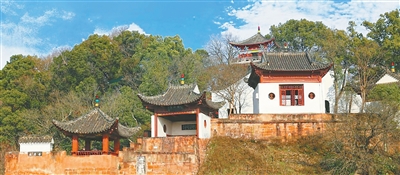
Core Viewpoint - The implementation of the "Regulations on the Protection and Utilization of Dongpo Cultural Resources in Danzhou City" aims to strengthen the protection and utilization of Dongpo culture, marking the first specialized regulation of its kind in the province [1][2] Group 1: Regulatory Framework - The regulations consist of 21 articles and establish a three-tiered mechanism involving the city, departments, and towns (villages) for effective management and implementation [1] - The Danzhou Municipal Government leads the initiative, with the tourism and cultural department overseeing management, supported by multiple departments including development and reform, and natural resources [1] Group 2: Protection Measures - A threefold defense system is constructed for the protection of Dongpo cultural resources, including planning, a catalog, and safety measures [1] - The tourism and cultural department will collaborate with various departments to create a protection and utilization plan, ensuring scientific validity through public consultation and expert review [1] - A city-level protection catalog will be developed to classify and preemptively protect confirmed and potential resources [1] Group 3: Innovative Initiatives - The regulations encourage social capital participation and establish a diversified investment mechanism to promote Dongpo culture [2] - There is a focus on integrating Dongpo culture with local cultural elements like Danzhou Tiaosheng to create distinctive cultural tourism brands and develop cultural products [2] - A digital display system and sharing platform will be established for the digital presentation of cultural resources [2] Group 4: Implementation and Oversight - The Danzhou Municipal Bureau of Tourism and Culture will draft a specialized plan for the protection and utilization of Dongpo culture, detailing measures for orderly advancement [2] - A regular supervision and inspection mechanism will be established to ensure the effective execution of the regulations and to address any violations [2]
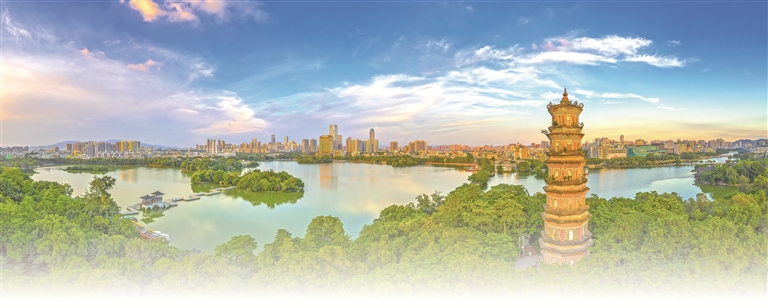
廉洁文化中国行丨城湖江岭 文韵悠悠
Zhong Yang Ji Wei Guo Jia Jian Wei Wang Zhan· 2025-06-27 00:30
Group 1: Cultural Significance of Huizhou - Huizhou is known for its rich cultural heritage, blending various cultural influences including Dongpo culture, Hakka culture, and revolutionary red culture, making it a historical cultural city with a 5000-year civilization history [6][10] - The city is famous for its scenic West Lake, which is often compared to Hangzhou's West Lake, and has been shaped by the contributions of Su Dongpo, who lived there during his exile [10][11] - Su Dongpo's philosophies and literary contributions during his stay in Huizhou have had a lasting impact on the local culture, promoting values of integrity and dedication to the people [11][12] Group 2: Historical Figures and Their Legacy - General Ye Ting, a significant figure in Chinese history, was born in Huizhou and played a crucial role in the Chinese revolutionary movement, leading the first regular armed force directly controlled by the Communist Party [14][15] - The Ye Ting Memorial Park, which includes his childhood home and various historical buildings, serves as a testament to his contributions and the revolutionary spirit of the area [14][15] - The local architecture, such as the unique Hakka round houses, reflects the cultural and historical narratives of the region, showcasing the resilience and aspirations of the Hakka people [16][18] Group 3: Architectural Heritage - The architectural style of Huizhou, particularly the Hakka round houses, is characterized by defensive features and a symmetrical layout, representing the cultural identity and historical experiences of the Hakka community [18] - The construction of these houses often symbolizes the connection to homeland and the enduring spirit of the diaspora, as seen in the story of the "Biyun Tower" built by a Malaysian Hakka leader [16][18] - The intricate carvings and designs in these buildings not only serve aesthetic purposes but also convey deeper meanings related to family, community, and cultural heritage [17][18]