
房地产转型

Search documents
舍弃旧能源、拥抱新能源,“地产+新能源”能否拯救卧龙地产?
Bei Jing Shang Bao· 2025-05-11 06:46
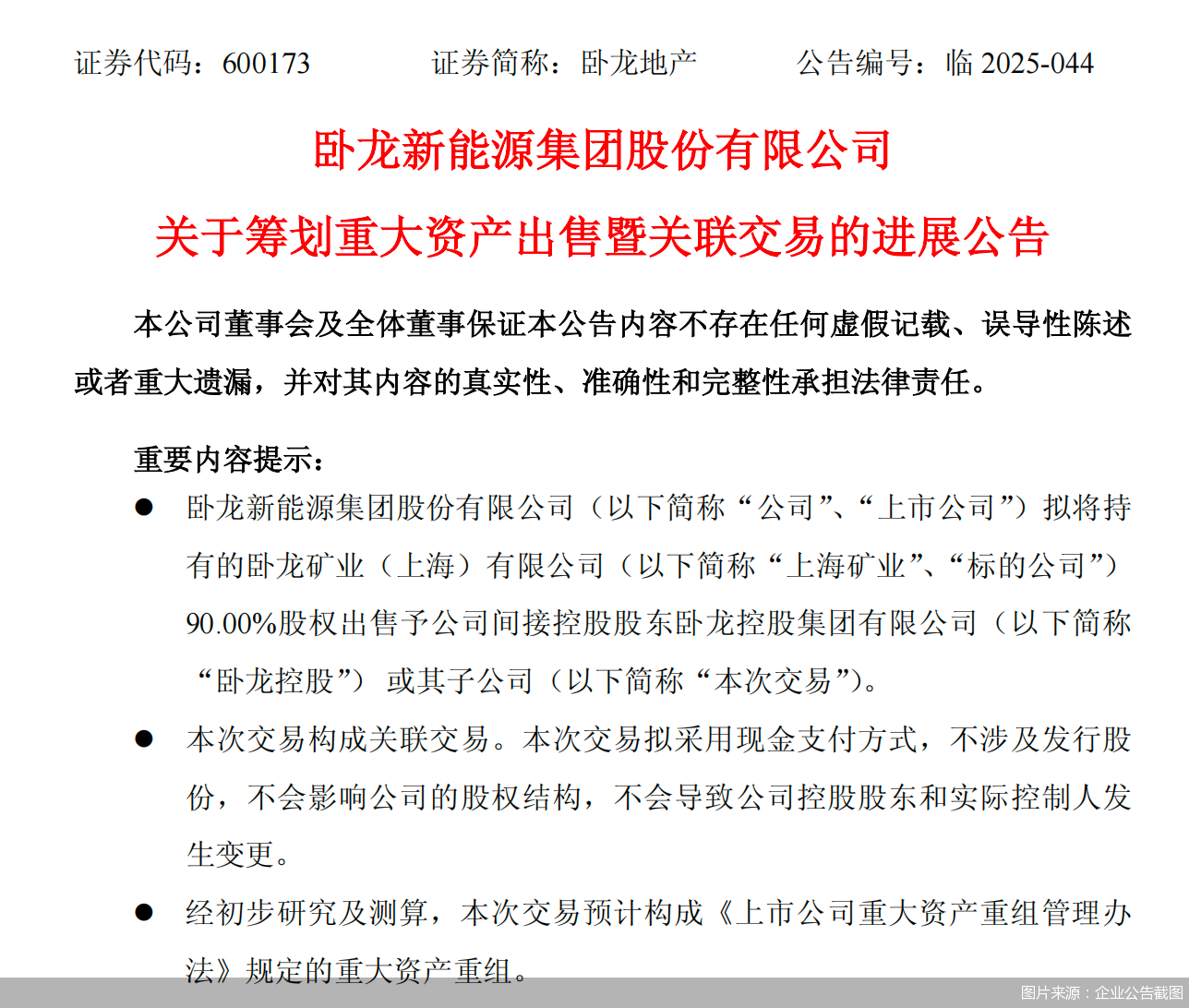
Core Viewpoint - Wolong Real Estate is undergoing a significant transformation by divesting its mining business and shifting focus towards the renewable energy sector, aiming to establish a dual business model of "real estate + renewable energy" [1][10]. Group 1: Divestment of Mining Business - On May 10, Wolong Real Estate announced plans to sell 90% of its stake in Shanghai Mining to its indirect controlling shareholder, Wolong Holdings, marking a complete exit from the mining trade [3][4]. - In 2024, Wolong Real Estate's total revenue was reported at 3.611 billion yuan, with the mining business contributing 2.477 billion yuan, accounting for 68.6% of total revenue [3][4]. - The decision to divest comes amid a decline in the revenue of the mining business, which fell from 3.599 billion yuan in 2022 to 2.477 billion yuan in 2024 [4][6]. Group 2: Shift to Renewable Energy - Concurrently, Wolong Real Estate has acquired several companies in the renewable energy sector, including Zhejiang Long Energy and Zhejiang Wolong Energy Storage, and will change its name to "Wolong New Energy" on May 15 [10][12]. - The acquired companies include one profitable entity, Long Energy, which reported a net profit of approximately 105 million yuan in 2024, while the others reported losses [12]. - The strategic shift towards renewable energy is seen as a proactive response to industry cycles and aims to capture growth opportunities in the context of global energy transition and carbon neutrality goals [12][13]. Group 3: Industry Context and Challenges - The renewable energy sector is experiencing high growth, with global photovoltaic installations increasing by over 30% in 2024, and battery shipments growing by 25% [13]. - However, the industry is also facing challenges, with some companies experiencing profit declines, highlighting the competitive landscape and the need for effective resource integration and management [13][16]. - The trend of real estate companies diversifying into other sectors, such as renewable energy, is becoming more common as firms seek to mitigate risks associated with the traditional real estate market [14][15].


地产大事件丨速览一周地产行业要闻(4.27—4.30)
Cai Jing Wang· 2025-04-30 09:29
Company Changes - Gree Real Estate has completed its business name change to Zhuhai Zhuhai Mian Group Co., Ltd, with the stock abbreviation changing from "Gree Real Estate" to "Mian Group" while the stock code remains unchanged. This change is due to the completion of a significant asset swap, with Zhuhai Duty-Free Enterprises Group Co., Ltd becoming the controlling subsidiary, marking a strategic shift towards a focus on duty-free business [1] Financial Performance - China State Construction reported a first-quarter revenue of 555.3 billion yuan, reflecting a year-on-year increase of 1.1%. The company also signed new contracts worth 1.2702 trillion yuan, up 6.9% year-on-year, and achieved a net profit attributable to shareholders of 15.01 billion yuan, a slight increase of 0.6% compared to the previous year [2] Real Estate Market - In Beijing, two land parcels were successfully sold for approximately 13.376 billion yuan. A consortium including China State Construction, Jinmao, Yuexiu, and Chaoyang City Development acquired a project in Chaoyang District for 12.6 billion yuan, with a floor price of 54,500 yuan per square meter. Additionally, China Railway Construction secured a land parcel in Tongzhou District for 775.52 million yuan, with a premium rate of 21.94% and a floor price of 35,800 yuan per square meter [4] Policy Developments - The Guangdong Provincial Department of Housing and Urban-Rural Development announced plans to explore a "people, housing, land, and money" factor linkage mechanism to enhance urban renewal and village renovation efforts. This initiative aims to combine urban renewal with employment stability and market expectations, promoting a new model for real estate development [5] Education and Housing - Guangzhou Nansha District has introduced a policy allowing parents or guardians who purchase new residential properties in the area to secure public school placements for their children. This policy, effective from January 10, 2025, is the first of its kind among first-tier cities, linking home purchases directly to educational opportunities [6]