
Overcapacity

Search documents
Eastman(EMN) - 2025 Q2 - Earnings Call Transcript
2025-08-01 13:00
Financial Data and Key Metrics Changes - The company is targeting a reduction in capital spending for 2026, indicating a focus on cost savings in 2025 as well [6][14] - There is an expected mid-single-digit drop in demand for the second half of the year, influenced by trade dynamics and seasonality [12][15] - The company anticipates a utilization headwind of approximately $75 million to $100 million in the second half of the year due to inventory reduction efforts [13][16] Business Line Data and Key Metrics Changes - The Chemical Intermediates segment is expected to improve by over $30 million, while the Specialty and Fibers segments are projected to decline by a similar amount [70] - The AFP business saw a 4% year-over-year price increase primarily driven by cost pass-through contracts [54] - The Fibers business is facing a $20 million headwind due to tariffs and a $20 million asset utilization headwind, alongside higher energy costs [95][96] Market Data and Key Metrics Changes - The automotive market is expected to see a low single-digit decline in the back half of the year, with challenges stemming from tariff impacts and consumer behavior [50][51] - The textile market has slowed down significantly due to tariffs, impacting demand and leading to a cautious approach from customers [57][58] - The company is experiencing accelerated demand in certain areas, particularly in mechanical recycling for food-grade packaging applications [35] Company Strategy and Development Direction - The company is focusing on cash generation and cost management in response to current market uncertainties [13][16] - There is an emphasis on improving the structural strength of the business, particularly in the chemical and materials segments [21][22] - The company is exploring debottlenecking investments to enhance operational efficiency and profitability in its methanol system plant [30][31] Management's Comments on Operating Environment and Future Outlook - Management highlighted the chaotic nature of the current operating environment, driven by trade dynamics and consumer caution [12][14] - There is a belief that stability may return in 2026, contingent on resolving trade issues and improving economic conditions [15][16] - The management remains cautious about predicting demand due to ongoing uncertainties in the market [40][81] Other Important Information - The company is targeting additional cost cuts of $75 million to $100 million, which will be detailed in plans for the second half of the year [103] - The methanol system plant is performing well, with expectations for increased profitability as operational efficiencies are realized [30][31] Q&A Session Summary Question: Can you help us understand how representative the second half should be when thinking about trough earnings levels? - Management indicated that the second half is heavily impacted by trade situations, making it a poor measure of overall company performance [7][10] Question: How far along is the investment in the Metapasys unit, and what gives confidence in profitability? - Management discussed ongoing challenges in the chemical and materials business but expressed optimism about improving profitability through strategic investments [20][24] Question: What triggered the change in customer dialogue in July? - Management noted that the trade pause allowed customers to reassess their inventory and demand, leading to a more cautious approach [41][42] Question: Can you provide more color on the weakness in the automotive end markets? - Management confirmed that while the aftermarket performed well, the interlayer business faced challenges due to production moderation in response to tariffs [49] Question: What is the outlook for the Fibers business next year? - Management indicated that the Fibers business is facing headwinds this year but expects stabilization and potential recovery in the following year [94][100]

EU Defends US Trade Deal in Face of Criticism
Bloomberg Television· 2025-07-30 18:37
Trade Agreement & Tariffs - The European Union initially sought zero tariffs but settled for a 15% tariff, indicating a compromise [1] - A 15% tariff on Mercedes could cost German auto companies billions annually [3] - Tariffs are considered a tax on American consumers and businesses [2] Geopolitical Implications - The trade deal is seen as a cave by the European Union to the United States, especially considering their initial stance of zero tariffs [6] - The deal relies on European military spending being directed towards American defense, potentially impacting German defense companies [5] - The US and Europe share concerns about overcapacity, veiled as a reference to China [4] Economic Impact & Market Sentiment - European markets had already priced in a tariff between 10% and 15%, suggesting the 15% deal was viewed as a win [8] - The European economy lacks the fiscal strength and national champions compared to the US and China, limiting its ability to retaliate with matching tariffs [7] - A previous Japan deal involved private corporations funding businesses in the US, raising questions about a similar model for Europe with companies like Siemens [9] Future Outlook - The focus shifts to the relationship between Canada, Mexico, and China, with expectations that US-China talks continuing in September would be considered a positive outcome [12][13] - Japan committed $550 billion on top of existing expenditures to the United States, primarily through loans, the specifics of which remain unclear [10]


The Chinese have kept the yuan weak to deal with U.S. tariffs, says Michelle Caruso-Cabrera
CNBC Television· 2025-07-25 11:29
Trade Agreements and Tariffs - The markets interpret recent trade announcements with Japan and Indonesia as a sign of reduced uncertainty, with tariffs potentially higher but not catastrophic [2] - The expectation is that the US-China trade deadline will be extended, continuing the detente [6] - The EU's meeting with China was described as tense, highlighting concerns about China's overcapacity threatening European industrialization [8][9] - The EU has imposed tariffs as high as 45% on Chinese EVs [13] Currency Impact on Trade - Currency devaluation can offset the inflationary impact of tariffs, as seen with the Chinese yuan against the euro [14] - A weaker dollar, contrary to expectations, has not led to significant inflation [16] Venezuela and Oil Markets - The US administration is reportedly allowing Chevron to resume drilling in Venezuela [18] - This decision aims to increase oil supply by a million barrels, providing leverage regarding Iran and preventing oil price increases [19] - The move is also seen as potentially benefiting the Venezuelan opposition in the future [20]

中国太阳能行业 - 价格监管支撑多晶硅及硅片价格上涨- China Solar Industry _Prices regulation support polysilicon..._
2025-07-21 14:26
Summary of the Conference Call on the China Solar Industry Industry Overview - The conference call focused on the **China Solar Industry**, particularly the pricing dynamics of polysilicon and wafers, which are critical components in solar panel manufacturing [2][3]. Key Points and Arguments 1. **Price Increases**: - Mono-grade polysilicon prices rose by **12.4% week-over-week** to **Rmb 41.7/kg**. - N-type wafer prices increased by **45% week-over-week**, with prices reaching **Rmb 1.45/1.65/1.93 per piece** for M10/G12R/G12N [2]. - The price hikes are attributed to compliance with the **China NDRC's regulation** that prohibits selling below total costs, including taxes [2]. 2. **Cost Analysis**: - The estimated industry average cost for polysilicon is **Rmb 43.874/kg**, while Tier 1 companies have a cost of approximately **Rmb 41.8/kg**, aligning closely with current market prices [2]. - The average cost for wafers is also consistent with the current prices, indicating a tight cost structure in the industry [2]. 3. **Demand Dynamics**: - Despite the price increases, actual trading volumes are expected to be limited due to sluggish demand. The market's price sensitivity is low, suggesting that demand may not significantly decline despite higher costs [3]. - There is a concern that elevated prices could dampen demand further, but the current market conditions indicate minimal impact on demand levels [3]. 4. **Regulatory Environment**: - The call highlighted the need for more stringent regulations to address overcapacity in the solar industry. This includes raising technology and energy emissions standards [4]. - The government may enhance oversight on pricing and utilization rates, potentially imposing penalties for non-compliance [3]. 5. **Market Sentiment and Future Outlook**: - Although fundamental pressures are expected to persist into the second half of 2025 due to weaker demand, there is optimism for improved market sentiment and better supply-demand dynamics in the long term [4]. Risks and Opportunities - **Downside Risks**: - Slower-than-expected growth in installed domestic renewable energy capacity. - Larger-than-anticipated tariff cuts for renewable energy projects. - Increased competition from alternative power sources due to future power reforms [6]. - **Upside Risks**: - Faster-than-expected growth in installed renewable energy capacity. - Smaller-than-expected tariff cuts for renewable energy projects. - Potential market share gains for solar energy compared to other power resources [7]. Additional Important Information - The report was prepared by **UBS Securities Asia Limited**, and analysts involved include Yishu Yan, Anna Yuan, and Ken Liu [5]. - The document emphasizes the importance of considering various factors in investment decisions, including potential conflicts of interest and the need for independent financial advice [5][10]. This summary encapsulates the critical insights from the conference call regarding the current state and future outlook of the China solar industry, highlighting both challenges and opportunities for investors.

摩根士丹利:中国股票策略-反内卷信息提振 A 股市场情绪
摩根· 2025-07-11 02:22
Investment Rating - The report indicates a preference for A-shares over offshore markets due to their lagging performance year-to-date and more reasonable valuations compared to offshore markets [12]. Core Insights - Investor sentiment for A-shares has improved, with the weighted Morgan Stanley A-share Sentiment Indicator (MSASI) rising to 78% and the simple MSASI to 65% [2][6]. - The Chinese government has intensified its anti-involution message to address overcapacity issues in sectors like solar, lithium batteries, new energy vehicles, and e-commerce [4]. - Despite the positive sentiment, near-term volatility is expected to rise, and the report cautions against a beta-focused strategy in the offshore market [12]. Summary by Sections Investor Sentiment - A-share investor sentiment improved with the weighted MSASI increasing by 7 percentage points to 78% and the simple MSASI rising by 8 percentage points to 65% compared to the previous cutoff date [2]. - Average daily turnover for ChiNext and A-shares decreased by 11% and 7% respectively, while equity futures and Northbound turnover increased by 7% and 9% [2]. Market Inflows - Southbound markets experienced net inflows of US$2.7 billion from July 2 to July 9, with year-to-date and month-to-date net inflows reaching US$95.8 billion and US$0.5 billion respectively [3]. Economic Indicators - The Producer Price Index (PPI) showed a deflation of -0.4% month-over-month in June, driven by weak construction activities and tariff impacts, while the Consumer Price Index (CPI) rose to 0.1% year-over-year from -0.1% in May [5]. Policy Implications - The report emphasizes the need for a tailored approach to the anti-involution initiative, as different sectors have varying competitive landscapes, ESG considerations, and market sizes [4]. - The implementation of policies to rebalance and reflation the economy remains challenging due to institutional inertia [5].
X @Bloomberg
Bloomberg· 2025-07-10 04:49
Industry Overview - China's solar industry is facing overcapacity and intense competition [1] - Measures to reduce output and establish a price floor have not yet stopped losses [1]
瑞银:中国太阳能行业_加大力度应对内卷竞争
瑞银· 2025-07-07 15:44
Investment Rating - The report does not explicitly state an investment rating for the solar industry, but it suggests that polysilicon and module names could exhibit the highest potential upside within the sector due to inexpensive valuation and limited downside risks [4]. Core Insights - The solar glass manufacturers in China are beginning to cut production due to persistently weakening demand, with estimates suggesting a reasonable production cut of 10-20%, leading to an effective monthly production of around 45-50GW [2]. - The government is expected to push for capacity cuts across the solar supply chain, starting with the polysilicon segment, and discussions are ongoing regarding acquiring smaller players [3]. - There is a stronger commitment from the government to tackle overcapacity, with expectations of more policy support to phase out obsolete capacity and deter price competition, despite lingering fundamental pressures in the second half of 2025 [4]. Summary by Sections Production and Demand - Solar glass manufacturers are cutting production due to weak demand, with a potential cut of 10-20% rather than the 30% estimated by some media [2]. - The effective production capacity could be around 45-50GW monthly, with the possibility of resuming operations once prices rebound [2]. Government Policies - The government is anticipated to implement capacity cuts in the solar supply chain, particularly in the polysilicon segment, and is discussing measures to acquire smaller players [3]. - There is speculation about policies to curb excess capacity, with a belief that the government is determined to reduce involution competition [4]. Market Sentiment and Valuation - Despite expected fundamental pressures in the second half of 2025, market sentiment may improve in the long term due to better supply-demand dynamics [4]. - Polysilicon and module names are highlighted as having the highest potential upside within the sector, attributed to inexpensive valuations and limited downside risks [4].
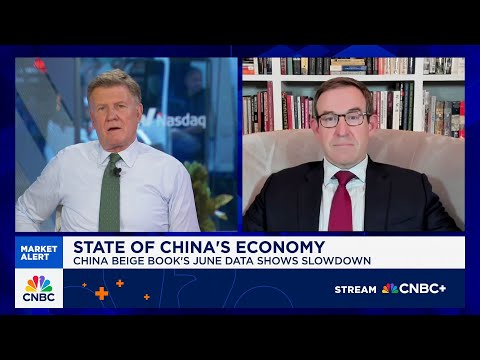
China Beige Book CEO: Saw a falloff 'in just about everything' in China's economy in June
CNBC Television· 2025-06-26 11:43
China's Economic Slowdown - China Beige Book data indicates a broad slowdown in China's economy, with declines in manufacturing, consumption, and bank borrowing [3] - May data initially appeared positive due to tariff reductions and consumer trade-in programs, but subsequent data revealed a fall-off [2][3] Beijing's Policy Stance - Beijing seems less concerned about the economic situation and is intervening less aggressively than before [4] - This reduced concern is attributed to Beijing's confidence in its leverage in trade discussions with the United States [4] - China is easing rates and engaging in fiscal stimulus, but not to the extent that would be expected in an extreme downside scenario [5][6] Trade War Dynamics - China is perceived to be able to withstand more economic pain compared to Western democracies [8] - China is using export controls, particularly on rare earth magnets, to demonstrate leverage against the United States [8] - China feels it has presented a strong front in the trade war, reducing the immediate need for aggressive economic measures [9] Consumption and Manufacturing - Claims of China transforming into a mega consumer powerhouse are viewed skeptically [10][11] - China's weak domestic demand leads to increased exports and potential dumping of products on global markets [13][14] - Overcapacity in various sectors, including cars and EVs, contributes to the pressure to export [17] Overcapacity and Export Strategy - China's economic model, characterized by weak domestic consumption and strong supply-side support, results in overcapacity being channeled to the global market [17] - This overcapacity can be used strategically to exert leverage on adversaries like the United States, particularly in critical minerals [16]
Daqo New Energy(DQ) - 2025 Q1 - Earnings Call Transcript
2025-04-29 16:47
Financial Data and Key Metrics Changes - In Q1 2025, revenues decreased to $123.9 million from $195.4 million in Q4 2024 and $415 million in Q1 2024, primarily due to a decrease in sales volume [17][18] - Gross loss was $81.5 million, compared to a gross loss of $65.3 million in Q4 2024 and a gross profit of $72 million in Q1 2024, resulting in a negative gross margin of 66% [18][21] - Net loss attributable to shareholders was $71.8 million, an improvement from a net loss of $180 million in Q4 2024, but down from a net income of $15.5 million in Q1 2024 [21][22] Business Line Data and Key Metrics Changes - The company operated at a reduced utilization rate of approximately 33% of nameplate capacity, with total production volume at 24,810 metric tons, slightly below guidance [9][10] - Polysilicon unit production costs increased by 11% sequentially to an average of $7.157 per kilogram, while cash costs increased by 5% to $5.31 per kilogram [11][12] Market Data and Key Metrics Changes - China's new solar PV installations reached 59.71 gigawatts in Q1 2025, reflecting a robust year-over-year growth of 30.5% [15] - Domestic polysilicon production volume was reported at 105,500 metric tons in March, with January and February below 100,000 metric tons [12][13] Company Strategy and Development Direction - The company aims to enhance its competitive edge by improving efficiency and optimizing cost structures through digital transformation and AI adoption [16] - The transition to a market-based pricing mechanism for renewable energy is expected to promote sustainable development in the industry [14][15] Management's Comments on Operating Environment and Future Outlook - Management noted that the solar PV industry is facing significant challenges due to overcapacity and low polysilicon prices, but believes that ongoing losses will lead to a healthier industry in the long term [9][15] - The company remains confident in its ability to weather the current market downturn and emerge as a leader in the industry [16] Other Important Information - As of March 31, 2025, the company had a cash balance of $792 million and no financial debt, providing ample liquidity [9][22] - The company expects total production volume in Q2 2025 to be in the range of 25,000 to 28,000 metric tons [12] Q&A Session Summary Question: When do you think overcapacity will be eliminated and which players might exit the market? - Management indicated that rebalancing of supply and demand will take longer than expected, with no companies completely exiting the market yet, but many are lowering utilization rates or undergoing temporary shutdowns [26][28] Question: What is the expected trend for industry utilization rates throughout the year? - Management expects the industry utilization rate to remain between 40% to 50% in the near term, with potential for slight increases depending on market conditions [30][32] Question: What is the strategy regarding ADR delisting risk? - Management acknowledged the risk of ADR delisting but considers it a low probability, while remaining vigilant and monitoring regulatory developments [40][42] Question: What is the outlook on cash costs for the subsequent quarters? - Management indicated that cash costs may remain similar to slightly lower in Q2 2025, depending on production levels, with current costs impacted by maintenance of facilities [45][50]

Daqo New Energy(DQ) - 2025 Q1 - Earnings Call Transcript
2025-04-29 13:02
Financial Data and Key Metrics Changes - In Q1 2025, revenues decreased to $123.9 million from $195.4 million in Q4 2024 and $415 million in Q1 2024, primarily due to a decrease in sales volume [17][18] - Gross loss was $81.5 million, compared to a gross loss of $65.3 million in Q4 2024 and a gross profit of $72 million in Q1 2024, resulting in a negative gross margin of 66% [18] - Net loss attributable to shareholders was $71.8 million, an improvement from a net loss of $180 million in Q4 2024 but a decline from net income of $15.5 million in Q1 2024 [20] Business Line Data and Key Metrics Changes - The company operated at a reduced utilization rate of approximately 33% of nameplate capacity, with total production volume at polysilicon facilities at 24,810 metric tons, slightly below guidance [11] - Polysilicon unit production costs increased by 11% sequentially to an average of $7.157 per kilogram, while cash costs increased by 5% to $5.31 per kilogram [12] Market Data and Key Metrics Changes - China's new solar PV installations reached 59.71 gigawatts in Q1 2025, reflecting a robust 30.5% year-over-year growth [15] - Domestic polysilicon production volume was reported at 105,500 metric tons in March, with lower production levels in January and February [12] Company Strategy and Development Direction - The company aims to enhance its competitive edge by improving efficiency and optimizing cost structures through digital transformation and AI adoption [16] - The transition to a market-based pricing mechanism for renewable energy is expected to promote sustainable development in the solar PV industry [14] Management's Comments on Operating Environment and Future Outlook - Management acknowledged significant challenges in the solar PV industry, including overcapacity and low polysilicon prices, but expressed confidence in the company's strong balance sheet and ability to navigate the downturn [9][10] - The company anticipates that ongoing losses will lead to the exit of less competitive players, ultimately resulting in a healthier industry [15] Other Important Information - The company maintains a strong liquidity position with a cash balance of $792 million and no financial debt as of March 31, 2025 [10] - The introduction of a market-based reform policy for new energy on-grid tariffs is expected to impact future electricity prices and revenue generation [13] Q&A Session Summary Question: When does the company expect overcapacity to be eliminated? - Management indicated that rebalancing of supply and demand will take longer than expected, with no companies completely exiting the market yet [27][28] Question: What is the expected trend for industry utilization rates? - The current industry utilization rate is between 40% to 50%, with expectations for gradual improvement but potential downside risks due to policy changes and external tensions [30][32] Question: What is the strategy regarding ADR delisting risk? - Management acknowledged the risk of ADR delisting but considers it a low probability, while monitoring market and regulatory developments closely [40][41] Question: What is the outlook on cash costs for subsequent quarters? - Cash costs are expected to remain similar to slightly lower in Q2 2025, depending on production levels, with current maintenance costs impacting the figures [44][49]