Interest Rates

Search documents
Bond Investors Embrace Maturity Risk in 2026
Investing· 2026-02-25 12:46
Core Insights - The bond market's risk appetite has increased in 2026 as investors become more confident in the economic outlook and interest rate trajectory [1] - A strategy favoring long-dated government securities has proven successful this year [1] Bond Market Performance - Long-dated Treasuries are leading the market with significant year-to-date gains, with the Vanguard LongTerm Corporate Bond ETF (VCLT) up 3.5% and the iShares 10–20 Year Treasury Bond ETF (TLH) up 2.8% [2] - The Vanguard Total Bond Market ETF (BND), representing the US investment-grade fixed income benchmark, has only gained 1.5% [2] - Bank loans (BKLN) have declined by 2.0% this year, primarily due to rising credit risk concerns, particularly in the software industry [2] Economic Context - The current market sentiment is influenced by expectations that inflation will remain manageable and that the Federal Reserve will maintain steady rates before potentially cutting them in June [3] - Economic growth is slowing, and hiring has downshifted, creating a favorable environment for increased risk in government bonds [3] Potential Risks - There are concerns that shifts in fiscal policy or the federal budget deficit could impact the current appetite for Treasuries [4]


Stock Market Today: Dow Jones, Nasdaq 100 Futures Rise After Trump's State Of The Union Address—Nvidia, HSBC, Workday In Focus - State Street SPDR S&P 500 ETF Trust (ARCA:SPY)
Benzinga· 2026-02-25 10:14
Market Overview - U.S. stock futures rose on Wednesday after a positive close on Tuesday, with all major benchmark indices showing gains [1] - The Dow Jones increased by 0.14%, S&P 500 by 0.16%, Nasdaq 100 by 0.20%, and Russell 2000 by 0.42% [3] Company Performance - Workday Inc. (NASDAQ: WDAY) saw a premarket decline of 9.51% despite reporting upbeat fourth-quarter earnings, as forward guidance fell below estimates [4] - HP Inc. (NYSE: HPQ) dropped 5.16% after issuing second-quarter GAAP EPS guidance below expectations [4] - HSBC Holdings PLC (NYSE: HSBC) rose 4.43% following a 6% increase in net interest income to $34.8 billion for 2025, while also cutting 10% of its U.S.-based debt capital [4] - Nvidia Corp. (NASDAQ: NVDA) was up 0.44% with analysts expecting earnings of $1.53 per share on revenue of $65.87 billion [4] - Shell PLC (SHEL) maintains a strong price trend across all time frames, supported by a solid value score [5] Sector Insights - Consumer discretionary, information technology, and industrials sectors led the S&P 500 higher, while energy and health care stocks trended lower [6] Analyst Insights - Professor Jeremy Siegel maintains an optimistic outlook for the U.S. economy and equity markets in 2026, citing strong underlying private demand despite a softer 1.4% fourth-quarter GDP report [7] - Siegel anticipates a market rotation favoring small caps, industrials, and globally exposed companies, viewing potential energy-driven volatility as a recalibration rather than a cycle-ending shock [8]


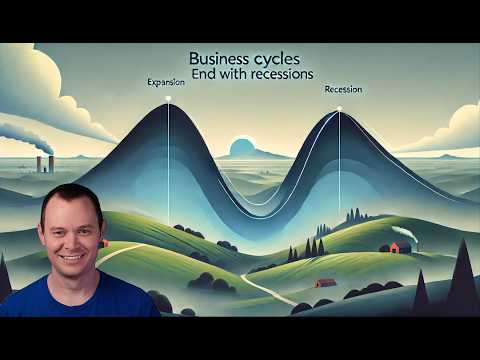
Business Cycles Ends With Recessions
Benjamin Cowen· 2026-02-25 03:28
Hey everyone and thanks for jumping back into the macroverse. Today we're going to talk about how business cycles end with recessions. If you guys like the content, make sure you subscribe to the channel, give the video a thumbs up, and check out bjamancow.com if you have any inquiries or if you want to reach out about any of the services that we offer. Let's go ahead and jump in. So, a couple of days ago, I released a video called visualizing the business cycle.And in that video, we showed some interesting ...
Chicago Fed's Goolsbee Throws Cold Water on Rate Cuts
Barrons· 2026-02-24 21:08
Core Insights - The Federal Reserve considers a three-percent inflation rate insufficient to warrant interest rate cuts, indicating a cautious approach to monetary policy [1] Group 1: Inflation and Interest Rates - A three-percent inflation rate is viewed as too high for the Federal Reserve, suggesting that the central bank is unlikely to lower interest rates in the near term [1] - The current inflation level does not meet the criteria for the Federal Reserve to justify a reduction in interest rates, reflecting ongoing concerns about economic stability [1]

Treasury Yields Just Fell by the Fastest Rate in 5 Months. What Comes Next?
Yahoo Finance· 2026-02-24 12:50
Group 1 - The relationship between stocks and bonds has shown unusual behavior, with stocks and bonds not moving in opposite directions as historically expected [1] - Since the beginning of 2023, the S&P 500 has consistently moved higher, while long-term Treasury yields have remained largely flat [1][2] - The recent rotation out of tech and growth stocks suggests that money is flowing into other areas of the equity market, particularly defensive, value, low-volatility, and small-cap stocks [2] Group 2 - The 10-year Treasury yield experienced a significant drop of approximately 25 basis points over a seven-day period, marking the sharpest decline since September [4] - Such sudden declines in Treasury yields typically indicate shifts in investor sentiment, which was also reflected in increased market volatility [5] - The decline in inflation from its 2022 peak has not fully aligned with the movements in Treasury yields, suggesting broader market dynamics at play [6][7]
Best CD rates today, February 23, 2026 (Lock in up to 4% APY)
Yahoo Finance· 2026-02-23 11:00
Core Insights - The Federal Reserve has reduced its target interest rate three times in 2025, impacting deposit account rates and presenting a potential opportunity to secure high certificate of deposit (CD) rates before they decrease further [1]. Group 1: Current CD Rates - The highest CD rate available today is 4% APY, offered by Marcus by Goldman Sachs for a 1-year CD [2]. - Today's average CD rates are among the highest seen in nearly two decades, significantly exceeding the national average rates [3]. Group 2: National Average CD Rates - The national average interest rate for a 1-year CD is currently 1.55%, which is considerably lower than the best available rates [3]. - The elevated average CD rates are largely a result of the Federal Reserve's actions to combat inflation by maintaining higher interest rates [3]. Group 3: Finding the Best CD Rates - It is advisable for consumers to shop around and compare CD rates from various financial institutions to find the best options [4]. - Online banks typically offer more competitive rates due to lower overhead costs, making them a preferred choice for higher interest rates on CDs [4]. - Consumers should check minimum deposit requirements and review account terms, including early withdrawal penalties and auto-renewal policies, to ensure they select a CD that aligns with their financial goals [4].
US futures, bitcoin fall, Asian markets mixed after Supreme Court nixes Trump's tariffs
BusinessLine· 2026-02-23 06:20
Market Reactions - US futures dropped while Asian shares were mostly higher following the Supreme Court's decision to strike down most of President Trump's tariffs [1] - The S&P 500 rose 0.7% to 6,909.51, while the Dow Jones Industrial Average added 0.5% to 49,625.97, and the Nasdaq composite rose 0.9% to 22,886.07 [7] - The future for the S&P 500 lost 0.8%, the Dow Jones Industrial Average dropped 0.7%, and the Nasdaq composite index was down 1% [6] Cryptocurrency Market - Bitcoin tumbled as much as 5%, dropping below $65,000, losing nearly half its value since reaching a record high of $126,210.50 on October 6 [1][2] - The sell-off in Bitcoin has been attributed to investors pulling out of speculative assets and concerns regarding future cryptocurrency regulation [1] Company-Specific News - Akamai Technologies experienced a sharp loss of 14.1% after reporting stronger-than-expected results for the end of 2025 but providing a profit forecast that fell short of estimates [9] - Akamai plans to allocate a larger percentage of its revenue to equipment and other investments, indicating the impact of computer memory shortages due to the AI boom [10] Economic Indicators - Reports indicate slowing US economic growth and accelerating inflation, which have drawn a muted response from traders [10] - The Federal Reserve faces a dilemma over interest rates, with traders still betting on at least two rate cuts this year [11] - Lower interest rates could boost the economy and investment prices but may worsen inflation [12]

X @Bloomberg
Bloomberg· 2026-02-23 03:40
Australia is in a “difficult position” as it raised interest rates at a slower pace than peers following the post-pandemic surge in inflation, New Zealand central banker Karen Silk said https://t.co/3u4dMhWv9M ...
X @CryptoJack
CryptoJack· 2026-02-22 20:25
🇺🇸 Markets are currently expecting that the Federal Reserve will begin actively cutting interest rates starting in July. https://t.co/sK1x6wEp2x ...
Visualizing the Business Cycle
Benjamin Cowen· 2026-02-22 13:14
Hey everyone and thanks for dropping back into the macroverse. Today we are going to visualize the business cycle. If you guys like the content, make sure you subscribe to the channel.Give the video a thumbs up and check out benjamancow. com if you have any inquiries, if you want to reach out, or if you want to read the recent report that we published about a week ago now, the macro risk memo, which I think does a pretty good job of outlining my thoughts on where we are in the business cycle. Okay.But in th ...