党的自我革命

Search documents
水利部党组和驻部纪检监察组召开2025年第一次专题会商会议
Shui Li Bu Wang Zhan· 2025-06-29 12:46
Group 1 - The meeting focused on implementing Xi Jinping's important speeches regarding the Party's construction and self-revolution, emphasizing the need for a deep understanding of the new situations and tasks in strict governance of the Party [1][2] - The Ministry of Water Resources aims to enhance the responsibility system for strict governance of the Party, ensuring that all levels of Party organizations and members are aware of their responsibilities and act accordingly [2] - The meeting discussed the implementation of the second special consultation meeting's decisions and the supervision work conducted in the first half of 2025, highlighting the importance of accountability and risk prevention mechanisms [1][2] Group 2 - The Ministry plans to strengthen the supervision mechanism for responsibility implementation and improve the water conservancy integrity risk prevention system [2] - Continuous education on the central eight regulations is emphasized to ensure that the responsibilities of strict governance of the Party are effectively implemented [2]
新华全媒头条|“永远做中国人民和中华民族的主心骨”——写在中国共产党成立104周年之际
Xin Hua She· 2025-06-29 10:12
Group 1 - The article emphasizes the historical achievements and leadership of the Communist Party of China (CPC) over the past 104 years, highlighting its role in the nation's development and the realization of the Chinese Dream of national rejuvenation [1][2][3] - The CPC is described as the world's largest Marxist ruling party, with over 99 million members and more than 5.1 million grassroots organizations, leading a nation of over 1.4 billion people towards modernization and national strength [2][3] - The article asserts that the CPC's leadership is essential for China's progress, stating that without the CPC, there would be no new China or national rejuvenation [3][4] Group 2 - The CPC's commitment to self-reliance and innovation is highlighted as a key factor in transforming China into the world's largest manufacturing power, with a complete range of industrial categories [3][4] - The article discusses the importance of the CPC's political leadership as the fundamental characteristic of socialism with Chinese characteristics, emphasizing its role in ensuring the interests and destiny of the people [4][5] - The CPC's historical role in uniting the nation during times of crisis, such as the anti-Japanese war, is underscored, showcasing its ability to mobilize the masses for national survival [6][7] Group 3 - The article outlines the CPC's strategic vision for the future, particularly in the context of the 14th Five-Year Plan and the upcoming 15th Five-Year Plan, emphasizing the importance of top-level design and public consultation in governance [10][11] - It highlights the CPC's focus on comprehensive governance and the need for a strong political foundation to achieve modernization and stability [11][12] - The article stresses the significance of maintaining a strong party discipline and the ongoing efforts to enhance the party's self-construction and self-revolution [14][15][16] Group 4 - The CPC's approach to governance is characterized by a commitment to strict party management and the promotion of a healthy political environment, which includes addressing issues of accountability and corruption [17][18][20] - The article emphasizes the need for a systematic approach to party governance, integrating political, ideological, and organizational aspects to strengthen the party's capabilities [21][22] - It discusses the importance of fostering a culture of responsibility and innovation among party members, encouraging them to actively contribute to national development [23][24] Group 5 - The article concludes with a call for unity and collective effort among the Chinese people to achieve the goals of national rejuvenation, emphasizing the CPC's role as a guiding force in this endeavor [34][35][36] - It reflects on the historical context of the CPC's leadership and its commitment to the people, asserting that the party will continue to strive for progress and prosperity [27][28][29]
周红波调研群众身边不正之风和腐败问题集中整治工作
Nan Jing Ri Bao· 2025-06-28 01:18
Group 1 - The core viewpoint emphasizes the importance of addressing corruption and misconduct in communities, which is a significant concern for the public and essential for the party's governance foundation [1] - The focus on healthcare services highlights the collaboration between local health centers and provincial medical institutions to provide accessible expert services, aiming to reduce patient costs and improve healthcare efficiency [1] - The need for precise supervision in the medical field is stressed, with an emphasis on creating a fair, efficient, and transparent healthcare environment for the public [1] Group 2 - The issue of food safety in schools is highlighted, with a call for zero tolerance towards corruption in the "campus meal" sector, ensuring safety and quality in food procurement and preparation [2] - The establishment of a comprehensive risk prevention system in school food services is advocated, along with the promotion of "sunshine canteens" to eliminate corruption [2] - The focus on village inspections aims to enhance the effectiveness of local governance and promote rural revitalization through targeted feedback and collaboration with educational institutions [2]
第三届“复兴论坛”“党的自我革命与中国式现代化”研讨会举办
Zhong Yang Ji Wei Guo Jia Jian Wei Wang Zhan· 2025-06-26 09:27
中国人民大学党委书记张东刚,全国党建研究会副会长吴玉良,中央党史和文献研究院副院长季正聚, 中国社会科学院副秘书长马援,教育部思想政治工作司副司长余先亭出席开幕式并致辞。中国人民大学 党委副书记、副校长王易主持。张东刚表示,党的自我革命与中国式现代化伟大事业血脉相连、同频共 振。中国式现代化是中国共产党领导的社会主义现代化,是一场人类历史上波澜壮阔伟大的社会革命, 既要以伟大自我革命引领伟大社会革命,又要以伟大社会革命促进伟大自我革命。 本届论坛是深入学习贯彻习近平总书记关于党的自我革命的重要思想的具体体现,也是贯彻落实党的二 十届三中全会精神的生动实践,旨在更好地回答"以何引领中国式现代化"的重大课题。必须深刻认识党 的自我革命是中国式现代化行稳致远的根本保障。必须深刻把握党的自我革命是中国式现代化全面推进 的方向指引。必须深刻领会党的自我革命是中国式现代化开拓创新的强大动力。 原中央党史研究室主任欧阳淞,中国纪检监察学院党委书记刘硕,中共浙江省委党校常务副校长陈柳裕 等先后作主题发言。当天下午,"党风建设与执政党建设规律""党的自我革命与作风建设""统筹发展和 安全与中国式现代化"三个平行分研讨会同步进行 ...
中国海油:连续7年开展“每月一问题”工作
Zhong Yang Ji Wei Guo Jia Jian Wei Wang Zhan· 2025-06-26 04:22
Core Viewpoint - The article emphasizes the importance of self-revolution within the party, guided by Xi Jinping's significant discourse, and highlights the ongoing initiative "One Problem a Month" to identify and rectify issues within the disciplinary inspection and supervision system [1][2]. Group 1: Implementation of "One Problem a Month" - The "One Problem a Month" initiative has been conducted for seven consecutive years, focusing on identifying and addressing prominent issues within the disciplinary inspection system [1][5]. - The initiative aims to foster a culture of self-reflection and accountability among the staff, encouraging them to confront problems directly rather than avoiding them [2][5]. - The approach has evolved from written reports to more interactive discussions, enhancing the quality of problem identification and resolution [5][6]. Group 2: Mechanisms and Strategies - The initiative employs a "Five-Step Work Method" to guide staff in thoroughly examining issues, analyzing root causes, and formulating corrective measures [2][5]. - A tracking mechanism has been established to monitor the quality and effectiveness of problem-solving efforts, with monthly reports detailing progress and challenges [5][6]. - The leadership plays a crucial role in setting an example and ensuring accountability, with strict reviews of the problem identification process [3][4]. Group 3: Outcomes and Future Directions - The initiative has led to significant improvements in the accountability and responsiveness of the disciplinary inspection team, with a notable increase in the sense of responsibility among staff [6][7]. - The focus on addressing systemic issues has resulted in the removal of 262 redundant participation roles in coordination bodies, allowing for a more concentrated effort on supervision and enforcement [6][7]. - Moving forward, the team aims to continue leveraging the "One Problem a Month" initiative to enhance the quality of disciplinary inspection work and align with broader party objectives [7].

传承弘扬遵义会议精神 走好新时代长征路
Zhong Yang Ji Wei Guo Jia Jian Wei Wang Zhan· 2025-06-26 01:18
Group 1 - The core viewpoint emphasizes the significance of the Zunyi Conference in saving the party, the Red Army, and the Chinese revolution, highlighting its role as a model for self-revolution within the Communist Party of China [1][4] - The spirit of the Zunyi Conference, characterized by firm belief, adherence to truth, independence, and unity, is crucial for advancing the comprehensive and strict governance of the party in the new era [1][2] Group 2 - The article stresses the importance of maintaining the authority of the Party Central Committee and the principle of centralized leadership as fundamental political requirements, derived from the lessons of the Zunyi Conference [2][4] - It highlights the necessity of political supervision to ensure unified thought, will, and action across the party, reinforcing the concept of "two safeguards" [2][3] Group 3 - The need for lifelong theoretical training is emphasized, with a focus on integrating Xi Jinping's important speeches with the central government's decisions, ensuring a deep understanding of the essence of Xi Jinping's thought [3][5] - The article outlines a structured approach to political supervision, including specific areas of focus and the establishment of mechanisms to address corruption and misconduct [3][5] Group 4 - The article discusses the importance of self-revolution within the party, recognizing corruption as a significant threat and advocating for a sustained anti-corruption campaign [4][6] - It calls for a comprehensive approach to tackling corruption, emphasizing the need for a strong deterrent effect through case handling and collaboration with various departments [5][6] Group 5 - The article highlights the necessity of placing the people at the center of governance, reflecting on the historical context of the Red Army's actions during the Zunyi period [6][7] - It advocates for a focus on benefiting the people through effective governance and addressing their needs, ensuring that the party remains rooted in the support of the populace [6][7]
学有所悟 | 不断厚植廉洁文化土壤
Zhong Yang Ji Wei Guo Jia Jian Wei Wang Zhan· 2025-06-26 01:18
Group 1 - The core viewpoint emphasizes the importance of strengthening the construction of a clean culture in the new era as a fundamental project for the Party's self-revolution and a major political task [1] - The construction of a clean culture is essential for promoting the Party's self-revolution and ensuring that members are educated to avoid corruption [2][4] - The integration of traditional Chinese culture, revolutionary culture, and socialist advanced culture is crucial for nurturing a clean political culture [3] Group 2 - Strengthening the moral integrity of leaders is highlighted as a key aspect of clean culture construction, which serves as a benchmark for social moral development [4] - Continuous education on integrity is necessary to enhance the ability of Party members to resist corruption, making it a foundational aspect of the clean culture initiative [5] - Coordinated efforts and comprehensive leadership from the Party are essential for enhancing the ability to resist corruption and ensuring the effectiveness of clean culture construction [6]
市委常委会召开会议:从严从实抓好学习教育,不断提高干部能力素质
Chang Jiang Ri Bao· 2025-06-23 14:46
Group 1 - The meeting emphasized the importance of studying and implementing Xi Jinping's instructions on the work of the office system, aiming to strengthen the party's construction, business development, and team building in the city [2][3] - It highlighted the need for political alignment with the central leadership and the importance of serving the overall situation to promote high-quality development through effective coordination and support [2][3] - The meeting called for a focus on reducing formalism and burdens on grassroots levels, ensuring that the implementation of policies is effective and beneficial [2][3] Group 2 - The meeting stressed the necessity of deepening the education and rectification of issues related to corruption and misconduct, enhancing the sense of responsibility among party members to address these problems [3][4] - It underscored the importance of improving the capabilities of the cadre team, aligning with provincial requirements to ensure strong organizational support for high-quality development in Wuhan [4] - The meeting addressed the need for effective flood and drought prevention measures, emphasizing risk awareness and the importance of safeguarding public safety and social stability [4]
学有所悟 | 将党的自我革命进行到底
Zhong Yang Ji Wei Guo Jia Jian Wei Wang Zhan· 2025-06-19 00:56
Group 1 - The core idea emphasizes the importance of self-revolution and strict governance within the party as a distinctive characteristic of the Communist Party of China [1][5] - The necessity of maintaining centralized and unified leadership from the Party Central Committee is highlighted as essential for overcoming challenges and ensuring continuous victories [2][4] - A problem-oriented approach is advocated, focusing on the "nine practices" proposed by Xi Jinping to deepen the self-revolution and enhance the effectiveness of anti-corruption efforts [3][4] Group 2 - The need to maintain strategic determination is underscored, as it differentiates the party from others and is crucial for navigating difficulties and achieving long-term success [4][5] - The spirit of thorough self-revolution is emphasized, with a call for continuous efforts in strict governance and addressing deep-rooted issues within the party [5]
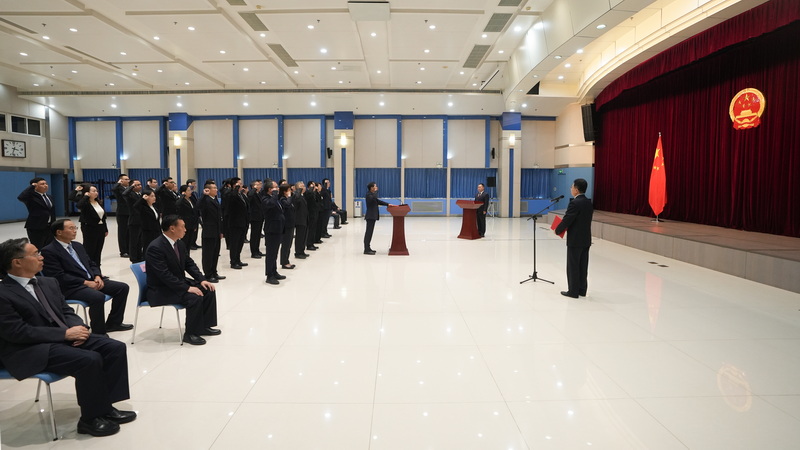
水利部举行机关新任职公务员宪法宣誓仪式
Shui Li Bu Wang Zhan· 2025-06-18 22:22
Core Points - The Ministry of Water Resources held a constitutional oath ceremony for 30 newly appointed officials, emphasizing the importance of political loyalty and adherence to the Constitution [2][3] - The ceremony was presided over by Minister Li Guoying, with other senior officials in attendance, highlighting the significance of the event [2][4] Group 1 - The oath-taking ceremony was conducted in a solemn atmosphere, with participants singing the national anthem and reciting the oath in front of the national flag and emblem [2] - Minister Li Guoying stressed the need to strengthen political loyalty and implement Xi Jinping's thoughts on water management, focusing on principles such as "water conservation first" and "systematic governance" [3] - The Minister called for a commitment to the rule of law and the application of legal thinking in promoting high-quality water resource development and ensuring national water security [3] Group 2 - There was a strong emphasis on enhancing political responsibility and historical mission in water management, encouraging officials to tackle challenges and achieve new results [3] - The importance of self-discipline and adherence to the Party's regulations was highlighted, with a call to combat formalism and bureaucratism [3]