健康科技

Search documents
“全球独角兽榜”青岛企业占6席
Sou Hu Cai Jing· 2025-07-02 04:37
Group 1 - The core viewpoint of the article highlights the emergence of 10 unicorn companies from Shandong province, with a focus on new industries such as semiconductors, software services, industrial internet, and renewable energy [3][4] - Qingdao has the highest number of unicorns in Shandong, with 6 companies listed, including GoerTek Microelectronics, which has a valuation of 20.5 billion yuan, ranking 395th globally [4] - Other notable companies from Qingdao include Nengchain Group with a valuation of 18.5 billion yuan, and Kaos, Teld, and others, showcasing a diverse range of sectors [4] Group 2 - The Hurun Research Institute identified a total of 1,523 unicorn companies globally, an increase of 70 companies (approximately 5%) from the previous year, with China ranking second with 343 companies [5] - The report indicates that 77% of unicorns are focused on software and services, particularly in fintech, software services, and AI, while 23% are in physical products, mainly in semiconductors, renewable energy, and health technology [5] - SpaceX is noted as the highest-valued unicorn globally, with a valuation increase of 1.2 trillion yuan, reaching 2.6 trillion yuan, while OpenAI has the fastest growth rate for the second consecutive year [5] Group 3 - The 2025 "China's 500 Most Valuable Brands" report lists 22 brands from Qingdao, with 5 entering the top 100, including Haier, Qingdao Beer, and Hisense [6] - Haier leads with a brand value of 573.517 billion yuan, ranking 3rd overall, while Qingdao Beer maintains its position as the top beer brand in China with a value of 280.355 billion yuan [6] - Other brands like Kaos and Double Star Tire also feature prominently, indicating strong brand presence and value in the Qingdao region [6]






2025年3C消费电子三大市场增长报告-消费电子的未来战场 中国制造“卷”向全球-数说故事
Sou Hu Cai Jing· 2025-06-21 13:02
Global Consumer Electronics Market Overview - Chinese brands are actively expanding into overseas markets, seeking faster growth, with exports of electromechanical products increasing by over 8% in 2023 compared to 2021 [1] - The global consumer electronics industry is also on an upward trend, with an expected growth rate of approximately 21% in overseas markets by 2024 [1] Demand Differences and Growth Categories in Three Major Markets China Market - Demand Characteristics: Consumers focus on extreme experiences in outdoor, therapeutic, and entertainment scenarios, preferring narrative-driven marketing [1] - Growth Categories: - Power Banks: Driven by outdoor trends, there is an increasing demand for "outdoor power+" and compatibility with new devices [1] - Portable Speakers: Transitioning from individual use to a necessity for creating an atmosphere, catering to various scenarios like camping and group activities [1] - AR/VR Glasses: Evolving from niche products to mainstream necessities, driven by virtual viewing experiences and interactive dramas [1] Europe and America Market - Demand Characteristics: Focus on entertainment atmosphere, emotional companionship, therapeutic needs, and personalized beauty, with emotional experiences becoming essential [1] - Growth Categories: - Projectors: In the post-pandemic era, homes have become primary entertainment venues, with camping culture rising, fulfilling immersive experience demands [1] - Smart Companion Robots: Addressing the loneliness economy and mental health concerns, catering to elderly care needs [1] - Home Beauty Devices: High cost-performance ratio combined with AI skin detection, meeting personalized skincare demands [1] Southeast Asia Market - Demand Characteristics: Safety anxiety, energy concerns, and health needs are driving the smart home product upgrades, with narrative-driven marketing favored [2] Technological Innovations and Future Trends Technology-Driven Transformation - AI technology is empowering product innovation across the board, including AI translation headsets and whole-home smart systems; sustainable development is integrated throughout the industry chain, with eco-friendly technologies covering the entire product lifecycle; health technology upgrades are creating a "full-domain health network" [2] Future Trends - Exhibition Trends: IFA 2024 and CES 2025 indicate that AI, sustainability, and health will be the main trends, with AI experiencing the fastest growth [2] - Scenario Trends: Home and travel are common growth trends across the three major markets, with AI+[home+travel] scenarios driving new product categories, such as smart glasses; the AI+X era will bring limitless possibilities to consumer electronics, deeply integrating into various life scenarios [2]

2025年3C消费电子三大市场增长报告(中国×欧美×东南亚)-数说故事
Sou Hu Cai Jing· 2025-06-20 03:08
Global Consumer Electronics Industry Overview - Chinese brands are actively expanding into overseas markets, driving continuous growth in the global consumer electronics industry. From 2020 to 2024, the export value of electromechanical products from China is expected to rise annually, with growth rates of 8.7%, 1.62%, and 6.78% for 2021-2023 respectively. The global consumer electronics market is also showing growth, with overseas market share exceeding 20% from 2021 to 2024 [1]. Market Demand Differences and Growth Categories China Market - Demand Characteristics: Consumers focus on extreme experiences in outdoor, therapeutic, and entertainment scenarios, preferring narrative-driven marketing [4]. - Growth Categories: - Power banks: Addressing outdoor power anxiety and compatibility with new devices. - Portable speakers: Transitioning from personal use to essential for creating atmosphere in various settings. - AR/VR glasses: Moving from niche to mainstream demand, particularly in entertainment and gaming [4]. Europe and America Market - Demand Characteristics: Key needs include entertainment atmosphere, emotional companionship, and personalized beauty, with a strong preference for narrative-driven marketing [4]. - Growth Categories: - Projectors: Catering to immersive home and outdoor entertainment experiences, symbolizing "lifestyle aesthetics." - Smart companion robots: Addressing loneliness and mental health needs, providing emotional support and elderly care. - Home beauty devices: High cost-performance ratio, integrating AI skin detection for personalized skincare [4]. Southeast Asia Market - Demand Characteristics: Safety concerns, energy anxiety, and health needs are driving the smart home product upgrades, with narrative-driven marketing being more readily accepted by consumers [4]. - Growth Categories: - Smart home security: Rising middle class and increased safety awareness are boosting demand for smart cameras. - Smart water heaters: Addressing soaring electricity prices and unstable gas supply, focusing on energy-saving and dual-mode functions. - Smart mattresses: Post-pandemic health awareness is increasing interest in sleep monitoring and chronic disease management [4]. Technological Innovations and Future Trends Technological Innovation Directions - AI technology: Deep integration into home appliances and wearable devices, such as AI translation headsets and whole-home smart systems. - Environmental technology: Covering the entire product lifecycle to aid in energy saving and carbon reduction. - Health technology: Expanding into home and personal care scenarios, creating a "holistic health network" [4]. Future Trends - Scenario-driven growth: Home and travel are common growth trends across China, Europe, and Southeast Asia. - AI and scenario integration: Examples include AI-driven smart brushing and cooking in home scenarios, and real-time translation with smart glasses in travel scenarios. - Hardware innovation: Standalone AR glasses are expected to become the next major computing platform [4].
2月家居品牌TOP15,健康科技驱动品牌升级|世研消费指数品牌榜
3 6 Ke· 2025-04-29 09:16
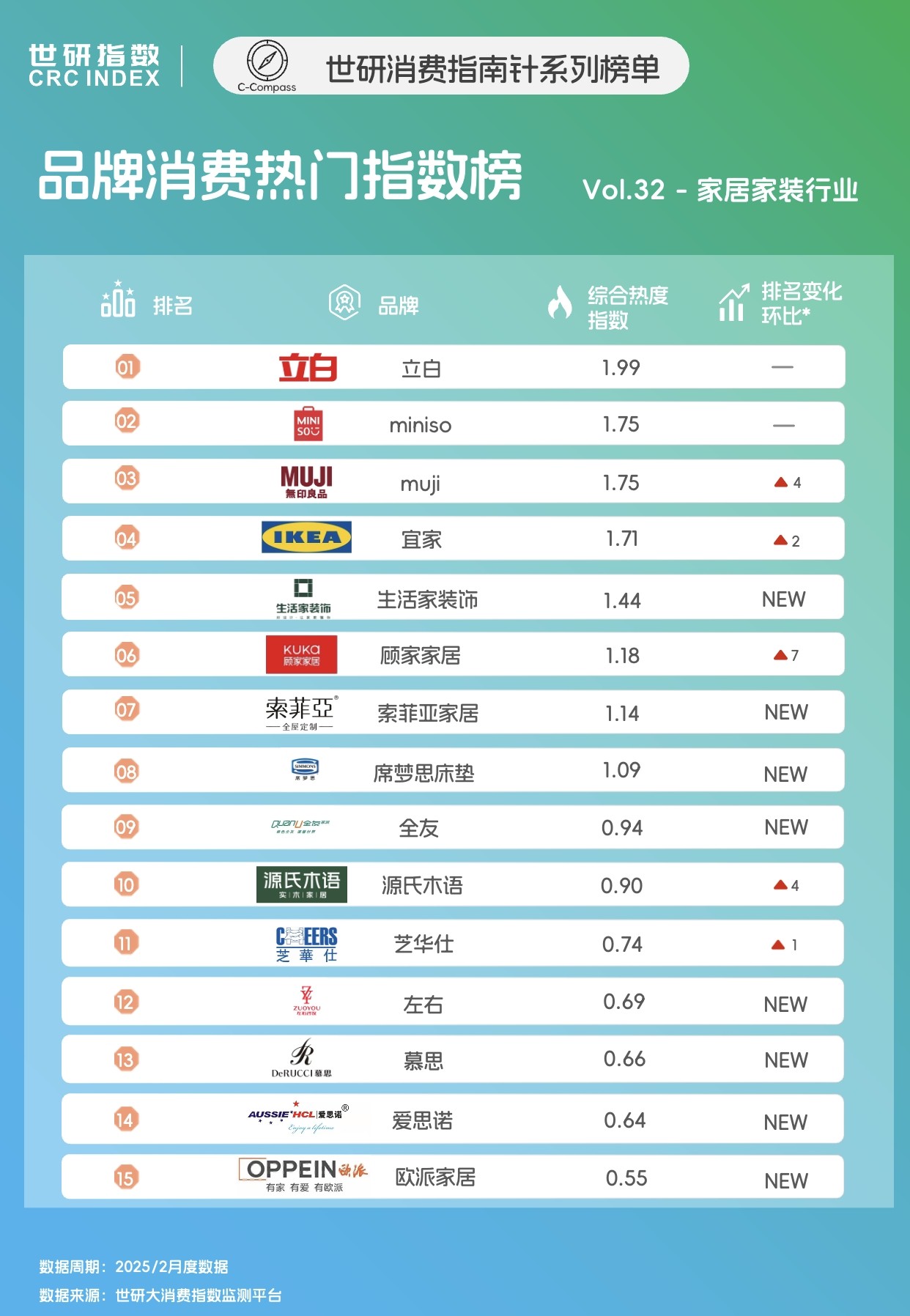
Core Insights - The report highlights the top brands in the home and decoration sector, with Libai, Miniso, and Muji leading the popularity index with scores of 1.99, 1.75, and 1.75 respectively [2][3] Brand Rankings - The top brands in the home and decoration category are as follows: 1. Libai - 1.99 2. Miniso - 1.75 3. Muji - 1.75 (up 4 spots) 4. KER - 1.71 (up 2 spots) 5. Mainstream Home Decoration - 1.44 (new entry) 6. Kuka Home - 1.18 (up 7 spots) 7. Sogou Home - 1.14 (new entry) 8. Xibanshishi Mat - 1.09 (new entry) 9. Quanyou - 0.94 (new entry) 10. Genji Wood Language - 0.90 (up 4 spots) [2] Consumer Trends - The report indicates that holiday cycles and social trends are driving the consumption of health-oriented and low-cost home products. The demand for home renewal post-Spring Festival and Valentine's Day marketing create a dual effect, prompting brands to strategically position their products for specific scenarios [4] - Libai focuses on deep cleaning needs by enhancing marketing for pet-specific cleaning products, while Miniso targets emotional consumption during Valentine's Day with affordable home items, reflecting a dual consumption logic of functionality and emotional connection [4] Technological Integration - The integration of health technology in home products is evolving from a conceptual phase to a standard value proposition. Brands like Oppein are incorporating smart home systems, while Aisino is focusing on health management through innovative bedding products [5] - This shift indicates a deeper user demand for both high-end and mass-market products, where technology becomes a fundamental value rather than an added feature [5] Index Overview - The report is part of the "World Research Consumption Guide" series, which includes various consumption indices aimed at objectively presenting trends in the consumer market to assist brands in tracking market dynamics [6][7]