独角兽企业

Search documents
总书记关切的独角兽新增数,2025年终于止跌回升
母基金研究中心· 2026-03-19 09:06
Core Viewpoint - The 2025 China Unicorn Enterprise Observation Report indicates a slight recovery in the number of new unicorns, with 22 new unicorns added in 2025, a 10% increase year-on-year, although the total number of existing unicorns has decreased to 509, reflecting a challenging venture capital market [2][3]. Group 1: Unicorn Growth and Market Trends - In 2025, China saw 22 new unicorns, up from 20 in 2024, marking a halt in the declining trend observed since 2022 when the average annual new unicorns were over 60 [2]. - The unicorn count had previously experienced a significant drop, with growth rates plummeting to 1.8% in 2023, a decline of nearly 30 percentage points from 2021 [2]. - The unicorn market is undergoing an adjustment phase, with the number of exits (24) surpassing new entries (22) in 2025 [2]. Group 2: Market Environment and Investment Trends - In 2025, the fundraising environment improved significantly, with national institutional LPs contributing 9,319 investments, a 36% increase from 2024, and total commitments reaching 18,243 million yuan, up 43% [4]. - The investment landscape also saw a reversal of the downward trend, with a 33% increase in financing events year-on-year [4]. - The number of IPOs in A-shares and Hong Kong stocks increased significantly in 2025, with A-share sell-off amounts nearly doubling compared to the previous year [4]. Group 3: Policy Support and Government Initiatives - The 14th Five-Year Plan emphasizes the development of venture capital, aiming to diversify funding sources for long-term entrepreneurial investments [5]. - The government work report reiterated support for venture capital and angel investments, highlighting the importance of patience capital in nurturing emerging industries [6]. - The establishment of the National Venture Capital Guiding Fund is expected to attract nearly 1 trillion yuan in local and social capital, enhancing the venture capital landscape [7]. Group 4: Future Outlook for Venture Capital - The National Venture Capital Guiding Fund is anticipated to provide substantial liquidity to the market, boosting confidence among venture capital firms facing fundraising challenges [8]. - The government’s commitment to optimizing the private equity and venture capital exit channels is expected to stimulate more social capital investments in early-stage and hard technology ventures [8]. - The venture capital industry is expected to play a crucial role in fostering technological innovation and responding to national strategic calls for investment in new productive forces [9].


中国储能独角兽企业排行榜|独家
24潮· 2026-03-15 23:03
Core Viewpoint - The article emphasizes the importance of fostering "specialized, refined, unique, and innovative" small and medium-sized enterprises (SMEs) in China, particularly focusing on the development of unicorn companies in the energy storage sector, which are crucial for enhancing national competitiveness in the global value chain [2][3]. Group 1: Unicorn Companies - The concept of "unicorn companies" refers to startups valued at over $1 billion and established within the last 10 years, representing significant technological breakthroughs and innovative business models [2]. - China ranks second globally with 343 unicorn companies, with approximately 23 unicorns in the energy storage sector, valued at over 500 billion RMB [2]. Group 2: Strategic Importance of Energy Storage - The strategic position of energy storage, especially new energy storage technologies, is continuously rising amid global energy transformations [3]. - The National Development and Reform Commission of China aims to develop six emerging pillar industries, including new energy storage, with an estimated output value of nearly 6 trillion RMB by 2025, potentially doubling to over 10 trillion RMB by 2030 [3]. Group 3: Market Dynamics and Competition - Chinese energy storage companies are experiencing significant growth in global markets, with an estimated overseas order volume of nearly 284.26 GWh by 2025, which is 3.49 times the new installed capacity in 2024 [3]. - Chinese companies dominate the global energy storage battery shipment rankings, holding 88.8% of the market share, and occupy eight positions in the global energy storage system shipment rankings [3]. Group 4: Challenges and Future Outlook - Western countries, led by the US and Europe, are implementing trade policies to increase the costs of "Made in China" products, aiming to constrain China's competitiveness in the global energy storage market [4]. - The energy storage industry has undergone multiple economic and policy cycles, leading to intense competition and the rise and fall of numerous companies [4]. - Future success in the energy storage sector will depend on companies' capabilities in technological innovation, global expansion, financial health, and brand influence [4]. Group 5: Evaluation of Unicorn Companies - The 24潮产业研究院 (TTIR) plans to release a "China Energy Storage Unicorn Company Ranking" starting in 2026, evaluating companies based on five primary dimensions: industry influence, technological innovation, capital control, global expansion, and brand building [5]. - The ranking will provide insights into the competitive strength of leading companies in the energy storage sector and their impact on the industry [5].
中国独角兽排行榜2025
泽平宏观· 2026-02-12 16:06
Core Insights - The 2025 China Unicorn Rankings report highlights a slowdown in primary financing, a surge in secondary listings in Hong Kong, and explosive growth in three key sectors: AI, new energy, and robotics [3][5]. Financing and Market Trends - As of May 2025, the total scale of Chinese unicorns reached 8.46 trillion yuan, a slight increase of 0.23% from 2024 [3]. - The number of new unicorns is insufficient to fully replace those that have gone public, with notable companies like Mixue Ice Cream and Horizon Robotics achieving pre-IPO valuations exceeding 60 billion yuan [3]. - The trend of unicorns choosing to list in Hong Kong is significant, with 60% of unicorns opting for this route between April 2024 and April 2025, and 67% of these companies seeing an increase in market value post-IPO [4][33]. Sectoral Growth - The unicorn landscape is dominated by three core areas: AI applications, emerging technologies (commercial aerospace, biotechnology, AI+AR), and cultural exports through social media and gaming [5][14]. - In the AI sector, there are 39 unicorns, with a total valuation of 262.2 billion yuan, making it the leading area of growth [6][8]. - The intelligent driving sector is also thriving, with companies like Yihang Intelligent achieving valuations in the hundreds of billions [11]. Regional Insights - Hangzhou and Shenzhen are emerging as strongholds for new unicorns, while Beijing and Shanghai remain foundational for innovation [4][20]. - Beijing leads with 65 unicorns valued over 3 trillion yuan, accounting for 35.6% of the national total [23]. - Shenzhen has 30 unicorns with a total valuation of 926.9 billion yuan, showing a 13% increase from 2024 [29]. IPO Trends - The number of unicorns going public has decreased, with 40 companies listing between April 2024 and April 2025, totaling a market value of 104.2 billion USD, down from 54 companies and 168.2 billion USD in 2024 [33][34]. - The average market value of listed unicorns has also declined, with Hong Kong becoming the preferred market for smaller unicorns [36][38]. Cultural and Gaming Exports - The cultural export sector is gaining traction, with companies like ByteDance and Xiaohongshu leading the way in global user engagement and revenue growth [17][18]. - The gaming industry is also a significant contributor to cultural exports, with titles like "Black Myth: Wukong" achieving nearly 1 billion USD in revenue [18][19].
独角兽城市黑马,为什么是合肥
2 1 Shi Ji Jing Ji Bao Dao· 2026-02-12 10:06
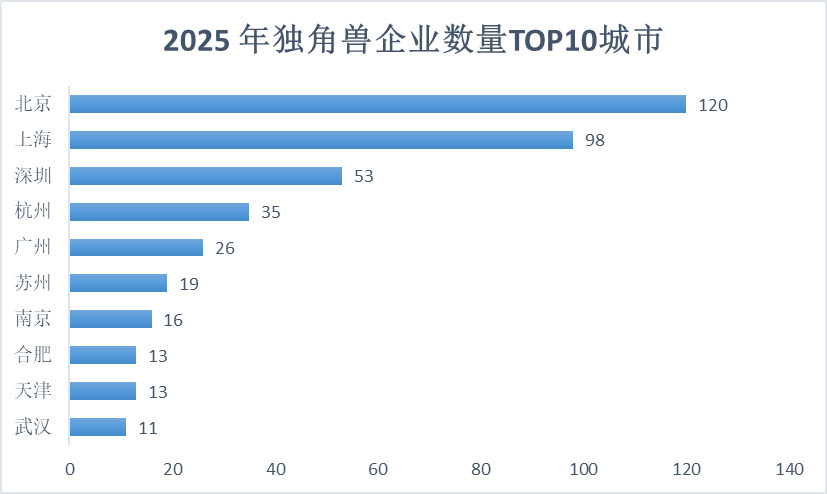
Core Insights - The "2025 China Unicorn Enterprise Observation Report" reveals that there are currently 509 unicorn companies in China, with nearly 80% concentrated in five regions: Beijing, Shanghai, Guangdong, Jiangsu, and Zhejiang [1] - The report highlights a significant contrast between GDP rankings and the number of unicorns, with cities like Chongqing and Chengdu, ranked 4th and 7th in GDP, having only 10 and 8 unicorns respectively, while Hefei, ranked 19th in GDP, has emerged as a notable player in unicorn growth [3][4] Group 1: Unicorn Distribution - Beijing and Shanghai maintain a strong "innovation dual-core" structure with 120 and 98 unicorns respectively, followed by Shenzhen, Hangzhou, and Guangzhou [1] - Hefei has surpassed Shenzhen in the number of newly added unicorns from 2023 to 2025, ranking 3rd nationally, indicating a significant shift in the unicorn landscape [3] Group 2: Challenges in Chongqing and Chengdu - Despite high GDP figures of 3.38 trillion and 2.48 trillion respectively, Chongqing and Chengdu lag in unicorn numbers, indicating a shortfall in their innovation ecosystems [4] - Key issues identified include insufficient high-level innovation platforms, lack of leading enterprises to drive innovation, and weak integration of ecological support [5] Group 3: Hefei's Unicorn Growth Strategy - Hefei's unicorn growth is attributed to a robust capital investment strategy, with state-owned funds exceeding 280 billion yuan and a focus on long-term returns in high-tech sectors [8] - The city has established a six-tier nurturing system for startups, facilitating their growth and development [8] - Hefei has pioneered a "scene innovation promotion center" to bridge the gap between laboratory innovations and market applications, enhancing the commercialization of technology [8] Group 4: Economic Impact of Innovation - Hefei's GDP is projected to reach 1.4 trillion yuan by 2025, with a growth rate of 6.1%, ranking it second among trillion-yuan cities [9] - The city's industrial growth is notable, with a 17.6% increase in industrial added value and significant growth in the computer and automotive manufacturing sectors [9]
独角兽城市黑马,为什么是合肥
21世纪经济报道· 2026-02-12 09:46
Core Insights - The report highlights the distribution of China's 509 unicorn companies, with nearly 80% concentrated in Beijing, Shanghai, Guangdong, Jiangsu, and Zhejiang, indicating a strong innovation ecosystem in these regions [1][2] - Despite high GDP rankings, cities like Chongqing and Chengdu lag in unicorn numbers, raising questions about their innovation ecosystems [2][4] - Hefei has emerged as a significant player in unicorn growth, surpassing Shenzhen in new unicorns from 2023 to 2025, showcasing a robust innovation strategy [9][10] City Distribution of Unicorns - Beijing leads with 120 unicorns, followed by Shanghai with 98, while Shenzhen, Hangzhou, and Guangzhou have 53, 35, and 26 respectively [1] - Hefei, ranked 19th in GDP, has become the 7th city in unicorn count, indicating a shift in innovation dynamics [2] Innovation Ecosystem Challenges - Chongqing and Chengdu face challenges such as insufficient high-level innovation platforms, lack of leading enterprises driving innovation, and weak integration of support ecosystems [4] - The absence of national laboratories and major technological infrastructure in Chongqing highlights the need for improvement in its innovation capacity [4] Government Initiatives - Both Chongqing and Chengdu have outlined strategies to enhance their innovation ecosystems, focusing on fostering unicorn companies and integrating industry-academia-research collaboration [5] - The emphasis on innovation as a primary driver in government reports indicates a commitment to transforming these cities into significant tech innovation centers [5] Hefei's Unicorn Growth Strategy - Hefei's rapid increase in unicorns is attributed to substantial capital investment, a structured growth pathway for companies, and effective commercialization of technology [9][10] - The city has established a comprehensive funding ecosystem, with state-owned funds exceeding 280 billion yuan, supporting over 2,100 projects [9] - Hefei's unique approach includes creating innovation centers that facilitate the transition of technologies from labs to market applications [10] Economic Impact - Hefei's GDP is projected to reach 1.4 trillion yuan by 2025, with a growth rate of 6.1%, reflecting the positive impact of its innovation strategies [10] - The city's industrial growth, particularly in electronics and automotive manufacturing, showcases the effectiveness of its focus on hard technology [10] Conclusion - Hefei's experience serves as a model for other cities, emphasizing the importance of nurturing original innovation over merely focusing on GDP rankings [11]

星海图宣布完成10亿元B轮融资,估值突破百亿元
Bei Ke Cai Jing· 2026-02-11 04:40
Core Insights - Xinghai Map has completed a Series B financing round of 1 billion yuan, with investors including industry capital, Beiqi Investment, Bihong Investment, and several private equity funds [1] - The total financing amount for Xinghai Map has reached nearly 3 billion yuan, with a valuation exceeding 10 billion yuan, positioning it among other unicorns like Yushu, Zhiyuan, and Galaxy General [1] - The company has engaged in deep scenario validation with numerous leading enterprises in manufacturing, logistics, and services, securing orders in the thousands from top domestic automotive manufacturers and smart logistics companies [1]
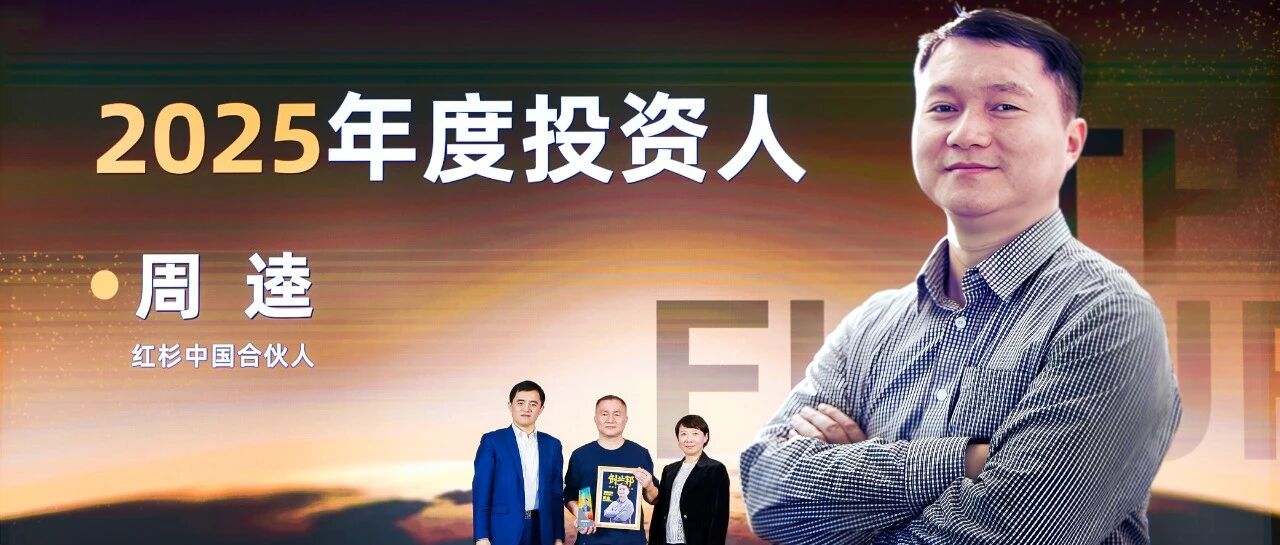
红杉中国合伙人周逵获评“2025年度投资人”大奖
创业邦· 2026-02-06 11:32
Core Insights - Zhou Kui, a partner at Sequoia China, was awarded the "2025 Investor of the Year" at the 18th Chuangyebang Annual Conference, recognizing his significant achievements and influence in the investment field [2] - With 25 years in the industry, Zhou has successfully navigated three technological cycles: PC internet, mobile internet, and artificial intelligence, achieving remarkable results in technology, consumer, and healthcare sectors [3] - Zhou has led investments in over 20 well-known companies that have successfully entered global capital markets, with notable recent successes including the upcoming IPOs of Pony.ai and Horizon Robotics [4] Investment Philosophy - Zhou emphasizes the importance of vision, preparation, resilience, and optimism in successful investors, advocating for early and substantial investments that align social value with commercial potential [4] - He is recognized as one of the most diligent and insightful investors in China's venture capital scene, known for his ability to support a diverse range of entrepreneurs [4][5] Notable Achievements - Zhou's investment strategy has led to the emergence of two companies with a market value exceeding 100 billion, showcasing his foresight and commitment to supporting entrepreneurs [4] - His long-term support for companies like Yimaitian during challenging times has been highlighted by founders, demonstrating his constructive and professional approach [5] Industry Context - The Chuangyebang Annual Conference has been a key platform for investment and entrepreneurial insights since 2008, focusing on unicorns and future unicorns [6] - The conference theme "Only the Timeless Thrive" reflects the ongoing evolution and resilience required in the investment landscape, with reports on global unicorns and venture capital development being released [6]
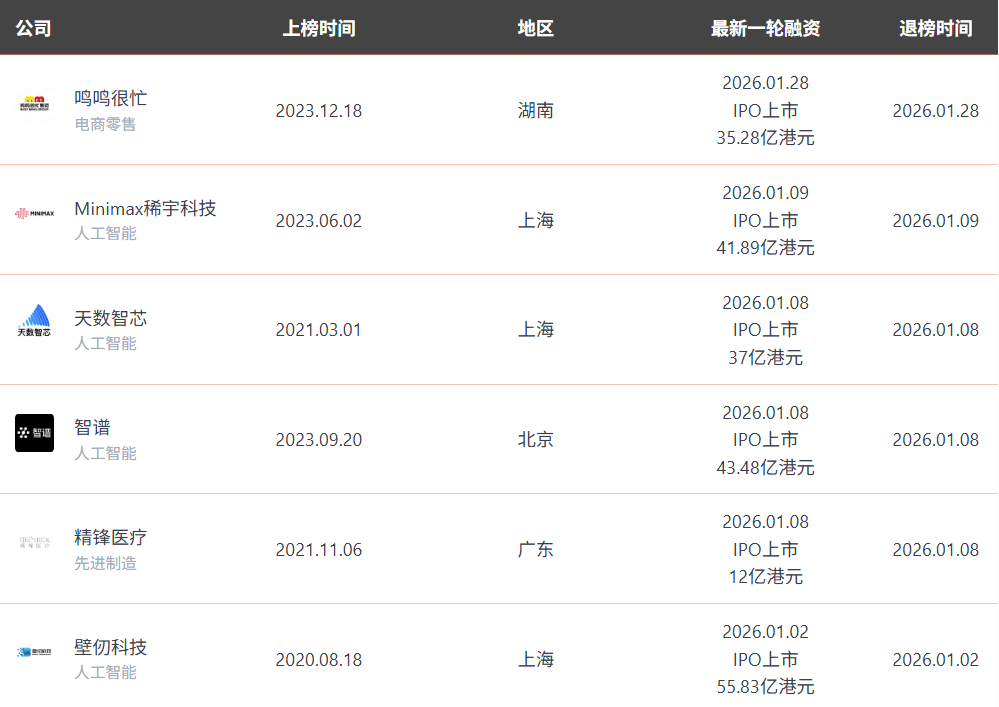
6家公司密集在港股IPO;它成立3个月融资4.8亿美元,速成独角兽 | 1月独角兽月报
Sou Hu Cai Jing· 2026-02-05 07:35
Core Insights - The domestic startup market in China is experiencing a surge in financing, with multiple companies securing over 1 billion yuan in funding, including notable firms like Jieyue Xingchen and Geely's flying car company WoFei ChangKong [1][2] Group 1: New Unicorns - In January 2026, 11 new unicorns emerged in China, spanning sectors such as AI, humanoid robots, healthcare, eVTOL, and quantum computing [2] - Humans& became a new unicorn after raising $480 million in seed funding, achieving a post-money valuation of $4.48 billion, backed by investors like NVIDIA and Google Ventures [3][4] - WoFei ChangKong, a subsidiary of Geely, completed nearly 1 billion yuan in financing, reaching a valuation of 10 billion yuan, focusing on low-altitude travel and flying car development [6][7][8] - ZiBian Robot secured 1 billion yuan in A++ round financing, achieving a post-money valuation of over $1 billion, with plans to enhance its humanoid robots and expand into various application scenarios [9] - RayNeo announced a new round of financing exceeding 1 billion yuan, achieving a valuation of $1 billion, and launched the world's first eSIM independent communication AR glasses [10][11] Group 2: IPO Activities - Six unicorn companies went public in January, all listed on the Hong Kong Stock Exchange, marking a concentrated IPO wave at the beginning of the year [12] - Notable IPOs include Zhiyuan, which raised 4.348 billion HKD, and Minimax, which raised 4.189 billion HKD, both focusing on AI and large model technologies [13] - Other companies like Biran Technology and Jingfeng Medical also completed IPOs, with respective fundraising targets of 5.583 billion HKD and 1.2 billion HKD [15] Group 3: Major Financing Events - Jieyue Xingchen completed over 5 billion yuan in B+ round financing, setting a record for the largest single financing in China's large model sector over the past year [16][18] - ByteDance's "Doubao" AI glasses are set to enter the market, with plans for a no-screen version to be released in Q1 2026 and a display version by Q4 2026 [19][20] - Baidu's Kunlun Chip has submitted a confidential IPO application, with a valuation of 21 billion yuan following its latest funding round [22][23]
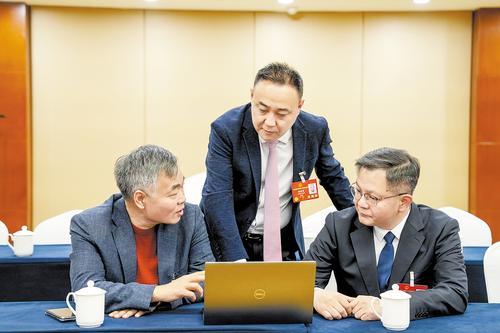
一堂特别的独角兽成长课
Xin Lang Cai Jing· 2026-01-27 23:08
Group 1 - The discussion among representatives focused on the growth and nurturing of unicorn companies, highlighting the importance of selecting the right industry "track" for success [3][5] - The representatives emphasized the potential of the biopharmaceutical industry in China, particularly in the context of the ongoing innovation wave in drug development [3][5] - The representatives shared their experiences in innovation and research, with one company holding over 300 independent intellectual property rights and another achieving significant advancements in third-generation semiconductor materials [6][5] Group 2 - The representatives discussed the importance of collaboration with academic institutions to overcome technological challenges, with examples of partnerships with universities and research institutes [6] - The conversation underscored the need for talent in innovation, suggesting that companies should build their own research teams while also leveraging external expertise [6] - The insights gained from this discussion provided motivation and confidence for companies aiming to transition into unicorn status [6]
南京6只“瞪羚”,跑进全球榜单
Sou Hu Cai Jing· 2026-01-27 09:45
Core Insights - The HuRun Research Institute released the "2025 HuRun Future Unicorn: Global Gazelle Enterprises List," featuring six companies from Nanjing that are likely to achieve a billion-dollar valuation by 2028 [1] - China has 278 gazelle enterprises, with 27 located in Jiangsu province, highlighting the region's strong entrepreneurial ecosystem [1] Group 1: Company Highlights - Nanjing's listed companies include BanJie Electronics, XinDe Semiconductor, XunLu Bio, YunZhangFang, BoLiu Intelligent, and AoTeKu [1] - BoLiu Intelligent focuses on developing high-integration, low-power IoT wireless connection chips, addressing the need for efficient device connectivity while reducing power consumption and costs [6][9] - XunLu Bio's CAR-T therapy, Ikigai Lunsai injection, received approval from the National Medical Products Administration in 2023 and has since gained recognition in multiple international markets [12] Group 2: Technological Innovations - The AI-driven accounting system developed by YunZhangFang has significantly increased efficiency, allowing accountants to manage up to 1,800 clients, compared to the traditional limit of 20 [3][6] - BoLiu Intelligent's BL704L chip, used in Amazon Basics products, operates at ultra-low power levels, addressing concerns about battery life in IoT devices [8] - A collaboration between STMicroelectronics and AoTeKu resulted in a cutting-edge audio solution for smart vehicles, overcoming challenges in audio transmission technology [10] Group 3: Policy and Support - Nanjing's government has implemented policies to foster the growth of unicorn and gazelle enterprises, aiming for a total of 800 such companies by 2027 [15] - The city is providing financial support and incentives to nurture these high-potential companies, ensuring a conducive environment for innovation and growth [15][16]