基金溢价

Search documents
白银基金,明日全天停牌!
中国基金报· 2026-01-21 14:45
Core Viewpoint - The Guotou Silver LOF Fund announced a full-day suspension of trading on January 22 to protect investors amid a high premium rate exceeding 50% [3][5][12]. Group 1: Fund Performance and Market Conditions - As of January 21, the Guotou Silver LOF's secondary market price was reported at 3.92 yuan, with a premium rate exceeding 50% [3][13]. - The fund's scale surged to 18.944 billion yuan by the end of the fourth quarter, reflecting a growth of over 185% compared to the end of the third quarter [3]. - The fund's net asset value (NAV) was 2.6095 yuan on January 20, while the closing price on January 21 was significantly higher at 3.92 yuan, indicating a substantial premium [7]. Group 2: Suspension Announcement and Investor Reactions - The fund's announcement of a full-day suspension was made to mitigate risks associated with the high premium, with potential further measures if the premium does not decrease [5][10]. - Investor reactions were mixed, with some expressing surprise and frustration over the sudden suspension after attempting to purchase shares [7][10]. Group 3: Market Dynamics and Risks - The high premium of the Guotou Silver LOF is linked to the rising international silver prices, and it is expected that the premium will diminish if silver prices decline [17]. - Historical trends indicate that silver price volatility is often greater than that of gold, suggesting potential risks for investors [17]. - The high premium is typically a result of supply-demand imbalances and excessive investor sentiment, which could lead to losses if investors buy at inflated prices [17].

白银基金明天将“按下暂停键”,确实把不少投资者吓了一跳。溢价率冲到五成以上,二级市场价格远远跑在净值前面,基金公司只能用停牌来给市场降温。国际银价还在高位晃,情绪被推得更热,投机的味道越来越浓。高溢价背后,是部分资金把商品类LOF当成短线工具,价格和净值越拉越大。有人吐槽“停牌没用”,...
Sou Hu Cai Jing· 2026-01-21 14:18
Group 1 - The silver fund will "hit the pause button" tomorrow, surprising many investors as the premium rate surged over 50%, with secondary market prices significantly outpacing net asset values [1] - The high premium is driven by some funds treating commodity LOFs as short-term tools, leading to a widening gap between prices and net values [1] - The fundamental aspects of silver futures are crucial, as the fund's rapid movement is primarily influenced by market sentiment [1] Group 2 - There are still some LOFs with premiums exceeding 20%, often related to tight QDII quotas, scarcity of underlying assets, and limited subscription options [1] - Investors can avoid pitfalls by checking real-time premium and discount information through official channels such as fund company websites, exchange websites, and fund information platforms [1] - Key warning signals include sudden premium spikes, subscription suspensions, abnormal trading volumes, price trends diverging from underlying assets, and overheated sentiment on social platforms [1] Group 3 - Commodity funds can both rise and fall, emphasizing the importance of maintaining composure, understanding net values, and controlling positions to navigate volatility effectively [1]
突发公告!白银基金将停牌一天,目前溢价已超50%
Xin Lang Cai Jing· 2026-01-21 12:37
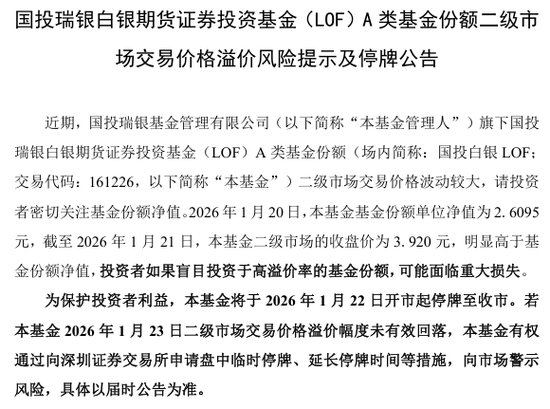
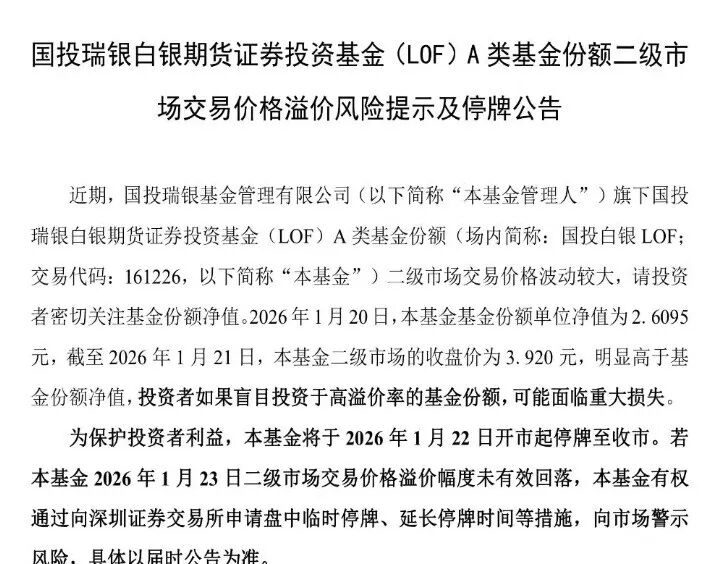
白银基金飙涨,明日全天停牌。 国投瑞银基金管理有限公司1月21日公告,旗下国投瑞银白银期货证券投资基金(LOF)A类基金份额 (简称"国投白银LOF")二级市场交易价格波动较大,请投资者密切关注基金份额净值。 炒股就看金麒麟分析师研报,权威,专业,及时,全面,助您挖掘潜力主题机会! 2026年1月20日,国投白银LOF基金份额单位净值为2.6095元,截至2026年1月21日,国投白银LOF二级 市场的收盘价为3.920元,明显高于基金份额净值,投资者如果盲目投资于高溢价率的基金份额,可能 面临重大损失。为保护投资者利益,国投白银LOF将于2026年1月22日开市起停牌至收市。 若国投白银LOF2026年1月23日二级市场交易价格溢价幅度未有效回落,国投白银LOF有权通过向深圳 证券交易所申请盘中临时停牌、延长停牌时间等措施,向市场警示风险,具体以届时公告为准。 综合自:公告、Wind行情 责任编辑:杨红卜 值得一提的是,国投白银LOF今日大涨超9%,本周累计涨幅为26.7%,1月以来累计涨幅为74.17%。目 前,其二级市场交易价格已较净值溢价超50%。 与此同时,国际银价维持高位震荡走势,伦敦银现昨日盘中 ...
白银基金溢价率超50% 明天全天停盘
Cai Jing Wang· 2026-01-21 12:01
Group 1 - The core issue is the significant premium of the Guotou UBS Silver Futures Securities Investment Fund (LOF) A-class fund shares, with a market price of 3.920 yuan on January 21, 2026, compared to a net asset value of 2.6095 yuan on January 20, 2026, resulting in a premium rate exceeding 50% [1] - To protect investors, the fund will suspend trading from January 22, 2026, and may apply for temporary suspension if the premium does not decrease effectively by January 23, 2026 [1] - The fund is an open-ended fund (LOF) allowing investors to trade on the secondary market or subscribe and redeem at the net asset value, with a current single subscription limit of 100.00 yuan [3] Group 2 - The fund management emphasizes that the high premium is not sustainable and may lead to adjustments in the subscription limit [3] - The secondary market price is influenced by multiple factors, including net asset value, market supply and demand, systemic risks, and liquidity, warning investors against blind speculation [3] - The fund management reiterates the principle of "buyers bear their own risks," urging investors to read the fund contract and prospectus carefully and make independent decisions based on their risk tolerance and investment goals [3]
白银基金,明日全天停牌,溢价率高达50%
2 1 Shi Ji Jing Ji Bao Dao· 2026-01-21 11:55
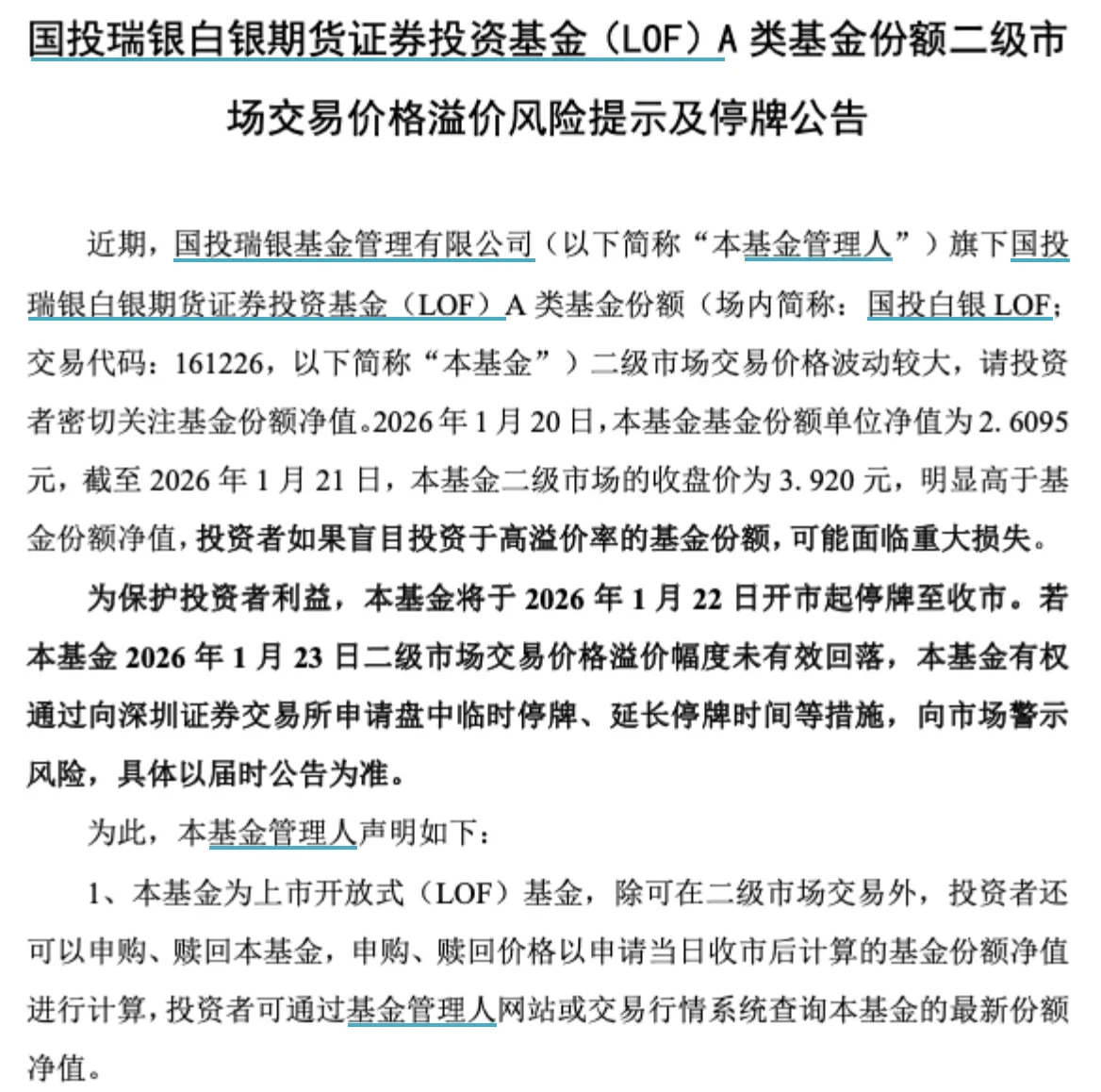
公告称,国投瑞银基金管理有限公司旗下国投瑞银白银期货证券投资基金(LOF)A类基金份额二级市场交易价格波 动较大,请投资者密切关注基金份额净值。2026年1月20日,本基金基金份额单位净值为2.6095元,截至2026年1月21 日,本基金二级市场的收盘价为3.920元,明显高于基金份额净值,投资者如果盲目投资于高溢价率的基金份额,可 能面临重大损失。为保护投资者利益,本基金将于2026年1月22日开市起停牌至收市。若本基金2026年1月23日二级 市场交易价格溢价幅度未有效回落,本基金有权通过向深圳证券交易所申请盘中临时停牌、延长停牌时间等措施, 向市场警示风险,具体以届时公告为准。 近期国投白银LOF的走势再陷"疯狂",连续7个交易日大涨,其年内场内累计涨幅超60%,领涨LOF市场。截至21日 收盘,其溢价率已超50%。 1月21日,国投瑞银白银期货证券投资基金(LOF)A类基金份额发布二级市场交易价格溢价风险提示及停复牌公 告。 | 国投瑞银白银期货(LOF)A (161226) 2 | | | | 开放式-商品型 | | | --- | --- | --- | --- | --- | --- | | ...
突发公告!白银基金将停牌一天,目前溢价已超50%
证券时报· 2026-01-21 11:53
白银基金飙涨,明日全天停牌。 国投瑞银基金管理有限公司1月21日公告,旗下国投瑞银白银期货证券投资基金(LOF)A类基金份额 (简称"国投白银LOF") 二级市场交易价格波动较 大,请投资者密切关注基金份额净值。 与此同时,国际银价维持高位震荡走势,伦敦银现昨日盘中一度突破95美元/盎司,截至发稿, 伦敦银现报94.891美元/盎司,涨0.35%。 2026年1月20日, 国投白银LOF 基金份额单位净值为2.6095元,截至2026年1月21日, 国投白银LOF 二级市场的收盘价为3.920元,明显高于基金份额净 值,投资者如果盲目投资于高溢价率的基金份额,可能面临重大损失。为保护投资者利益, 国投白银LOF 将于2026年1月22日开市起停牌至收市。 若 国投白银LOF 2026年1月23日二级市场交易价格溢价幅度未有效回落, 国投白银LOF 有权通过向深圳证券交易所申请盘中临时停牌、延长停牌时间等 措施,向市场警示风险,具体以届时公告为准。 值得一提的是, 国投白银LOF今日大涨超9%,本周累计涨幅为26.7%,1月以来累计涨幅为74.17%。目前,其二级市场交易价格已较净值溢价超50%。 | 国投白银 ...

白银基金,明日全天停牌,溢价率高达50%
21世纪经济报道· 2026-01-21 11:46
记者丨 庞华玮 黎雨桐 编辑丨 包芳鸣 1月21日,国投瑞银白银期货证券投资基金(LOF)A类基金份额发布二级市场交易价格溢价风险提示及停复 牌公告。 套利和投机再现? 公告称,国投瑞银基金管理有限公司旗下国投瑞银白银期货证券投资基金(LOF)A类基金份额二级市场交 易价格波动较大,请投资者密切关注基金份额净值。2026年1月20日,本基金基金份额单位净值为2.6095 元,截至2026年1月21日,本基金二级市场的收盘价为3.920元,明显高于基金份额净值,投资者如果盲目投 资于高溢价率的基金份额,可能面临重大损失。为保护投资者利益, 本基金将于2026年1月22日开市起停牌 至收市。 若本基金2026年1月23日二级市场交易价格溢价幅度未有效回落,本基金有权通过向深圳证券交易 所申请盘中临时停牌、延长停牌时间等措施,向市场警示风险,具体以届时公告为准。 近期国投白银LOF的走势再陷"疯狂",连续7个交易日大涨,其年内场内累计涨幅超60%,领涨LOF市场。截 至21日收盘,其溢价率已超50%。 | 值得一提的是, 这并不是这只基金第一次经历大幅溢价和快速上涨。 | | --- | 2025年12月底时,该基 ...

白银LOF连续6天提示风险!
Sou Hu Cai Jing· 2026-01-12 00:17
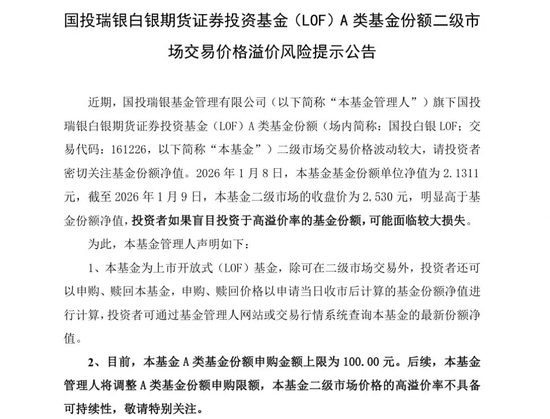
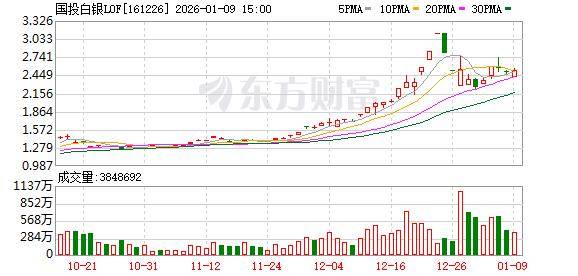
Core Viewpoint - The recent trading activity of the Guotou Silver LOF fund has shown significant price volatility, with a high premium over its net asset value, prompting multiple risk warnings from the fund management [3][4]. Group 1: Fund Performance and Pricing - As of January 8, the net asset value of the A-class shares of Guotou Silver LOF was 2.1311 yuan, while the market closing price on January 9 was 2.530 yuan, indicating a substantial premium [2]. - The fund experienced a notable price increase, with a single-day rise of 9.53% on January 6, reaching a closing price of 2.598 yuan and a trading volume exceeding 1.587 billion yuan [4]. - The fund's trading prices exhibited a "rise then fall" pattern from January 5 to January 9, closely mirroring the fluctuations in COMEX silver prices [4]. Group 2: Risk Factors and Warnings - The fund has issued multiple premium risk warnings, particularly from January 5 to January 10, highlighting the potential for significant losses if investors engage in blind investments in high-premium shares [3][5]. - The high premium is attributed to three main factors: the fund's uniqueness as the only public fund primarily investing in silver futures, restrictions on external subscriptions leading to increased demand in the secondary market, and the inefficacy of the arbitrage mechanism due to T+2 settlement delays [4]. - Industry experts caution that the current high premium status of the fund remains unchanged, and the inherent volatility of the silver futures market poses additional risks for investors [5].
白银LOF连续6天提示风险,业内人士:避免盲目追高
Sou Hu Cai Jing· 2026-01-11 06:54
Core Viewpoint - The recent announcement by Guotou Silver LOF highlights significant premium risks in the secondary market, urging investors to closely monitor the fund's net asset value due to substantial price fluctuations [1] Group 1: Fund Performance and Risks - Guotou Silver LOF issued a premium risk warning on January 10, indicating that the fund's trading prices have been highly volatile recently [1] - The fund has released premium risk alerts for six consecutive days from January 5 to January 10, signaling ongoing concerns about its high premium status [1] - Industry experts caution that the high premium state of Guotou Silver LOF has not fundamentally changed, and investors should be aware of the inherent risks associated with this fund [1] Group 2: Market Dynamics and Investor Behavior - The high premium often indicates unsustainable conditions, with potential speculative trading by large investors behind such premiums [1] - In the context of weak liquidity for LOF products, any market fluctuations could lead to rapid sell-offs by large investors, resulting in significant price drops [1] - Recent market sentiment regarding silver futures indicates an intensifying tug-of-war between bullish and bearish positions, necessitating caution among investors regarding potential risks [1]
白银LOF,连续6天提示风险!
Xin Lang Cai Jing· 2026-01-11 03:46
Core Viewpoint - The Guotou Silver LOF fund has issued multiple premium risk alerts due to significant fluctuations in its secondary market trading prices, urging investors to closely monitor the fund's net asset value [1][5]. Group 1: Fund Performance and Market Trends - As of January 8, the net asset value of the A-class shares of Guotou Silver LOF was 2.1311 yuan, while the closing price on January 9 was 2.530 yuan, indicating a substantial premium over the net asset value [3][7]. - The fund experienced a "first rise then fall" trading pattern during the week of January 5 to January 9, closely mirroring the COMEX silver market trends, with notable volatility [3][7]. - The fund saw a significant increase in price, with a single-day rise of 9.53% on January 6, closing at 2.598 yuan, and a trading volume that exceeded 1.587 billion yuan [3][7]. Group 2: Factors Contributing to High Premium - The high premium of the fund is attributed to three main factors: its uniqueness as the only public fund primarily investing in silver futures, restrictions on subscription amounts leading to increased demand in the secondary market, and the inefficacy of the arbitrage mechanism due to T+2 settlement delays [4][8]. - Despite a recent decline in premium rates from their peak in December 2025, the premium remains elevated, indicating ongoing market interest and risk [3][4]. Group 3: Risk Warnings and Market Sentiment - The fund has consistently issued risk alerts and temporarily suspended trading on January 7 and 8 to caution investors about the dual risks of high premiums and volatility [3][4]. - Industry experts warn that the current high premium status is unlikely to change fundamentally, and investors should be aware of the high-risk nature of the fund, as high premiums can often be unsustainable and may be driven by speculative trading [4][9].