银行股估值修复

Search documents
13连阳!7年来四大国有行首次摆脱“破净”
Zhong Guo Jing Ying Bao· 2025-10-21 11:53
Core Viewpoint - The A-share banking sector is experiencing a significant rally, with Agricultural Bank of China (ABC) breaking the "price-to-book" (PB) ratio barrier, marking a shift in market perception towards bank valuations [1][2][3] Summary by Sections Agricultural Bank of China Performance - As of October 21, ABC's stock price reached 7.88 CNY per share, surpassing its net asset value of 7.65 CNY per share, a first among the four major state-owned banks since 2018 [2][3] - ABC's stock has shown a 13-day consecutive rise, indicating strong market interest and a potential shift in investor sentiment towards bank stocks [1][2] Market Dynamics and Investor Sentiment - The recent performance of ABC is seen as a signal of renewed investor interest in undervalued bank stocks, particularly during market adjustments when stable returns are sought [2][3] - Analysts suggest that the banking sector is entering a bottoming phase, with expectations of a recovery in valuations as economic conditions improve [5] Other Banks Approaching Net Asset Value - Other banks such as China Merchants Bank, Chengdu Bank, Changshu Bank, and Hangzhou Bank are also nearing their respective net asset values, with stock prices at 41.98 CNY, 18.40 CNY, 7.08 CNY, and 16.39 CNY, compared to their net asset values of 42.1 CNY, 19.47 CNY, 8.79 CNY, and 18.02 CNY [4] - The trend of banks breaking the "price-to-book" barrier is expected to continue, driven by stable earnings and high dividend yields appealing to investors [4] Future Outlook for the Banking Sector - Analysts predict that banks with strong asset quality and stable profitability are more likely to break the "price-to-book" barrier in the future, supported by regulatory policies and market confidence [4] - The focus will be on whether the valuation recovery in the banking sector can be sustained, as it is influenced by policy, capital flow, and fundamental performance [4]

农行13连阳,市净率站上1倍关口!传递出什么信号
Shang Hai Zheng Quan Bao· 2025-10-21 11:44
Core Viewpoint - Agricultural Bank of China (ABC) has shown strong stock performance, leading the banking sector's rebound, with its A-shares reaching a new high and recording a 13-day consecutive rise [1][2] Group 1: Stock Performance - As of October 21, ABC's A-share price increased by 1.68%, closing at 7.88 yuan per share, with a total market capitalization exceeding 2.76 trillion yuan [1][2] - Since 2025, ABC's stock price has risen over 50%, significantly outperforming the overall banking sector [2] - ABC's A-share price-to-book ratio (PB) surpassed 1 for the first time since March 2018, breaking the long-standing "below par" situation of state-owned banks [2][4] Group 2: Investment Appeal - The high dividend yield of quality assets and stable performance are key factors attracting capital inflow into the banking sector [2][3] - The average dividend yield of the A-share banking sector is approximately 4.39%, notably higher than the 10-year government bond yield of 1.86%, creating a significant spread [3] - Major state-owned banks have dividend yields exceeding 4%, while some joint-stock banks and city commercial banks have yields between 5% and 5.5%, indicating high overall value [2][3] Group 3: Financial Performance - In the first half of 2025, ABC reported operating income of 369.94 billion yuan, a year-on-year increase of 0.85%, and a net profit attributable to shareholders of 139.51 billion yuan, up 2.7%, leading among the four major state-owned banks [3] - ABC has strengthened its competitive advantage in the rural market, with "three rural" credit issuance growing rapidly, adding 916.4 billion yuan to county loans, which now exceed 10 trillion yuan [3] Group 4: Market Sentiment and Future Outlook - Analysts suggest that the recent rise in ABC's PB ratio signals a positive valuation recovery for the banking sector, reflecting optimistic investor expectations for ABC's operational prospects [4] - Morgan Stanley's report highlights multiple factors supporting the revaluation of bank stocks, including upcoming dividend distributions, stable interest rates, and supportive financial policies [6]


重要信号 农行13连阳!大摩最新研判:多重因素支撑银行股重估
Shang Hai Zheng Quan Bao· 2025-10-21 09:54
Core Viewpoint - The banking sector, led by Agricultural Bank of China, is experiencing a positive valuation recovery, with significant increases in stock prices and market capitalization, indicating a shift in investor sentiment towards bank stocks [1][2][5]. Group 1: Stock Performance - Agricultural Bank's stock price has reached new historical highs, recording a 13-day consecutive increase, with a closing price of 7.88 yuan per share on October 21 [3]. - The total market capitalization of Agricultural Bank has surpassed 2.76 trillion yuan, with a price increase of over 50% since 2025, outperforming the overall banking sector [2][3]. - The bank's A-share price-to-book ratio (PB) has crossed the 1.0 mark for the first time since March 2018, breaking the long-standing "below par" situation of state-owned banks [2][5]. Group 2: Financial Performance - For the first half of 2025, Agricultural Bank reported operating income of 369.94 billion yuan, a year-on-year increase of 0.85%, and a net profit attributable to shareholders of 139.51 billion yuan, up 2.7%, leading among the four major state-owned banks [4]. - The bank has strengthened its competitive advantage in rural markets, with a significant increase in "three rural" credit issuance, adding 916.4 billion yuan to county loans, bringing the total to over 1 trillion yuan [4]. Group 3: Market Trends and Analysis - Analysts suggest that the current market environment favors high dividend yields from quality assets, attracting capital inflows into the banking sector [2][4]. - The average dividend yield for A-share banks is approximately 4.39%, significantly higher than the 10-year government bond yield of 1.86%, creating a notable spread [4]. - Morgan Stanley's recent report highlights multiple factors supporting the revaluation of bank stocks, including upcoming dividend distributions, stable interest rates, and supportive financial policies [7].

12连阳!农业银行市净率一度突破1倍,将逆袭宇宙行
Guan Cha Zhe Wang· 2025-10-20 07:58
Core Viewpoint - The recent rebound in bank stocks, particularly Agricultural Bank of China, indicates a potential recovery in the banking sector after a period of decline, with Agricultural Bank's stock price showing significant strength and a return to a price-to-book (PB) ratio above 1 [1][2][3]. Group 1: Stock Performance - On October 20, major stock indices rose collectively, with Agricultural Bank's stock price reaching 7.74 CNY per share, marking a 1.57% increase and achieving a 12-day consecutive rise [1]. - Agricultural Bank's market capitalization fluctuated around 2.712 trillion CNY, at times surpassing that of Industrial and Commercial Bank of China [1]. - The stock price of Agricultural Bank hit a new high of 7.69 CNY, exceeding its mid-year net asset value of 7.65 CNY, before closing at 7.62 CNY [2]. Group 2: Valuation Metrics - Agricultural Bank's PB ratio has returned to above 1, ending a prolonged period of trading below book value for state-owned banks [2]. - Among 42 listed banks, only four, including Agricultural Bank, have a PB ratio above 0.9, while many others remain below 0.4 [2]. Group 3: Market Dynamics - The recent increase in Agricultural Bank's PB ratio is attributed to liquidity-driven factors, with the overall banking sector still in a valuation recovery phase [3]. - Since July, bank stocks have faced a downturn, but have rebounded post-National Day, with the China Securities Banking Index rising by 4.77% while the Shanghai Composite Index fell by 0.43% [3]. - Investors are seeking "safe havens" in bank stocks due to their low valuations, high dividend yields, and stable operations, especially during market volatility [3]. Group 4: Future Outlook - Analysts expect that the upcoming quarterly reports for banks will show a stable performance, with positive trends in interest margins and stable non-performing loan generation [4]. - The banking sector is anticipated to see a significant increase in attractiveness due to dividend value and the potential for asset revaluation as macro-prudential management expands [4]. - Short-term prospects are favorable for quality small and medium-sized banks with performance potential, while long-term views favor resilient state-owned banks and regional leaders amid increasing market concentration [4].

12连阳!总市值2.6万亿元的农业银行,市净率估值修复到1倍PB以上
第一财经网· 2025-10-20 05:21
Core Insights - Agricultural Bank of China (ABC) has ended the long-standing situation of trading below book value, with its price-to-book (PB) ratio surpassing 1 for the first time in years [2] Group 1: Stock Performance - On October 20, bank stocks showed mixed performance, with ABC's A-shares rising by 0.79% to 7.68 CNY per share, marking a 12-day consecutive increase [1] - ABC's stock price reached a new high of 7.74 CNY during the trading session, reflecting strong market interest [1] - As of the latest calculations, ABC's total market capitalization stands at 2.61 trillion CNY, surpassing that of Industrial and Commercial Bank of China (ICBC) at 2.51 trillion CNY [2] Group 2: Valuation Metrics - ABC's PB ratio has returned to above 1, indicating a recovery from the previous trend of trading below book value, which has been common among state-owned banks [2] - The median PB ratio for 42 listed banks in A-shares remains around 0.6, with only four banks, including ABC, having a PB ratio above 0.9 [2] - Other state-owned banks, apart from ABC, have PB ratios below 0.8, with the lowest being 0.55 for Bank of Communications [2] Group 3: Financial Performance - In the first half of the year, the six major banks reported positive revenue growth year-on-year, with three of them, including ABC, showing an increase in net profit attributable to shareholders [3] - ABC led the major banks with a net profit growth rate of 2.66%, while its revenue for the first half was 369.94 billion CNY, ranking third among the major banks [3]
农业银行市净率一度突破1倍释放了什么信号?
Zheng Quan Ri Bao· 2025-10-20 00:17
Core Viewpoint - The rise in Agricultural Bank of China’s price-to-book (PB) ratio above 1 signifies a shift towards more rational long-term value assessments in the Chinese banking sector, particularly for state-owned banks, reflecting an increasing attractiveness of Chinese assets in the global capital market [1] Group 1: Fundamental Resilience and Valuation Support - The core support for valuation recovery stems from the continuously improving operational fundamentals, with Agricultural Bank reporting a revenue of 369.94 billion yuan and a net profit of 139.51 billion yuan for the first half of 2025, marking year-on-year growth of 0.85% and 2.7% respectively, leading among the four major state-owned banks [2] - The bank's county-level financial strategy has deepened, with county loans exceeding 10 trillion yuan, accounting for 40.9% of domestic loans, creating a competitive barrier and driving performance growth [2] - The increase in Agricultural Bank's PB ratio reflects a regained market confidence in the asset quality of the banking sector, indicating a shift in the perception of state-owned banks from "too big to fail" to "important and indispensable" [2] Group 2: High Dividend Asset Revaluation - In a global low-interest-rate environment, the high dividend yield of quality Chinese assets is becoming a significant advantage for attracting global capital, with Agricultural Bank maintaining an average dividend yield of 5.79% from 2018 to 2024 [4] - The China Securities Bank Index has a PB ratio of 0.71, with a dividend yield of 4.07%, significantly higher than the yield of ten-year government bonds, showcasing its comparative value in global capital markets [4] - International institutions have highlighted the "high dividend sector" as a key allocation focus, reflecting a strong demand for assets that offer both safety margins and yield potential [4] Group 3: Inflow of Incremental Capital - With the release of policy dividends, medium to long-term funds are accelerating towards quality assets, with bank stocks comprising 47.2% of the heavy holdings in insurance assets, indicating strong institutional confidence in high dividend assets [5] - The overall PB ratio of the banking sector has risen from 0.52 at the beginning of 2024 to 0.67, while the total market capitalization of listed banks has increased from 8.85 trillion yuan to 15.48 trillion yuan [5] - Several international investment banks have systematically upgraded their ratings on Chinese bank stocks, reflecting strengthened expectations regarding net interest margin stabilization, asset quality improvement, and profit recovery [5]
农业银行市净率一度突破1倍释放了什么信号
Zheng Quan Ri Bao Zhi Sheng· 2025-10-19 17:36
Core Viewpoint - The rise in Agricultural Bank of China's price-to-book (PB) ratio above 1 signifies a shift towards more rational long-term value assessments in the Chinese banking sector, particularly for state-owned banks, reflecting an increase in the attractiveness of Chinese assets in the global capital market [1] Group 1: Fundamental Resilience and Valuation Support - The core support for valuation recovery stems from the continuously improving operating fundamentals, with Agricultural Bank reporting a revenue of 369.937 billion yuan and a net profit of 139.51 billion yuan for the first half of 2025, marking year-on-year increases of 0.85% and 2.7% respectively, leading among the four major state-owned banks [2] - The bank's county-level financial strategy has deepened, with county loans exceeding 10 trillion yuan, accounting for 40.9% of domestic loans, creating a competitive barrier and driving performance growth [2] - The increase in Agricultural Bank's PB ratio reflects a recovery in market confidence regarding the asset quality of the banking sector, indicating a shift in the perception of state-owned banks from "too big to fail" to "important and indispensable" [2] Group 2: High Dividend Asset Revaluation - In a global low-interest-rate environment, the high dividend yield of quality Chinese assets is becoming a significant advantage for attracting global capital, with Agricultural Bank maintaining an average dividend yield of 5.79% from 2018 to 2024 [4] - The China Securities Bank Index has a PB ratio of 0.71, with a dividend yield of 4.07%, significantly higher than the yield on ten-year government bonds, indicating strong allocation value compared to major global capital markets [4] - International institutions have highlighted the "high dividend sector" as a key allocation focus, reflecting a growing demand for assets that balance safety margins and yield potential amid global economic restructuring [4] Group 3: Inflow of Incremental Capital - Policy incentives are accelerating the flow of medium- to long-term capital into quality assets, with bank stocks comprising 47.2% of the heavy holdings in insurance assets, showcasing institutional confidence in high dividend assets [5] - The overall PB ratio of the banking sector has risen from 0.52 at the beginning of 2024 to 0.67, while the total market capitalization of listed banks has increased from 8.85 trillion yuan to 15.48 trillion yuan [5] - Several international investment banks have systematically upgraded their ratings on Chinese bank stocks, indicating strengthened expectations for net interest margin stabilization, asset quality improvement, and profit recovery [5]
银行业周度追踪2025年第41周:如何展望银行股行情的持续性?-20251019
Changjiang Securities· 2025-10-19 13:45
Investment Rating - The investment rating for the banking sector is "Positive" and is maintained [11] Core Viewpoints - There is still divergence in the market regarding the sustainability of the banking stock market. However, it is believed that valuation recovery will continue. From a strategic perspective, it is essential to view the relationship between banking stocks and market sentiment dialectically. In the medium to long term, undervalued banking stocks align with the market's slow bull direction, as the index has been reaching new highs over the past year. In the short term, the performance of growth stocks benefiting from high-risk preferences may diverge from low-risk banking stocks, which indirectly help stabilize the index [6][38] - The fundamental logic supporting the valuation recovery of banking stocks remains solid. The trend of establishing a bottom line for significant risks in urban investment, real estate, and capital is clear, with policies still supporting urban investment debt and orderly capital replenishment for important banks. Mainstream banks continue to show stable growth in performance, with revenue growth points shifting from investment income to net interest income since 2025. It is expected that more banks will see a reversal in net interest income growth as deposit costs continue to decline in 2026 [6][39] Summary by Sections Market Performance - This week, the banking index rose by 5.0%, outperforming the CSI 300 and ChiNext indices by 7.3% and 10.7%, respectively. The market's risk appetite has decreased since the fourth quarter, but the banking sector has seen significant relative gains due to a valuation recovery [2][8] - Individual stocks such as Chongqing Bank and Yunnan Rural Commercial Bank led the gains, while the stock price of Shanghai Pudong Development Bank showed notable elasticity as its convertible bonds approach maturity [19][21] Trading Dynamics - Each round of adjustment presents opportunities for low-valuation configurations. The mid-term dividend has already started, and the demand for dividend assets from absolute return funds remains unchanged. The pressure from new funds and the maturity of existing non-standard assets will push the dividend yield of banking stocks to continue declining [7][39] - The trading volume and turnover rate of state-owned banks, city commercial banks, and rural commercial banks have decreased compared to last week, but the turnover rate of banking stocks has begun to rise again, indicating a change in market risk appetite [10][31] Convertible Bonds - Attention is drawn to the strong redemption trading opportunities for convertible bonds in the banking sector. As the banking sector rises, the stock prices of convertible bond banks are approaching their strong redemption prices. The recent rebound in the stock price of Shanghai Pudong Development Bank has been driven by active conversions by major shareholders [9][26] Future Outlook - The market remains optimistic about the effectiveness of anti-involution measures and the expected recovery of the PPI next year. If macroeconomic recovery resolves the asset shortage contradiction, the fundamentals of banking stocks will benefit accordingly. Additionally, local state-owned assets and industrial capital continue to have a positive outlook on banking stocks, with frequent increases in holdings by major shareholders and management since the third quarter [7][39]

银行业周度追踪2025年第40周:从恒生1.8xPB私有化看境内银行重估-20251013
Changjiang Securities· 2025-10-13 05:09
Investment Rating - The industry investment rating is "Positive" and maintained [13] Core Insights - The privatization of Hang Seng Bank by HSBC reflects a significant undervaluation of quality domestic bank stocks [6][40] - The Longjiang Bank Index increased by 0.2% this week, outperforming the CSI 300 Index by 0.7% and the ChiNext Index by 4.1%, indicating a potential valuation recovery in the banking sector [2][21] - HSBC's core Tier 1 capital adequacy ratio was 14.6% at the end of June, with the privatization expected to have a one-time impact of approximately 125 basis points on capital metrics [6][40] Summary by Sections Market Performance - The Longjiang Bank Index saw a cumulative increase of 0.2%, with significant individual stock performances from Qilu Bank, Changsha Bank, and Shanghai Bank, which rose by 2.6% [2][21] - HSBC's stock fell by 5.8% due to market concerns over the premium paid for the privatization of Hang Seng Bank [8][21] Valuation Insights - The privatization acquisition is expected to provide critical guidance for the valuation of quality bank stocks, with a target price-to-book (PB) ratio of 1.8x for quality banks [7][43] - The report highlights that the return on equity (ROE) for leading domestic retail banks is generally between 10% and 15%, while Hang Seng Bank's projected return on tangible equity (ROTE) for 2024 is 11.3% [7][43] Convertible Bonds - There are opportunities for valuation recovery in convertible bonds of banks, with specific mention of the increasing distance to strong redemption prices for stocks like CCB and SPDB [9][27] - SPDB's convertible bonds are set to be delisted soon, with a current balance of 24.3 billion yuan and a conversion premium of 16.7% [9][27] Trading Activity - The trading activity of state-owned banks, city commercial banks, and rural commercial banks has decreased compared to the previous week, indicating a stabilization in trading density [10][32] - The average dividend yield of the six major state-owned banks in A-shares has risen to 4.16%, with a yield spread of 231 basis points over the 10-year government bond yield [23][26]
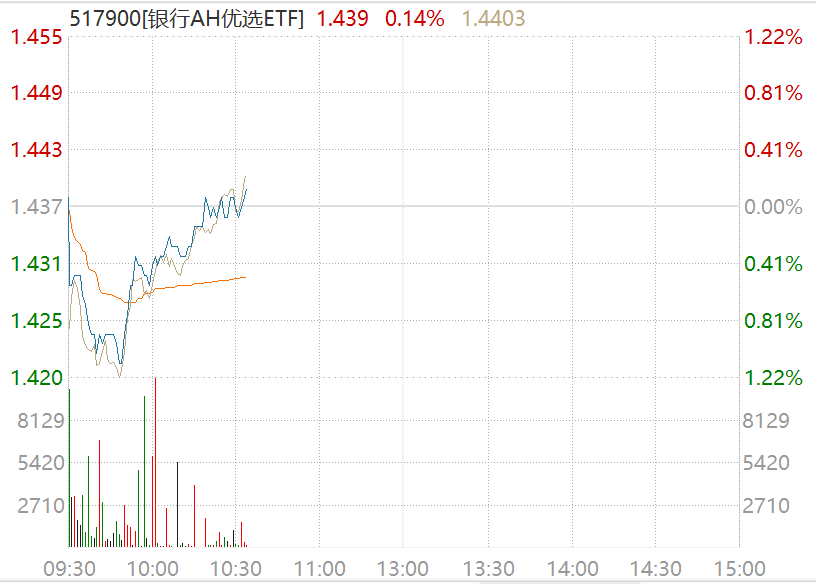
AMC机构16亿增持,浦发银行涨超4%!银行AH优选ETF(517900)逆市翻红
2 1 Shi Ji Jing Ji Bao Dao· 2025-10-13 03:35
Core Viewpoint - The banking sector is showing resilience amid market volatility, with defensive characteristics leading to positive performance, particularly for banks like Shanghai Pudong Development Bank, which saw a rise of over 4% [1][2]. Group 1: Market Activity and Investment Trends - Shanghai Pudong Development Bank disclosed that China Orient Asset Management Co. and its affiliates increased their stake in the bank by purchasing 134 million shares and convertible bonds, amounting to 1.675 billion yuan from September 20 to 29 [2]. - Since 2025, Asset Management Companies (AMCs) have significantly increased their investments in bank stocks, with China Cinda also acquiring shares in Shanghai Pudong Development Bank and gaining a board seat [2]. - Long-term capital inflows into the banking sector are expected to drive a systematic valuation recovery, as current bank stock valuations are low compared to their stable dividends and performance [2]. Group 2: Valuation and Performance Metrics - As of October 10, the banking sector's price-to-book (PB) ratio has fallen to 0.67x, with state-owned banks offering an average dividend yield of 4.11%, which is significantly higher than the yield on ten-year government bonds [3]. - The banking sector's dividend yield is reported at 4.8% for the AH index and 4.3% for the CSI banking index, indicating strong value for investors [3]. - In the first half of 2025, 42 A-share listed banks reported a total revenue of 2.92 trillion yuan, a year-on-year increase of 1%, and a net profit of 1.1 trillion yuan, up 0.8% [3][5]. Group 3: Operational Stability and Future Outlook - The banking sector has shown improvement in operational quality, with a non-performing loan ratio of 1.15%, reflecting a decrease of 1 basis point [3][5]. - The increase in the number of banks paying dividends to 17, with over half maintaining a payout ratio of 30% or more, highlights the sector's profitability [5]. - The outlook for the third quarter suggests a slight slowdown in revenue growth, but profits are expected to maintain a positive trend, emphasizing stability in the sector [5].