Antitrust

Search documents
Google gets to keep Chrome but is barred from exclusive search deals, judge rules
CNBC Television· 2025-09-02 21:15
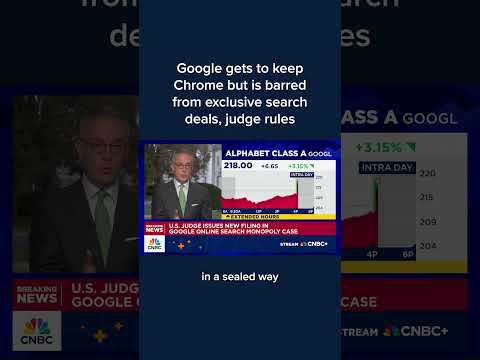
And we've got some movement in the Google anti-rust case. As you remember, we were waiting for a decision from a federal judge on ultimately whether or not to break up Google. That decision uh was expected by the end of August.We didn't get it. Well, today uh just within the past few moments, there has been a filing uh by the judge in that case, and it's a little bit nuanced because the the document here is redacted, meaning we can't see the full Google document filed by the judge just a couple of moments a ...


Google avoids break up, faces new oversight in search antitrust trial
TechCrunch· 2025-09-02 20:45
Core Viewpoint - A federal judge has ordered changes to Google's business practices to prevent anticompetitive behavior, but has not mandated a breakup of its search business [1][4]. Group 1: Court Orders and Remedies - U.S. District Court Judge Amit P. Mehta has outlined remedies that will prevent Google from entering exclusive deals that tie the distribution of its services to other apps or revenue arrangements [2]. - Google is required to share certain search index and user-interaction data with "qualified competitors" and must offer search and search ad syndication services at standard rates [3][4]. - A technical committee will be established to enforce the final judgment, which will last for six years and take effect 60 days after entry [4]. Group 2: DOJ's Position and Proposals - The Department of Justice (DOJ) had advocated for stronger penalties, including the divestiture of Google's Chrome browser and possibly Android, as well as ending agreements with major partners [5]. - The DOJ also requested that Google share its search index, user-side data, and ads data with competitors under privacy-protected terms [6]. Group 3: Market Context and Implications - Google has maintained approximately 90% market share in the traditional search market for the last decade and argues that the government's proposals could stifle innovation and jeopardize user privacy [8]. - Judge Mehta's decision may influence a separate antitrust trial related to Google's advertising technology business, with a remedies trial scheduled for late September [11]. - The ongoing legal proceedings may extend until late 2027 or early 2028, as appeals and potential escalations to the Supreme Court are anticipated [13].

Google can't have exclusive search deals — but won't have to divest Chrome or Android, judge rules in antitrust case
Business Insider· 2025-09-02 20:23
Core Viewpoint - A federal judge has ruled that Google operates a monopoly in the online search market and has imposed restrictions on its business practices, while not requiring divestiture of key assets like Chrome and Android [1][2][8]. Summary by Sections Legal Ruling - US District Judge Amit Mehta issued a 230-page ruling that prohibits Google from having exclusive contracts for its search and related products [1]. - The ruling concluded that Google must share search data with competitors, but it did not mandate the sale of Chrome or Android, which the Justice Department had sought [2][9]. Market Impact - Following the ruling, Alphabet shares increased by over 6% in after-hours trading, indicating a positive market reaction to the decision [2]. - The judge acknowledged the evolving landscape of online search due to advancements in general artificial intelligence, which influenced the remedies proposed [3][7]. Government's Position - The Justice Department had requested more stringent measures, including the divestiture of Chrome and the termination of exclusive agreements with major companies to make Google the default search engine [9][10]. - The DOJ argued that without eliminating Google's substantial payments, the company would continue to dominate search distribution opportunities [14]. Future Considerations - Google plans to appeal the ruling, which could prolong the legal process for years [14][15]. - The company faces additional antitrust challenges, including a ruling regarding its monopoly in online advertising technology markets [16].
Live Nation's Share-Price Reveals It As A Visionary, Not A Monopolist
Forbes· 2025-09-02 18:35
Core Points - The article discusses the ongoing antitrust case against Live Nation, highlighting the complexities of business decisions and the unpredictability of future outcomes [2][4][8] - It emphasizes that Live Nation's significant growth and success were achieved despite market skepticism and competition, showcasing the company's ability to foresee commercial opportunities that others did not [6][7][8] Group 1: Live Nation's Business Evolution - Live Nation has evolved into a multifaceted entity, functioning as a concert promoter, artist manager, venue owner, and ticket seller and reseller, which is a departure from its origins [3] - The company's journey involved numerous risks and uncertainties, with decisions made often accompanied by significant worry and doubt [5][6] Group 2: Financial Performance - Live Nation's stock price increased from $10.75 in December 2005 to $164 in 2025, representing a 1,430% return for investors, significantly outperforming the S&P 500's 400% return in the same period [6] - The substantial disparity in returns indicates that Live Nation's executives made successful decisions amid considerable market skepticism [6][7] Group 3: Antitrust Case Context - The antitrust lawsuit against Live Nation is framed as a response to its success rather than evidence of monopolistic behavior, suggesting that the company identified a commercial future that competitors failed to see [8] - The article argues that the lawsuit should be reconsidered, advocating for recognition of Live Nation's achievements rather than penalizing them [8]

European Commission to Impose ‘Modest' Penalties in Google AdTech Case
PYMNTS.com· 2025-08-29 23:45
Core Viewpoint - The European Commission is expected to impose a "modest" fine on Google in an antitrust case related to its AdTech business, without requiring the company to divest any part of its operations [1][2]. Summary by Relevant Sections Antitrust Case Details - The European Commission has accused Google of abusing its dominance in the online AdTech industry since 2014, alleging favoritism towards its own ad exchange, AdX, in auction matching [4]. - The fine is anticipated to be less than the 4.3 billion euros imposed in a previous case in 2018 [2]. Regulatory Approach - The new EU antitrust chief, Teresa Ribera, is reportedly focusing on encouraging companies to cease anti-competitive practices rather than imposing large fines [3]. Google's Position - Google contends that serving both advertisers and publishers is standard practice in the industry, and that competitors also operate similar AdTech businesses [5]. - In 2024, advertising revenue constituted 75.6% of Google's total revenue [5]. U.S. Legal Challenges - Google is also facing legal challenges in the United States, where a federal judge has ruled that the company unlawfully maintained monopolies in key areas of the online ad industry [6]. - The U.S. Justice Department has called for Google to divest significant components of its digital advertising business, including the AdX marketplace and DFP ad-serving platform, to restore competition [7].
X @Bloomberg
Bloomberg· 2025-08-29 19:56
Marfrig and Minerva are clashing over Uruguay beef plants at the center of an antitrust review — at a time when US tariffs are making those assets more valuable to the Brazilian meatpackers https://t.co/UQnwqlGfDe ...
Foot Locker Shareholders Approve Acquisition by Dick's Sporting Goods
PYMNTS.com· 2025-08-25 22:46
Core Viewpoint - Foot Locker shareholders have approved the acquisition by Dick's Sporting Goods, with 99% of votes cast in favor, indicating strong support for the deal [2][3]. Company Overview - The acquisition was announced on May 15, with an implied equity value of $2.4 billion and an enterprise value of $2.5 billion [3]. - Dick's plans to operate Foot Locker as a standalone business unit while maintaining its brands and enhancing store designs and omnichannel experiences [4]. Market Impact - If the acquisition is completed, Dick's would control over 15% of the U.S. sporting goods market, raising potential antitrust scrutiny due to the size of the deal and the companies' significant presence in the athletic footwear market [6]. Strategic Intent - Foot Locker's CEO expressed optimism about the acquisition, highlighting the potential to expand sneaker culture and improve customer experiences [3]. - Dick's Executive Chairman noted the opportunity for growth by applying operational expertise to Foot Locker, aiming to enhance its market position [5].



Musk's xAI sues Apple, OpenAI alleging antitrust violations
TechXplore· 2025-08-25 19:40
Core Argument - Elon Musk's companies xAI and X have filed a US antitrust lawsuit against Apple and OpenAI, alleging an illegal partnership aimed at stifling competition in the AI and smartphone markets [1][2]. Group 1: Lawsuit Details - The 61-page complaint, filed in Texas, accuses Apple and OpenAI of forming an exclusive deal that makes ChatGPT the only generative AI chatbot integrated into Apple's iPhone operating system, thereby blocking competitors like xAI's Grok [2]. - The lawsuit claims that Apple holds 65% of the US smartphone market, while OpenAI controls at least 80% of the generative AI chatbot market through ChatGPT [3]. - The partnership between Apple and OpenAI was announced in June 2024, allowing ChatGPT exclusive access to "billions of user prompts" from hundreds of millions of iPhone users [3]. Group 2: Allegations of Manipulation - The complaint alleges that Apple manipulated App Store rankings to favor ChatGPT and delayed updates to the Grok app [4]. - Musk's companies are seeking billions in damages and a permanent injunction against the alleged anticompetitive practices, along with a jury trial [4]. Group 3: Context and Background - The lawsuit follows a public feud between Musk and OpenAI CEO Sam Altman, with accusations of manipulation and dishonesty exchanged between the two [5][7]. - Musk founded xAI in 2023 to compete with OpenAI and other major AI players, which have invested heavily in AI since the launch of ChatGPT in late 2022 [8].


Musk quietly dropped xAI’s public benefit status while suing OpenAI, court filings show
CNBC Television· 2025-08-25 18:45
Antitrust Allegations & Legal Actions - XAI, Elon Musk's AI startup, is suing Apple and OpenAI for alleged antitrust violations, claiming they colluded to dominate the AI assistant market [2] - The lawsuit alleges Apple manipulates App Store rankings to disadvantage AI chatbots competing with OpenAI's ChatGPT, giving OpenAI an unfair advantage [3] - Musk seeks billions of dollars in damages and a court order to halt the alleged anti-competitive practices [3] - The core issue extends beyond app store rankings to the future of search, particularly concerning Google's default search engine status on Apple devices [4] AI Market Dynamics & Competition - OpenAI's search market share has reportedly doubled in the last 6 months [4] - Musk aims to ensure Grock, XAI's AI offering, remains relevant in the AI conversation [5] - Musk co-founded OpenAI with Altman 10 years ago but left due to disagreements over its direction, later launching XAI in 2023 to compete [5] XAI's Corporate Structure & Evolution - XAI was initially founded as a public benefit corporation legally obligated to comply with the public good, but it quietly lost that status last year [6] - OpenAI is restructuring into a public benefit corporation to comply with stipulations of a SoftBank-led $40 billion fundraising [7]
Musk's XAI Sues Apple And OpenAI, Alleging App Store Collusion
Forbes· 2025-08-25 16:15
Core Viewpoint - Elon Musk's AI startup xAI has initiated legal action against Apple and OpenAI, alleging that the companies have "colluded" to suppress competition and hinder other AI firms from achieving prominence in the App Store, fulfilling Musk's previous claims of an "unequivocal antitrust violation" [1] Group 1 - xAI filed the lawsuit in conjunction with X Corp, the parent company of the social media platform [1]