DFP

Search documents
Atlantic mag sues Google, accusing tech giant of rigging digital ad market
New York Post· 2026-01-14 20:28
Core Argument - The Atlantic has filed a lawsuit against Google, alleging monopolization of the digital advertising market through deceptive practices and antitrust violations [1][2][9] Allegations Against Google - The lawsuit claims that Google and its parent company Alphabet have manipulated the digital advertising market via secret auction schemes and illegal tying, which have resulted in significant revenue losses for publishers [2][9] - The Atlantic alleges that Google conditioned access to its AdX ad exchange on the mandatory use of its own ad server, effectively eliminating competition and leaving publishers with no alternatives [5][7] Antitrust Violations - Central to the case is the allegation of illegal "tying," where a dominant company forces customers to use a second product they might not choose otherwise [4] - The complaint describes Google's actions as a "sophisticated, anticompetitive, and deceptive scheme" that has been ongoing for over a decade, likening it to insider trading [7] Financial Impact - The lawsuit cites an internal analysis indicating that Google's practices could depress a publisher's revenue by "upwards of 40%" [12] - The Atlantic claims that Google's actions have led to "dramatically less revenue for publishers," while Google reportedly made $30 billion in profits in 2022 [13] Legal Context - The Atlantic's lawsuit was filed in Manhattan federal court and follows a similar complaint from Penske Media Corporation and SheMedia, both represented by the same law firm [14][17]



谷歌广告跌倒,亚马逊吃饱
Hu Xiu· 2025-09-25 05:35
Core Points - The Google advertising monopoly case has entered the "remedial phase," where the court will determine how to rectify the identified anti-competitive behaviors [1][3] - The presiding judge, Leonie Brinkema, will decide on several key issues regarding the future of Google's advertising practices and market structure [4][5][6][7] Group 1: Remedial Phase Details - The remedial phase aims to ensure the market is free from anti-competitive behaviors, correcting past actions and preventing future manipulation [4] - Key decisions include whether to dismantle Google's core assets, specifically AdX and DFP, or to impose regulatory changes to limit their power [5] - The court will also consider if Google can continue to profit from its dominant position and how to prevent the re-emergence of similar monopolistic structures [6][7] Group 2: Timeline and Case Background - The remedial phase is expected to last until the end of September or early October, followed by a briefing period that could extend to late October or early November [8] - The case against Google can be divided into two main lines: the search engine market and the advertising technology market, with the latter being the focus of the current proceedings [9][10] Group 3: Industry Reactions and Lawsuits - Following the court's ruling on Google's monopoly, there has been a surge in lawsuits from both competitors and media publishers, indicating a shift in industry sentiment against Google [24][27] - Companies like OpenX and PubMatic have initiated lawsuits against Google, claiming unfair practices that have harmed their businesses [30] - Media organizations, previously reliant on Google, are now also pursuing legal action, alleging that Google has reduced their advertising revenues without their knowledge [33][34] Group 4: Potential Outcomes and Market Dynamics - The court may opt for a compromise solution rather than a complete breakup of Google's advertising business, focusing on structural adjustments and regulatory limitations [43][44] - Amazon is positioned to capitalize on any shifts in the advertising landscape, expanding its advertising capabilities and potentially becoming a major competitor to Google [49][50][55] - The transition of advertising budgets from Google to Amazon is not guaranteed, as the competition for advertising dollars remains intense and complex [61][62]
欧洲头条丨欧美数字主权之争加深跨大西洋裂痕
Yang Shi Xin Wen· 2025-09-12 05:02
Group 1 - The European Commission, led by President Ursula von der Leyen, remains firm on regulating large US tech companies despite threats from President Trump regarding tariffs, indicating escalating tensions between the US and EU over tech regulation [1][10] - The EU has imposed a record fine of €29.5 billion on Google for violating antitrust regulations in the advertising technology sector, marking the fourth significant penalty against the company [2][3] - The total fines imposed on Google by the EU have reached €9.5 billion, with previous fines for abuses in shopping, Android, and advertising practices [3][7] Group 2 - The EU has demanded that Google propose a viable remedy within 60 days, or face mandatory measures, while Google plans to appeal the decision [7][10] - Trump's administration has expressed strong dissatisfaction with the EU's actions, threatening to initiate a Section 301 investigation into what it deems unfair trade practices by the EU [7][8] - The ongoing conflict highlights a deeper divide in digital regulations, with the EU aiming to assert digital sovereignty and the US tech giants accusing the EU of overreach and discrimination [10][11] Group 3 - The EU's recent decision to impose a fine rather than enforce a forced divestiture of Google's business has sparked internal criticism, with some arguing that fines alone will not change Google's monopolistic behavior [16][17] - The EU faces challenges in balancing external pressures from the US and internal divisions among member states regarding trade interests and regulatory strategies [14][18] - The ongoing battle over digital sovereignty is seen as a critical test of the EU's global governance capabilities and strategic autonomy in the face of US pressure [18]

European Commission to Impose ‘Modest' Penalties in Google AdTech Case
PYMNTS.com· 2025-08-29 23:45
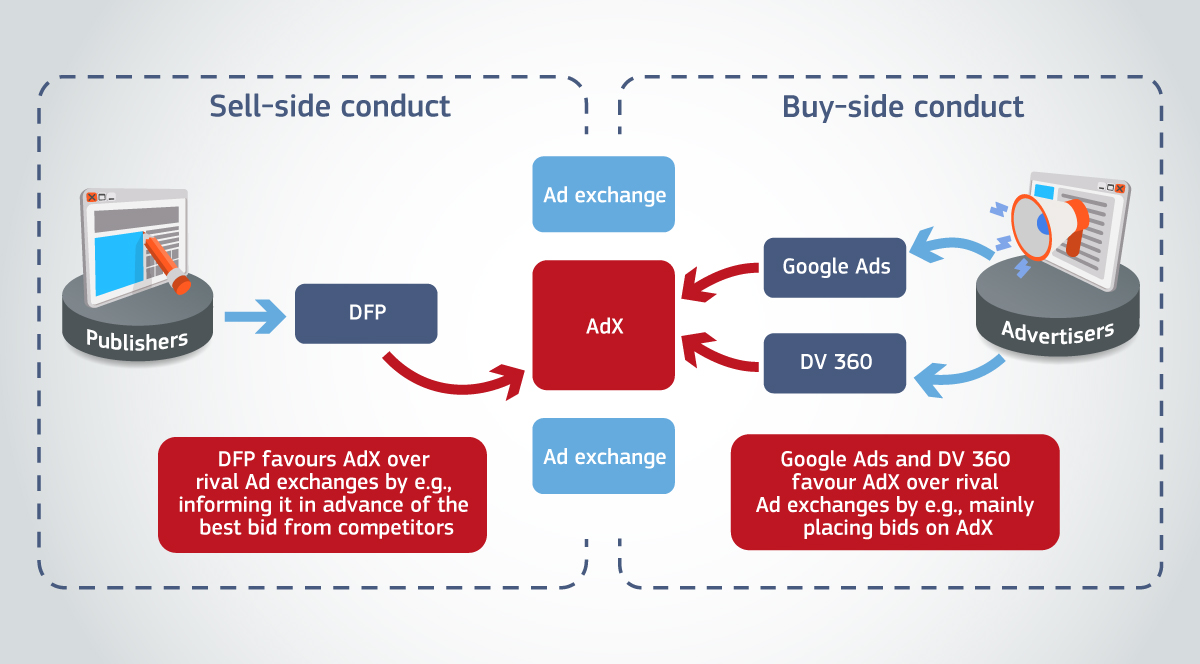
Core Viewpoint - The European Commission is expected to impose a "modest" fine on Google in an antitrust case related to its AdTech business, without requiring the company to divest any part of its operations [1][2]. Summary by Relevant Sections Antitrust Case Details - The European Commission has accused Google of abusing its dominance in the online AdTech industry since 2014, alleging favoritism towards its own ad exchange, AdX, in auction matching [4]. - The fine is anticipated to be less than the 4.3 billion euros imposed in a previous case in 2018 [2]. Regulatory Approach - The new EU antitrust chief, Teresa Ribera, is reportedly focusing on encouraging companies to cease anti-competitive practices rather than imposing large fines [3]. Google's Position - Google contends that serving both advertisers and publishers is standard practice in the industry, and that competitors also operate similar AdTech businesses [5]. - In 2024, advertising revenue constituted 75.6% of Google's total revenue [5]. U.S. Legal Challenges - Google is also facing legal challenges in the United States, where a federal judge has ruled that the company unlawfully maintained monopolies in key areas of the online ad industry [6]. - The U.S. Justice Department has called for Google to divest significant components of its digital advertising business, including the AdX marketplace and DFP ad-serving platform, to restore competition [7].