Machine Learning

Search documents
Overlooked Stock: PL Soars on Earnings, Upped Guidance & Government Funds
Youtube· 2025-12-11 22:42
Core Viewpoint - Planet Labs' stock surged 34% following the release of its latest earnings report, which included an increase in sales guidance for the full year [2][5]. Company Performance - Planet Labs operates the largest fleet of Earth orbit satellites, providing satellite imagery and geospatial data on a subscription basis [3]. - The company reported a break-even profit on an adjusted basis, which was better than the expected loss of 4 cents per share [4]. - Revenue for the quarter reached $81 million, exceeding estimates by $9 million and representing a 30% increase from $62 million in the same quarter last year [5]. Future Guidance - The company raised its revenue guidance for the next quarter to a range of $76 million to $80 million, with a conservative estimate of $78 million [5][6]. Sector Growth - Planet Labs is increasingly focusing on the government sector, having secured a contract with a European surveillance defense company, which contributed to growth [6]. - Revenue from the defense sector has shown significant year-over-year growth, offsetting some declines in the commercial segment due to seasonality [7][12]. Competitive Landscape - Competitors in the geospatial services market include private sector companies like Blue Sky and Safe Logic, but Planet Labs maintains a unique position due to its partnerships, such as with Google for geospatial data [9][10]. Stock Performance - The stock has appreciated by 350% over the past year, reflecting strong demand for surveillance programs associated with government and defense [12][14]. - The company is on a path toward consistent profitability, which is attracting investor attention [14].



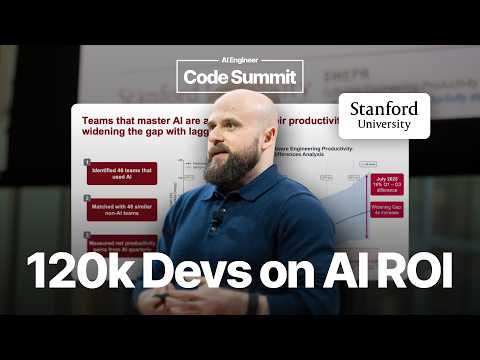
Can you prove AI ROI in Software Engineering? (120k Devs Study) – Yegor Denisov-Blanch, Stanford
AI Engineer· 2025-12-11 21:56
[music] So companies spend millions on AI tools for software engineering. But do we actually know how well these tools work in the enterprise or are these tools just all hype. To answer this and for the past two years, we've been researching the impact of AI on software engineering productivity.And our research is time series because we look at get historical data, meaning we can go back in time. And it's also cross-sectional because we cut across companies. And the way we use to measure most of the of the ...
5 Life Insurers Stocks to Buy in a Low-Interest Rate Environment
ZACKS· 2025-12-11 18:25
Core Insights - The life insurance industry is focusing on redesigning and repricing products to maintain sales and profitability, with increased automation expected to drive premium growth and efficiency [1][5] - The Federal Reserve's recent interest rate cut to 3.5%-3.75% poses challenges for life insurers as they invest premiums to meet guaranteed obligations [1][3] - The life insurance market is projected to grow, with gross written premiums expected to reach $1.34 trillion by 2025 and $2.5 trillion by 2026 [2][4] Industry Overview - The Zacks Life Insurance industry includes companies providing life insurance and retirement benefits, with a growing demand for protection products driven by an increasing number of baby boomers [2] - Economic growth is fostering confidence in the market, although rising mortality costs may impact profitability [2] Trends Impacting the Industry - Interest rates have been lowered, which may weigh on investment returns for life insurers, but could also relieve pressure on indexed universal life and whole life sales [3] - Product redesigning is leading to a shift away from long-duration term life insurance, with a focus on investment products that offer bundled covers [4] - The adoption of technology is increasing, with insurers leveraging digital platforms and AI to enhance efficiency and reduce operational costs [5] Market Performance - The life insurance industry has underperformed compared to the S&P 500 and the Finance sector, with a year-to-date gain of 4.7% compared to 15% for the Finance sector and 18.6% for the S&P 500 [9] - The industry's current price-to-book (P/B) ratio is 1.89X, significantly lower than the S&P 500's 8.51X and the Finance sector's 4.22X [11] Company Highlights - Jackson Financial (Zacks Rank 1) is expected to grow due to diversified product sales and a strong contribution from Registered Index-Linked Annuities [15][16] - F&G Annuities & Life (Zacks Rank 1) is evolving into a fee-based, higher-margin business, capitalizing on demographic trends and untapped market demand [20] - AIA Group (Zacks Rank 2) benefits from a strong agent force and a shareholder-friendly capital return program, with earnings expected to grow [25] - Manulife Financial (Zacks Rank 2) is well-positioned for growth due to its strong Asia business and investments in digital capabilities [28] - Lincoln National (Zacks Rank 2) is expected to benefit from a recovering Group Protection business and pricing discipline [32]


Howard Marks Worries About What AI Is Doing to Society
Bloomberg Television· 2025-12-11 17:03
Well, I think that the the unproductive bubbles I would describe as financial fads. Portfolio insurance was one, subprime mortgages was another. Just, you know, financial activities that become fashionable, zoom into popularity, get overhyped and then recede.But then there are bubbles which are based on technological progress, starting with the steam engine, the railroad, the radio, the automobile, computers, internet, etc.. And these actually push society ahead and change it irreversibly. But in the proces ...

Freight Technologies Announces Third Quarter 2025 Results
Globenewswire· 2025-12-11 14:36
Core Insights - Freight Technologies, Inc. is advancing its transition towards a software- and AI-driven logistics model, enhancing automation and real-time intelligence across its solutions [2][5] - The company has improved its operating performance despite challenges such as elevated tariffs and cross-border uncertainties, focusing on product innovation and execution [2][5] - For the full year 2025, the company expects revenue between $12 million and $14 million, with an operating loss projected between $5.5 million and $6.5 million [5] Business Highlights - The AI Lab developed autonomous voice-agent capabilities for the Zayren platform, improving automation and accuracy [2] - Fleet Rocket's adoption is expanding, with more customers integrating the platform into their operations [2] - The company has established new tracking integrations to enhance real-time geolocation data for shippers and carriers across North America [7] Financial Highlights - In Q3 2025, the operating loss improved year-over-year by $0.4 million, from $1.7 million in Q3 2024 to $1.3 million in Q3 2025, driven by a higher-margin brokerage business and lower operating expenses [7] - Year-to-date operating loss improved by $1.2 million from $5.5 million in YTD 2024 to $4.3 million in YTD 2025 [7] - Revenue for Q3 2025 was $2.46 million, compared to $1.89 million in Q3 2024, while total costs and expenses increased from $3.59 million in Q3 2024 to $3.79 million in Q3 2025 [12] Cash Flow and Balance Sheet - As of September 30, 2025, the company reported cash and cash equivalents of $291,940, an increase from $204,032 at the end of 2024 [15] - Total assets increased to $12.20 million from $5.69 million at the end of 2024, reflecting improved working capital and capital structure management [15][16] - The company has strengthened its equity position and increased cash balances while lowering interest expenses [7]


5 Mid-Cap Financial Technology Stocks to Buy on Recent Fed Rate Cut
ZACKS· 2025-12-11 14:31
Core Insights - The Federal Reserve has reduced the benchmark interest rate by 25 basis points to a range of 3.5-3.75%, marking a total reduction of 75 basis points in 2025 after a 1% cut in 2024, and will begin purchasing $40 billion in Treasury Bills [1] Group 1: Fintech Sector Performance - The fintech sector's performance is inversely related to interest rate movements, benefiting from a low-interest-rate environment which supports technological improvement and product innovation [2] - The expansion of mobile and broadband networks, along with advancements in AI and machine learning, positions fintech for significant growth, enhancing banking, payments, and investment solutions [3] Group 2: Recommended Fintech Stocks - Five mid-cap fintech stocks are recommended for investment: EVERTEC Inc. (EVTC), Enova International Inc. (ENVA), LendingClub Corp. (LC), OppFi Inc. (OPFI), and Bread Financial Holdings Inc. (BFH), all of which have favorable Zacks Ranks [4][9] - These stocks are expected to benefit from the Fed's rate cut, with improved earnings estimates for the upcoming year amid growing fintech demand [9] Group 3: Company-Specific Insights - **EVERTEC Inc. (EVTC)**: Engaged in transaction processing primarily in Latin America and the Caribbean, with expected revenue and earnings growth rates of 5.3% and 4% respectively for next year [7][10] - **Enova International Inc. (ENVA)**: Provides online financial services with expected revenue and earnings growth rates of 15.8% and 10.5% respectively for next year [11][12] - **LendingClub Corp. (LC)**: Offers an online marketplace for loans, with expected revenue and earnings growth rates of 13.2% and 35.7% respectively for next year [13] - **OppFi Inc. (OPFI)**: Provides a financial technology platform for consumer credit access, with expected revenue and earnings growth rates of 9.1% and 8.6% respectively for next year [14] - **Bread Financial Holdings Inc. (BFH)**: Focuses on personalized financial solutions, with expected revenue growth of 3.3% and a decline in earnings of -9.6% for next year [15][17]






X @Forbes
Forbes· 2025-12-11 14:30
5 Ways AI Will Transform The Manager Role In 2026The leaders who succeed in the coming year won't be machine learning experts. They'll be the ones who grasp how AI transforms human work and can guide their teams through that shift with clarity, empathy and humility.Here are five ways AI will transform the role of manager in 2026. https://t.co/IUlDKo0CKD ...
Braiin Ltd(BRAI) - Prospectus(update)
2025-12-11 14:02
As filed with the Securities and Exchange Commission on December 11, 2025 Registration No. 333-291410 UNITED STATES SECURITIES AND EXCHANGE COMMISSION Washington, D.C. 20549 Amendment No. 1 to FORM F-1 REGISTRATION STATEMENT UNDER THE SECURITIES ACT OF 1933 Braiin Limited (Exact Name of Registrant as Specified in its Charter) (State or other jurisdiction (Primary Standard Industrial Classification Code Number) Australia 6770 98-1850021 (I.R.S. Employer Identification No.) 283 Rokeby Road Subiaco, Western Au ...
NextNRG Signs 28-Year Microgrid Power Purchase Agreement with Topanga Terrace, Further Advancing Its Expansion into Healthcare Energy Infrastructure
Globenewswire· 2025-12-11 14:00
Core Insights - NextNRG has signed a 28-year Power Purchase Agreement (PPA) with Topanga Terrace Rehabilitation & Subacute Care Center, enhancing its long-term, asset-backed revenue pipeline [1][3] - The Topanga PPA is projected to generate approximately $3.85 million in gross revenue over its term, with a 2% annual rate escalator [2][3] - The agreement positions NextNRG as a key player in the healthcare microgrid sector, which is expected to see significant growth due to increasing demand for reliable power solutions [3][4] Company Overview - NextNRG specializes in AI-driven energy solutions, focusing on integrating renewable energy sources, battery storage, and backup generation systems [1][8] - The company aims to eliminate high capital expenditures for healthcare facilities by providing predictable energy pricing and full system redundancy [5][7] - NextNRG's Utility Operating System (UOS) and SmartGrid AI platform enhance its technological leadership in energy management [5][9] Market Dynamics - The healthcare sector, including over 15,000 nursing homes and 32,000 assisted-living communities, represents a multi-billion-dollar opportunity for resilient power solutions [3][4] - Regulatory standards are tightening, requiring long-term care facilities to maintain backup power for essential systems, driving demand for microgrid solutions [4] - NextNRG's model is well-positioned to meet the immediate demand for dependable, multi-source microgrid solutions in this sector [4][6] Project Details - The Topanga microgrid will feature approximately 350–380 kW of rooftop solar, a 250 kW / 1,000 kWh lithium-ion battery energy storage system, and integration with existing natural gas backup generation [6][12] - NextNRG will own, operate, and maintain the microgrid for the duration of the agreement, utilizing third-party financing to avoid upfront costs for the facility [7]

NetraMark Continues Expansion Into Phase 3 Programs With Contract From Global Biopharmaceutical Company
Globenewswire· 2025-12-11 13:30
Core Insights - NetraMark Holdings Inc. has secured a new contract with a global biopharmaceutical company to provide analytics support for a pivotal Phase 3 clinical trial, highlighting the company's growing influence in the pharmaceutical sector [1][2]. Group 1: Contract and Project Details - The new engagement is part of an existing master services agreement and represents a discrete project aimed at enhancing decision support in Phase 3 trials, showcasing the increasing interest in NetraAI technology [2][4]. - NetraMark will utilize its NetraAI platform to identify and characterize patient subpopulations, including responders and non-responders, which will aid in interpreting treatment response patterns and variability within the study population [3][4]. Group 2: Technology and Methodology - NetraAI is designed to separate small datasets into explainable and unexplainable subsets, which helps avoid overfitting and enhances the accuracy of insights derived from clinical trials [5][6]. - The technology's unique focus mechanisms allow for better segmentation of diseases and classification of patient responses, thereby increasing the likelihood of clinical trial success [5][6]. Group 3: Company Position and Future Outlook - The CEO of NetraMark emphasized the growing trust from biopharmaceutical companies in the value of explainable AI for high-stakes development programs, indicating a positive trajectory for the company's future engagements [4][7]. - This contract reinforces NetraMark's position in AI-powered clinical trial optimization and suggests potential for further growth as the company becomes integrated into standard operating procedures of biopharmaceutical firms [4][7].