农信社改革

Search documents
一省级农信联社理事长到访内蒙古农商银行畅谈农信改革
Zheng Quan Ri Bao· 2025-07-17 07:44
Core Insights - Inner Mongolia Rural Commercial Bank has set a record for the fastest reform in rural financial institutions in China, consolidating 121 entities into a unified legal entity bank, marking a new chapter in the region's rural cooperative finance history [2] - The bank aims to become a pillar of the financial industry in Inner Mongolia by innovating its systems, management, and operational models [2] - The reform model of Inner Mongolia serves as a reference for other provinces, demonstrating effective resource integration and optimization while efficiently managing non-performing assets [2] Company Overview - Inner Mongolia Rural Commercial Bank was established in May this year through the merger of the Inner Mongolia Rural Credit Cooperative Union and 93 county-level rural credit institutions, along with 26 newly established village and town banks [1] - The bank's establishment reflects a significant shift in the rural financial landscape, aiming for comprehensive modernization [2] Industry Context - The reform in Inner Mongolia is seen as a potential blueprint for other provinces, showcasing how to attract diverse capital and create a stable, multi-faceted shareholder structure [2] - The innovative approach taken by Inner Mongolia's rural financial institutions has the potential to reshape the operational dynamics of rural credit systems across the country [2]
广东农信系统改革关键年,“75后”刘鹏任广东省联社主任!已有十地农信社改革落地
Xin Lang Cai Jing· 2025-06-06 11:33
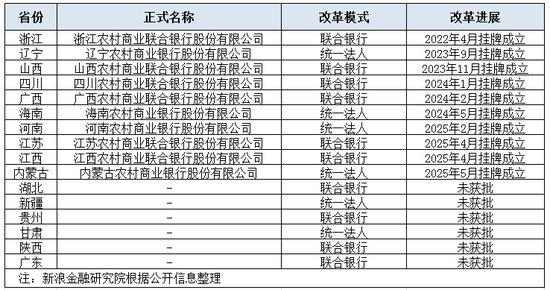
Core Viewpoint - The Guangdong Rural Credit Cooperative Union (Guangdong Union) is undergoing significant personnel changes and accelerating reforms, including the establishment of rural commercial banks, as part of a broader initiative to enhance the financial system in the province [1][7]. Personnel Changes - Liu Peng has been approved to serve as the director of Guangdong Union, previously holding the position of deputy mayor in Jieyang City [1][3]. - The former director, Mai Yanthou, was promoted to chairman in October 2022, and the director position has remained vacant since then [6]. Reform Initiatives - The Guangdong Union's 2024 report emphasizes the need for management system reforms and the establishment of rural commercial banks, marking the first official announcement of this initiative since the start of the new round of rural credit system reforms [7]. - The Guangdong government has been actively promoting the reform of rural credit cooperatives, with a focus on enhancing financial service capabilities in economically weaker regions [8]. Financial Performance - As of the last report, the total assets of 81 rural commercial banks in Guangdong reached 4.8 trillion yuan, reflecting a year-on-year growth of 3.79%. However, financial income and profits have seen declines of 3.6% and 14.7%, respectively, marking two consecutive years of downturns [9]. Broader Context of Reform - The reform of rural credit cooperatives is being implemented across multiple provinces, with ten provinces having already made progress. These include Zhejiang, Liaoning, Shanxi, Sichuan, Guangxi, Hainan, Henan, Jiangsu, Jiangxi, and Inner Mongolia [10]. - Various provinces are adopting different models for reform, with many opting for the "joint bank" model, which is seen as cost-effective and preserves multi-level governance structures [11][12].

内蒙古农商行正式挂牌,580亿资本重构区域金融新格局
Guan Cha Zhe Wang· 2025-05-29 06:38
Core Insights - The establishment of Inner Mongolia Rural Commercial Bank marks a significant step in the financial reform of Inner Mongolia, integrating 121 rural credit institutions and village banks into a unified provincial legal entity [1][3][9] Group 1: Bank Formation and Structure - Inner Mongolia Rural Commercial Bank was officially opened on May 27, with a registered capital of 58.02 billion yuan, making it one of the largest provincial rural commercial banks in China [1][2] - The bank's total assets amount to 928.8 billion yuan, with deposits of 777.8 billion yuan and loans of 440.5 billion yuan, positioning it as the largest local legal bank in Inner Mongolia [1][2] - The bank has a diverse shareholder structure, including the Inner Mongolia Rural Finance Association and several state-owned enterprises, ensuring a solid capital base and support for its operations [1][4][6] Group 2: Organizational Framework - The bank has established a comprehensive organizational structure with 23 functional departments, 3 regional audit centers, 14 central branches, and 103 county-level branches, supported by over 2,000 service outlets and approximately 30,000 employees [2][6] Group 3: Integration and Reform Model - The integration process was completed in just 90 days, a rapid pace compared to typical reforms in the rural credit system, aiming to consolidate resources and improve operational efficiency [3][9] - The reform aims to address issues of resource fragmentation and management challenges associated with the previous decentralized system, enhancing risk management capabilities [3][4] Group 4: Service and Development Focus - The bank intends to provide consistent financial services across different regions, addressing disparities caused by the previous fragmented structure, and focusing on supporting rural key sectors and small enterprises [7][8] - It plans to leverage technology to create an integrated online and offline service platform, enhancing accessibility for rural clients and promoting financial literacy [7][8] Group 5: Economic Impact and Future Outlook - Inner Mongolia Rural Commercial Bank aims to support local industries, particularly in dairy and livestock sectors, by providing comprehensive financial services to enhance competitiveness [8] - The bank's establishment is expected to reshape the regional financial landscape, potentially prompting other financial institutions to innovate and optimize their services in response to increased competition [8][9]

农信改革方程式:两种解法的实践验证
Zhong Guo Zheng Quan Bao· 2025-05-28 20:35
Core Viewpoint - The reform of rural credit cooperatives is accelerating across multiple regions in China, with Inner Mongolia's establishment of a unified legal entity rural commercial bank serving as a model for other areas [1][3]. Group 1: Reform Progress - Inner Mongolia Rural Commercial Bank officially opened on May 27, with a registered capital of 58.017 billion yuan [1]. - Various regions, including Zhejiang, Shanxi, Liaoning, Sichuan, Guangxi, and Hainan, have implemented reform plans for rural credit cooperatives [1][4]. - The reform approaches vary by region, with Inner Mongolia adopting a "one-step integration" model, while others like Liaoning and Henan are taking a phased approach [3][4]. Group 2: Shareholding Structure - Inner Mongolia Rural Commercial Bank has 27,700 natural person shareholders holding 19.01% of the total shares, while 145 legal entity shareholders hold 80.99% [2]. - Major shareholders include Inner Mongolia Financial Asset Management Co., Erdos Municipal Finance Bureau, and Inner Mongolia Autonomous Region Finance Department, each holding significant stakes [2]. Group 3: Challenges and Goals - The bank's chairman emphasized the need for substantial reforms in governance, risk management, and addressing historical issues [3]. - The lack of financial support for local risk management is a significant challenge, highlighting the need for effective capital injection and management [3][6]. - The overarching goal of the reforms is to enhance capital strength, improve governance mechanisms, and focus resources on rural revitalization [6][7]. Group 4: Implementation Difficulties - The implementation of a unified legal entity model faces challenges due to varying asset scales and quality among rural credit cooperatives [5][6]. - The reform aims to clarify the shareholding structure and governance systems while addressing the historical burdens of non-performing assets [6][7]. - Experts suggest that successful reform requires a focus on sustainable development, risk management, and digital transformation to meet rural financial needs [7].
内蒙古农商银行一步整合120家机构,全国农信社改革落地省份扩至10个
Xin Lang Cai Jing· 2025-05-27 01:01
Core Points - Inner Mongolia Rural Commercial Bank has officially completed its establishment and will commence operations on May 27, 2025, marking a significant advancement in the rural credit cooperative reform in Inner Mongolia [1][5] - The bank is the first provincial-level unified legal entity bank in China to integrate 120 rural credit institutions and village banks in one go [1][6] Summary by Sections Establishment and Capitalization - Inner Mongolia Rural Commercial Bank was registered on May 17, 2025, with a registered capital exceeding 58 billion yuan [1][5] - The bank's establishment involved the merger of 93 rural credit legal entities and 26 village banks, totaling 120 institutions [6][8] Reform Progress - As of May 2025, 10 provinces, including Zhejiang, Liaoning, Shanxi, Sichuan, Guangxi, Hainan, Henan, Jiangsu, and Jiangxi, have established provincial-level rural commercial banks or rural commercial joint banks [9][10] - The reform of rural credit cooperatives is accelerating, with various models being explored, including unified legal entity banks and provincial rural commercial joint banks [6][9] Asset Management and Risk Control - During the preparatory phase, the bank prioritized the recovery of non-performing assets, holding multiple meetings to strategize on asset recovery [4][5] - The bank's establishment is part of a broader initiative to address risks in small financial institutions, as highlighted in recent government reports [9][11] Historical Context - The Inner Mongolia Rural Credit Cooperative Union was established in August 2005, with 93 legal entities prior to the merger, including 37 rural commercial banks and 3 rural cooperative banks [8] - The total assets of the Inner Mongolia rural credit system reached 883.3 billion yuan by the end of 2024, with deposits growing by 6.2% and loans by 4.6% [8]
内蒙古农商银行正式设立筹备期重点攻坚不良清收
Zhong Guo Zheng Quan Bao· 2025-05-22 21:02
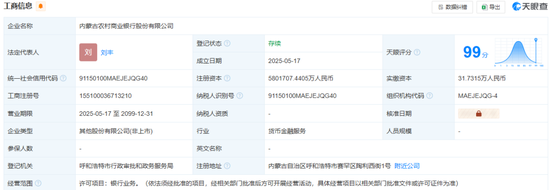
Core Viewpoint - The establishment of Inner Mongolia Rural Commercial Bank marks a significant step in the reform of rural financial institutions in Inner Mongolia, with a registered capital of 58.017 billion yuan and a focus on improving asset recovery processes [1][2]. Group 1: Establishment and Significance - Inner Mongolia Rural Commercial Bank was officially established on May 17, with a registered capital of 58.017 billion yuan, indicating a new phase in the reform of rural credit cooperatives in the region [1]. - The establishment is part of a broader national effort to deepen financial reforms, with the bank's formation expected to enhance the financial landscape in Inner Mongolia [1][2]. - The bank's preparatory work began in 2024, involving 120 legal entities and nearly 900 billion yuan in assets within the Inner Mongolia rural credit system [1]. Group 2: Focus on Non-Performing Assets - The bank's leadership has prioritized the recovery of non-performing assets, with multiple meetings held to address asset recovery strategies and challenges [2]. - A systematic approach to categorizing non-performing assets has been emphasized, with plans to create at least eight categories for targeted recovery efforts [2][3]. - The bank aims to establish a regular reporting mechanism to ensure accountability and progress in asset recovery initiatives [2]. Group 3: Reform and Risk Management - The reform of rural small and medium-sized banks is being implemented amid various challenges, with a focus on clarifying responsibilities and enhancing management practices [3]. - The financial regulatory authority has outlined plans to tackle risks in the banking sector, aiming for high-quality completion of reform tasks and effective risk prevention strategies [3][4]. - The approach to reform is expected to vary by region, with a need for tailored strategies to address local conditions and challenges [3].
大消息!又一省级银行来了
Zhong Guo Ji Jin Bao· 2025-05-20 07:39
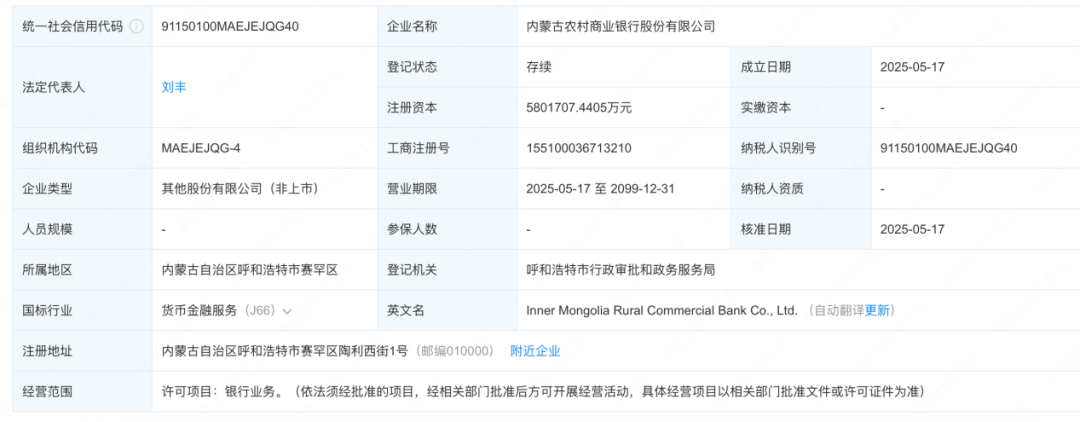
Core Points - Inner Mongolia Rural Commercial Bank has officially been established with a registered capital exceeding 58 billion yuan [1][2] - The bank's establishment is part of a larger reform initiative within the Inner Mongolia rural credit system, which includes the merger of 120 institutions into a unified legal entity [4][5] - The bank aims to achieve significant operational metrics within 3 to 5 years, positioning itself among the top 30 provincial rural financial institutions in China [5] Company Overview - The legal representative of Inner Mongolia Rural Commercial Bank is Liu Feng, and it was registered on May 17, 2025 [2] - The bank's business scope includes banking services, subject to regulatory approvals [2] - The bank is located in Hohhot, Inner Mongolia, and is classified as a non-listed joint-stock company [2] Industry Context - The establishment of Inner Mongolia Rural Commercial Bank is part of ongoing reforms in the rural credit system, which have been emphasized in recent national policies aimed at risk mitigation for small financial institutions [7] - The reform model adopted in Inner Mongolia is unique, involving a comprehensive merger of various rural financial entities, differing from approaches taken in other provinces [4] - The financial regulatory authority has been actively promoting the restructuring and risk management of rural credit institutions across the country [7]
中小银行改革化险稳步推进
Jing Ji Ri Bao· 2025-05-15 22:05
Group 1: Core Insights - The recent establishment of multiple rural commercial banks in China signifies a new phase in the development of the rural financial system, laying a solid foundation for rural financial reform [1][2] - The reform of rural credit cooperatives is a crucial driver for enhancing financial services to the real economy, with a focus on the unified legal person model and cooperative bank model as mainstream directions [2][3] - The "one province, one policy" strategy is essential for the reform of rural credit cooperatives, allowing for tailored solutions based on local conditions and challenges [3] Group 2: Financial Services and Challenges - Rural small and medium-sized banks play a vital role in serving agriculture, small enterprises, and local residents, particularly in underdeveloped regions where large banks have limited presence [4][5] - Despite a steady increase in agricultural loans, challenges remain for small banks, including intensified competition from larger banks and the lack of collateral among their primary clients [4][6] - Financial institutions are encouraged to optimize agricultural credit services by developing tailored financial products and improving loan approval processes to better meet local needs [6][7] Group 3: Risk Management and Governance - The stability of small and medium-sized banks is critical for the overall financial system, necessitating a focus on both addressing existing risks and preventing future issues [7][8] - Effective governance structures and clear accountability are essential for managing risks, with regulatory bodies urged to enhance their oversight capabilities [8][9] - Local governments and financial regulators must coordinate resources to address specific challenges faced by rural financial institutions, such as asset quality and capital structure [9]
农信社改革需要平衡四个关系|宏观经济
清华金融评论· 2025-05-02 10:37
文/中国国际经济交流中心博士后研究员、中邮理财有限责任公司高级投资经理 卜振兴 农信社当前存在的公司治理结构不完善、风险防控能力差等问题,背后体 现的是定位不清的问题。而农信社在改革中找准定位需要处理四个关系, 即顶层设计与自主探索的关系,商业运作与历史定位的关系,服务当地与 跨区域经营的关系,以及业务发展与风险防范的关系。处理好这四个关系 也就能找准农信社发展的定位,把握农信社改革发展的方向。 农信社是我国农村金融体系的重要组成部分,在推动农业农村建设,推动农民增收方面发挥了极其重要 的作用。党的十八大以来,农信社的改革发展进入一个新的阶段,尤其是2020年以来,农信社改革更进 一步。农信社当前存在的公司治理结构不完善、风险防控能力差等问题,背后体现的是定位不清的问 题。 而农信社在改革中找准定位需要处理四个关系,即顶层设计与自主探索的关系,商业运作与历史定位的 关系,服务当地与跨区域经营的关系,以及业务发展与风险防范的关系。处理好这几个关系也就能找准 农信社发展的定位,把握农信社改革发展的方向。 引言 从机构形态来看,农村信用社是农村商业银行、农村合作银行、农村信用合作联社等,这些机构在广义 上统称为"农 ...
县域机构加速“洗牌”,又一地将组建市级农商行
Bei Jing Shang Bao· 2025-04-16 12:41
农信社改革不断提速,在省级农商行成立的同时,地市级农商行也不断涌现。4月16日,北京商报记者获 悉,当日,自贡农商行、富顺农商行、荣县农商行召开临时股东大会,审议自贡农商行吸收合并富顺农商 行、荣县农商行,成立自贡市级统一法人农商行等议案,后续或将推进实施。不久前,资阳市也传出组建 市级农商行的消息。除四川外,新疆、安徽、云南、广西、湖南等地也在有序推进筹建地市级农商行。 在分析人士看来,适度地通过兼并重组的手段来组建地市级农商行,可以在一定程度上整合和优化现有的 资源,在形成一定的规模效应的同时,进一步优化基层法人的股权和治理结构,化解和处置存量风险,同 时与省级农商行改革相呼应,以构建更加完善和高效的地方金融服务网络,服务当地经济和社会发展需 求。 又有两家县级机构将被合并 延期6天后,4月16日,四川省自贡市三家农商行临时股东大会召开。北京商报记者获悉,自贡农商行、富 顺农商行、荣县农商行分别在自贡市、富顺县、荣县召开2025年第一次临时股东大会,审议自贡农商行吸 收合并富顺农商行、荣县农商行,成立自贡市级统一法人农商行等议案。 "临时股东大会延期到今日早上召开,之前已经发布了补充通知,审议吸收富顺农商 ...