Investment Banking

Search documents
Citi's Wall Street rebound turns Raghavan into CEO contender
American Banker· 2025-09-29 16:56
Core Insights - Citigroup's investment banking division is experiencing a revitalization under the leadership of Vis Raghavan, who was recruited by CEO Jane Fraser to enhance the bank's performance in a competitive market [3][4][5] - Raghavan's aggressive approach has led to significant personnel changes, including the hiring of numerous bankers from JPMorgan, and a focus on improving deal-making capabilities [10][12][13] - The bank has seen a notable increase in M&A advisory rankings and investment banking revenue, with a 13% rise in fees year-over-year in the second quarter [15][16][17] Leadership Changes - Vis Raghavan was brought in to lead Citigroup's investment banking after a successful pitch to CEO Jane Fraser, indicating a strategic shift in leadership [3][4] - Raghavan's compensation package includes a $22.6 million salary and a $52 million make-whole award, positioning him as a potential future CEO candidate [7][8] Performance Metrics - Citigroup has climbed to fourth place in M&A advisory rankings, a position not held since 2019, and has recently outperformed JPMorgan in significant deals [16][17] - The bank's stock has increased by 47% this year, outperforming JPMorgan and Goldman Sachs, indicating a positive market response to the changes [17] Cultural Shift - Raghavan has instilled a culture of accountability within the investment banking division, emphasizing performance and deal-making efforts [13][14] - The hiring strategy has favored male candidates, leading to concerns about diversity within the leadership ranks, as all five key business units are still led by men [9][10] Strategic Focus - Raghavan's strategy includes cutting underperforming staff and recruiting top talent to enhance the bank's competitive edge in investment banking [4][11] - The CFO noted that Raghavan has critically assessed the cost structure of the business, identifying areas for talent improvement [15]



X @Bloomberg
Bloomberg· 2025-08-22 18:05
Leadership Change - Citigroup appoints Erik Savola as head of corporate banking for Europe [1] Investment Banking Strategy - The US bank continues to strengthen its investment banking franchise [1]
Goldman Shares Gain 26.8% YTD: Should you Hold the Stock for Now?
ZACKS· 2025-08-12 15:40
Core Viewpoint - Goldman Sachs has experienced a significant share price increase of 26.8% year to date, outperforming its peers and the industry average, driven by strategic shifts and strong performance in investment banking and asset management [1][9]. Group 1: Financial Performance - Goldman Sachs' investment banking (IB) revenues surged by 24% in 2024, reaching $7.73 billion, rebounding from previous declines due to geopolitical tensions and economic uncertainties [10]. - The Global Banking and Markets segment has shown a compounded annual growth rate (CAGR) of 3.7% from 2022 to 2024, with a 16% year-over-year increase in the first half of 2025 [6]. - The Asset and Wealth Management (AWM) division's net revenues experienced a CAGR of 9.9% from 2022 to 2024, although it saw a 3% decline year-over-year in the first half of 2025 due to market uncertainties [7][8]. Group 2: Strategic Initiatives - The company is exiting its non-core consumer banking business to concentrate on Global Banking and Markets and AWM, which are viewed as more stable revenue sources [5][9]. - Goldman Sachs is exploring acquisitions to expand its AWM footprint, emphasizing fee-based revenue streams and targeting ultra-high-net-worth individuals [8]. Group 3: Capital Management - Goldman Sachs maintains a strong liquidity profile with cash and cash equivalents of $153 billion and near-term borrowings of $69 billion, allowing for aggressive capital returns to shareholders [13]. - The quarterly dividend was increased to $4.00 per common share, a 33.3% rise from the previous payout, reflecting a commitment to returning capital to shareholders [14]. Group 4: Market Position and Valuation - The Zacks Consensus Estimate projects year-over-year sales growth of 6.2% and 6.5% for 2025 and 2026, respectively, with earnings growth estimates of 12.4% and 14.9% for the same periods [16]. - Goldman Sachs' stock is trading at a forward price/earnings (P/E) ratio of 14.45X, slightly above the industry average of 14.39X, indicating a premium valuation compared to peers [18]. Group 5: Future Outlook - The company's strong first-half 2025 performance aligns with its mid-term goals of achieving a 14-16% return on equity (ROE) and a 60% efficiency ratio, supported by a robust deal pipeline in investment banking [21][22]. - The evolving macroeconomic environment, particularly regarding tariff policies and inflation, poses challenges that could impact performance, necessitating careful navigation by the company [22][23].


X @Bloomberg
Bloomberg· 2025-08-05 21:08
Human Resources Policy - Bank of America is requiring investment-banking analysts to disclose acceptance of jobs elsewhere [1] - Analysts may face redeployment if they disclose accepting other jobs [1]

X @Bloomberg
Bloomberg· 2025-07-29 12:25
Investment Banking Division - Barclays' investment banking division needs improvement, requiring investors to take a leap of faith [1] Market Opinion - Investors are betting on an improvement in Barclays' investment banking division [1]
RBC's Cassidy expects median EPS and capital markets revenue to grow in this round of bank eanrings
CNBC Television· 2025-07-14 22:07
Market Expectations & Potential Catalysts - Optimism is high for large-cap banks' Q2 earnings, with focus on loan growth and investment banking activity in the second half of the year [2][3] - IPO market recovery is seen as a potential catalyst for investment banks [3] - High valuations (e g, Bank of America trading at a PE of around 15) suggest caution going into earnings announcements [4] - Regulatory changes are a significant driver for bank stock movements this year [6] Key Metrics & Risk Factors - Net interest income growth, impacted by net interest margin, is a key focus [9] - Credit quality remains generally good, but commercial real estate office market and low FICO score consumers are potential areas of concern [8] - Risk-on sentiment suggests less concern about credit picture, while risk-off would increase focus on credit [7][8] Mergers and Acquisitions - Industry expects consolidation among regional banks due to deregulation [13] - The top 5-7 banks control 85-90% of the assets, with smaller banks controlling the rest, indicating increased polarization in banking [14] - Potential for big regionals to merge or be acquired by G-SIBs exists [15] - Clarity on Basel III endgame proposal is needed before M&A activity accelerates [15] Leadership Transition - Jamie Dimon's leadership has significantly impacted JP Morgan's stock [10] - Jamie Dimon's eventual retirement will likely negatively impact the stock on the day of the announcement [12] - Marianne Lake is considered a potential successor to Jamie Dimon [11]

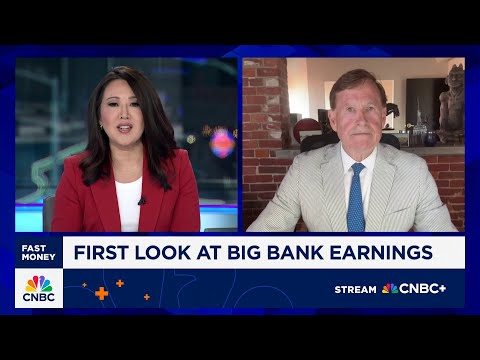
Big Banks Kick Off Earnings Season With Trading Revenue Set to Rise
Bloomberg Television· 2025-07-14 14:48
Market Trends & Outlook - US lenders are forecasted to show increases in trading revenue, which is a key focus this earnings season [1] - Net interest income is expected to accelerate in the second half of the year, offsetting seasonal declines in trading [2] - The environment has improved significantly since April, with recession odds for 2025 dropping from 65-70% to around 20%, and expectations shifting from close to four rate cuts to two [4] - Banks' guidance is expected to be stable or with a bias to the upside, as they were conservative in their adjustments a few months ago due to volatility [5] Investment Banking Performance - Investment banking results are expected to underperform, marking the 14th consecutive quarter where they contribute less than a quarter of industry revenues [7] - A typical global investment banking revenue pool consists of approximately 50% FICC (Fixed Income, Currencies, and Commodities), 25% equities trading, and 25% banking fees [8] - There is potential for improvement in equity fees and equity underwriting, especially with global equities indices hitting record highs [10] - While equity fees may improve, it will be tough to hit the high watermark seen a couple of years ago [10] Strategic Focus - Investors are focusing on the profitability of investment banking, as it is a capital-light business, rather than just revenue [9]
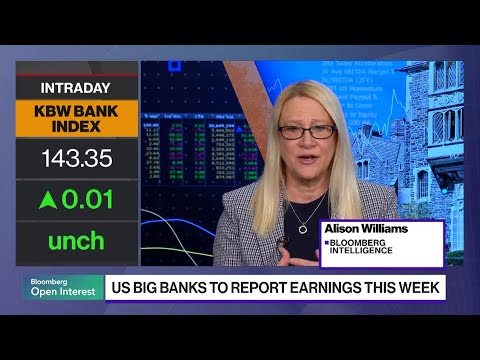
How To Trade Bank of America Stock Ahead of Earnings?
Forbes· 2025-07-08 10:30
Group 1 - Bank of America is expected to report earnings on July 16, 2025, with revenues projected at approximately $26.77 billion, reflecting a 5.5% year-over-year increase, and earnings per share anticipated to be around $0.87, up from $0.83 in the same period last year [2] - The bank may see an increase in net interest income due to reduced deposit costs and higher yielding assets, but the investment banking sector is likely to negatively impact overall performance, with a potential revenue decline of up to 25% in Q2 due to slowed deal activity from policy uncertainties [2] - Bank of America currently has a market capitalization of $374 billion and reported a net income of $28 billion over the past twelve months, despite an operational loss [3] Group 2 - Historical data indicates that Bank of America has recorded 20 earnings data points over the last five years, with positive one-day returns occurring approximately 60% of the time, increasing to 75% when considering the last three years [5] - The median of the 12 positive one-day returns is 2.9%, while the median of the 8 negative returns is -2.6% [5] - Correlation data shows the relationship between one-day post-earnings returns and subsequent five-day returns, which can inform trading strategies [6]
Loosening capital requirements will lead to increased bank M&A, says RBC’s Gerard Cassidy
CNBC Television· 2025-06-26 21:44
Bank Stress Test & Regulatory Environment - Banks are expected to pass stress tests with flying colors, potentially leading to a shrink in stress capital buffer for some, like NT Bank [2] - The stress test primarily focuses on credit quality and liquidity, but does not adequately address interest rate shock scenarios [9][10] - Deregulation is expected to impact various industries, including banking and energy [13] Investment Banking & Capital Markets - Jefferies indicates resilience in investment banking and capital markets, expressing optimism for the second half of the year [5] - April was a challenging month for investment banking due to tariff news, but performance improved in subsequent months [6] - Investment banking revenues are projected to be down high single digits, while trading revenues driven by equities are expected to be up mid to high single digits; these figures may improve due to strong June performance [7] Mergers & Acquisitions (M&A) - There appears to be a build-up of potential M&A activity due to uncertainty in March and April [12] - The current administration is perceived as supportive of consolidation, including M&A activity across various industries [12][13] Commercial Real Estate (CRE) - The stress test this year has lower credit losses in commercial real estate, which would be another benefit for banks [4] - NT Bank has a higher level of commercial real estate loans than its peers, which previously led to a higher stress capital buffer, but this has been reduced [3]
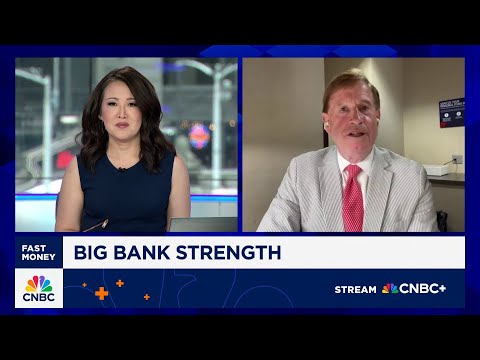
Higher for longer rate environment benefits banks, says Chris Marinac
CNBC Television· 2025-06-18 22:17
Interest Rate Environment & Bank Performance - Higher for longer rate environment benefits banks due to higher spread [3] - Deposit costs have already come down, contributing to bank profitability [3] - Lack of certainty from the Fed encourages banks to maintain careful lending practices and slow loan growth [3] Regulatory Changes & Capital - Potential easing of capital requirements (SLR change) for large banks could free up capital [1][4] - SLR change primarily benefits the large eight G-SIFI banks that are trading treasuries [4] - SLR facilitates trading and activity to create more liquidity in the treasury market [5][6] Bank Earnings & Competitive Advantage - Spread is the biggest driver of dollars for banks, followed by investment banking and trading [8] - Banks still make significant money on regular way deposit and loan taking [9] - Low cost of funds remains a key competitive advantage for banks [9] Regional Banks & M&A - Medium-sized banks are not growing revenues as fast as other parts of the financial ecosystem [11] - Regulatory environment is expected to help banks merge and have less onerous rules [11][12] - M&A activity is expected to be concentrated in the mid-cap and smaller-cap arena, creating more $40-60 billion banks [14][15]