
AI bubble

Search documents
[DowJonesToday]Dow Jones Slides Amid Tech Valuation Concerns and Profit-Taking
Stock Market News· 2025-11-04 22:10
Market Overview - The Dow Jones Industrial Average closed down 251.44 points (-0.53%) at 47085.24 on November 4th, 2025, primarily due to profit-taking in the technology and AI sectors and concerns over high valuations [1][2] - Prominent Wall Street bank CEOs issued warnings about a potential market correction, adding to the negative sentiment in equities [1] Sector Performance - The reassessment of tech valuations led to profit-taking, particularly affecting AI companies, with Palantir Technologies (PLTR) experiencing a share price decline despite strong quarterly results [2] - The healthcare sector also showed weakness, impacting the overall performance of the Dow [2] Individual Stock Movements - The Travelers Companies (TRV) was the biggest gainer among the Dow components, rising 2.40%, followed by Merck & Co., Inc. (MRK) at 1.08% and Goldman Sachs Group Inc. (GS) at 0.74% [3] - Conversely, NVIDIA Corp. (NVDA) led the declines with a drop of -3.41%, followed by Boeing Company (BA) at -3.35%, Caterpillar Inc. (CAT) at -3.10%, and Salesforce, Inc. (CRM) at -2.93% [3]


AMD forecasts fourth-quarter revenue above estimates on strong AI chip demand
Yahoo Finance· 2025-11-04 21:18
Core Viewpoint - Advanced Micro Devices (AMD) forecasts fourth-quarter revenue exceeding market estimates, driven by the expansion of data center infrastructure and increased demand for AI chips [1][2]. Financial Performance - AMD expects fourth-quarter revenue of approximately $9.6 billion, with a variance of $300 million, surpassing analysts' average estimate of $9.15 billion [3]. - The company reported third-quarter sales of $9.25 billion, exceeding analysts' average estimate of $8.74 billion [4]. Market Dynamics - AMD's data center segment, which includes AI chips, saw a revenue increase of 22% to $4.3 billion in the September quarter, outperforming estimates of $4.09 billion [5]. - The client segment, catering to the personal computer market, experienced a 46% revenue increase to $2.8 billion in the third quarter [6]. Investment Trends - Significant investments in AI hardware have been made by companies like OpenAI and the U.S. Department of Energy, indicating continued spending on advanced processors [2]. - Major tech companies are heavily investing in AI hardware, with a notable portion directed towards chips, benefiting suppliers like AMD [5]. Competitive Landscape - AMD is gaining market share in the server CPU market against Intel, driven by the increased demand for server CPUs alongside AI GPUs [6]. - Microsoft reported a record capital expenditure of nearly $35 billion for its fiscal first quarter, with approximately half allocated to chips, highlighting the strong demand for AMD's products [5].

Don't Forget Defensive ETFs Even as Market Optimism Builds
ZACKS· 2025-11-04 17:26
Market Performance - The S&P 500 ended October with a 1.9% increase, marking its sixth consecutive monthly gain, the longest stretch in four years [1][2] - The index continued its upward momentum into November, adding approximately 0.18% on the first Monday of the month [1] Economic Outlook - Progress in the U.S.-China trade agreement, the Federal Reserve's interest rate cut in October, and rising AI demand contribute to a positive outlook for the U.S. economy [2] - Despite the optimistic economic picture, underlying volatility risks remain, suggesting a cautious approach may be prudent [2][5] Volatility Concerns - Ongoing government shutdown, diminishing expectations for a December rate cut, and worries about a potential AI bubble may increase market volatility [3][4] - The sustainability of the U.S.-China trade truce is questioned, adding to investor anxiety [3] Market Predictions - Goldman Sachs and Morgan Stanley predict a potential 10-20% market pullback within the next 12 to 24 months, which is typical in long-term bull markets [6][7] - Both firms emphasize that periodic pullbacks should be viewed as healthy market corrections rather than crises [8] Investment Strategies - Investors are advised to adopt a defensive and conservative investment theme to navigate potential market turbulence [9] - Increasing allocations toward defensive funds while maintaining exposure to growth-oriented investments may be a sound strategy [10] ETF Recommendations - Value ETFs, characterized by solid fundamentals and trading below intrinsic value, have shown positive performance, with the S&P 500 Value Index gaining 7.52% year to date [12] - Consumer staple ETFs provide stability, with the S&P 500 Consumer Staples Index up 3.20% year to date, making them a good option for risk-averse investors [13] - Quality ETFs are recommended as a strategic response to market uncertainty, offering a buffer against potential headwinds [14] Investment Strategies for Stability - Passive, long-term strategies such as buy-and-hold or dollar-cost averaging are suggested to help investors navigate potential pullbacks while positioning for sustainable returns [15][16]

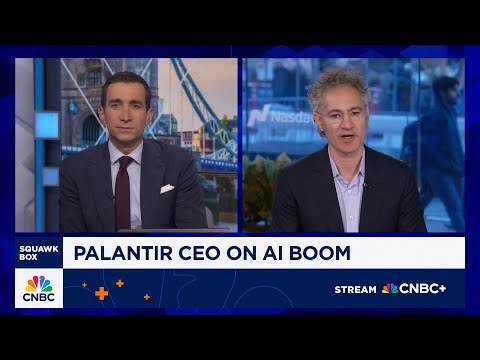
Palantir CEO Alex Karp on AI bubble: Depends whether GDP grows because of AI
CNBC Television· 2025-11-04 15:17
Alex, we've heard a lot of talk from the likes of a Michael Bur, but more broadly about whether we're in an AI bubble, whether the economics make sense. Clearly, in the context of Palunteer, uh they do make sense in so far as you you're you're printing money over there. Um not everybody in the AI space is printing money in the same way, and they're spending an enormous amount um on chips, data centers, and the like.How do you see the broader space right now in terms of just how things are are are developing ...

Palantir CEO Alex Karp on AI bubble: Depends whether GDP grows because of AI
Youtube· 2025-11-04 15:17
Group 1 - The AI market is experiencing varied financial success, with some companies like Palunteer generating significant profits while others struggle with high expenditures on infrastructure [1][4] - The addressable market for AI is crucial, particularly focusing on segments that yield quantifiable financial returns, either commercially or in practical applications [2][3] - The concept of "trader optimality" is essential, where every part of the AI value chain must create more value than it charges, otherwise it risks being labeled a bubble [3][4] Group 2 - The relationship between AI advancements and GDP growth is complex, with a focus on "worker available GDP" and how AI can enhance productivity for workers [5][6] - There is a societal concern regarding whether the benefits of AI will be equitably distributed, as the average American perceives AI's growth but questions its personal impact [7][8] - Proving that AI growth translates to tangible benefits for workers is critical for societal acceptance and stability [8]

Amazon Just Landed a $38 Billion OpenAI Deal: Your Signal to Watch 3 ETFs
ZACKS· 2025-11-04 15:11
Core Insights - OpenAI has signed a significant $38 billion agreement with Amazon to utilize AWS for its AI workloads over the next seven years [1] - Following the announcement, Amazon's stock price increased by 4%, indicating investor optimism about the AI industry's growth potential [2] - OpenAI's partnerships with major tech companies, including Microsoft, Oracle, and Google Cloud, are part of a broader strategy to expand its AI capabilities [5] Company Analysis - OpenAI's aggressive spending strategy includes plans to invest over $1.4 trillion in infrastructure, which raises concerns about the sustainability of its growth given its estimated annual revenue of approximately $13 billion [6] - The AI industry faces challenges such as a shortage of skilled labor in the U.S. and potential limitations in the power grid's capacity to support rapid growth [7][8] - Despite these challenges, Bain & Company projects that North America will account for about half of global data center capacity by 2030, driven by capital expenditures from hyperscalers [9] Investment Opportunities - Investing in ETFs with significant exposure to Amazon may provide a diversified approach to mitigate risks associated with individual stock volatility [3][4] - Three ETFs highlighted for their exposure to Amazon include: - ProShares Online Retail ETF (ONLN), with Amazon comprising 27.20% of the fund and a year-to-date increase of 35.8% [12][13] - Vanguard Consumer Discretionary ETF (VCR), with Amazon at 21.54% and a year-to-date rise of 7% [14] - Consumer Discretionary Select Sector SPDR Fund (XLY), where Amazon holds 24.37% and has increased by 8.6% year to date [15][16]


Here Are Tuesday’s Top Wall Street Analyst Research Calls: Apple, AbbVie, Broadcom, CyberArk, Palantir Technologies and More
Yahoo Finance· 2025-11-04 14:11
Market Overview - The S&P 500 and NASDAQ futures are down over 1% following Palantir's 6.9% decline despite beating earnings expectations and providing strong forward guidance, raising concerns over an AI bubble [2] - The Dow Jones Industrial Average traded lower due to weakness in Merck Inc. and UnitedHealth Group Inc., while the NASDAQ surged to a new record high driven by major technology stocks [2] - Amazon.com jumped nearly 4% after announcing a $38 billion deal with OpenAI, utilizing chips from NVIDIA, indicating continued strength in mega-cap technology [2] Treasury Bonds - Treasury yields increased across the curve, with the 10-year note finishing at a 4.11% yield, up from 3.93% in late October, reflecting consistent selling pressure [3] - The combination of a rich stock market and a hawkish Federal Reserve is driving investors towards the 10-year note as a safe haven [3] Oil and Gas Sector - Oil prices rose modestly, with West Texas Intermediate closing at $61.05 and Brent Crude at $64.84, supported by OPEC+'s decision to halt production increases in January [4] - SM Energy Co. and Civitas Resources announced a $12.8 billion all-stock merger, creating one of the largest independent U.S. shale producers, signaling potential consolidation in the sector [4] Cryptocurrency Market - The cryptocurrency market experienced a sell-off, with Bitcoin and Ethereum trading lower, indicating ongoing volatility in this sector [5]
‘Big Short’ trader makes $1bn bet against AI boom
Yahoo Finance· 2025-11-04 10:38
Experts say Michael Burry ‘believes that there is an AI bubble which is due to pop’ - Jim Spellman/WireImage A US investor depicted in the film The Big Short has placed a significant bet against artificial intelligence (AI). Michael Burry, who bet on a US housing market crash in the run-up to the 2007 crisis, has wagered $1.1bn (£840m) on falls in shares of chip-maker Nvidia and software company Palantir. The moves will intensify concerns about a possible bubble in AI stocks, following a surge in values ...
X @Bloomberg
Bloomberg· 2025-11-04 02:56
Market Trends - Analysts suggest the bursting of the global AI bubble could be India's best hope to regain interest from global risk capital [1]
Michael Burry Is Super-Bearish On Palantir — With 5 Million Puts
Benzinga· 2025-11-03 23:17
Group 1: Investment Moves by Scion Asset Management - Scion Asset Management, led by billionaire investor Michael Burry, purchased five million put options on Palantir Technologies, Inc. (NASDAQ:PLTR) and one million put options on NVIDIA Corp. (NASDAQ:NVDA) [1] - Burry's bearish position in Palantir has a market value of $912.1 million, while the Nvidia puts are valued at $186.58 million [2] Group 2: Portfolio Adjustments - The updated 13F filing reveals that Scion added 50,000 shares of Lululemon Athletica, Inc. (NASDAQ:LULU), opened a 125,000 share position in Molina Healthcare, Inc. (NYSE:MOH), and a 480,000 share position in SLM Corp. (NASDAQ:SLM) [5] - Additionally, Burry purchased 2.5 million calls on Halliburton Co. (NYSE:HAL) and six million calls on Pfizer, Inc. (NYSE:PFE) [5] Group 3: Closed Positions - Scion Asset Management closed its positions in Estee Lauder Companies, Inc. (NYSE:EL), Regeneron Pharmaceuticals, Inc. (NASDAQ:REGN), MercadoLibre, Inc. (NASDAQ:MELI), and UnitedHealth Group, Inc. (NYSE:UNH) [6] Group 4: Market Commentary - Burry referenced an AI bubble in a post, comparing Cloud segment growth for major tech companies from 2018 to 2022 with the current period [3] - He shared charts illustrating AI deals among Nvidia, OpenAI, Oracle Corp. (NYSE:ORCL), and others, as well as AI capital expenditures matching the tech spending of the 1999-2000 tech bubble [4]
