CPO(共封装光学)

Search documents
Lumentum(LITE) - 2025 Q3 - Earnings Call Transcript
2025-05-06 21:00
Financial Data and Key Metrics Changes - In Q3, the company reported revenue of $425.2 million and non-GAAP EPS of $0.57, both exceeding the high end of guidance [20] - Non-GAAP gross margin was 35.2%, up 290 basis points sequentially and 650 basis points year on year, attributed to better manufacturing utilization and a favorable product mix [20][21] - Non-GAAP operating margin improved to 10.8%, up 290 basis points sequentially and 1,100 basis points year on year [20][21] Business Line Data and Key Metrics Changes - Cloud and Networking segment revenue reached $365.2 million, increasing 8% sequentially and 16% year on year, driven by strong demand from hyperscale cloud customers [9][22] - Industrial Tech segment revenue was $60 million, down 5% sequentially but up 14% year on year, with ultrafast laser shipments remaining steady [14][15][22] Market Data and Key Metrics Changes - The company anticipates strong sequential growth in the Cloud and Networking segment in Q4, driven by new capacity and increasing demand from network equipment manufacturers [14] - The Industrial Tech segment is expected to see a sequential decline in revenue due to ongoing macroeconomic headwinds and typical seasonal trends [16] Company Strategy and Development Direction - The company aims to achieve quarterly revenue of $750 million, gross margins above 40%, and operating margins greater than 20% [6][18] - Focus on high-growth areas such as cloud and AI, with investments directed towards expanding manufacturing capacity and product offerings [17][18] Management's Comments on Operating Environment and Future Outlook - Management expressed confidence in achieving medium and long-term financial targets despite macroeconomic uncertainties and tariff impacts [18] - The company is building resilience through a diversified manufacturing footprint and flexible supply chain [18] Other Important Information - The company is ramping production of CW lasers and EMLs, with expectations to double EML shipments by the end of calendar 2025 [10][11] - The company is also focusing on co-packaged optics (CPO) as a future growth area, although significant adoption is expected to take several years [118] Q&A Session Summary Question: How is the company tracking towards the $500 million revenue target? - Management confirmed they are still on track for the $500 million target by the end of the year, emphasizing confidence in current performance [30] Question: Update on datacom chip business performance? - The company is outperforming initial expectations in terms of volume and ASP, with a focus on increasing capacity for EMLs and CW lasers [32][34] Question: Clarification on tariff headwinds? - The company quantified a 100 basis point headwind to gross margins due to increased component costs and tariffs, with plans to move more production to Thailand to mitigate this [41][42] Question: Contributions from co-packaged optics? - Management indicated that while CPO is a long-term prospect, they are looking to add components to the CPO ecosystem over the coming years [48][118] Question: Insights on telecom performance and supply issues? - Telecom performance met expectations, with improvements anticipated in supply for pumps and tunables moving into Q4 [97][99] Question: Guidance caution related to macro or tariffs? - Management acknowledged macro uncertainty but expressed confidence in the guidance provided, highlighting strong demand across product lines [100][102]

英伟达引爆CPO新战场
半导体芯闻· 2025-03-24 10:20
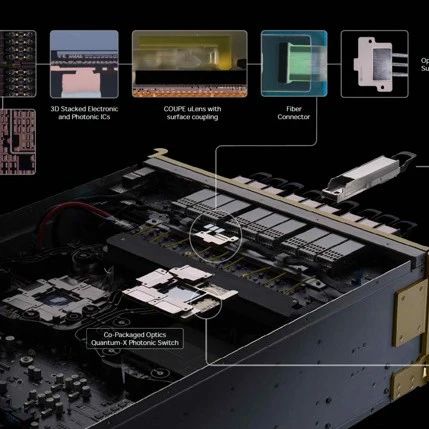
Core Viewpoint - NVIDIA has officially launched two CPO (Co-Packaged Optics) switch products, Quantum-X Photonics for InfiniBand and Spectrum-X Photonics for Ethernet, with the InfiniBand CPO expected to debut in the second half of 2025 and the Ethernet CPO in the second half of 2026 [1][2]. Group 1: CPO Technology and Market Position - CPO will be an optional configuration, and NVIDIA will continue to offer traditional switch systems with pluggable modules [2]. - The primary driver for NVIDIA's investment in CPO technology is power optimization, with a significant reduction in power consumption from 30W to 9W for a 1.6T port, achieving a 70% decrease [2]. - NVIDIA's CPO solution utilizes new micro-ring modulators (MRM) for enhanced energy efficiency, contrasting with Broadcom's CPO solution that achieved a 50% power reduction using traditional Mach-Zehnder modulators (MZM) [2]. Group 2: Ecosystem and Partnerships - The technology involves a multi-component ecosystem, integrating electronic and photonic chips through 3D stacking, with TSMC's compact optical engine technology playing a key role [3]. - NVIDIA's CPO partners include major industry players such as Browave, Coherent, Corning, Fabrinet, Foxconn, Lumentum, Senko, SPIL, Sumitomo, Tianfu Communication, and TSMC [3]. Group 3: Strategic Implications and Future Developments - LightCounting notes that NVIDIA's first CPO product is an InfiniBand switch, which has been overshadowed by Ethernet in NVIDIA's AI strategy, indicating that the initial deployment will primarily serve NVIDIA's own clusters [4]. - The Spectrum-X platform aims to elevate Ethernet performance to match that of InfiniBand, with potential for significant GPU interconnectivity in future architectures [4]. - NVIDIA's entry into the CPO market is expected to invigorate the ecosystem, with both NVIDIA and Broadcom projected to release single-channel 200G CPO switches by 2027, leading to a more mature industry landscape [4]. Group 4: Technical Challenges and Innovations - Scale-out is seen as a low-risk entry point for CPO, while scale-up is critical for success, particularly for the mixed expert (MoE) model requiring rapid response times across GPUs [5]. - NVIDIA has previously announced fiber-based NVLink plans, with at least one cluster built internally, but large-scale deployment has been hindered by high power consumption of timing modules [6]. - The NVLink CPO is scheduled for 2028, allowing NVIDIA to validate technology feasibility over two product cycles, significantly reducing future integration risks [6].