
EML芯片

Search documents
未知机构:12026年800G光模块在手订单400万只Meta200万微软150-20260330
未知机构· 2026-03-30 01:40
Summary of Conference Call Transcript Company and Industry Overview - The company operates in the optical module industry, focusing on high-capacity products such as 800G and 400G optical modules, as well as EML chips. Key Points and Arguments 1. **800G Optical Module Orders**: The company has secured 4 million orders for 800G optical modules for 2026, with major clients including Meta (2 million), Microsoft (1.5 million), and others (0.5 million). The target shipment is between 5 to 6 million units [1][2][3]. 2. **400G Optical Module Shipments**: The expected shipment for 400G optical modules is 2 million units, primarily for clients Microsoft and Alibaba. Additionally, there are approximately 400,000 orders for 1.6T optical modules [1][2][3]. 3. **EML Chip Production**: The company's EML chips are primarily for in-house use. The production line in Jintan is currently in the debugging phase, with unstable yield rates. The planned monthly production capacity is 9 million units [1][2][3]. Additional Important Information - The company is focusing on increasing its production capacity and stabilizing the yield rates of its EML chips, which is crucial for meeting the growing demand in the optical module market [1][2][3].

通信行业周报:光模块:1.6T放量在即,上游再趋紧
GOLDEN SUN SECURITIES· 2026-03-29 10:24
Investment Rating - The report maintains a "Buy" rating for key companies in the optical module sector, specifically recommending companies like Zhongji Xuchuang and Xinyi Sheng [13]. Core Insights - The 1.6T optical module is entering a phase of large-scale release in 2026, with upstream core components (DSP, EML, silicon photonics capacity, and isolators) facing a tightening supply situation [22][28]. - The DSP market is dominated by a duopoly of Broadcom and Marvell, with advanced process capacity becoming a bottleneck due to high demand from AI chips [23][28]. - EML chips are primarily led by overseas companies like Sumitomo, while domestic firms are accelerating to fill the supply gap [24][27]. - The silicon photonics sector is seeing increased penetration, with a diverse design landscape and critical reliance on foundry capacity [25][28]. - Isolators are becoming a hidden bottleneck in the delivery of high-speed optical modules due to their essential role in preventing damage from reflected light [26][32]. Summary by Sections Optical Module Market - The 1.6T optical module is set for large-scale production, driven by the evolution of AI computing clusters towards higher density [22]. - Supply constraints are emerging for core components, particularly DSPs, which are critical for high-speed signal recovery [28]. DSP Market - The DSP market is characterized by a duopoly, with Broadcom and Marvell controlling the majority of the supply for 1.6T DSPs [23]. - Advanced process nodes (5nm and 3nm) are creating significant barriers to entry, with TSMC's capacity being heavily allocated to AI chip production [23][28]. EML Market - The EML chip market is currently dominated by Japanese firms, but domestic companies are rapidly advancing to meet the growing demand [24][27]. Silicon Photonics - The silicon photonics segment is experiencing accelerated growth due to its high integration and cost advantages, with a focus on both design and foundry capabilities [25][28]. Isolators - Isolators are becoming increasingly critical in high-speed optical modules, with their production facing challenges due to material dependencies and manufacturing complexities [26][32]. Investment Recommendations - The report suggests focusing on companies within the optical module supply chain, particularly those with strong capabilities in silicon photonics and EML production, such as Zhongji Xuchuang and Xinyi Sheng [10][16].
行业研究|行业周报|通信设备Ⅲ:通信周观点:云巨头Capex指引跃增,InP产能紧缺催生长协-20260212
Changjiang Securities· 2026-02-12 08:43
Investment Rating - The report maintains a "Positive" investment rating for the communication equipment sector [10]. Core Insights - The communication sector experienced a decline of 6.91% in the fifth week of 2026, ranking 31st among major industries in the Yangtze River region. Year-to-date, the sector is down 1.86%, ranking 29th [2][5]. - Major cloud players, Google Cloud and AWS, reported significant growth in capital expenditures (Capex) for 2026, with Google Cloud's profit margin reaching a historic high of 30% and AWS revenue growth at 23.6%, the highest in nearly three years. This indicates strong investment in AI computing infrastructure [2][8]. - Lumentum and Coherent, leading companies in optical communication, reported impressive earnings growth, driven by strong demand for InP optical chips, which are currently in short supply, leading to long-term agreements (LTA) to secure supply [2][8]. Summary by Sections Market Performance - In the fifth week of 2026, the communication sector fell by 6.91%, with a year-to-date decline of 1.86%. The top three gainers among companies with a market cap over 8 billion yuan were Tongding Interconnection (+18.6%), Changfei Fiber (+17.2%), and Jiangsu Communication (+11.3%). The largest decliners were Zhongji Xuchuang (-16.8%), Lian Te Technology (-14.7%), and Shijia Photon (-14.4%) [2][5]. Cloud Computing Insights - Google reported Q4 2025 revenue of $113.83 billion, a year-on-year increase of 18.0%, with cloud revenue at $17.66 billion, up 47.8%. The operating profit margin for the cloud business reached 30.1%, a 12.6 percentage point increase year-on-year. For 2026, Google has guided Capex between $175 billion and $185 billion, nearly doubling from the previous year [6]. - Amazon's Q4 2025 revenue was $211.49 billion, a 12.6% year-on-year increase, with AWS revenue at $35.58 billion, growing 23.6%, the highest growth rate in 13 quarters. Amazon's Capex for 2026 is projected to be around $200 billion, a 52% increase year-on-year, primarily directed towards AWS [6]. Optical Communication Developments - Lumentum reported FY26Q2 revenue of $670 million, a 65.5% year-on-year increase, with a net profit of $80 million, marking a return to profitability. The company is experiencing a supply-demand gap of 25%-30% for InP chips and has initiated long-term agreements to secure supply [7]. - Coherent's FY26Q2 revenue was $1.69 billion, up 17.5% year-on-year, with a net profit of $150 million, a 41.9% increase. The company is ramping up production capacity for its unique 6-inch InP wafer line, expecting to double capacity by FY26Q4 [7]. Investment Recommendations - The report recommends several companies across different segments: - Telecom operators: China Mobile, China Telecom, China Unicom - Optical modules: Zhongji Xuchuang, Xinyi Sheng, Tianfu Communication - Liquid cooling: Yingweike - Air-core fiber: Fenghuo Communication, Hengtong Optic-Electric - Domestic computing: Runze Technology, Guanghuan New Network - AI applications: Boshi Jie, Heertai - Satellite applications: Huace Navigation, Haige Communication [8].




【光通信芯片】行业市场发展现状:市场将保持快速增长,国产化率水平提高
Xin Lang Cai Jing· 2026-02-09 10:21
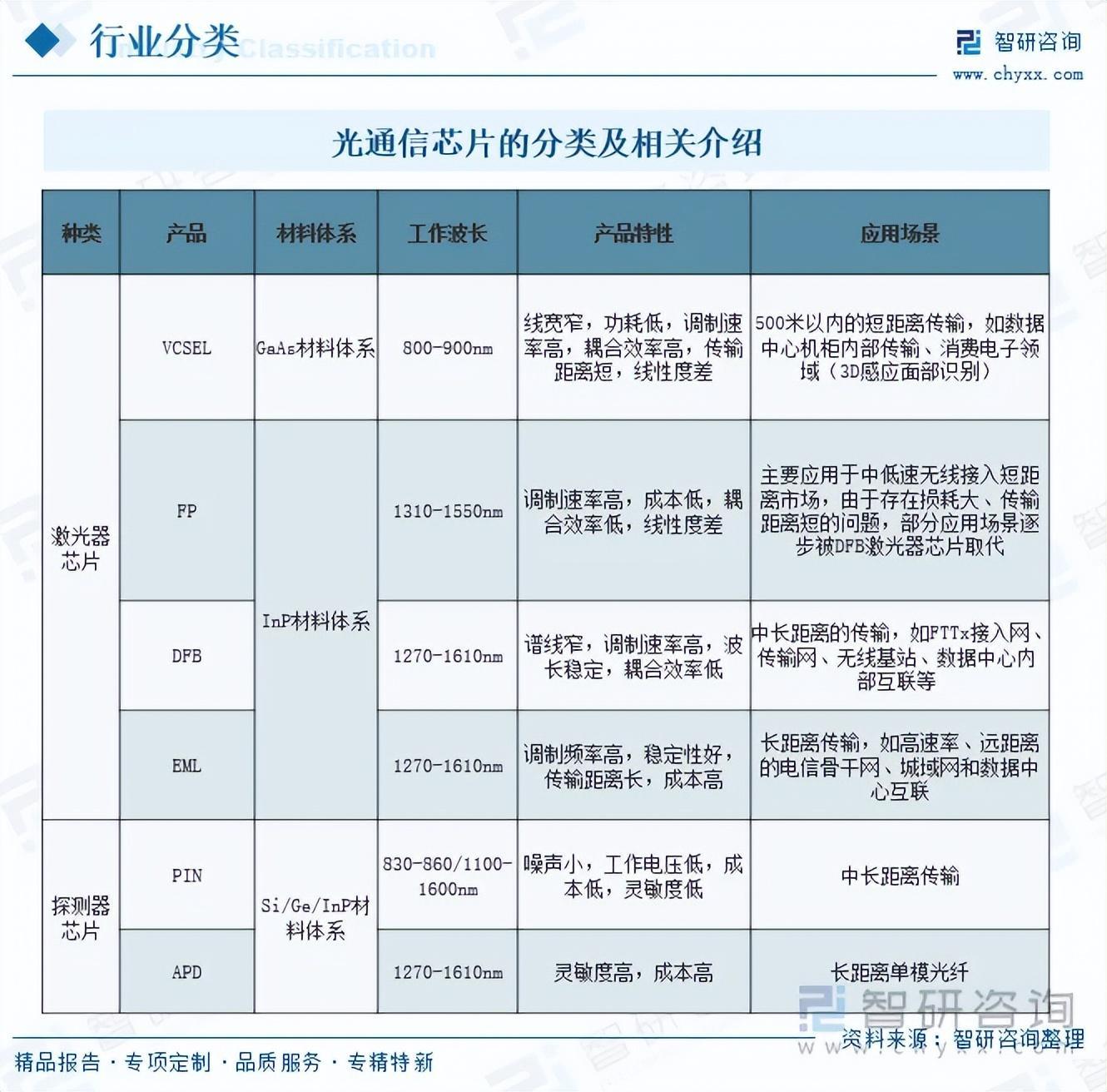
Core Insights - The optical communication chip market in China is experiencing continuous growth driven by artificial intelligence, data center expansion, consumer electronics, and 5G deployment [1][20][27] - The production and demand for optical communication chips are projected to increase significantly, with production reaching 867 million units and demand reaching 1.198 billion units in 2024, resulting in a market size of 15.16 billion yuan [1][20][27] - The market is expected to maintain rapid growth, with production estimated at 904 million units and demand at 1.249 billion units in 2025, leading to a market size of approximately 16.02 billion yuan [1][20][27] Industry Definition and Classification - Optical communication chips are defined as chips that convert optical signals and are used for generating, modulating, amplifying, and detecting optical communication signals [2][21] - These chips can be classified into laser chips and detector chips, with laser chips further divided into surface-emitting and edge-emitting types [2][21] Current Industry Status Global Market - The global optical communication chip market is projected to reach $5.43 billion in 2024, with North America accounting for $1.317 billion, Europe for $829 million, and the Asia-Pacific region for $3.048 billion [5][24] - The demand for optical communication chips is driven by the rapid development of new information technologies such as mobile internet, 5G, and cloud computing [5][24] Chinese Market - The Chinese optical communication chip market is expected to see a demand increase to 1.198 billion units in 2024, with high-speed optical communication chips accounting for approximately 13.98% of the total demand [8][27] - The market size for optical communication chips in China is projected to reach 15.16 billion yuan in 2024, with high-speed chips contributing 50.6 billion yuan [8][27] Industry Supply and Competition - The number of companies entering the domestic optical communication chip industry is increasing, leading to improved production technology and a rising domestic production rate [11][30] - The production of optical communication chips in China is expected to grow from 517 million units in 2018 to 867 million units in 2024 [11][30] Industry Value Chain - The optical communication chip industry value chain consists of upstream materials and equipment, midstream chips and modules, and downstream application markets [13][32] - The current landscape shows a monopoly in high-end materials and equipment by overseas companies, while domestic companies dominate the lower-end applications [13][32]






未知机构:兴证通信LumentumFY26Q2财报点评云收发器OCS双引擎爆发-20260204
未知机构· 2026-02-04 01:55
Lumentum Q2 FY26 Earnings Call Summary Company Overview - **Company**: Lumentum - **Fiscal Quarter**: Q2 FY26 - **Revenue**: $666 million, a year-over-year increase of 65% and a quarter-over-quarter increase of 17%, marking a historical high [1][1][1] Key Insights Industry Dynamics - **AI-Driven Growth**: The growth is primarily driven by AI, leading to a significant increase in demand for cloud transceivers and OCS (Optical Circuit Switch) products [1][1][1] - **Backlog Orders**: OCS backlog orders have surpassed $400 million, indicating strong future revenue potential [1][1][1] Financial Performance - **Components Revenue**: - Revenue from optical components reached $444 million - Strong demand for EML (Electro-Absorption Modulated Laser) lasers driven by DCI (Data Center Interconnect) and long-haul applications [2][2][2] - Contribution to data center laser chip revenue is 10% despite only accounting for 5% of sales volume [2][2][2] - **Systems Revenue**: - Revenue from optical systems was $222 million - Cloud transceivers revenue increased by approximately $50 million quarter-over-quarter due to the transition to 1.6T networks [2][2][2] - OCS backlog is expected to be delivered in the second half of 2026 [2][2][2] Profitability Metrics - **Gross Margin**: Non-GAAP gross margin improved to 42.5%, a significant increase of 820 basis points year-over-year and 310 basis points quarter-over-quarter [2][2][2] - **Operating Margin**: Non-GAAP operating margin reached 25.2%, an increase of 1730 basis points year-over-year [3][3][3] - **Earnings Per Share (EPS)**: Non-GAAP EPS was $1.67 [3][3][3] Future Outlook - **Revenue Guidance for FY26 Q3**: Expected revenue between $780 million and $830 million, with a midpoint of $805 million, representing a year-over-year growth rate of 85% [3][3][3] - **EPS Guidance**: Projected EPS between $2.15 and $2.35 [3][3][3] - **Supply-Demand Gap**: There remains a 30% supply-demand gap for EML capacity, with all capacity secured through long-term agreements [3][3][3] - **Growth Drivers**: Three main growth drivers identified: 1. Cloud transceivers (1.6T ramp-up) 2. OCS (release of $400 million+ orders) 3. CPO (multi-million dollar order reserves) [3][3][3] - **Capacity Expansion**: Progress on InP (Indium Phosphide) wafer fabrication expansion is ahead of schedule, with efforts to seek foundry partnerships to meet explosive demand [3][3][3] - **Product Mix Improvement**: The share of 200G products is expected to rise to 25% by year-end, potentially leading to a dual boost in valuation and performance [3][3][3]
光芯片深度:芯光璀璨,智算未来
Changjiang Securities· 2026-01-31 11:05
Investment Rating - The investment rating for the optical chip industry is "Positive" and maintained [11] Core Viewpoints - Optical chips are a high-value segment within the optical communication industry, characterized by significant technical barriers and value [3][9] - The industry predominantly adopts the IDM model, which covers the entire process from design to manufacturing and testing, leading to high entry barriers [7][50] - Domestic optical chip manufacturers are expected to benefit from a combination of industry growth, structural opportunities in silicon photonics, and increased market share from domestic replacements [8][9] Summary by Sections Optical Chips - Optical chips are the core active components in optical communication, determining the quality, speed, and energy efficiency of optical signal transmission [6][21] - The transition from traditional discrete solutions to high-integration silicon photonics solutions is accelerating, driven by the limitations of existing technologies [6][36] Manufacturers of Optical Chips - Manufacturers typically use the IDM model, which enhances collaboration with downstream module manufacturers and allows for rapid iteration and optimization of processes [7][50] - The industry faces significant barriers in R&D iteration, process yield, and capacity expansion, with domestic manufacturers focusing on the CW light source route due to its shorter production chain and better yield optimization [7][9] AI and Connectivity Demand - The demand for optical chips is expected to rise due to the commercialization of AI by North American cloud providers, leading to increased capital expenditures and a positive feedback loop in computing power investments [8][9] - The supply side is constrained by a concentrated upstream InP substrate market and long expansion cycles, with a predicted 25%-30% shortfall in optical chips [8] Investment Recommendations - The report recommends focusing on leading domestic CW light source manufacturers, particularly Shijia Photon, and paying attention to Yuanjie Technology [9][12]
未知机构:康宁大涨1660亿美元Meta订单0128Meta与康-20260129
未知机构· 2026-01-29 02:05
Summary of Key Points from Conference Call Records Company: Corning Inc. (康宁) Core Insights and Arguments - Corning has secured a significant agreement with Meta to supply $6 billion worth of optical communication products for AI data centers by 2030, primarily focusing on MMC/MPO and fiber optic orders [1] - Other Cloud Service Providers (CSPs) are expected to follow suit with similar orders, indicating a potential increase in demand across the industry [1] Industry: Optical Communication and AI Market Dynamics - The CPO (Chiplet Packaging Optimization) industry is accelerating, with a projected 20% supply shortage for EML (Electro-Absorption Modulated Laser) chips by 2026, which is seen as a core catalyst for growth in the AI computing and optical interconnect market [2] - The optical communication device revenue is expected to surge by 73.89%, driven by the high growth certainty in the main business [3] Competitive Positioning - Corning is one of only three global manufacturers and the sole domestic producer of thin-film lithium niobate devices, which are critical for high-speed optical communication [3] - The company has achieved a domestic market share exceeding 90%, with its thin-film lithium niobate modulators offering bandwidths of 70-110 GHz and 40% lower power consumption compared to international competitors [3] Future Projections - For 2025, Corning anticipates a substantial increase in net profit, with growth estimates ranging from 152% to 172%, and a non-GAAP net profit increase of 178% to 198% [3] - The company is set to commercialize 400G PAM4 modulator chips by 2026, which will replace EML chips and address the anticipated supply gap [3] - Global production capacity is expanding with facilities in Zhuhai, Thailand, and Wuhan, achieving a monthly output of over 250,000 units, with Thai production benefiting from tariff exemptions [3] - The overseas shipment volume is expected to double, contributing to an 8% reduction in costs [3]


这类芯片,前景看好
半导体芯闻· 2025-12-29 10:26
Core Viewpoint - The laser chips and detector chips, collectively known as optical chips, are the core components of optical modules, with the global Ethernet optical module market expected to grow rapidly, reaching $18.9 billion by 2026, driven by strong demand from AI infrastructure and advancements in optical interconnect technology [2][5]. Group 1: Optical Chip Market Dynamics - Optical chips are essential for optical modules, primarily used for optical signal conversion and processing, with laser chips categorized into surface-emitting and edge-emitting types [2]. - The global EML laser chip market is projected to reach 3.71 billion yuan in 2024, growing to 7.412 billion yuan by 2030, with a compound annual growth rate (CAGR) of 12.23% [3]. - The demand for silicon photonic modules is increasing due to their high integration, low power consumption, and cost-effectiveness, which is driving the demand for continuous wave (CW) lasers [4]. Group 2: Growth Drivers and Supply Constraints - The global Ethernet optical module market is expected to grow by 35% to $18.9 billion in 2026, with double-digit growth rates anticipated from 2027 to 2030, potentially exceeding $35 billion by 2030 [5]. - AI infrastructure demands are pushing cloud providers to increase GPU purchases and deploy ASIC chips, which will enhance the demand for optical modules [5]. - Major companies like Coherent and Lumentum are expanding their production capacities to meet the growing demand for optical chips, with Coherent's production capacity expected to double within a year [6][7]. Group 3: Company-Specific Developments - Tower's silicon photonic product revenue reached $52 million in Q3 2025, a 70% year-on-year increase, driven by strong demand for 1.6T products [8]. - Sumitomo Electric's communication business saw operating profit triple year-on-year, driven by the expansion of data centers and the demand for high-speed optical components [9]. - Broadcom reported a significant increase in AI-related orders, with a backlog of approximately $73 billion, including $20 billion from networking and optical interconnect products [9].

国盛证券:高速率光芯片前景广阔 看好光芯片景气周期
Zhi Tong Cai Jing· 2025-12-29 06:53
Core Insights - The global Ethernet optical module market is expected to grow rapidly, with a projected increase of 35% to reach $18.9 billion by 2026, driven by strong demand for AI infrastructure and the application of optical interconnect technology in AI scale-up networks [3][1] - The demand for optical chips, which are essential components of optical modules, is expected to remain tight due to increasing requirements for high-speed optical communication [4][3] Group 1: Optical Chip Market Dynamics - Optical chips, consisting of laser and detector chips, are critical for optical modules, primarily used for optical signal conversion and processing [1] - The EML laser chip market is projected to reach $3.71 billion by 2024 and grow to $7.41 billion by 2030, with a compound annual growth rate (CAGR) of 12.23%, dominated by a few international giants [2][1] - Silicon photonic modules are driving demand for continuous wave (CW) lasers due to their high integration, low power consumption, and suitability for high-speed short-distance transmission [2][1] Group 2: Demand Drivers and Supply Constraints - The demand for optical modules is expected to continue rising, with the global Ethernet optical module market projected to exceed $35 billion by 2030, supported by AI infrastructure and cloud service providers increasing GPU purchases [3][1] - Major companies like Coherent and Lumentum are expanding their production capacities to meet the growing demand for high-speed optical components, with Coherent's production capacity expected to double within a year [4][5] - Tower's silicon photonic business is anticipated to exceed $220 million in revenue by 2025, driven by strong demand for 1.6T products and significant investments in capacity expansion [6][5] Group 3: Company-Specific Developments - Coherent is experiencing strong growth in orders for 800G and 1.6T transceivers, with plans to expand production capabilities in multiple locations [4][1] - Lumentum has set a record for EML laser shipments driven by demand for 100Gbps products and is beginning to deliver CW lasers to 800G optical module manufacturers [5][1] - Broadcom's AI network demand has led to a significant increase in orders for optical components, with a backlog of approximately $73 billion, including $20 billion from network and optical interconnect products [7][1]


招银国际:AI驱动下光模块强势表现方兴未艾 海内外主要厂商实现显著盈利扩张
Zhi Tong Cai Jing· 2025-11-27 09:17
Group 1 - The demand for AI infrastructure is rapidly expanding to other cloud service providers, sovereign nations, and enterprise clients, with Nvidia's visibility of over $500 billion in revenue boosting confidence in the current super cycle [1][2] - Major cloud providers in the US (Google, Microsoft, Meta, Amazon) are projected to have capital expenditures of $230 billion in 2024 (up 55% year-on-year) and further investments of $259 billion in the first three quarters of 2025 (up 65% year-on-year) [1] - The capital expenditure for 2025 is expected to reach $367 billion (up 59% year-on-year), with a projected growth of 35% to $495 billion in 2026 [1] Group 2 - Leading optical module manufacturers are experiencing strong revenue growth driven by the AI boom, with Coherent, Zhongji Xuchuang, and NewEase achieving revenue growth rates of 15%, 120%, and 175% respectively in 2024 [3] - Gross margins are improving due to the upgrade of AI network deployments to 800G/1.6T optical modules, with increases of 2.5, 9.2, and 5.4 percentage points from Q3 2024 to Q3 2025 [3] - By 2026, it is expected that leading companies will continue to perform strongly due to growth in shipment volumes, product structure optimization, and price increases from 1.6T products [3] Group 3 - The supply chain remains tight, particularly for key components like EML chips, with Lumentum indicating that demand "far exceeds supply" [4] - The EML industry is actively expanding capacity, with Lumentum planning a 40% increase, while silicon photonics technology is accelerating its penetration to alleviate supply bottlenecks [4] - By 2026, silicon photonics is expected to exceed a 50% market share, with global shipments of 800G and 1.6T optical module products projected to reach 49 million and 22 million respectively, despite a significant supply-demand gap [4] Group 4 - The optical module industry is reaffirmed as a preferred sector, with a "buy" rating maintained for Zhongji Xuchuang, targeting a price of 591.00 RMB [5] - The company is positioned as a global leader in optical modules (first in market share in 2024) and is expected to benefit from the expansion of overseas AI capital expenditures and increased demand for 1.6T optical modules [5]
