老鼠仓

Search documents
海富通基金“老鼠仓”事件被处罚 风控专家担任董事长
Zhong Guo Jing Ji Wang· 2025-10-28 01:13
Core Points - The recent punishment of a former fund manager at Hai Fu Tong Fund for "mouse trading" marks the second such incident in seven years for the company [1][2] - Regulatory authorities have intensified their crackdown on illegal activities like "mouse trading," with significant penalties imposed [3] Group 1: Incident Details - Yang Ningjia, the former fund manager, was found to have used non-public information to facilitate trading activities for Chen Dong, who controlled a related securities account [1] - The Shanghai Securities Regulatory Bureau imposed a fine of 500,000 yuan on Yang Ningjia for violating the Fund Law [1] - This incident follows a previous case in 2018 where former fund manager Xie Zhigang was sentenced to three years in prison for similar offenses, having illegally profited 2.704 million yuan [2] Group 2: Regulatory Environment - In 2022, the China Securities Regulatory Commission (CSRC) issued guidelines to enhance the quality of the public fund industry and emphasized the need to combat "mouse trading" [3] - In 2024, the CSRC handled 87 insider trading cases, including 12 related to "mouse trading," with total fines exceeding 1.5 billion yuan [3] Group 3: Company Management Changes - In April 2024, the company appointed Xie Lebin, a well-known risk control expert, as the new chairman, indicating a focus on addressing compliance and risk management issues [3]
海富通再曝“老鼠仓”,主角竟是90后
Shen Zhen Shang Bao· 2025-10-27 13:50
Core Points - Hai Fu Tong Fund's former fund manager Yang Ning Jia was penalized for "mouse warehouse" behavior, marking the second such incident in seven years for the company [1][2] - The Shanghai Securities Regulatory Commission imposed a fine of 500,000 yuan on Yang Ning Jia for using undisclosed information to facilitate trading activities [1] - The company has a history of regulatory issues, with a previous case in 2018 involving former fund manager Xie Zhi Gang, who was sentenced to three years in prison for similar offenses [2][3] Company Overview - Hai Fu Tong Fund is one of the first Sino-foreign joint venture fund companies in China, established in April 2003, with a management scale of 216.122 billion yuan as of mid-year, ranking 35th in the industry [4] - The company is co-owned by Guotai Haitong Securities Co., Ltd. (51% stake) and Paris Asset Management BE (49% stake) [4] - In April 2023, the company appointed Xie Le Bin, a former vice president of Guotai Haitong Securities, as the new chairman, who is recognized for his strong risk control and compliance background [4] Regulatory Environment - The regulatory authorities have intensified their crackdown on "mouse warehouse" and other illegal activities, with the China Securities Regulatory Commission handling 87 insider trading cases in 2024, including 12 "mouse warehouse" cases [3] - In April 2022, the China Securities Regulatory Commission issued guidelines to accelerate the high-quality development of the public fund industry, emphasizing the need to combat illegal activities [3]
业绩亏损近四成又现“老鼠仓”,海富通基金三度陷违规泥潭
Sou Hu Cai Jing· 2025-10-27 11:26
【文/羽扇观金工作室】 一位"90后"基金经理的堕落轨迹,再次将海富通基金推向舆论的风口浪尖。 近日,证监会公布行政处罚决定书显示,海富通基金原基金经理杨宁嘉因利用职务便利向好友透露未公 开信息,构成"老鼠仓"违法行为,被处以50万元罚款。 这位曾手握17.35亿元资金的年轻基金经理,不仅在投资业绩上交出了惨淡答卷——其管理的核心产品 任职回报亏损最高达近40%,更在职业操守上越过了红线。更令市场忧虑的是,这已是海富通基金近十 年来第三次曝出"老鼠仓"丑闻,继2014年和2018年两次违规事件后,合规风控的短板再次暴露无遗。 "老鼠仓"行为不仅严重破坏市场公平交易秩序,损害基金持有人的合法权益,更对整个资产管理行业的 信誉造成难以修复的伤害。目前,海富通基金管理规模虽已突破2000亿元,但公司营收和利润已连续三 年下滑,新任董事长谢乐斌正面临着提升投资业绩与修复品牌形象的双重压力,这家老牌公募基金的转 型之路愈发艰难。 业绩惨淡叠加违规操作,"90后"基金经理栽了跟头 从行业角度看,杨宁嘉案例反映出的问题具有一定的代表性。一些年轻基金经理在面对业绩压力时,心 理承受能力不足,风险意识淡薄,在利益诱惑面前放松了 ...

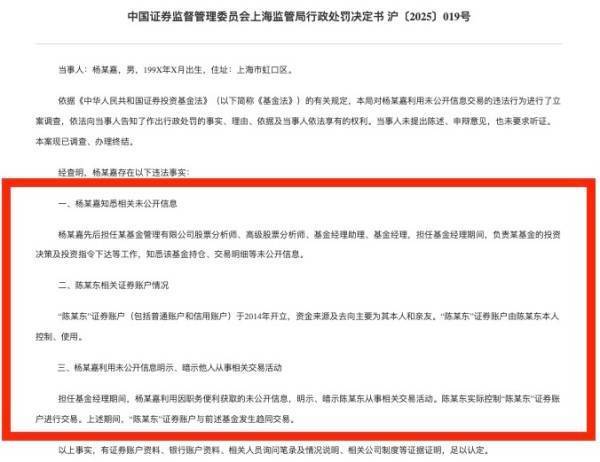
基金经理“老鼠仓”被罚50万元,整合漩涡中海富通急需补齐合规短板
YOUNG财经 漾财经· 2025-10-27 11:15
Core Viewpoint - The article discusses the recent "mouse warehouse" incident involving a fund manager at Hai Fu Tong, highlighting compliance issues and the need for regulatory oversight in the public fund industry [1][5]. Group 1: Incident Overview - Fund manager Yang Ningjia was fined 500,000 yuan for using non-public information to facilitate trading activities for another individual, Chen Chongdong, during his tenure [1][3]. - Yang's performance as a fund manager was poor, with three funds under his management showing significant negative returns, including -19.69% and -37.79% [3]. Group 2: Regulatory Environment - The article emphasizes that in the current big data era, regulatory bodies monitor fund transactions and manager behaviors closely, making it increasingly difficult to engage in unethical practices without detection [4]. - The incident serves as a warning for Hai Fu Tong, which is undergoing significant restructuring and must address compliance shortcomings [5]. Group 3: Company Background and Restructuring - Hai Fu Tong, established in 2003, is a Sino-foreign joint venture with a registered capital of 300 million yuan, and is currently undergoing a merger with Guotai Junan Securities [5][6]. - The management structure of Hai Fu Tong is changing, with recent leadership shifts indicating a potential merger with Huashan Fund, as both companies are now under the control of Guotai Junan [6]. Group 4: Fund Management Performance - As of the second quarter of this year, Hai Fu Tong managed 243.39 billion yuan in public funds, while Huashan Fund managed over 740 billion yuan, indicating a significant disparity in asset management scale [6]. - Despite the lower management scale, Hai Fu Tong holds valuable licenses for managing enterprise annuities and social security funds, which are attractive to industry peers [6][8]. Group 5: Future Implications - The merger of Hai Fu Tong and Huashan Fund is likely to retain the "Hai Fu Tong" brand due to regulatory requirements, suggesting a strategic direction for the combined entity [7]. - However, Hai Fu Tong's performance in managing enterprise annuities has been subpar, ranking last among peers in terms of returns, which could impact its reputation post-merger [8].

基金经理任内亏损近40%,还指挥好友“抄作业”
Zhong Guo Jing Ji Wang· 2025-10-27 02:52
Group 1 - The Shanghai Securities Regulatory Commission announced a penalty of 500,000 yuan against Yang Ningjia for engaging in insider trading activities, specifically for using non-public information to suggest trading actions to others [1][3]. - Yang Ningjia had a controversial tenure at Hai Fu Tong Fund, where he served as a stock analyst and fund manager, with significant losses reported in the products he managed [2][4]. - During his management, the Hai Fu Tong Electronic Information Media Industry fund experienced a loss of 13.51%, despite a strong performance in the TMT sector, attributed to his heavy investment in the new energy sector [4][5]. Group 2 - Yang Ningjia's management saw the total scale of funds reach a peak of 1.735 billion yuan by the second quarter of 2023, but this dropped to 617 million yuan by the third quarter of 2024 [4]. - The performance of the funds under Yang's management was poor, with two products recording significant losses of 39.52% and 20.39%, ranking in the bottom 30% of their peers [5]. - The trend of regulatory penalties for fund managers involved in insider trading is notable, with similar cases resulting in fines despite the lack of profitable outcomes from the trades [7].
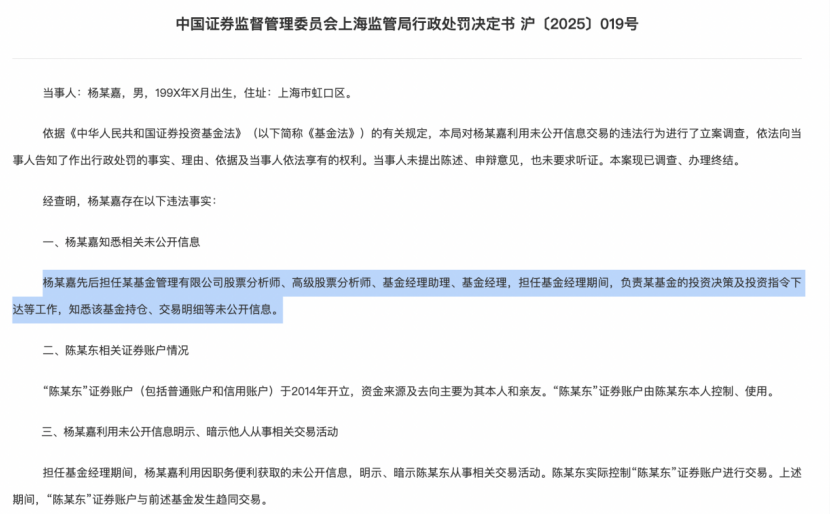
产品亏近40%却搞“老鼠仓”,90后基金经理领50万罚单
第一财经· 2025-10-26 12:34
Core Viewpoint - The article discusses a recent case of insider trading involving a fund manager in Shanghai, highlighting the absurdity of a situation where a manager with a nearly 40% loss in managed products still engaged in illegal trading activities using insider information [4][11]. Group 1: Incident Overview - The Shanghai Securities Regulatory Commission issued a fine to a fund manager, identified as Yang Moujia, for using undisclosed information to guide others in trading activities, resulting in a fine of 500,000 yuan [4][6]. - Yang Moujia's actions were classified as "rat trading," a serious violation where securities personnel trade in a manner that aligns with their institution's operations to gain improper benefits [6][12]. Group 2: Performance and Background - Yang Moujia, who has a career trajectory that matches a former fund manager named Yang Ningjia, managed three equity funds with a total scale exceeding 600 million yuan, but his performance was poor, with a nearly 40% loss during his tenure [8][9]. - The article notes that Yang Ningjia's funds underperformed significantly, with returns lagging behind benchmarks by over 23 percentage points [9][10]. Group 3: Industry Implications - The article emphasizes that the phenomenon of poor performance coupled with illegal activities is not isolated, as similar cases have emerged in the industry, indicating a troubling trend [11][12]. - The increasing sophistication of regulatory technology has made it more challenging for fund managers to engage in "rat trading," as regulators can now track and analyze trading patterns more effectively [11][12]. Group 4: Trust and Compliance Issues - The essence of fund management is based on trust, and "rat trading" undermines this foundation, leading to a loss of investor confidence [12]. - There is a noted lack of legal awareness and compliance understanding among some fund managers, which contributes to ongoing violations despite increased regulatory scrutiny [12].
产品亏近40%却搞“老鼠仓”,90后基金经理领50万罚单
Di Yi Cai Jing· 2025-10-26 09:00
Core Viewpoint - The article highlights a case of a fund manager, Yang Moujia, who faced penalties for insider trading while managing funds that experienced significant losses, raising concerns about ethical standards in the fund management industry [2][3][8]. Group 1: Case Details - Yang Moujia, a fund manager in Shanghai, was penalized with a fine of 500,000 yuan for using non-public information to influence trading activities [2][5]. - The investigation revealed that Yang utilized his position to provide hints to another individual, Chen Moudong, who controlled a trading account that mirrored the fund's transactions, constituting a form of "rat trading" [5][6]. - Yang's performance as a fund manager was notably poor, with losses nearing 40% during his tenure, and his funds underperformed their benchmarks by over 23 percentage points [7][8]. Group 2: Industry Implications - The incident reflects a broader issue within the fund management industry, where poor performance and ethical violations are increasingly common, as seen in other cases involving fund managers with similar misconduct [8][9]. - Regulatory bodies are enhancing their monitoring capabilities to detect "rat trading" and similar violations, but some fund managers still attempt to evade detection through more sophisticated methods [9][10]. - The fundamental principle of trust in fund management is being undermined by such unethical practices, highlighting the need for improved legal awareness and compliance among industry professionals [9][10].
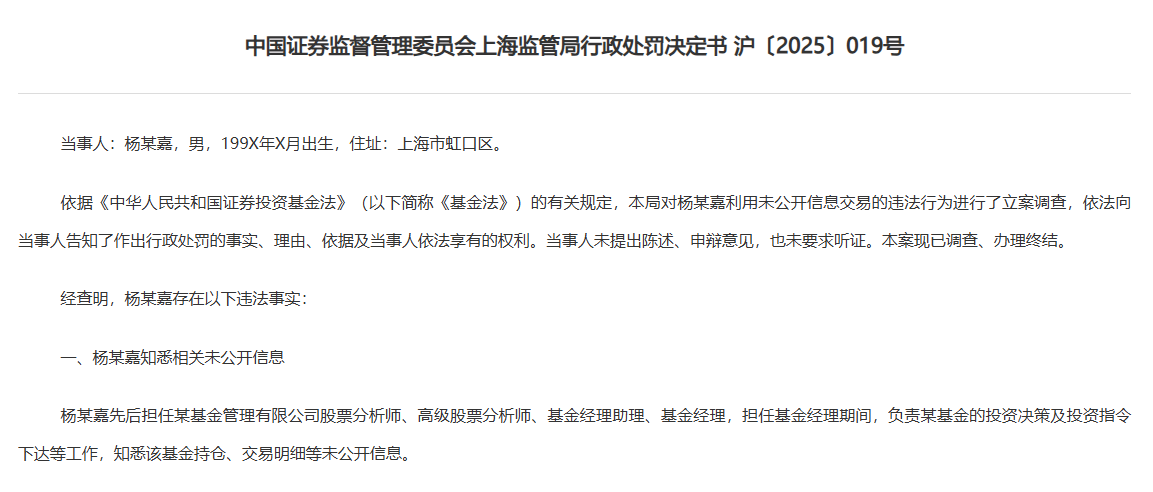
90后基金经理因“老鼠仓”被罚50万元!管理产品任职回报亏损近40%
Mei Ri Jing Ji Xin Wen· 2025-10-24 14:28
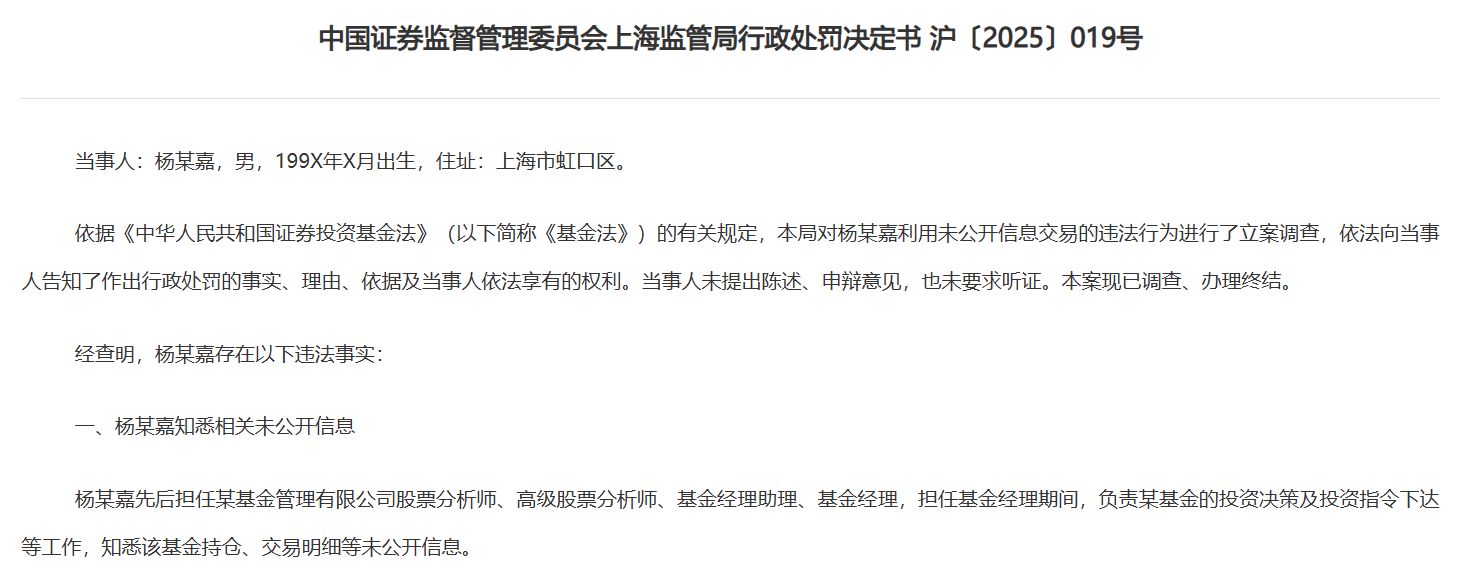
Core Viewpoint - The China Securities Regulatory Commission (CSRC) Shanghai Regulatory Bureau has issued an administrative penalty decision against Yang Moujia for insider trading, resulting in a fine of 500,000 yuan [1][3]. Group 1: Administrative Penalty Details - Yang Moujia, while serving as a fund manager, used undisclosed information obtained through his position to suggest trading activities to Chen Moudong, leading to a penalty of 500,000 yuan [1][3]. - The decision cites violations of the Fund Law, specifically Article 20, Section 6, and Article 123, Section 1 [3]. Group 2: Background on Yang Moujia - Yang Moujia has held various positions including stock analyst, senior stock analyst, assistant fund manager, and fund manager at a fund management company [3]. - There is a strong likelihood that Yang Moujia is the same individual as Yang Ningjia, the former fund manager at Hai Futong Fund, who managed multiple funds from 2017 to 2024 [3][4]. Group 3: Fund Performance and Departure - Yang Ningjia's performance during his tenure was subpar, with a nearly -40% return for the C class shares of the Hai Futong Electronic Media Fund over three years and close to -20% for the Hai Futong New Domestic Demand Mixed Fund over one year [5]. - Yang Ningjia resigned from all managed products on October 14, 2024, citing personal reasons, which may now be questioned in light of the insider trading allegations [4][5].
基金经理任内亏损近40%,还指挥好友“抄作业”
财联社· 2025-10-24 12:09
Core Viewpoint - The article discusses the recent penalties imposed on fund managers for engaging in insider trading, highlighting the connection between poor fund performance and regulatory violations [2][9]. Group 1: Regulatory Actions - The Shanghai Securities Regulatory Bureau announced a fine of 500,000 yuan against Yang Ningjia for using undisclosed information to facilitate trading activities [2]. - Yang Ningjia, a former fund manager at Hai Fu Tong Fund, was found to have engaged in insider trading by indicating to another individual to conduct related transactions [5]. - Another fund manager, Li Dan, was fined 600,000 yuan for similar violations, despite the lack of profitable outcomes from the trades [10][12]. Group 2: Fund Performance - During Yang Ningjia's tenure, the Hai Fu Tong Electronic Information Media Industry fund experienced a significant loss of 13.51%, attributed to heavy investments in the new energy sector during a TMT market surge [6]. - Under Yang Ningjia's management, the fund's total scale peaked at 1.735 billion yuan in Q2 2023, but dropped to 617 million yuan by Q3 2024 [7]. - The performance of Yang Ningjia's managed funds was notably poor, with two products recording losses of 39.52% and 20.39%, ranking in the bottom 30% of their peers [8].