Rate Cuts

Search documents
Goldman Sachs' Ashok Varadhan says he is 'very optimistic for 2026', expects more rate cuts
Youtube· 2025-12-16 16:58
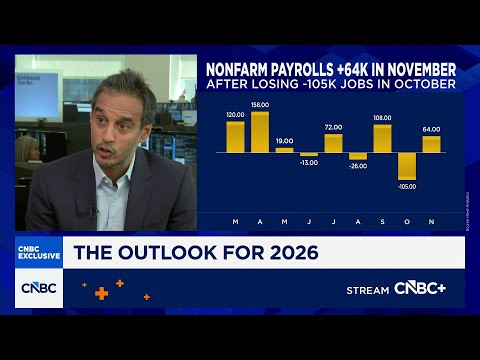
Here with me now at the Goldman Sachs trading floor in a CNBC exclusive is Goldman's co-head of global markets and banking Ashook Verdon. It's become a little bit of a tradition to do this at the end of the year. >> Yeah, welcome back to the trading floor call.>> Thanks for having us Ashook. So the Hasset view is kind of rhymes with what you what you what you believe will happen in 26 and that is growth can accelerate and we'll we can get back to target. >> Absolutely.uh you know maybe for a little bit diff ...



Goldman Sachs' Ashok Varadhan says he is 'very optimistic for 2026', expects more rate cuts
CNBC Television· 2025-12-16 16:58
Here with me now at the Goldman Sachs trading floor in a CNBC exclusive is Goldman's co-head of global markets and banking Ashook Verdon. It's become a little bit of a tradition to do this at the end of the year. >> Yeah, welcome back to the trading floor call.>> Thanks for having us Ashook. So the Hasset view is kind of rhymes with what you what you what you believe will happen in 26 and that is growth can accelerate and we'll we can get back to target. >> Absolutely.uh you know maybe for a little bit diff ...
Top-Ranked Utility ETFs Poised to Benefit From Recent Fed Rate Cut
ZACKS· 2025-12-16 14:06
Core Insights - The U.S. Federal Reserve has lowered the interest rate benchmark by 25 basis points to a target range of 3.50-3.75%, marking the third reduction in 2025, aimed at supporting a cooling labor market [1][2] Interest Rate Impact on Utilities - Lower interest rates create a favorable environment for capital-intensive sectors like utilities, which require significant funding for infrastructure and operations [2] - The utility sector has an inverse correlation with interest rates; rate cuts reduce the cost of servicing debt, enhancing profit margins and cash flows for utility companies [3] - As interest rates fall, utility stocks become more attractive to income-focused investors, leading to increased demand for high-dividend sectors like utilities [4] Investment Case for Utilities - The combination of lower financing costs, stable cash flows, and rising electricity demand from AI data centers strengthens the investment case for utilities amid macroeconomic uncertainty [5] - Investing in diversified Utility ETFs is recommended over individual utility stocks to mitigate risks associated with regulatory changes and company-specific issues [6] Utility ETFs Overview - Utility ETFs provide a one-stop solution for investors, offering exposure to a broad range of companies in the utilities sector while ensuring superior liquidity and lower expense ratios compared to actively managed funds [7] Recommended Utility ETFs - **Fidelity MSCI Utilities Index ETF (FUTY)**: Net assets of $2.25 billion, exposure to 67 utility stocks, year-to-date gain of 17.1%, fees of 8 bps [9] - **State Street Utilities Select Sector SPDR ETF (XLU)**: AUM of $22.16 billion, exposure to 31 companies, year-to-date gain of 16.6%, fees of 8 bps [10][11] - **iShares U.S. Utilities ETF (IDU)**: Net assets of $1.78 billion, exposure to 44 companies, year-to-date gain of 15.7%, fees of 38 bps [12] - **Vanguard Utilities ETF (VPU)**: Net assets of $8.3 billion, exposure to 68 companies, year-to-date gain of 17.1%, fees of 9 bps [13] - **Invesco Dorsey Wright Utilities Momentum ETF (PUI)**: Market value of $51.5 million, exposure to 35 companies, year-to-date gain of 16.8%, fees of 81 bps [14][15]

Markets Will Stay Choppy Into Christmas: 3-Minutes MLIV
Youtube· 2025-12-16 08:51
Very good morning to you. So we're busy waiting for nonfarm payrolls. One and a half non-farm payrolls.Looking at us features a little bit weaker, weighing on sentiment for tech here in Europe as well. What do you make of the price action heading into the yet important data points. It's been very disappointing price action and I think this kind of choppy price action with a negative bent is going to be the dynamic for the festive period.I don't think it's so much about the jobs data. I think the job today i ...

大宗商品价格展望:2026 年第一季度有望上行-metal&ROCK -The Price Deck – 1Q26 Upside Ahead
2025-12-16 03:30
Summary of Key Points from the Conference Call Industry Overview - The conference call focuses on the metals industry, particularly in Europe, with a positive outlook for various metals in 2026, driven by rate cuts and demand for real assets [1][2]. Core Insights and Arguments - **Positive Outlook for Metals**: The overall outlook for metals remains strong, supported by rate cuts, potential USD weakness, and increasing investor demand for real assets. New demand sources, such as energy storage systems (ESS) batteries and data centers, are expected to contribute to copper demand growth by approximately 0.6 percentage points in 2026 [2][3]. - **Top Picks**: Uranium and lithium are highlighted as top picks due to rising contracting activity and tighter market conditions, respectively. Conversely, iron ore and zinc are viewed with more caution [1][3]. - **Supply Challenges**: Significant supply challenges are noted, including disruptions in copper mines and competition for electricity among aluminum smelters and data centers [2][3]. - **China's Demand**: China's metals demand is bolstered by its manufacturing and export model, which is expected to continue. The US energy secretary's discussions on strategic uranium stockpiling also support this outlook [2][3]. Price Forecasts - **Uranium**: Expected to benefit from rising contracting activity and disappointing supply growth, leading to price upside [3][10]. - **Lithium**: Anticipated to enter a tighter market in 2026 due to accelerated ESS demand [3][10]. - **Aluminum**: Expected to catch up with copper prices as supply constraints from China and other regions persist [3][10]. - **Copper**: Projected to rise further due to tight supply and US stockpiling, although China demand remains a concern [3][10]. - **Gold**: Expected to see smaller gains in 2026 as central bank and ETF buying slows, but rate cuts may support prices [3][10]. - **Iron Ore**: Forecasted to tip into surplus as supply growth outpaces steel demand, although high-cost mines in China may set a price floor [3][10]. - **Zinc**: LME tightness is expected to fade as mine supply growth continues [3][10]. Key Risks - **Demand Destruction Risks**: With significant price increases in the BCOM Precious Metals Index (up 66%) and Industrial Metals (up 13%), there are concerns about potential demand destruction and disconnection from cost curves [4]. - **Global Growth Slowdown**: A sustained global growth slowdown could negatively impact prices, alongside energy price weakness and elevated by-product credits that may drag down cost curves [4]. Additional Insights - **Investor Behavior**: New investments in precious metals are noted, including Tether's gold purchases and India's pension regulator's approval for gold and silver ETF allocations [2]. - **Market Dynamics**: The report emphasizes the importance of resource security and strategic stockpiling, particularly in the context of geopolitical tensions and local opposition to mining projects [28]. Conclusion - The metals industry outlook for 2026 is characterized by a positive skew, driven by various macroeconomic factors and emerging demand sources. However, potential risks related to demand destruction and global economic conditions warrant close monitoring.
Fed Governor Stephen Miran: I don't see tariffs as a major driver of inflation
Youtube· 2025-12-15 16:57
Core Viewpoint - Federal Reserve Governor Steven Myron advocates for sharper rate cuts, arguing that current policy is too tight and could negatively impact the labor market and increase unemployment [3][10]. Inflation Measurement - Myron believes that underlying inflation is closer to the Fed's target than commonly perceived, citing that much of the perceived inflation excess is due to measurement quirks [4][10]. - The housing market's lagging measurement of inflation is a significant factor, as rent adjustments occur infrequently, leading to a delayed reflection of current market conditions [5][6]. Contributing Factors to Inflation - Myron highlights that market rents have been growing at about 1% for the past few years, suggesting a downward convergence in shelter inflation is forthcoming [6]. - Imputed prices for non-market services, such as portfolio management fees, have contributed approximately 25 basis points to inflation over the last year, despite a long-term downward trend in actual fees [8][10]. Disagreement with Tariff-Induced Inflation - Myron disagrees with Fed Chair Powell's assertion that tariffs are a major driver of persistent inflation, arguing that he does not see tariffs as significantly impacting inflation levels [11][12].

Fed’s Miran Defends Push for Steeper Rate Cuts Despite Elevated Inflation
Barrons· 2025-12-15 14:50
This copy is for your personal, non-commercial use only. Distribution and use of this material are governed by our Subscriber Agreement and by copyright law. For non-personal use or to order multiple copies, please contact Dow Jones Reprints at 1-800-843-0008 or visit www.djreprints.com. ...
Riskier Small Caps Seen Outperforming in 2026 on Growth Outlook
Yahoo Finance· 2025-12-15 10:30
Core Viewpoint - The recent rally in small-cap stocks, driven by falling interest rates and economic growth, is expected to continue into 2026, with small caps potentially leading market gains [1][3]. Group 1: Market Performance - The Russell 2000 Index has outperformed the S&P 500 Index for four consecutive weeks, marking the longest such stretch in two years, despite a selloff in equities [2]. - Over the past month, both the Russell 2000 and the S&P Small Cap 600 Index have increased approximately 4%, surpassing the performance of the Magnificent 7 stocks, which rose only 0.3%, while the S&P 500 Index dropped by 0.3% [4]. Group 2: Future Projections - Strategists from major firms predict that small-cap leadership will extend into 2026, contingent on further rate cuts and economic growth, as well as a shift away from high-valued megacaps [3]. - Jonathan Krinsky from BTIG anticipates that small caps will continue to outperform the Magnificent 7, especially as investors may take profits from Big Tech due to high valuations [5]. - Bank of America's Jill Carey Hall forecasts a 17% earnings growth for small firms compared to 14% for large caps, attributing this to a potential profits rebound, rate cuts, and shifting investor flows [6].
How Fed Rate Cuts Affect Bitcoin, AI & The Market
Anthony Pompliano· 2025-12-13 14:01
Fed Policy & Market Impact - The Fed's 25 basis point rate cut was largely expected, but the dovish messaging, highlighting concerns about labor market weakness and potential overstatement of non-farm payroll numbers by approximately 60,000 jobs, surprised the market [1] - The Fed acknowledged the need to start treasury bill purchases at $40 billion per month, signaling continued liquidity support, which is seen as positive for assets like gold and Bitcoin [1] - Equities reacted positively, with small caps and transports rising, indicating a shift towards cyclical, pro-inflation trades, while growth stocks underperformed value stocks [2] Bitcoin & Crypto - Bitcoin's chart looks weak, but there are buy signals, with expectations of a surge back to $100,000 if it can get above $93,000, and Ethereum is outperforming Bitcoin [2] - The long-term view is that Bitcoin will benefit from the AI-driven hyper-productivity growth, as AI models compete with each other, diminishing moats and emphasizing adaptability, making Bitcoin a compelling large-cap growth investment [6][26] AI & Technology - The progress in AI models, particularly from GPT-4 to GPT-5, is based on advancements in reasoning and reinforcement learning, rather than solely on hardware, but the Blackwell deployment is crucial for visual language models and physical world applications like robotics and robo-taxis [3] - The consensus in San Francisco is that recursive self-improvement in AI will be reached in the next 2-4 years, leading to hyper-productivity and computers solving problems in energy and biology [5] - Open-source AI models are gaining traction, offering faster and cheaper solutions, but Blackwell chips provide a significant performance jump, potentially favoring closed-source models in the long run [5][6] Economic Transition & Investment Strategies - The US economy is transitioning from analog/electronic to digital, causing disruption and "shedding skin," with small business bankruptcies at a record high, but also creating opportunities for individuals to create income streams online [8] - The focus is shifting from software to hardware, with opportunities in energy, transportation, and small-cap companies making LiDAR and sensors, as the physical world is still essential to fuel technology [9] - The IPO market is expected to be historically active in the next 12-18 months, with companies like Anthropic, XAI, OpenAI, and SpaceX going public, requiring capital to build out physical infrastructure [8] Risks & Opportunities in 2026 - While a major recession is considered low probability, 20-30% market corrections are expected in the next 5 years due to events impacting profit margins and productivity [9] - A potential risk is the capex hole, where hyperscalers are spending heavily on infrastructure but not yet seeing corresponding revenue increases, potentially impacting valuations [9] - Embodied AI, starting with robo-taxis, is a major theme for the coming year, creating opportunities in hardware, batteries, and commodities like copper [10][11][12][13][14][15][16][17]

The Fed Did Banks a Solid This Week. More Favors May Be Needed
WSJ· 2025-12-13 10:30
Core Insights - The Federal Reserve's decisions regarding the size of its balance sheet are expected to have significant implications for banks, potentially more so than its rate cut decisions [1] Group 1 - The size of the Federal Reserve's balance sheet is a critical factor for the banking sector [1] - Banks may be more affected by changes in the balance sheet than by interest rate adjustments [1]