
网络谣言

Search documents
百万网红博主户晨风账号被封,详情披露!
新华网财经· 2025-11-06 02:36
Group 1 - The article discusses the negative impact of social media influencers, particularly focusing on the case of Hu Chenfeng, who has been banned from multiple platforms for inciting social division and promoting extreme views for the sake of gaining attention and followers [2][5][9] - Hu Chenfeng's content categorized users as "Apple people" representing the elite and "Android people" as the lower class, creating a divisive narrative that exploits consumer habits for commercial gain [7][9] - Experts emphasize the need for stricter regulations and a multi-faceted approach to manage online content, including improving platform algorithms and encouraging mainstream media to play a role in guiding public discourse [11][13] Group 2 - The article highlights the dangers of spreading rumors in public domains, which can lead to public panic and misinformation, particularly in areas like disaster reporting and economic news [14][24] - Specific cases of misinformation are cited, including false claims about electricity price changes and fabricated disaster videos, which were spread without verification, leading to administrative penalties for the perpetrators [16][20][23] - Experts recommend that the public should prioritize information from official sources and mainstream media to avoid falling for rumors and misinformation [26]


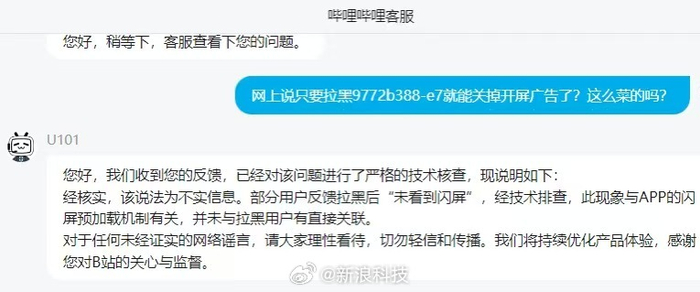
B站否认拉黑用户可屏蔽广告,称系预加载机制导致
Xin Lang Ke Ji· 2025-11-04 13:37
Core Viewpoint - Bilibili denies the claim that users can block ads by blacklisting specific users, stating that this information is false [1] Summary by Relevant Sections - **User Claims and Reactions** - Some users reported that blacklisting certain users resulted in not seeing splash ads, which sparked discussions online [1] - **Company Response** - Bilibili's customer service clarified that the phenomenon is related to the app's splash screen preloading mechanism and is not directly linked to user blacklisting [1] - The company urged users to approach unverified online rumors with caution and emphasized their commitment to optimizing product experience [1]

云南盐津一男子为博流量编造“有人跳桥” 被行拘3日
Yang Shi Wang· 2025-10-30 04:10
Group 1 - A man was detained for three days for fabricating a video claiming someone jumped off a bridge in Yunnan Province, which was found to be false information aimed at gaining attention and followers [1][5]. - The local police took the situation seriously and conducted an investigation around the electric station suspension bridge after discovering the misleading video [3]. - The investigation confirmed that there had been no incidents of missing persons related to the bridge, categorizing the video as a typical internet rumor [5].

为博流量利用AI造谣“在监狱直播带货” 一网民被行政处罚
Xin Jing Bao· 2025-10-29 00:53
Core Viewpoint - The rise of AI-generated content has significantly lowered the barriers for spreading rumors, leading to legal and ethical violations as individuals exploit this technology for personal gain [1][4]. Summary by Sections Incidents of AI-generated Rumors - In Shandong Weihai, two cases of individuals using AI to fabricate and disseminate false information were reported. One individual created a rumor about "live streaming sales from prison" to gain attention, while another fabricated a video about storm damage to attract views during a typhoon [1][2]. Legal Consequences - The individuals involved in the aforementioned incidents faced administrative penalties from law enforcement agencies [2]. Legal Framework - According to the Public Security Administration Punishment Law of the People's Republic of China, spreading rumors or falsely reporting emergencies can result in detention of five to ten days and fines up to 500 yuan. Lesser offenses may incur detention of less than five days or fines below 500 yuan [3]. Risks Associated with AI-generated Rumors - AI-generated rumors have created a gray industry with a clear division of labor, capable of producing 4,000 to 7,000 fake articles daily at a cost significantly lower than traditional rumor-mongering. The risks include: - Exponential increase in harm compared to traditional rumors due to technological characteristics [4]. - High realism and strong misleading potential, making it difficult for ordinary users to discern authenticity [4]. - Rapid evolution and iteration capabilities, allowing AI-generated rumors to quickly counteract debunking efforts [4]. Prevention Strategies - To identify potential AI-generated rumors, users can: - Check the source for credibility, avoiding content with unclear authorship or vague origins [5]. - Examine details in images and videos for typical AI-generated anomalies [5]. - Verify logical consistency, looking for factual errors or contradictions [5]. Tools for Verification - Users are encouraged to utilize authoritative debunking platforms and stay informed through alerts from the Ministry of Public Security's Cybersecurity Bureau. The public is urged to report any malicious rumor-spreading activities to help maintain a clear online environment [6].
国宝之“伤”:“大熊猫被虐待”网络谣言案调查
Xin Hua She· 2025-10-27 08:28
Core Viewpoint - The article discusses the rise of extreme "cat fans" who spread rumors and engage in disruptive behavior regarding giant pandas, leading to legal consequences for those involved in such activities [1][3]. Group 1: Background and Context - The death of the giant panda "Lele" and the poor condition of "Yaya" have sparked public concern, leading to the spread of rumors by some extreme "cat fans" and self-media bloggers under the guise of protecting pandas [3]. - Notable figures in this rumor-spreading activity include individuals like Bai and Xu, who have gained influence within the "cat fan" community [5]. Group 2: Methods of Rumor-Mongering - Bai, known as "Daliao Empress," initially engaged actively in "cat fan" groups before leveraging her popularity to conduct live streams, falsely claiming her husband was a police officer to gain trust [5][6]. - The primary methods of profit for Bai and Xu include receiving online donations during live streams and organizing offline fundraising events [6]. Group 3: Nature of the Rumors - The rumors propagated by the defendants included extreme and false claims about panda treatment, such as "electrocuting for sperm extraction" and "selling pandas for profit," which aimed to discredit relevant authorities and experts [8]. - These rumors incited harassment against experts and officials, including phone calls, text abuse, and even excessive reporting to authorities [8]. Group 4: Legal Proceedings - Following the investigation, the case was formally opened in March 2024, with the prosecution analyzing over 270 videos and issuing numerous rebuttals from official sources [10]. - The court ultimately sentenced Bai to 18 months and Xu to 14 months in prison for their roles in spreading false information and causing public disorder [10]. Group 5: Conclusion and Recommendations - Prosecutors emphasize the need for a rational and scientific approach to panda protection, urging both enthusiasts and the "cat fan" community to foster a supportive environment for panda conservation efforts [12].

美团辟谣骑手集体关机配送费上涨传闻
Cai Jing Wang· 2025-10-24 09:06
Core Viewpoint - The rumors regarding delivery riders collectively shutting down and the subsequent increase in delivery fees are false, as confirmed by the company [1][3][4]. Group 1: Rumor Details - Multiple social media posts claimed that riders collectively shutting down would lead to a rise in delivery fees, with specific examples cited, such as fees increasing from 3.5 to 6 yuan [1][3]. - The rumors began circulating on October 3, with initial claims about riders in Chongqing and Changsha, which evolved into more elaborate narratives involving cities like Guangzhou and Hangzhou [1][3]. Group 2: Company Response - The company has stated that no incidents of collective shutdowns occurred in Chongqing, Guangzhou, or Hangzhou, labeling the information as fabricated [4]. - The company has identified that many accounts spreading these rumors are linked to MCN organizations and exhibit signs of AI-generated content, prompting them to report these accounts to relevant authorities for accountability [1][3]. Group 3: Rider Income Information - In response to concerns about rider income, the company reported that the average monthly income for high-frequency riders nationwide is between 6,949 and 10,201 yuan, with skilled riders in major cities potentially earning up to 12,826 yuan [2].

虚假摆拍、编造传播网络谣言?公安部公布10起打击整治网络谣言典型案例
Yang Shi Wang· 2025-10-20 03:38
Core Viewpoint - The Chinese Ministry of Public Security has intensified efforts to combat online rumors and illegal activities, focusing on public concerns and promptly addressing misinformation related to trending events [1] Group 1: Cases of Online Rumors - Case 1: Four individuals were involved in creating a false video claiming an elderly man in Shanghai extorted 50,000 yuan after finding a luxury bag, which negatively impacted the local image and public order [2] - Case 2: An individual spread a rumor that entering Yuxi city in Yunnan required a fee of 200 yuan, misleading the public and disrupting social order [3] - Case 3: A man used AI to fabricate a story about his daughter being abducted, misleading many well-meaning individuals who attempted to help [4] - Case 4: A rumor about a gas truck explosion in Deyang, Sichuan, was spread, causing panic among local residents [5] - Case 5: A woman created a false narrative about a devastating earthquake in Datong, Shanxi, misleading the public and causing fear [6] - Case 6: A false report of a 6.8 magnitude earthquake in Chongqing was disseminated, leading to public panic [7] - Case 7: An individual fabricated a story about a knife attack during a traffic dispute, misleading the public [8] - Case 8: A rumor about a student dying during a physical test in Weifang, Shandong, was spread, causing public concern [9][10] - Case 9: A false claim about a school collapse on the first day of school in Weihai, Shandong, was circulated, causing panic [11] - Case 10: A rumor regarding a man's death from a viral infection in Foshan was spread, misleading the public [12] Group 2: Public Awareness and Responsibility - The police emphasize the importance of responsible online behavior, urging the public to discern and verify information, and to rely on authoritative sources to prevent the spread of rumors [13]
炮制剧本、摆拍视频……网警公布打击网络谣言典型案例
Zhong Guo Xin Wen Wang· 2025-10-17 02:36
炮制剧本、摆拍视频……网警公布打击网络谣言典型案例 近日,甘肃庄浪公安机关网安部门依法查处一起利用某直播平台,通过虚构经济纠纷、演绎暴力剧情, 吸引关注进行引流带货销售各种质量缺陷、描述与实际不符、缺乏售后保障商品的案件。 来源:中国新闻网 编辑:付健青 经查,为推销所谓"优质低价"、"限时秒杀"商品,当地两名网络主播在直播和短视频中不标注"演 绎"或"虚构",演绎各种"暴力冲突"剧本内容,刻意在网上制造紧张冲突氛围,博取网民同情并诱导购 买商品,引发大量网民关注和讨论,造成部分群众对当地社会治安误解。 虚假谣言扰乱商家正常经营 近日,甘肃永靖县公安网安部门陆续接到辖区内多家餐饮从业人员报案,称有人在网上恶意散布"某餐 饮店经营者患有艾滋病"的不实信息,严重扰乱了商家的正常经营秩序,造成当地居民恐慌,且对相关 个人的生活造成负面影响。 经核实,网传所谓"某店老板和老板娘有艾滋病"等言论属不实谣言信息,系人恶意捏造发布。经查,属 地梁某、罗某、吴某及柳某4人出于"猎奇心理",在多个互联网平台肆意散布相关虚假信息,引发社会 广泛关注,造成当地居民恐慌,引发不良社会影响。 以上人员,公安机关均已依法作出处罚。 中新 ...
虚假摆拍演绎暴力,捏造谣言造成恐慌……网警公布打击网络谣言典型案例
Yang Shi Wang· 2025-10-17 01:59
央视网消息:据公安部网安局微信公众号消息,炮制剧本、虚构场景、摆拍视频……从"卖惨助 农"到"制造对立",打造虚构的暴力冲突吸引流量进行带货;为彰显个性博取关注,发布低俗、有违社 会公序良俗的引流视频;随意捏造散布虚假不实信息,影响正常群众生产经营。网络并非法外之地。公 安网安部门深入开展"净网-2025"专项工作,严打网络违法犯罪,今日,公布相关违法典型案例。 虚构纠纷演绎冲突惹围观 近日,甘肃庄浪公安机关网安部门依法查处一起利用某直播平台,通过虚构经济纠纷、演绎暴力剧 情,吸引关注进行引流带货销售各种质量缺陷、描述与实际不符、缺乏售后保障商品的案件。 经核实,网传所谓"某店老板和老板娘有艾滋病"等言论属不实谣言信息,系人恶意捏造发布。经 查,属地梁某、罗某、吴某及柳某4人出于"猎奇心理",在多个互联网平台肆意散布相关虚假信息,引 发社会广泛关注,造成当地居民恐慌, 虚假谣言扰乱商家正常经营 近日,甘肃永靖县公安网安部门陆续接到辖区内多家餐饮从业人员报案,称有人在网上恶意散 布"某餐饮店经营者患有艾滋病"的不实信息,严重扰乱了商家的正常经营秩序,造成当地居民恐慌,且 对相关个人的生活造成负面影响。 经查,为 ...
网信、公安重点整治AI造假、挑动负面情绪等乱象
Zhong Guo Xin Wen Wang· 2025-10-10 05:58
Core Points - The article discusses the crackdown on online rumors and misinformation related to public policies, disasters, and social issues, highlighting the misuse of AI tools to create false narratives and the impact on public order and individual rights [1][2][3] Group 1: Online Misinformation - In September, rumors related to disasters and floods were prevalent, with exaggerated claims about typhoons and fabricated videos circulating on social media [2] - Specific instances include false reports about a typhoon in Guangdong and misleading videos about severe weather in Zhengzhou, which were generated using AI technology [2] Group 2: Fraudulent Activities - Criminals have exploited the situation by creating fake announcements about government subsidies and investment opportunities, leading to scams that compromise personal information and financial security [1] - Examples include a fraudulent app posing as an investment platform and misleading claims about national projects offering rewards [1] Group 3: Government Response - The Central Cyberspace Administration has initiated a special campaign to address issues related to inciting negative emotions and spreading panic, targeting platforms that fail to manage content responsibly [3] - Law enforcement has taken action against individuals spreading false narratives, including those fabricating stories for sensationalism [3]