SaaS

Search documents
2026年,AI SaaS的潮水正在迅猛来袭
3 6 Ke· 2026-02-06 11:20
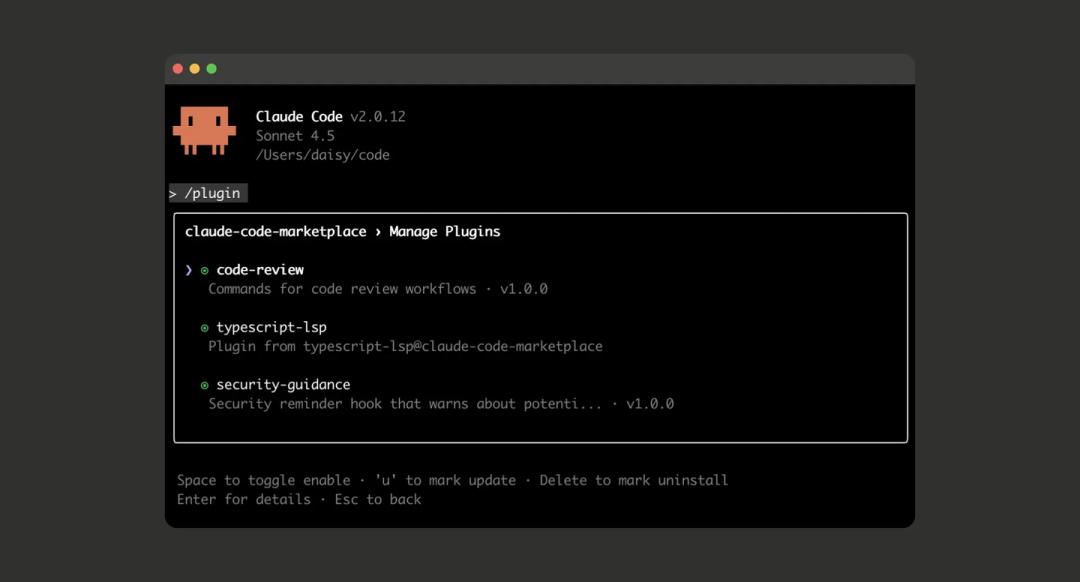
这种颠覆不仅限于软件即服务(SaaS)领域。人工智能如今正渗透到专业服务行业——财富管理、咨询、法律等,这些行业历来依赖高薪专家和劳动密 集型工作流程,且在很大程度上未受到以往技术革命的影响。人工智能不仅能提炼和整合专家知识,还能打破领域壁垒,提供跨学科的智能服务,其表现 超越了传统的人类专业技能。 一个越来越明确的事实是,人工智能正在重塑工作的方式,但并没有消解软件的存在价值。相反,在 AI 进入企业核心流程之后,软件作为基 础设施的重要性反而被进一步放大。 对头部SaaS厂商而言,真正的挑战不在于是否会被AI"取代",而在于能否成为AI调用的基础设施层,能否将自身产品转化为智能体时代的标准 化能力模块。商业模式的变化或许不可避免,但价值本身并未消失。 最近,AI 与 SaaS 的关系被一次市场波动推到了聚光灯下。随着 Anthropic 发布面向开发者的 AI 插件能力,多家头部 SaaS 公司股价在短时间内出现明显 下跌,"AI 是否正在取代软件""SaaS 是否正在走向终结"的讨论迅速蔓延。 这种情绪并不陌生。每一次底层技术发生跃迁,市场都会本能地将"工具"与"智能"对立起来,仿佛后者的出现必然意味着 ...

AI恐惧重挫软件股:是“毫无逻辑”的恐慌,还是SaaS的终结?
Hua Er Jie Jian Wen· 2026-02-06 07:39
Core Viewpoint - The recent launch of Anthropic's new AI tool has triggered a massive sell-off in software stocks, leading investors to reassess which software companies can survive in the AI era [1] Group 1: Market Reaction - The S&P 500 Software and Services Index fell over 4% overnight, marking its eighth consecutive day of decline, with a cumulative drop of approximately 20% year-to-date [1] - Companies such as Thomson Reuters, Salesforce, and LegalZoom have seen significant stock price declines this week, with the sell-off extending to Asian IT firms like Tata Consultancy Services and Infosys [1] - Hedge funds have shorted about $24 billion worth of software stocks this year, indicating a cautious outlook from institutional investors regarding the industry's future [1][5] Group 2: Industry Perspectives - NVIDIA CEO Jensen Huang dismissed market fears, stating that the notion of the software industry declining and being replaced by AI is "the most illogical thing in the world" [2] - Arm Holdings CEO Rene Haas echoed this sentiment, suggesting that enterprise AI deployment is still in its early stages and has not yet caused transformative impacts [2] - Wedbush Securities noted that while AI poses headwinds for software providers, the sell-off reflects a "doomsday scenario" that is far from reality, emphasizing that enterprises will not completely overhaul their existing software infrastructure [3] Group 3: Analyst Divergence - Constellation Research expressed concerns that AI could compress profits and limit pricing power for software companies, indicating that the sell-off is more about profit pressure than the industry's demise [3] - Rolf Bulk from Futurum Group highlighted that SaaS could be eroded by AI-driven workflows, potentially affecting industry valuation multiples [3] - Despite concerns, Bulk believes that certain software providers, particularly those handling critical enterprise workloads like Oracle and ServiceNow, possess enduring "profit rights" due to their deep data integration and established positions in customer workflows [3] Group 4: Strategic Adaptation - AlphaSense is betting on the strategy of integrating advanced AI with reliable content and deep domain expertise, as stated by Chris Ackerson, Senior Vice President of Products [4]
万亿市值一夜蒸发!Claude Cowork血洗全球软件业,老黄急了
猿大侠· 2026-02-06 04:12
Core Viewpoint - The release of Anthropic's new plugins for Claude Cowork has triggered a significant decline in the software sector, leading to a loss of approximately $300 billion in market value overnight and nearly $1 trillion over the past week, sparking fears of a "SaaSpocalypse" [1][2][7][9]. Group 1: Impact of Anthropic's Plugins - Anthropic's introduction of 11 new plugins allows AI to directly replace traditional software applications across various industries, including finance, sales, and legal sectors, marking a significant shift in the software landscape [5][6][18]. - The plugins enable AI to autonomously manage workflows, reducing the need for human intervention and potentially rendering traditional software solutions obsolete [25][72]. - The market reaction has been severe, with major software companies like Oracle, Adobe, and Salesforce experiencing significant stock declines, reflecting investor fears about the viability of the SaaS business model [9][80]. Group 2: Market Reactions and Trends - The S&P North American Software Index has dropped by 18% over the past month, reaching its lowest level since April 2025, while the S&P 500 Software Services Index fell nearly 13% in just five trading days [31][33]. - The decline in software stocks has not only affected the U.S. market but has also led to significant losses in European and Asian markets, with companies like WPP and Omnicom seeing declines of over 10% [62][65]. - Concerns about the impact of AI on software companies have led to a broader sell-off in related sectors, including private equity firms and cloud service providers, indicating a widespread reevaluation of the software industry's future [58][59][80]. Group 3: Future of Software and AI Integration - The emergence of AI-driven solutions like Claude Cowork suggests a transition from traditional SaaS models to "Agent as a Service" (AaaS), where AI can perform tasks previously handled by multiple software applications [72][75]. - Analysts predict that the traditional pricing models based on per-seat fees will be disrupted as AI capabilities allow for more efficient task execution, leading to a potential decline in demand for conventional software licenses [73][76]. - Despite the current turmoil, some analysts argue that the software industry will not be entirely replaced by AI but will instead evolve, with AI enhancing rather than eliminating the need for software solutions [84][86].

“AI杀死SaaS”论调引发全球抛售 软件的天塌了吗
2 1 Shi Ji Jing Ji Bao Dao· 2026-02-05 23:13
Core Viewpoint - The global capital markets are experiencing significant turbulence due to fears that AI may disrupt the SaaS industry, leading to a sharp sell-off in SaaS stocks following the release of an AI tool by Anthropic [1][3]. Group 1: Market Impact - On February 3, the combined market value of two S&P indices tracking software, financial data, and exchange stocks dropped by approximately $300 billion [1]. - The Hong Kong SaaS index fell by 6.39% on February 4, resulting in a total market value loss of nearly HKD 150 billion [1]. - Major SaaS stocks in Hong Kong, such as Kingdee International and Kingsoft, saw declines of 12.64% and 5.14%, respectively [1]. Group 2: Broader Market Reactions - The sell-off in the software sector affected the entire Hang Seng Tech Index, which dropped by 1.84%, with notable declines in Tencent (3.96%), Alibaba (0.93%), and NetEase (3.32%) [2]. - The A-share SaaS index also fell by 2.61%, with companies like Sangfor Technologies and Yonyou Network experiencing significant losses [2]. - The U.S. SaaS sector had already begun to decline on February 3, with a drop of 4.12% in the Wind U.S. SaaS index, leading to a total market value loss exceeding $30 billion [2]. Group 3: Causes of Market Sentiment - The catalyst for the sell-off was the introduction of an AI plugin by Anthropic, which automates various legal tasks, raising concerns about the potential obsolescence of traditional SaaS offerings [3][4]. - The term "SaaSpocalypse" was coined by traders to describe the market's reaction to the perceived threat posed by AI to the SaaS business model [3]. Group 4: SaaS Business Model Insights - SaaS operates on a subscription model, providing services like CRM and ERP, which contrasts with traditional software sales [6]. - The low entry barriers and integration of industry best practices are key advantages of SaaS, making it appealing to small and medium-sized enterprises [6]. - While AI can enhance SaaS offerings by providing personalized solutions, it also presents challenges, particularly for smaller businesses that may struggle with AI deployment [6]. Group 5: Future Outlook - The market may be overreacting, as SaaS still holds advantages in the SME sector, and a differentiation within the SaaS market is expected [7]. - Deloitte predicts that the SaaS business model may evolve, with a shift towards hybrid pricing models based on usage and outcomes by 2026 [7]. - Gartner forecasts that by 2030, at least 40% of enterprise SaaS spending will transition to usage-based or outcome-based pricing models [7].
谷歌电话会:1850亿支出“不得不花”,确认与苹果合作,Gemini并非SaaS的“终结者”
硬AI· 2026-02-05 12:32
Core Viewpoint - Google is heavily investing in AI, with projected capital expenditures reaching $175 billion to $185 billion by 2026, primarily for servers and data centers, as part of its commitment to the AI arms race [2][4][30]. Group 1: Capital Expenditure and AI Investment - The significant capital expenditure forecast for 2026 is aimed at supporting the development of Google DeepMind's advanced models and meeting the surging demand from cloud customers [6][30]. - Approximately 60% of the capital expenditure will be allocated to servers, while 40% will go towards data centers and network equipment [6][30]. - The increase in infrastructure investment is expected to lead to a substantial rise in depreciation expenses, which will exert ongoing pressure on profit margins [6][56]. Group 2: AI's Role in SaaS and Market Dynamics - In response to fears that AI could disrupt traditional software business models, Google’s CEO emphasized that Gemini serves as an "engine" for SaaS companies rather than a terminator, with 95% of the top 20 SaaS companies already utilizing Gemini [8][39]. - The Gemini App has surpassed 750 million monthly active users, indicating strong engagement and the potential for monetization through a new "agentic commerce" model [12][29]. Group 3: Partnership with Apple - Google has confirmed a significant partnership with Apple, positioning itself as the preferred cloud provider and collaborating on the development of the next-generation Apple Foundation model based on Gemini technology [9][10][39]. Group 4: Cloud Business and AI Infrastructure - Google Cloud's revenue grew by 48%, driven by strong demand for AI infrastructure, with a notable increase in new customer acquisition and larger customer commitments [19][36]. - The company is employing a dual strategy of using both self-developed TPUs and NVIDIA GPUs to enhance its AI capabilities [19][36]. Group 5: YouTube and Advertising Growth - YouTube's advertising revenue increased by 9%, with significant growth in subscription services, particularly YouTube Music Premium [21][46]. - The platform continues to lead in streaming, with Shorts averaging over 200 billion views daily, indicating a robust engagement trend [21][46]. Group 6: Efficiency and Internal Operations - Google has achieved a 78% reduction in service unit costs for Gemini through model optimization and efficiency improvements [22][56]. - Approximately 50% of the code is now written by coding agents, allowing engineers to focus on higher-level tasks and improve operational efficiency [22][66].
Claude一个插件吓哭华尔街,软件公司集体暴跌,2万亿元一日蒸发
3 6 Ke· 2026-02-05 12:01
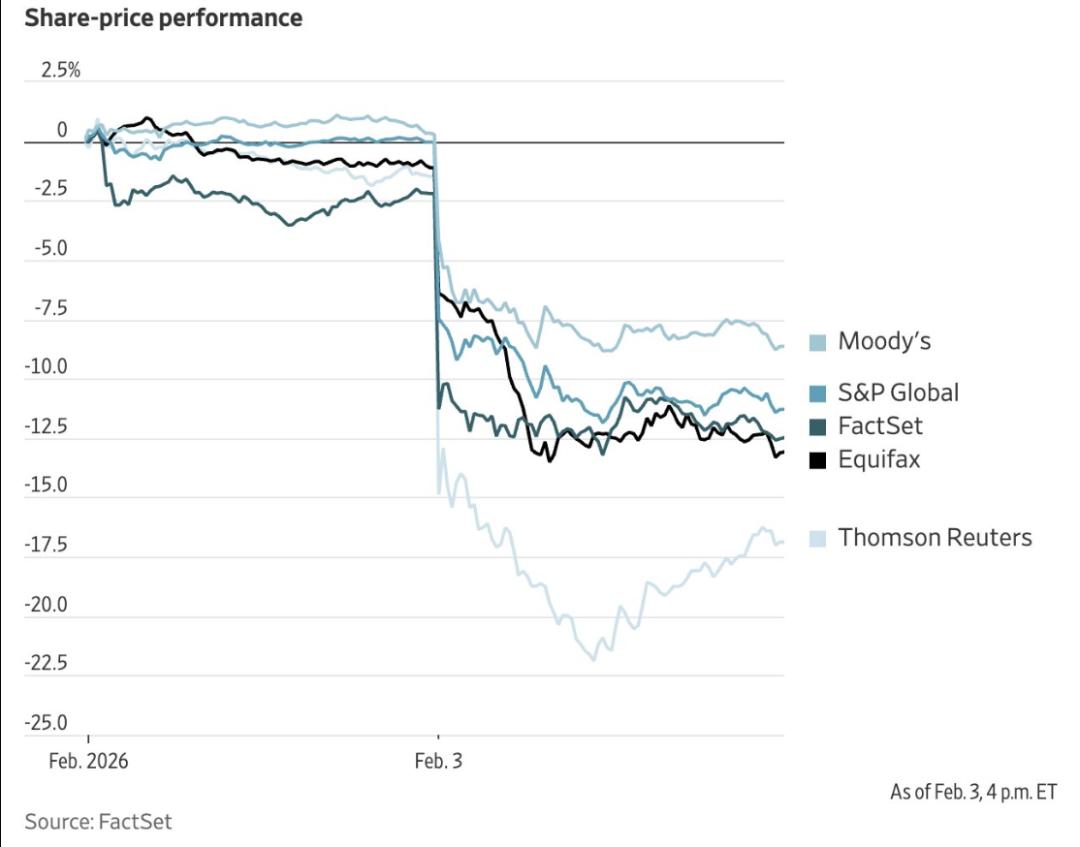
上周Anthropic推出了「插件」功能,发布11个「硅基员工」,涵盖销售、财务、市场营销等领域。 而如今,这11个「硅基员工」,全部变成了无情的SaaS杀手。 仅用了几个小时,就让纳斯达克的2850亿美元(折算人民币约2万亿元)灰飞烟灭。 其中,高盛美国软件股组合暴跌6%,创下自去年4月以来的最大单日跌幅。 一连串红线看的网友们瞠目结舌,高呼:软件公司玩完了! 甚至直接盖棺定论,宣判「SaaS已死」。 这还没完。 第二天,软件股再遭重击,iShares扩展科技软件行业ETF继续下跌2%。 大部分网友只是吃瓜看热闹,但华尔街,是真的慌了。 据Bloomberg报道,华尔街这次对软件股的悲观情绪,已经彻底演变成了末日论调。 我们称之为SaaS末日。 一名证券从业者直言,现在他们在交易时心里都在怒吼:快让我出去!! 只要是软件公司,先卖了再说,赶紧脱身。根本不在乎现在的价格是多少。 场面太过惨烈。惨到连黄仁勋都看不下去了,亲自站出来替SaaS公司说了几句话: 人们普遍认为AI会取代软件,这是我听过世界上最不合逻辑的想法。时间会证明一切。 Anthropic干碎华尔街 AI正在杀死软件公司。 今年1月,Anthro ...
Claude一个插件吓哭华尔街,软件公司集体暴跌,2万亿元一日蒸发
量子位· 2026-02-05 11:20
Core Viewpoint - The emergence of AI tools, particularly Anthropic's "Claude Cowork," is perceived as a significant threat to the Software as a Service (SaaS) industry, leading to a dramatic sell-off in software stocks and a widespread belief that "SaaS is dead" [1][2][8]. Group 1: Market Reaction - The launch of Anthropic's "plugins" resulted in a loss of approximately $285 billion in market value for Nasdaq, with software stocks experiencing a 6% drop, the largest single-day decline since April of the previous year [3][4]. - Following the initial drop, the iShares expanded technology software ETF fell an additional 2%, indicating ongoing market distress [6]. - The overall sentiment on Wall Street has shifted to a pessimistic outlook, with many investors eager to exit software stocks regardless of current prices [8][28]. Group 2: AI's Impact on SaaS - Anthropic's "Claude Cowork" can automate tasks traditionally handled by various software, such as legal document review, significantly reducing costs for businesses from $50,000 annually to potentially just over $100 monthly [14][20]. - The introduction of AI capabilities is expected to disrupt numerous vertical industries, including finance, sales, and marketing, as more plugins are developed [23][30]. - The perception that AI will replace software has led to a reevaluation of the SaaS model, which was previously seen as a complementary relationship [25][38]. Group 3: Competitive Landscape - Anthropic's self-developed underlying model positions it as a formidable competitor, potentially undermining traditional legal services and existing startups in the legal automation space [17][20]. - Other companies, such as Harvey AI and Legora, are also active in the legal automation sector, but Anthropic's capabilities may give it a competitive edge [15][17]. - The market is witnessing a broader trend where AI is seen as a direct competitor to SaaS companies, challenging their traditional business models [27][39]. Group 4: Long-term Outlook - Despite the current turmoil, some industry leaders, like Jensen Huang, argue that software will remain essential as a tool for AI, suggesting that the notion of SaaS being "dead" is misguided [9][47]. - The future may see a transformation in the SaaS business model, where SaaS becomes a more foundational infrastructure rather than a direct user interface [48][49]. - The long-term viability of SaaS companies may depend on their ability to adapt and leverage proprietary data and robust systems to maintain their competitive advantage [42][44].

又一次踩踏式崩盘。。黄仁勋、但斌发声!
Xin Lang Cai Jing· 2026-02-05 09:43
Group 1 - The core issue in the market is the fear surrounding AI, leading to a significant sell-off in software stocks, with a 15% drop over two days and a total market value loss of $1 trillion this year [1][3][4] - The catalyst for this panic appears to be the introduction of a new AI automation tool by Anthropic, which has raised concerns about AI directly replacing software rather than merely enhancing it [5][6] - Analysts are now questioning the future growth paths of software companies, suggesting that the traditional subscription model of SaaS may be disrupted as AI tools take over tasks previously requiring multiple software solutions [6][8] Group 2 - The semiconductor and storage chip sectors, which had previously seen significant gains, are now experiencing sharp declines, with companies like SanDisk and AMD seeing drops of 16% and 17% respectively [1][7] - NVIDIA's CEO Jensen Huang has publicly refuted the notion that AI will replace software tools, arguing that AI will instead utilize existing software to enhance productivity [8][9] - The Hang Seng Tech Index has shown volatility, entering a technical bear market but also demonstrating resilience with a 0.7% increase after a series of declines [12][14] Group 3 - Despite the downturn, there has been a notable inflow of capital into the Hang Seng Tech Index, with a net inflow of 66.73 billion yuan during a period of five consecutive declines [17][24] - The market is witnessing a shift in investment strategies, with funds increasingly buying into technology indices despite the recent sell-off, indicating a potential long-term confidence in the sector [20][26] - The overall sentiment in the market reflects a complex interplay between fear of AI disruption and the recognition of potential opportunities within the tech sector [6][12][18]


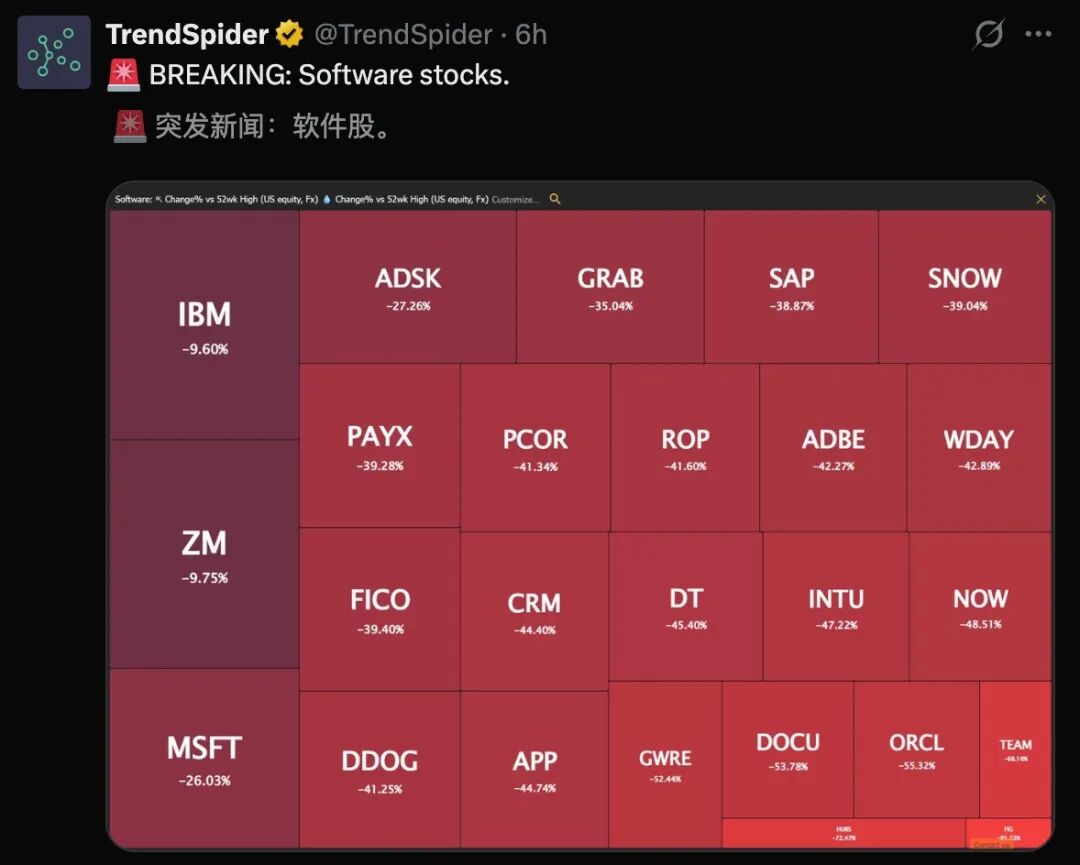
万亿市值一夜蒸发,Claude Cowork血洗全球软件业,老黄急了
3 6 Ke· 2026-02-05 07:40
又崩了!硅谷软件巨头短短一夜,蒸发3000亿美金,过去一周全球近万亿美金没了。令人想不到的是,罪魁祸首竟是Anthropic推出的一款插件。 瞳孔地震!一夜之间,全球软件股集体跳水,蒸发3000亿美金。 如今,整个硅谷都在说:软件(SaaS)已死! | 90 0 0 00 | TrendSpider & @TrendSpider · 6h * BREAKING: Software stocks. | | | | | | | | | | --- | --- | --- | --- | --- | --- | --- | --- | --- | --- | | | * 突发新闻:软件股。 | | | | | | | | | | | Softwarn: & Change% vs 52wk High (US equity, Fx) & Change% vs 52wk High (US equity, Fx) Customze ... | | Q | | | | | | × | | | IBM -9.60% | ADSK -27.26% | | GRAB -35.04% | | SAP -38.87% | | SNOW ...



1850亿美元“不得不花”,谷歌最新回应
华尔街见闻· 2026-02-05 05:30
Core Viewpoint - Alphabet (Google's parent company) signals that the AI arms race is far from over and has just entered the "deep water" phase [2] Financial Performance - Q4 performance exceeded expectations across the board, but the market was unsettled by the company's capital expenditure guidance of $175 billion to $185 billion for 2026 [3] - The significant capital expenditure raises concerns about depreciation pressure and potential erosion of profit margins, leading to a slight decline in the company's stock price post-announcement [4] Capital Expenditure Insights - CEO Sundar Pichai and CFO Anat Ashkenazi elaborated on the necessity of high expenditures, emphasizing the commercial prospects of AI agents and a major partnership with Apple [6] - The capital expenditure forecast for 2026 is set between $175 billion and $185 billion, with investments expected to increase gradually each quarter [8] - Approximately 60% of the capital expenditure will be allocated to servers, while 40% will go towards long-cycle assets like data centers and network equipment [9] - Increased infrastructure investment will lead to a significant rise in depreciation expenses, with an accelerated growth rate expected in 2026 [10] AI and Software Market Dynamics - In response to fears of AI disrupting traditional software business models, Pichai positioned Google as an ally to SaaS companies, stating that Gemini is becoming the "engine" for successful software firms [11] - 95% of the top 20 SaaS companies and over 80% of the top 100 are utilizing Gemini, indicating strong integration of AI into their workflows [11] - Google confirmed a deep partnership with Apple, positioning itself as the preferred cloud provider and developing the next generation of Apple Foundation models based on Gemini technology [12][13] AI Commercialization and User Engagement - The Gemini App has surpassed 750 million monthly active users, showcasing its monetization potential [14] - Google is transitioning from mere information retrieval to executing tasks for users through a new business model based on "Agentic AI" [14] - Pichai emphasized that there is no evidence of cannibalization of traditional Google search traffic, describing the current moment as expansionary [16][17] Cloud Business and Infrastructure - Google Cloud's revenue grew by 48%, largely attributed to its AI infrastructure advantages [18] - The company employs a dual strategy in chip development, utilizing both NVIDIA GPUs and its own TPUs [19] YouTube and Waymo Developments - YouTube's ad revenue grew by 9%, impacted by high comparative figures from the previous year, but Shorts now averages over 200 billion views daily [20] - Google confirmed significant investment in Waymo, with plans to expand services to multiple cities in the U.S., the U.K., and Japan [20] Efficiency and Internal Operations - Google is focused on enhancing internal efficiency, having reduced the service unit cost of Gemini by 78% through model optimization and improved utilization [22] - Approximately 50% of the code is now written by coding agents, allowing engineers to focus on more strategic tasks [22]