
谷神星一号

Search documents
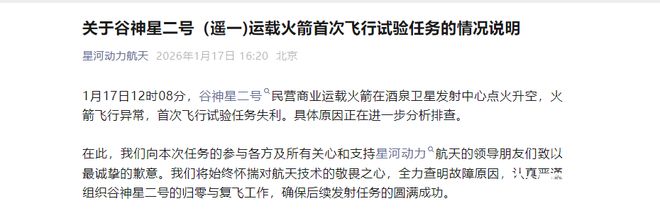
星河动力谷神星二号首飞失利致歉:正排查原因,确保后续复飞
Nan Fang Du Shi Bao· 2026-01-17 14:35
Core Viewpoint - The recent failure of the private rocket company Star River Dynamics' first flight of the Gushenxing-2 rocket highlights the complexities and challenges of aerospace technology exploration, occurring just after a successful launch of another rocket [1][2]. Group 1: Company Performance - Star River Dynamics has successfully completed 21 commercial launches, delivering 89 satellites into orbit [2]. - The company recently achieved a successful launch of the Gushenxing-1 sea-launched rocket, marking the first private commercial space launch in China for 2026 [1]. Group 2: Recent Events - On January 17, 2023, the Gushenxing-2 rocket experienced an abnormal flight and failed its first test mission shortly after its launch from the Jiuquan Satellite Launch Center [1]. - The company publicly apologized for the failure and committed to thoroughly investigating the cause and ensuring the success of future missions [1]. Group 3: Future Prospects - Star River Dynamics is in a critical phase of approaching the capital market, having completed 10 rounds of financing with a post-investment valuation of approximately 15 billion yuan [2]. - The company submitted its IPO counseling record in October 2025, aiming to be listed on the A-share market, but the recent failure presents new technical challenges during this period [2].

商业航天巨头致歉,估值150亿元,已启动IPO辅导
Xin Lang Cai Jing· 2026-01-17 11:30
Core Viewpoint - The first flight test of the Ceres II commercial rocket by Star River Dynamics was unsuccessful due to an anomaly during flight, with the specific cause under further investigation [1]. Group 1: Company Overview - Star River Dynamics, established in 2018, is the first private commercial rocket company in China to achieve mass production and high-density launches [3]. - The company has successfully conducted 21 commercial launches, delivering a total of 89 satellites into their designated orbits [3]. - The Ceres I rocket is the main model for Star River Dynamics, holding a competitive position in the commercial launch market [3]. Group 2: Recent Developments - On January 16, 2026, Star River Dynamics successfully launched the Ceres I sea-launch variant, marking a positive start for private commercial launches in 2026 [3]. - The company has completed 10 rounds of financing, with a valuation of approximately 15 billion yuan, and has submitted an IPO counseling report in October 2025 [3]. Group 3: Leadership and Ownership - The founder and chairman Liu Baiqi and president Liu Jianshe are acting in concert, holding a combined direct and indirect stake of 32.36% in the company [4]. Group 4: Industry Context - Other domestic commercial space companies, including Blue Arrow Aerospace, Tianbing Technology, China Aerospace Science and Industry Corporation, and Interstellar Glory, have also initiated IPO processes [5]. - Blue Arrow Aerospace's IPO application has been accepted, aiming to raise 7.5 billion yuan, while China Aerospace's listing counseling status has changed to acceptance as of January 17, 2026 [5].
商业航天:可回收运载火箭的高价值量环节和成本构成(附PPT)
材料汇· 2026-01-15 15:38
Core Viewpoint - The article provides an in-depth analysis of rocket structures, engines, and the application of 3D printing technology in the aerospace industry, highlighting advancements in rocket design and manufacturing processes. Section 1: Rocket Structure - The article explores various components of rocket structures, including the rocket engine, fuel tanks, and recovery technologies, emphasizing the importance of materials and design in enhancing performance and reliability [5][6][8]. - Liquid rocket engines are categorized into two main types: liquid and solid propellants, with a focus on the efficiency and reusability of liquid engines like the Merlin engine [9][11]. - The cost structure of rockets is detailed, with the Falcon 9 rocket's first stage costing approximately $30 million and the second stage around $10 million, totaling about $45 million for a new rocket [10]. Section 2: Rocket Enterprises and Their Rockets - The article discusses various rocket companies, including state-owned and private enterprises, highlighting their contributions to the commercial space sector [51]. - China’s Long March rockets are noted for their extensive launch capabilities, with Long March 8 and Long March 9 being key models for future missions [54]. - Private companies like Blue Arrow and Tianbing Technology are recognized for their innovative approaches, such as the development of reusable liquid oxygen and methane rockets [52][51]. Section 3: 3D Printing Technology in Rocket Engines - 3D printing technology is identified as a transformative force in rocket manufacturing, significantly reducing production time and costs while allowing for complex designs [19][18]. - The article mentions that companies like Tianbing Technology have achieved nearly 90% of their engine components through 3D printing, leading to a 70%-80% reduction in manufacturing cycles and a 40%-50% decrease in costs [19][18]. - The advantages of 3D printing include the ability to create lightweight structures and complex geometries that traditional manufacturing methods cannot achieve [17]. Section 4: Rocket Recovery Technologies - Various rocket recovery methods are discussed, including vertical landing, sea recovery, and innovative techniques like the "chopstick" capture method, which aims to reduce costs and improve efficiency [40][50]. - The article highlights successful recovery missions, such as SpaceX's Falcon 9, which has demonstrated the feasibility of reusing rocket stages [46][50]. - The development of a net recovery system for rockets is noted as a significant advancement in enhancing recovery reliability and reducing operational costs [47].

商业火箭专题-聚焦技术突破-重构全球格局
2026-01-15 01:06
Summary of Key Points from the Conference Call Industry Overview - The focus is on the commercial space launch industry, particularly advancements in rocket technology and the competitive landscape between the United States and China [1][4][21]. Core Insights and Arguments - **Rocket Engine Importance**: Rocket engines are critical components, accounting for 30%-50% of the total rocket cost. Solid fuel engines are simpler and have shorter launch cycles but are less controllable and have lower payload capacities. Liquid fuel engines offer better control and higher payload capacities but are more complex and have longer launch cycles [1][5]. - **Global Launch Statistics**: In 2025, there are expected to be 341 global space launches, a 25% increase from 2024. The U.S. leads with 211 launches, while China is expected to conduct 90 launches. The U.S. accounts for 84% of the total payload mass launched, significantly outpacing China, which holds only 10% [1][6][7]. - **SpaceX's Dominance**: SpaceX is the leader in the U.S. commercial space sector, with 92% of its launches being commercial payloads. The company has significantly reduced launch costs through technological innovations, including reusable rocket technology [1][8][9]. - **Financial Projections for SpaceX**: SpaceX's revenue is projected to reach $13.1 billion in 2024, with Starlink contributing $8.2 billion. The company's valuation is expected to rise to $800 billion by 2025, with an IPO planned for 2026 targeting a valuation of $1.5 trillion [1][8]. - **Cost Reduction through Reusability**: The Falcon 9 rocket's reusability has led to a significant reduction in launch costs. The cost per kilogram dropped from $1,867.82 to $1,063 after nine reuses, representing a 43% reduction compared to single recovery and a 63% reduction compared to non-recovery [1][11]. Other Important but Potentially Overlooked Content - **Technological Gaps**: China is working to close the technological gap with the U.S. in reusable rocket technology and liquid oxygen-methane engine technology. Companies like Blue Arrow Aerospace and others are making progress, but significant advancements are still needed [4][21][22]. - **Domestic Market Valuations**: Major Chinese commercial space companies have valuations significantly lower than their U.S. counterparts, with Tianming Technology valued at 22.5 billion yuan and Blue Arrow Aerospace at 22 billion yuan, compared to SpaceX's $800 billion valuation [4][18][19]. - **Future Directions**: The next two years are expected to see breakthroughs in China's reusable technology and advancements in full-flow staged combustion cycle engines, which could reshape the global commercial space landscape [22].
中国航天 更多精彩
Ren Min Ri Bao Hai Wai Ban· 2026-01-14 22:50
Core Viewpoint - China's space industry is experiencing significant advancements, with multiple successful missions and the introduction of new technologies, aiming to establish itself as a leading space power by 2026 [7][12][14]. Group 1: Manned Spaceflight Progress - The Shenzhou 21 crew has been working in orbit for over 70 days, conducting key training and scientific experiments [8]. - In 2025, China executed its first emergency launch mission in response to unexpected issues with the Shenzhou 20 spacecraft, demonstrating its capabilities [8]. - The Chinese space station has successfully conducted 265 scientific and application projects in three major fields by December 2025 [8]. Group 2: Deep Space Exploration - The Tianwen-2 mission successfully launched in 2025, marking China's first asteroid exploration and sample return mission, targeting asteroid 2016 HO3 [12]. - The mission aims to return to Earth by the end of 2027 after conducting scientific investigations on the asteroid and later on comet 311P [12]. - The Chang'e 7 mission is planned for 2026, focusing on lunar south pole exploration and ice detection [13]. Group 3: Commercial Space Development - In 2025, various commercial rockets, including Ceres-1 and Zhuque-3, were launched, indicating a surge in China's commercial space activities [14]. - The National Space Administration has initiated a plan to enhance the quality and safety of commercial space development from 2025 to 2027 [14]. - New generation rockets are expected to enter their maiden flights, supporting large-scale satellite networks and low-cost cargo transport [14].

卫星产业大回调,超2亿资金逆势加仓卫星产业ETF(159218)
Jin Rong Jie· 2026-01-13 02:32
Core Viewpoint - The satellite industry is experiencing a correction after a strong upward trend, with the satellite industry ETF (159218) dropping over 9% intraday, while funds are still flowing in significantly, indicating a mixed market sentiment [1] Group 1: Market Performance - The satellite industry ETF (159218) has increased by over 77.69% in the past month, with a net inflow of over 2.3 billion yuan in the last 20 days [1] - As of 10:11 AM, over 200 million yuan has flowed into the satellite industry ETF, showing a notable trend of capital accumulation despite the market correction [1] Group 2: Industry Insights - The satellite industry is in a rapid growth phase, driven by factors such as the frequent launches of reusable rockets, the advancement of commercial rocket IPOs, and the promotion of terminal applications [1] - Upcoming launches include the reusable rocket "Star Cloud No. 1" and the "Vulcan No. 1" rocket from Haiyao Seven, which are expected to further stimulate the industry [1] Group 3: Fund Management Perspective - The fund manager of the satellite industry ETF, Xu Rongman, highlights the significant absolute and relative gains in the sector due to the accumulation of favorable factors, while also cautioning about potential short-term correction risks [1] - The ETF tracks the CSI Satellite Industry Index, with a clear requirement that the combined weight of "satellite manufacturing + launch infrastructure" must not be less than 50%, aligning with the current core phase of industry development [1]
商业航天深度:技术收敛引爆“奇点”,蓝海市场破晓已至(附62页PPT)
材料汇· 2026-01-08 16:01
Group 1 - The article emphasizes the explosive growth of the commercial space industry driven by supportive policies and technological advancements [4][19] - The transition from traditional space (government-led) to commercial space (private sector-driven) is highlighted, showcasing the shift in funding and operational models [10][12] - The U.S. and China are establishing a bipolar competitive landscape in the space industry, with the U.S. leading in commercial launches and satellite deployments [24][28] Group 2 - Key sectors in the space industry include satellites, launch vehicles, ground equipment, and terminal applications, which are experiencing increased demand [3][29] - The competitive landscape is maturing, with significant advancements in technology such as reusable rockets and cost-effective satellite manufacturing [20][23] - Investment recommendations suggest focusing on companies that are well-positioned within the rapidly evolving commercial space ecosystem [3][39] Group 3 - The article outlines the historical development of commercial space, noting critical milestones from the 1980s to the present, including the rise of companies like SpaceX and Blue Origin [11][16] - The U.S. has shifted its procurement model from cost-plus contracts to fixed-price contracts, incentivizing cost reduction and innovation in the space sector [14][15] - China's commercial space sector is rapidly developing, with government initiatives aimed at fostering innovation and investment in the industry [19][27] Group 4 - The article discusses the structure of the space industry supply chain, which includes upstream (manufacturing), midstream (launch services), and downstream (applications) segments [30][32] - The total addressable market (TAM) for the space industry is projected to grow significantly, with commercial space revenues expected to dominate [39][40] - The article highlights the high barriers to entry in the space industry, particularly in the upstream segment, which contributes to high profit margins [41]
一年亏损1.8亿元,国内首家商业火箭公司拟易主
Mei Ri Jing Ji Xin Wen· 2026-01-07 08:04
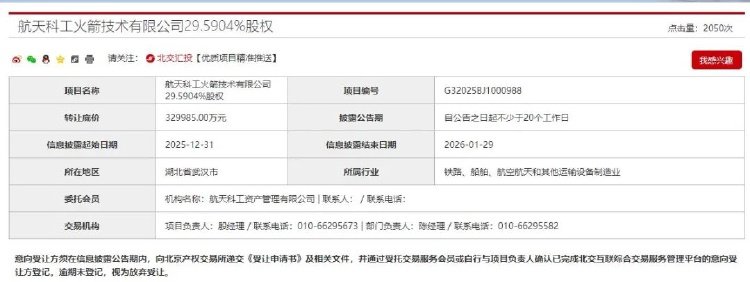
Core Viewpoint - The transfer of a 29.5904% stake in Aerospace Science and Industry Corporation Rocket Technology Co., Ltd. is set to take place, with a base price of approximately 3.3 billion yuan, indicating a significant shift in ownership and potential strategic direction for the company [1][2]. Group 1: Company Overview - Aerospace Science and Industry Corporation Rocket Technology Co., Ltd. was established in February 2016 and is recognized as China's first specialized rocket company operating under a commercial model [2]. - The company primarily operates solid rockets, including the "Kuaizhou-1A" and "Kuaizhou-11" [2]. Group 2: Financial Performance - The company has reported poor financial performance, with revenues of 63.81 million yuan in 2024 and a net loss of approximately 180 million yuan [2]. - For the period from January to November 2025, the company generated revenues of 67.36 million yuan and incurred a net loss of about 136 million yuan [2]. - As of November 30, 2025, the total assets of the company amounted to 3.033 billion yuan, with total liabilities of 472 million yuan [2]. Group 3: Market Competition - The solid rocket launch market is highly competitive, with domestic private aerospace companies achieving breakthroughs in both technology and market presence [2]. - Competing products include the "Liqian-1" from Zhongke Yuhang, which has a near-Earth orbit capacity of 2 tons, and the "Yingli-1" from Dongfang Space, which can carry up to 6.5 tons [2]. Group 4: Future Developments - The company is currently developing a liquid oxygen-methane launch vehicle as part of its Kuaizhou series [3]. - The reusable technology test vehicle for the Kuaizhou rocket has completed vertical takeoff and landing tests, although progress is lagging behind competitors such as Blue Arrow Aerospace and the Eighth Academy of Aerospace Science and Technology [3]. - The company has previously considered an IPO and was listed as a "seed" enterprise for the Hubei Province Science and Technology Innovation Board, but its progress has been slower than peers [3].
一年亏损1.8亿,国内首家商业火箭公司将易主
Guan Cha Zhe Wang· 2026-01-07 06:53
Core Viewpoint - The transfer of 29.5904% equity in Aerospace Science and Industry Rocket Technology Co., Ltd. (referred to as "Kegong Rocket") signifies a significant shift in the ownership structure, indicating a potential strategic adjustment by its controlling shareholder, China Aerospace Sanjiang Group Co., Ltd. (referred to as "Sanjiang") [1][5] Company Overview - Kegong Rocket, established in February 2016, is China's first commercial rocket company operating under a purely commercial model for the research and application of launch vehicles [1] - The company has completed two rounds of financing: 1.2 billion RMB in A round financing in December 2017, and 1.585 billion RMB in B round financing in June 2022 [2] Financial Performance - The company has faced continuous financial challenges, reporting revenues of 63.8078 million RMB in 2024 and a net loss of approximately 180 million RMB; in the first 11 months of 2025, revenues were 67.3565 million RMB with a net loss of about 136 million RMB [3] - As of November 2025, total assets were approximately 3.033 billion RMB, with liabilities around 472 million RMB [3] Market Position and Competition - Kegong Rocket's current active rocket products include "Kuaizhou-1A" and "Kuaizhou-11," but it faces intense competition from several private companies in the commercial space launch market, particularly in the solid rocket sector [3] - Competitors include Zhongke Yuhang's "Lijian-1," Xinghe Power's "Gushenxing-1," and others, with Kegong Rocket's payload capacities being significantly lower than some competitors [3] Industry Trends - The commercial space launch market is evolving towards larger capacity and reusable rockets, posing significant technical and market challenges for Kegong Rocket, which primarily relies on existing expendable solid rocket technology [5] - The equity transfer is viewed as a milestone in the development of China's commercial space industry, reflecting a trend towards resource integration and increased market concentration amid rising competition and higher expectations for profitability [5]

2025中国航天战报:全年92次发射创下新高,民营火箭亮出成绩单
Xin Lang Cai Jing· 2026-01-05 05:19
Core Insights - In 2025, global launch frequency reached 329 times, with China's share nearing 30%, indicating that approximately 1 in every 3 rockets launched globally originated from China [1] - China's total launches for the year amounted to 92, representing a 35.3% increase from 68 launches in 2024, with a high success rate of 97.8% [1] Launch Contributions - Multiple commercial rockets achieved significant launch results in 2025, contributing to the overall increase in launch volume [1] - Zhongke Aerospace's Lijian-1 completed 5 launches, placing 27 satellites into orbit with a total payload of about 6 tons, handling all external orders for commercial rockets [1] - Xinghe Power's Gushenxing-1 had 6 launches, successfully placing 27 satellites into orbit with a total payload of approximately 1 ton [1] - Blue Arrow Aerospace's improved Zhuque-2 had 2 launches, placing 6 satellites into orbit with nearly 1 ton of payload, while Zhuque-3 had its maiden flight without carrying any satellites [1] - Interstellar Glory's Hyperbola-1 completed 1 launch, placing 1 satellite into orbit with a payload of nearly 100 kilograms [1] - Dongfang Space's Gravitational-1 had 1 launch, successfully placing 3 satellites into orbit with a total payload of about 500 kilograms [1] Broader Achievements - Beyond rocket launches, China's aerospace sector made significant advancements in satellite constellation networking, commercial space investment and financing, rocket technology, and supporting infrastructure [1]