金融反腐

Search documents
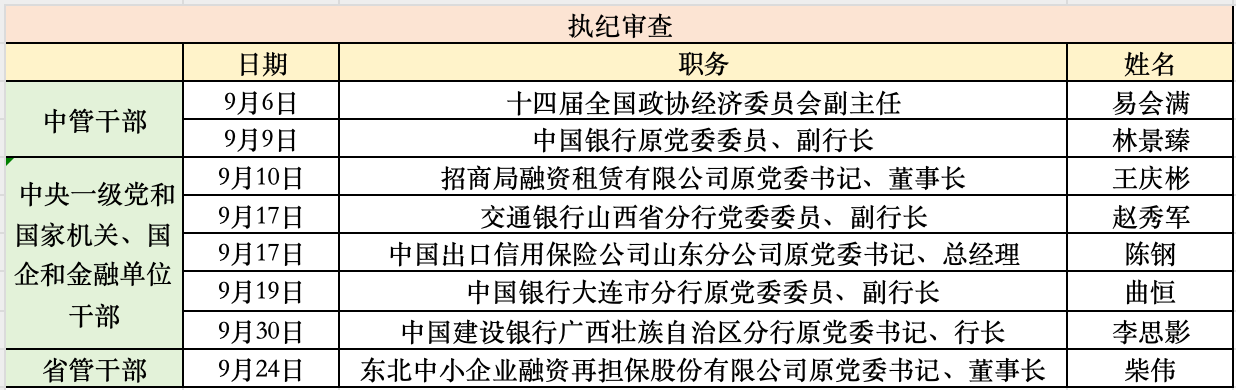
9月至少8人被查,涉2名中管干部
Feng Huang Wang· 2025-10-03 07:09
Core Insights - The financial anti-corruption campaign is steadily advancing, with at least 8 individuals investigated in September, including 2 central management cadres and 5 from central-level party and state agencies, state-owned enterprises, and financial institutions [1][4]. Group 1: Investigated Individuals - Among the investigated individuals, 2 central management cadres were identified: Yi Huiman, Vice Chairman of the Economic Committee of the 14th National Committee of the Chinese People's Political Consultative Conference, and Lin Jingzhen, former Deputy Governor of the Bank of China [2][3]. - The remaining 6 individuals include 4 from state-owned banks, specifically Zhao Xiujun from the Shanxi branch of the Bank of Communications, Qu Heng from the Dalian branch of the Bank of China, and Li Siying from the Guangxi branch of the China Construction Bank [4][5]. Group 2: Trends in Investigations - A total of 54 individuals have been investigated in the first nine months of this year, with a monthly breakdown showing 6 in January, 5 in February, 8 in March, 6 in April, 8 in May, 8 in June, 3 in July, and 2 in August [5]. - In comparison, at least 74 individuals were investigated in the first nine months of the previous year, indicating a slight decrease in the number of investigations year-over-year [5].

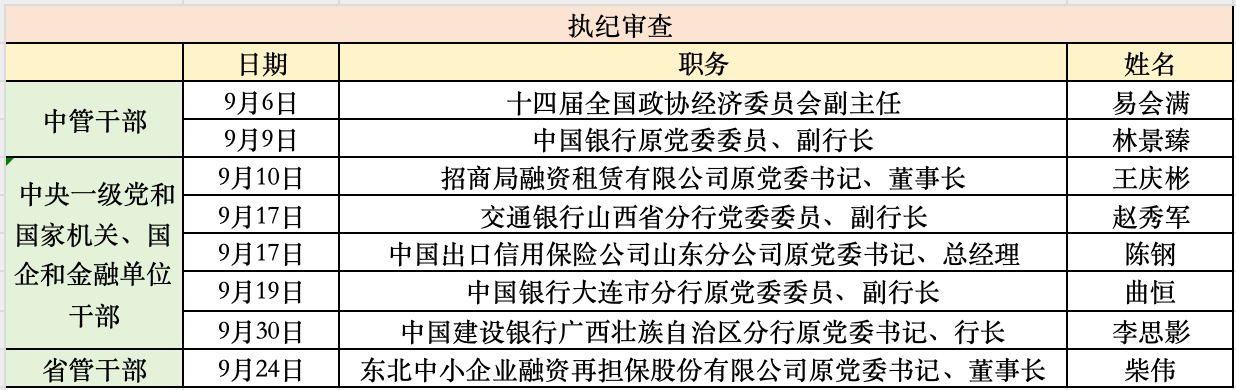
金融反腐追踪|9月至少8人被查,涉2名中管干部
Xin Lang Cai Jing· 2025-10-03 06:16
Core Insights - The financial anti-corruption campaign is steadily advancing, with at least 8 individuals investigated in September, including 2 central management cadres and 5 from central-level party and state agencies, state-owned enterprises, and financial institutions [1][4]. Group 1: Investigated Individuals - Among the 8 individuals investigated, 4 are from state-owned banks, including Lin Jingzhen, former Deputy Governor of the Bank of China, and Zhao Xiujun, Deputy Governor of the Shanxi branch of the Bank of Communications [4]. - The central management cadres investigated include Yi Huiman, Vice Chairman of the Economic Committee of the 14th National Committee of the Chinese People's Political Consultative Conference, and Lin Jingzhen, former Deputy Governor of the Bank of China [2][3]. Group 2: Financial Institutions Involved - The institutions involved in the investigations include major state-owned banks such as the Bank of China, Bank of Communications, and China Construction Bank, highlighting the focus on these entities in the anti-corruption efforts [4][5]. - Other financial entities investigated include a leasing company and insurance institutions, with specific individuals from these sectors also being scrutinized [5]. Group 3: Trends in Investigations - A total of 54 individuals have been investigated in the first nine months of this year, with a monthly breakdown showing varying numbers of investigations, indicating a consistent effort in the anti-corruption campaign [5]. - In comparison, at least 74 individuals were investigated in the same period last year, suggesting a sustained or increased focus on financial integrity [5].

银行地方“一把手”密集落马!10家金融机构公布巡视整改情况,多方强调对“一把手”监督
Xin Lang Cai Jing· 2025-09-26 01:11
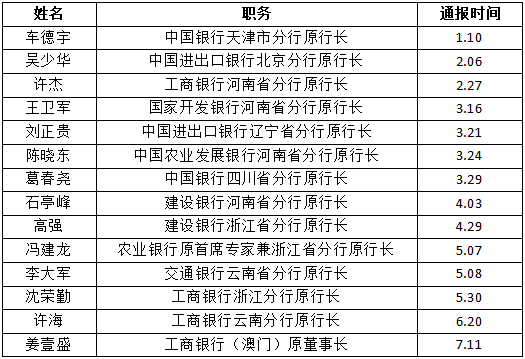
Group 1: Central Bank and Financial Regulatory Authority Actions - The Central Bank and the Financial Regulatory Authority are focusing on long-term rectification measures, including enhancing financial infrastructure, advancing information technology reforms, and promoting financial legislation [1][2] - The Financial Regulatory Authority has implemented multiple measures to prevent financial risks, such as strict market access regulations and enhancing administrative penalties to protect consumer rights [1][2] Group 2: Supervision of Leadership - Emphasis on the supervision of "one leaders" in financial institutions, with a focus on accountability and responsibility among top executives [2][9] - At least 32 financial unit officials have been investigated this year, with 23 in the first half alone, highlighting ongoing anti-corruption efforts [2][10] Group 3: Bank-Specific Initiatives - The Export-Import Bank is reinforcing its policy-oriented banking role and enhancing monitoring of policy-related business [3] - The Industrial and Commercial Bank is developing a high-quality growth strategy and improving internal governance and risk management [3] - The Agricultural Bank is focusing on supporting rural revitalization and agricultural development through increased financing [4] Group 4: Global Strategy and Regional Development - The Bank of China is continuing its global strategy by enhancing overseas operations and supporting enterprises in international expansion [5] - The Construction Bank is committed to regional development strategies, including support for the Guangdong-Hong Kong-Macao Greater Bay Area [5] Group 5: Insurance Sector Actions - China Life is addressing the negative impacts of the Wang Bin case and is implementing measures to ensure accountability among its leadership [6][7] - China Pacific Insurance is focusing on strengthening its talent pool and enhancing the political and organizational functions of its party committees [8]



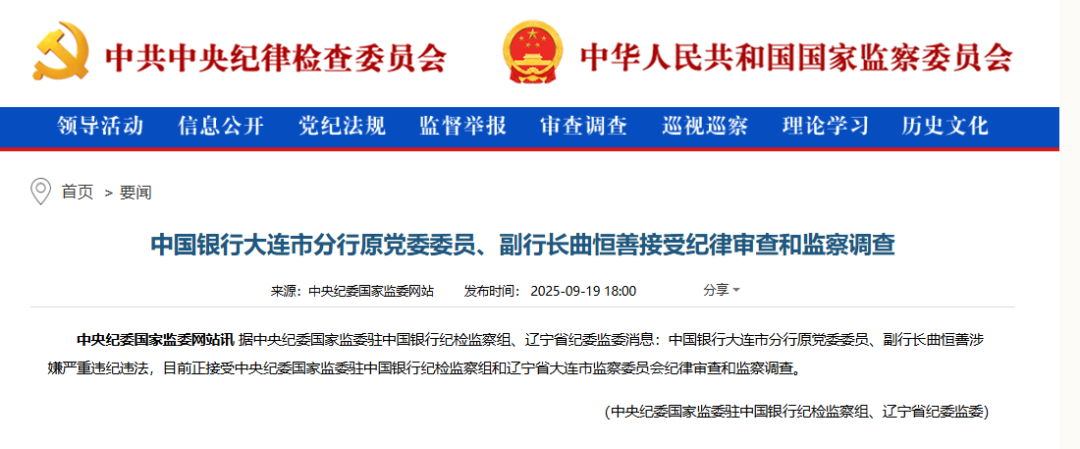
涉嫌严重违纪违法 曲恒善被查!
Zhong Guo Ji Jin Bao· 2025-09-19 15:06
Core Viewpoint - The ongoing anti-corruption efforts within the China Banking sector have led to multiple investigations and disciplinary actions against high-ranking officials at the Bank of China, indicating a significant focus on governance and compliance within the financial institution [1][3]. Group 1: Investigations and Disciplinary Actions - Qu Hengshan, former Deputy Governor of the Bank of China Dalian Branch, is under investigation for serious violations of discipline and law [1]. - Several other senior officials from the Bank of China have also faced similar scrutiny this year, including Lin Jingzhen, former Deputy Governor, and others who have been expelled from the Party or are under investigation [3]. - The frequency of these investigations suggests a systemic issue within the organization, with multiple high-profile cases reported throughout the year [3]. Group 2: Importance of Financial Oversight - The Central Commission for Discipline Inspection emphasizes the critical role of financial institutions in the national economy and the necessity of rigorous oversight to ensure compliance and integrity [4]. - The recent meetings involving the Central Commission and Bank of China leadership highlight the commitment to enhancing governance and addressing corruption within the financial sector [4]. - The focus on financial oversight is part of a broader strategy to promote high-quality development in the banking industry, aligning with national modernization goals [4].
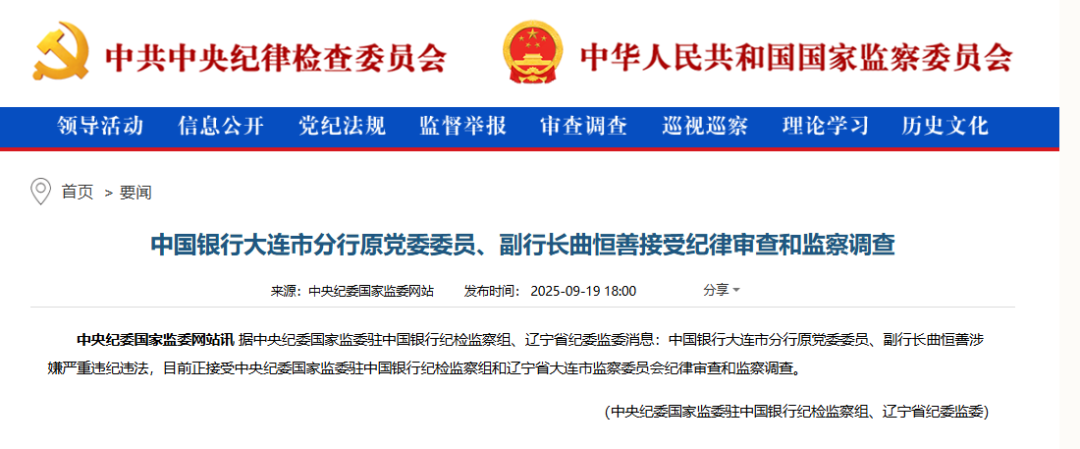
涉嫌严重违纪违法,曲恒善被查!
中国基金报· 2025-09-19 13:41
Group 1 - The article highlights the ongoing disciplinary investigations within the Bank of China, specifically mentioning the case of Qu Hengshan, the former deputy governor of the Dalian branch, who is under investigation for serious violations of discipline and law [1][3]. - Multiple high-ranking officials within the Bank of China have faced similar scrutiny this year, including Lin Jingzhen, the former deputy governor, and several others who have been expelled from the party and public office [3][4][5][6][7][8]. - The Central Commission for Discipline Inspection and the National Supervisory Commission have been actively involved in these investigations, emphasizing the importance of maintaining integrity within financial institutions [9]. Group 2 - The article discusses the significance of financial oversight, stating that finance is crucial to the national economy and a key component of national competitiveness, which is essential for the modernization of China [9]. - A meeting was held to mobilize the Central Ninth Inspection Team to conduct inspections within the Bank of China, highlighting the need for the bank's leadership to improve political awareness and accept supervision [9].

涉嫌严重违纪违法,曲恒善被查!
Zhong Guo Ji Jin Bao· 2025-09-19 12:57
Group 1 - The core viewpoint of the news is the ongoing disciplinary investigations and corruption cases within the Bank of China, highlighting a significant crackdown on financial misconduct [1][3]. - On September 19, it was reported that Qu Hengshan, the former deputy governor of the Bank of China Dalian Branch, is under investigation for serious violations of discipline and law [1]. - Multiple high-ranking officials from the Bank of China have been investigated this year, including Lin Jingzhen, the former deputy governor, and several others who have faced disciplinary actions or expulsion from the party [3]. Group 2 - The Central Commission for Discipline Inspection emphasized the importance of financial institutions in the national economy and the necessity of conducting inspections to ensure compliance and integrity within the sector [4]. - The Central Ninth Inspection Team has been mobilized to oversee the operations of the Bank of China, reinforcing the commitment to anti-corruption efforts and high-quality financial development [4].
金融圈突发!许杰,被开除党籍
Zhong Guo Ji Jin Bao· 2025-09-16 15:06
Core Points - The former Party Secretary and President of the Henan Branch of the Industrial and Commercial Bank of China, Xu Jie, has been expelled from the Party due to serious violations of discipline and law [2][3] - The ongoing anti-corruption campaign in the financial sector continues to reveal misconduct among high-ranking officials [1] Summary by Sections Disciplinary Actions - Xu Jie was found to have violated multiple disciplines including political, organizational, integrity, work, and life disciplines, as well as national laws, constituting serious job-related violations and suspected bribery [3] - The decision to expel Xu Jie from the Party was made by the Party committee of the Industrial and Commercial Bank of China, which also included the cancellation of his benefits and the confiscation of his illegal gains [3] Investigation Findings - The investigation revealed that Xu Jie disregarded the central eight regulations, accepted gifts and entertainment that could influence his official duties, and misused public funds for personal benefits [2] - He was also found to have engaged in corrupt practices such as providing assistance in loan approvals and employee recruitment in exchange for substantial financial gains [2][3] Background Information - Xu Jie held a master's degree and was a senior economist, having served in various positions within the People's Bank of China and the Industrial and Commercial Bank of China, including as the President of the Henan Branch [3] - After leaving the Henan Branch in 2018, he was appointed as the Chairman of ICBC Financial Asset Investment Co., Ltd., a position he held until 2020 [4] - The Henan Branch had previously faced administrative penalties totaling 6.4 million yuan for violations in wealth management, with Xu Jie as the main responsible person at that time [4]
金融圈突发!许杰,被开除党籍
中国基金报· 2025-09-16 14:08
Core Viewpoint - The article highlights the expulsion of Xu Jie, the former Party Secretary and President of the Henan Branch of the Industrial and Commercial Bank of China, due to serious violations of party discipline and laws, amid ongoing anti-corruption efforts in the financial sector [2][4]. Summary by Sections Investigation and Violations - Xu Jie was subjected to an investigation by the Central Commission for Discipline Inspection and the Tianjin Municipal Supervisory Commission for severe violations of discipline and law [4]. - The investigation revealed that Xu Jie disregarded the principles of the party, resisted organizational scrutiny, and violated the central eight regulations by accepting gifts and entertainment that could influence his official duties [4][5]. - He misused public funds for personal entertainment, engaged in private club activities, and allowed others to pay for expenses that should have been his responsibility [4][5]. Misconduct and Corruption - Xu Jie failed to report personal matters truthfully and sought benefits for others in personnel decisions, demonstrating a lack of integrity and a pursuit of personal gain through his position [5]. - He was involved in loan approvals and employee recruitment, providing assistance to related enterprises and individuals while accepting substantial bribes [5]. - The report emphasized that Xu Jie severely violated multiple disciplines, including political, organizational, and work discipline, and was suspected of bribery, with his actions having a significant negative impact [5]. Disciplinary Actions - Following the investigation, the Industrial and Commercial Bank of China decided to expel Xu Jie from the party, revoke his benefits, and confiscate his illegal gains [5]. - His case has been forwarded to the prosecutorial authorities for legal proceedings, along with the related assets [5]. Background Information - Xu Jie held a master's degree and had a career in various positions within the People's Bank of China and the Industrial and Commercial Bank of China, including leadership roles in the Hebei and Henan branches [6]. - Notably, in February 2018, the Henan Banking Regulatory Bureau publicly disclosed administrative penalties against the Henan branch for violations in wealth management, amounting to 6.4 million yuan, with Xu Jie as the main responsible person [6].

靠金融吃金融!利光秘,被开除党籍
Zhong Guo Ji Jin Bao· 2025-09-15 13:09
Group 1 - Li Guangmi, the former Party Secretary and Chairman of Hainan Rural Credit Cooperative Union, has been expelled from the Party due to serious violations of discipline and law [1][2] - The investigation revealed that Li Guangmi engaged in activities such as accepting gifts and entertainment at public expense, and misusing his power for personal gain, including facilitating loans for others [2][3] - Li Guangmi's actions were deemed to have a severe impact and were characterized as serious violations of organizational, integrity, and work discipline, leading to his expulsion and further legal actions [2][3] Group 2 - Li Guangmi has a long career in the banking sector, having worked at the Agricultural Bank of China in Hainan before taking leadership roles in the Hainan Rural Credit Cooperative Union [3] - The Hainan Rural Credit Cooperative Union was established in 2007 and is set to merge into Hainan Rural Commercial Bank by May 2024, which will be the first local bank established under a unified provincial model [3] - As of the end of 2024, Hainan Rural Commercial Bank is projected to have a deposit balance of 3300.35 billion yuan, a loan balance of 1956.86 billion yuan, and total assets of 3826.47 billion yuan [3]
靠金融吃金融!利光秘,被开除党籍
中国基金报· 2025-09-15 12:29
Core Viewpoint - The article reports on the expulsion of Li Guangmi, the former Party Secretary and Chairman of the Hainan Rural Credit Cooperative Union, from the Party due to serious violations of discipline and law, highlighting ongoing anti-corruption efforts in the financial sector [1][2]. Summary by Sections Investigation and Findings - Li Guangmi was subjected to an investigation by the Hainan Provincial Commission for Discipline Inspection and Supervision for serious violations of discipline and law [2]. - The investigation revealed that Li Guangmi lost his ideals and beliefs, violated the spirit of the Central Eight Regulations, and engaged in activities such as accepting gifts and entertainment at public expense [3]. - He was found to have abused his power for personal gain, engaging in corrupt practices including facilitating loan approvals for others and illegally accepting large sums of money [4]. Disciplinary Actions - Li Guangmi was expelled from the Party, stripped of his benefits, and required to return funds related to his misconduct. His case has been forwarded to the judicial authorities for prosecution [4]. - The disciplinary actions were based on violations of the Communist Party's disciplinary regulations and relevant laws [4]. Background Information - Li Guangmi, born in November 1960, has a doctoral degree and extensive experience in the banking sector, having worked at the Agricultural Bank of China and later at the Hainan Rural Credit Cooperative Union [5]. - The Hainan Rural Credit Cooperative Union was established in 2007 and is set to merge into Hainan Rural Commercial Bank by May 2024, with significant financial metrics reported, including deposits of 3300.35 billion and loans of 1956.86 billion [5].