金融反腐

Search documents
金融反腐再出重拳
母基金研究中心· 2026-03-30 09:08
Core Viewpoint - The article discusses the ongoing investigations and regulatory changes regarding corruption and misconduct among officials in financial and state-owned enterprises, highlighting the need for stricter compliance and oversight in these sectors [2][3][5]. Group 1: Investigations and Cases - Guo Xudong, former chairman of the China Securities Regulatory Commission's issuance review committee, is under investigation for serious violations, including accepting gifts and engaging in favoritism in stock issuance [2]. - Zhou Liang, a senior official at the National Financial Supervision Administration, is also under investigation for serious disciplinary violations [3]. - The case of economist Ba Shusong is being handled by the Shanghai police for alleged economic crimes involving significant amounts [3]. Group 2: Regulatory Changes - The revised "Regulations on the Integrity of State-Owned Enterprise Leaders" has been issued, updating standards for integrity and compliance after 17 years since the last version [3][4]. - The new regulations outline seven prohibitive areas, including 58 specific behaviors that are forbidden, emphasizing the need for stricter governance in state-owned enterprises [4]. Group 3: Corruption Trends - The Supreme People's Court is focusing on new trends in corruption, particularly in finance, state-owned enterprises, and public sectors, aiming to enhance the effectiveness of anti-corruption measures [5]. - Recent cases highlight the issue of officials engaging in business activities, which is seen as a significant risk to integrity and governance [6][7]. Group 4: Investment Regulations - The article emphasizes that party officials are prohibited from investing in private equity funds, as such actions are considered akin to engaging in business activities [11][12]. - There is a growing concern about officials using their positions to gain insider information and indirectly hold shares in non-listed companies through private equity investments [11][12]. Group 5: Historical Context - The article references historical regulations dating back to 1986 that prohibit government officials from engaging in business, underscoring a long-standing commitment to maintaining integrity in public service [8][9].


曾执掌三地证监局的王广幼落马,一年多来已有多名证监系统官员被查
第一财经· 2026-03-22 13:12
Core Viewpoint - The article discusses the ongoing anti-corruption efforts within the China Securities Regulatory Commission (CSRC), highlighting the recent investigation of former officials, including Wang Guangyou, and the emphasis on strict regulatory measures to combat corruption in the financial sector [3][10]. Summary by Sections Anti-Corruption Developments - Wang Guangyou, former head of the Hubei Securities Regulatory Bureau, is under investigation for serious violations of discipline and law, marking a continuation of the CSRC's anti-corruption campaign [3][5]. - Since 2025, multiple officials within the CSRC have been investigated, including former CSRC Chairman Yi Huiman and former Vice Chairman Wang Jianjun, indicating a systemic issue within the regulatory body [3][6]. Recent Investigations - Wang Guangyou has a long history in the CSRC, having served in various leadership roles across multiple provinces for nearly 20 years before retiring in 2024 [5]. - Other notable figures investigated include Guo Xudong, who was involved in the issuance review committee and had a long tenure at the CSRC, and Wang Huimin, the former discipline inspection secretary [6][7]. Regulatory Signals - A recent meeting held by the CSRC on March 17, 2026, reinforced the commitment to strict regulation and anti-corruption measures, aiming to eliminate obstacles to capital market reform [10][11]. - The meeting emphasized the need for a robust framework to supervise public power and ensure transparency in the regulatory process, aiming to close loopholes and prevent corruption [11].

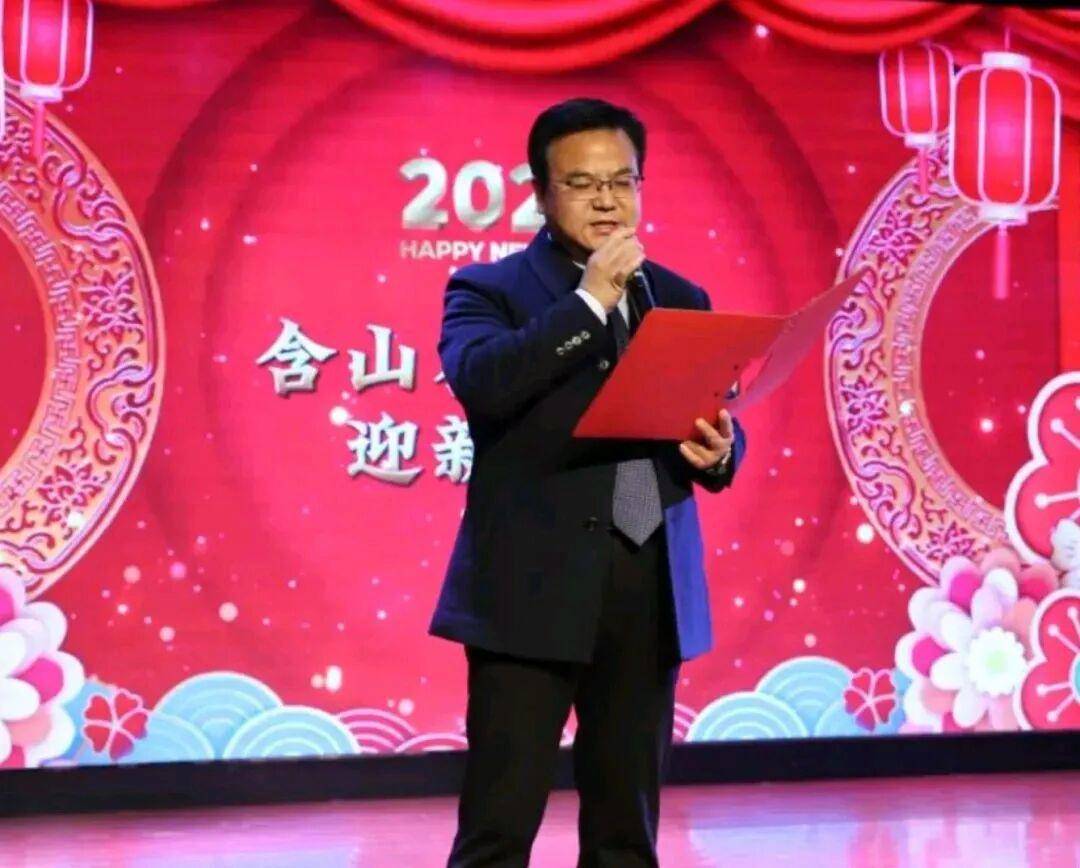
安徽含山农商行董事长黄晓武被查,曾多次违规受罚
Sou Hu Cai Jing· 2026-02-24 14:26
Group 1 - Huang Xiaowu, the chairman of Anhui Hanshan Rural Commercial Bank, has been investigated, marking a significant turn in his career after six years in leadership [1][7] - Huang has been with the bank since its inception in 2014, having served as president before becoming chairman in 2020, indicating a rapid rise within the organization [3] - Under Huang's leadership, the bank faced multiple regulatory penalties for violations, including a fine of 400,000 yuan for issuing loans in others' names and a 300,000 yuan fine for improper bond investments [4] Group 2 - The bank's performance has declined, with total assets reaching 16.971 billion yuan, and a net profit of 83.0378 million yuan, reflecting a year-on-year decrease of 2.15% and 10.07% respectively [5] - The non-performing loan ratio has increased to 1.65%, despite a high provision coverage ratio of 243.48%, indicating growing operational pressures [5] - Huang's absence from public appearances prior to the investigation suggests a potential accumulation of issues within the bank [6] Group 3 - Huang's investigation is part of a broader trend of anti-corruption efforts in the financial sector, highlighting the importance of compliance and internal governance for financial institutions [7] - The scrutiny of rural commercial banks like Hanshan reflects deeper governance issues within the industry, emphasizing the need for improved management practices [7]
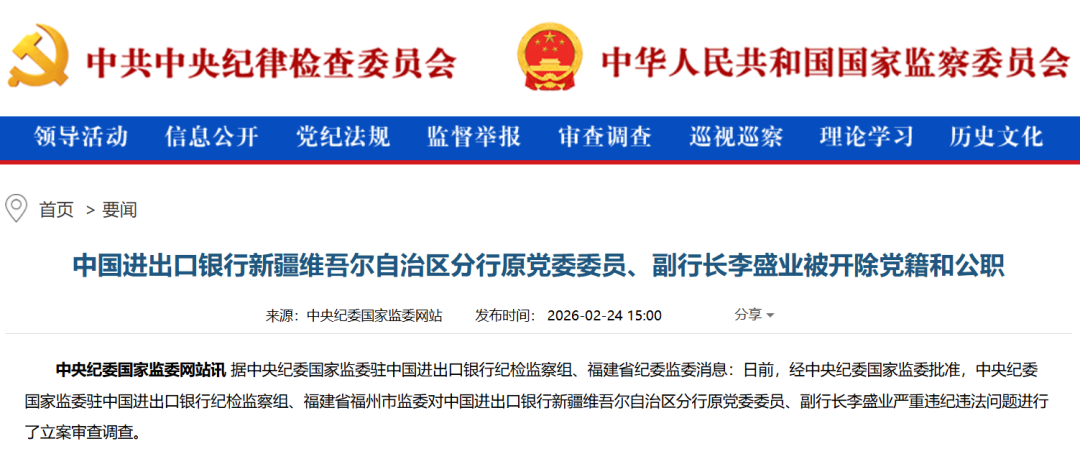
李盛业 被“双开”!
Zhong Guo Ji Jin Bao· 2026-02-24 13:53
Core Viewpoint - The former deputy governor of the Xinjiang branch of the China Export-Import Bank, Li Shengye, has been expelled from the Party and public office due to serious violations of discipline and law, highlighting ongoing anti-corruption efforts within the financial sector [1][2][3]. Group 1: Violations and Investigations - Li Shengye was found to have lost his ideals and beliefs, resisted organizational investigations, and provided false information during inquiries [2]. - He ignored the central government's eight-point regulations by accepting potentially compromising banquets [2]. - Li engaged in private lending for substantial returns and used his position to assist others in loan processing, illegally accepting large sums of money [2]. Group 2: Disciplinary Actions - The China Export-Import Bank's Party committee decided to expel Li Shengye from the Party and public office, confiscate his illegal gains, and refer his criminal activities to the prosecution [3]. - Li had a long tenure at the bank, with his qualifications as deputy governor approved in April 2024, and he was under investigation for serious violations by November 2025 [3]. Group 3: Broader Context of Corruption - The China Export-Import Bank has been actively addressing corruption, with a focus on cross-border corruption, bidding-related corruption, and monitoring high-risk areas [4]. - The bank's leadership has emphasized a zero-tolerance policy towards corruption, particularly targeting key positions and younger officials [4].
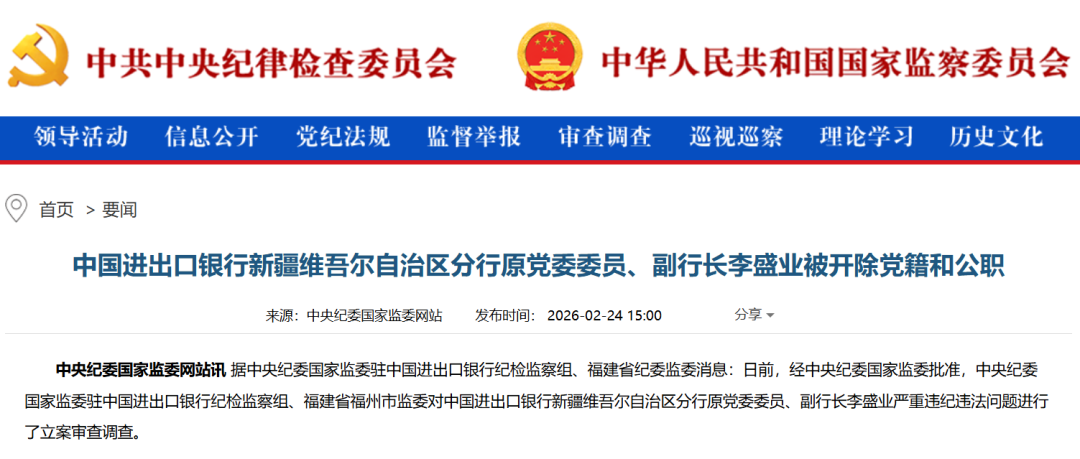
李盛业,被“双开”!
Zhong Guo Ji Jin Bao· 2026-02-24 13:40
Core Viewpoint - The former deputy governor of the Xinjiang branch of the China Export-Import Bank, Li Shengye, has been expelled from the Party and public office due to serious violations of discipline and law, highlighting ongoing anti-corruption efforts within the financial sector [1][2][3]. Group 1: Investigation and Findings - Li Shengye was subjected to an investigation by the Central Commission for Discipline Inspection and the Fujian Provincial Commission for Discipline Inspection for serious violations of discipline and law [2]. - The investigation revealed that Li Shengye lost his ideals and beliefs, resisted organizational scrutiny, and provided false information during investigations [3]. - He ignored the spirit of the Central Eight Regulations by accepting invitations that could influence the impartial execution of his duties [3]. Group 2: Violations and Consequences - Li Shengye was found to have breached the bottom line of integrity by obtaining large returns through private lending and using his position to assist others in loan processing and issuing financing guarantees, while illegally accepting substantial amounts of money [3]. - The disciplinary actions taken against him include expulsion from the Party and public office, confiscation of illegal gains, and referral of his criminal issues to the prosecutorial authorities for legal review [3]. - The China Export-Import Bank has seen multiple officials disciplined in 2025, indicating a broader crackdown on corruption within the institution [4]. Group 3: Broader Context - In January 2026, the China Export-Import Bank held a conference emphasizing the importance of combating cross-border corruption and thoroughly investigating corruption in bidding processes, particularly focusing on high-risk areas and key positions [4].
公子们为什么都喜欢搞金融
Xin Lang Cai Jing· 2026-02-12 02:15
Core Viewpoint - The article discusses the recent downfall of prominent figures in the financial sector, specifically focusing on the corruption cases involving Yi Lianhong and Yi Huiman, highlighting the intertwining of power and financial interests within their families [1][5][14]. Group 1: Corruption Cases - Yi Lianhong, the former Vice Chairman of the Financial and Economic Committee of the National People's Congress and former Secretary of the Zhejiang Provincial Party Committee, was officially announced to have fallen from grace on February 10 [1][17]. - Yi Lianhong's son, Yi Shiwei, has been reported to leverage his father's influence to secure projects, earning substantial bonuses, sometimes exceeding tens of millions [2][19]. - Yi Shiwei was identified as a vice president at China International Capital Corporation (CICC) and was involved in a 60 billion yuan industrial fund established in collaboration with Hunan Caixin Financial Holdings [3][20]. Group 2: Family Connections and Career Trajectories - The article draws parallels between Yi Lianhong and Yi Huiman, emphasizing similarities in their corruption methods and family benefit chains [5][23]. - Yi Huiman's son, Yi Chenyang, has a career trajectory closely aligned with his father's rise, moving through significant financial roles at major institutions [6][24]. - Yi Chenyang's rapid career advancement is noted, particularly his involvement in major financial projects during his father's tenure as the head of the China Securities Regulatory Commission [10][30]. Group 3: Financial Sector Corruption Insights - The article discusses why individuals from influential families are drawn to the financial sector, citing high liquidity, strong concealment capabilities, and resource alignment as key factors [13][32]. - It highlights that the financial system has become a focal point for anti-corruption efforts, with a clear directive from the Central Commission for Discipline Inspection to address both existing and emerging corruption [14][34]. - The narrative concludes that the intertwining of power and financial interests often leads to inevitable downfall, as seen in the cases of Yi Lianhong and Yi Huiman [14][15].
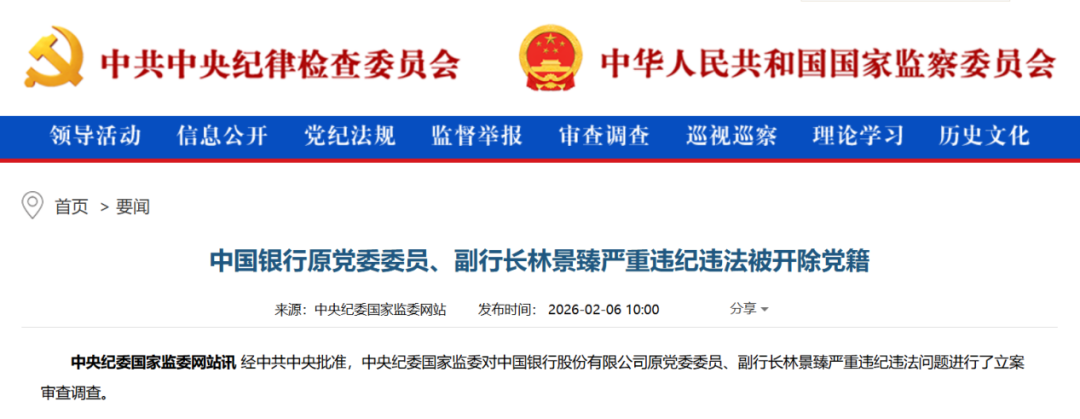
信贷权力异化,林景臻被开除党籍!多名大行原干部被处分
券商中国· 2026-02-07 07:21
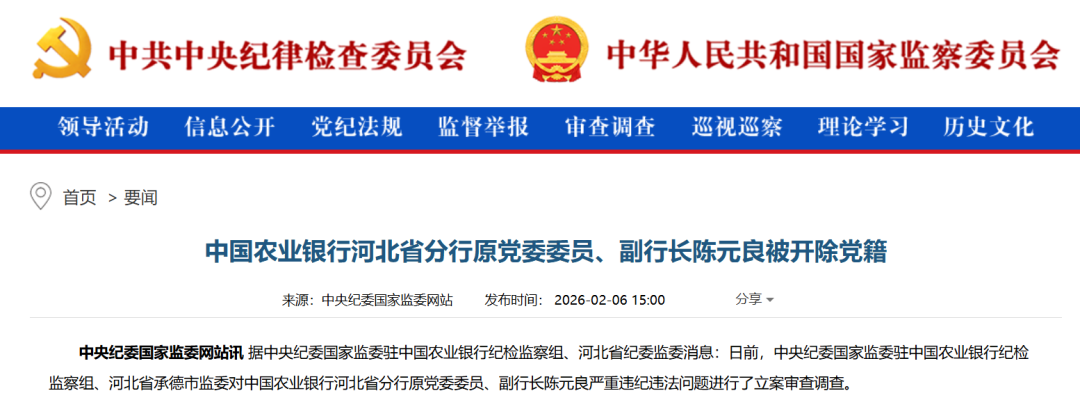
Core Viewpoint - The article highlights the ongoing anti-corruption efforts in China's financial sector, particularly focusing on the severe disciplinary actions taken against high-ranking officials in major state-owned banks for serious violations of party discipline and laws [1][2]. Group 1: Disciplinary Actions - Lin Jingzhen, former Vice President of the Bank of China, was expelled from the party for serious violations, including using his credit authority for personal gain and engaging in corrupt practices [1][2]. - Multiple senior officials from major banks, including the Bank of China, Industrial and Commercial Bank of China, and Agricultural Bank of China, have also faced expulsion from the party due to serious misconduct [4][5][6]. - The disciplinary actions reflect a broader crackdown on corruption within the financial sector, emphasizing the need for stricter adherence to party regulations and ethical standards [3]. Group 2: Specific Violations - Lin Jingzhen was found to have engaged in power-for-money transactions, misused his position for personal benefits, and illegally accepted large sums of money [2]. - Zhang Wenming, former Vice President of the Bank of China’s Guizhou branch, was expelled for serious violations, including falsifying evidence and accepting gifts that could influence his official duties [4][5]. - Liang Yangguo, former Deputy Secretary of the Industrial and Commercial Bank of China’s Anhui branch, was also expelled for similar violations, including accepting bribes and interfering in loan approvals [5]. - Chen Yuanliang, former Vice President of the Agricultural Bank of China’s Hebei branch, faced expulsion for misusing his position to benefit others and accepting gifts that could affect his impartiality [6].


贪欲膨胀,甘于被“围猎”!陈元良,被开除党籍!
Zhong Guo Ji Jin Bao· 2026-02-06 11:09
Core Viewpoint - The former Deputy Governor of Agricultural Bank of China, Hebei Branch, Chen Yuanliang, has been expelled from the Party due to serious violations of discipline and law, highlighting ongoing anti-corruption efforts within the bank [1][3]. Group 1: Violations and Investigations - Chen Yuanliang was investigated for severe disciplinary and legal violations, including loss of ideals, reading politically problematic materials, and resisting organizational scrutiny [3]. - He ignored the central eight regulations, misused vehicles of management and service objects, and violated organizational principles to gain personal benefits for others [3]. - Chen was found to have accepted gifts, cash, and other benefits, borrowed money from management and service objects, and engaged in profit-making activities against regulations [3]. Group 2: Disciplinary Actions - The Agricultural Bank of China decided to expel Chen Yuanliang from the Party and cancel his benefits, while also confiscating his illegal gains [4]. - His case has been forwarded to the procuratorial authorities for legal prosecution, along with the related assets [4]. - Chen Yuanliang had a long tenure at the bank, holding various positions, including Deputy Governor since 2012 [4]. Group 3: Broader Context - Several other officials from the Agricultural Bank of China, Hebei Branch, have also been investigated and punished for similar violations, indicating a pattern of misconduct within the institution [4][5]. - Notable cases include former senior expert Song Lei, who misused his position for financial gain, and Zhao Lihong, who engaged in illegal lending practices [5].

林景臻,被开除党籍、取消待遇!
Zhong Guo Ji Jin Bao· 2026-02-06 06:39
Core Viewpoint - The former Vice President of China Bank, Lin Jingzhen, has been expelled from the Party due to serious violations of discipline and law, highlighting ongoing issues of corruption within state-owned banks in China [1][2]. Summary by Relevant Sections Investigation and Findings - The Central Commission for Discipline Inspection and the National Supervisory Commission have initiated an investigation into Lin Jingzhen, revealing multiple serious violations including the possession of politically problematic materials and accepting gifts and services that could influence his official duties [2]. - Lin was found to have violated the central eight-point regulations, accepted gifts, and engaged in activities that compromised his integrity, including using his position for personal gain through loan financing [2]. Disciplinary Actions - Lin Jingzhen has been expelled from the Party, stripped of his benefits, and his case has been referred to the judicial authorities for prosecution [2]. - The investigation concluded that Lin's actions constituted severe violations of political, organizational, and integrity disciplines, with a significant negative impact [2]. Background Information - Lin Jingzhen, born in May 1965, has a long history with China Bank, having held various senior positions since joining in 1987, including Vice President since March 2018 [2]. - Recent reports indicate a pattern of disciplinary actions against other officials within China Bank, suggesting a broader crackdown on corruption within the institution [2]. Broader Context - The head of the disciplinary inspection team at China Bank emphasized the evolving nature of corruption in the financial sector, which often hides behind complex financial transactions and market behaviors [2]. - There is a call for enhanced analytical methods to identify corrupt practices and improve the effectiveness of oversight in the banking sector [2].

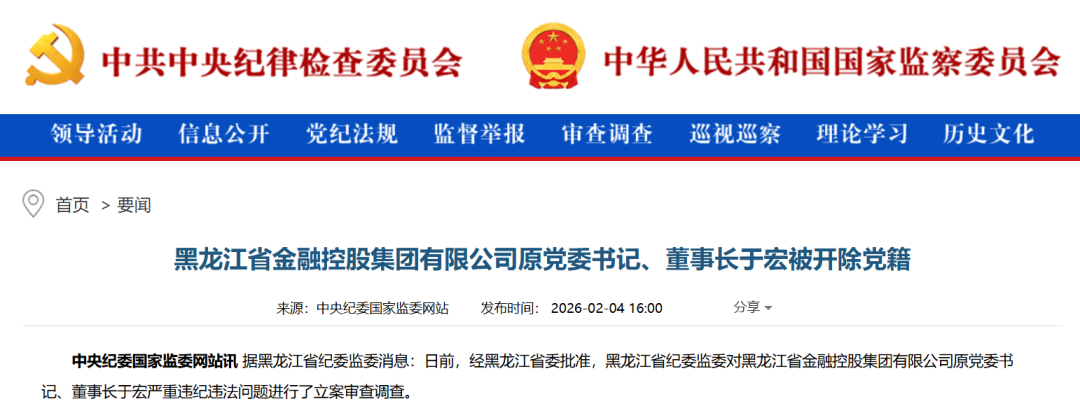
于宏,被开除党籍、取消待遇!
Zhong Guo Ji Jin Bao· 2026-02-04 09:44
Group 1 - The former Party Secretary and Chairman of Heilongjiang Financial Holding Group, Yu Hong, has been expelled from the Party due to serious violations of discipline and law [2] - Yu Hong was found to have lost his ideals and beliefs, accepted banquets that could influence the impartial execution of duties, and engaged in corrupt practices [2] - The investigation revealed that Yu Hong intervened in market economic activities, violated national laws, and used public power for personal gain, leading to severe disciplinary violations and potential criminal charges [2] Group 2 - Heilongjiang Financial Holding Group, established in December 2018, is a state-owned enterprise with a registered capital of 10.3 billion yuan and a long-term credit rating of AAA [2] - The company fully controls several subsidiaries, including Heilongjiang Dazheng Investment Group and Heilongjiang Xinzhen Financing Guarantee Group, and is a major shareholder in local banks and financial institutions [2] - Yu Hong's previous disciplinary actions included a severe warning in November 2020 for accepting gifts and banquets, highlighting ongoing issues within the company's governance [2]