世界经济不稳定性

Search documents
汇正财经参与2026中国首席经济学家论坛年会,热议资本市场新年开局机遇
Cai Fu Zai Xian· 2026-01-13 08:17
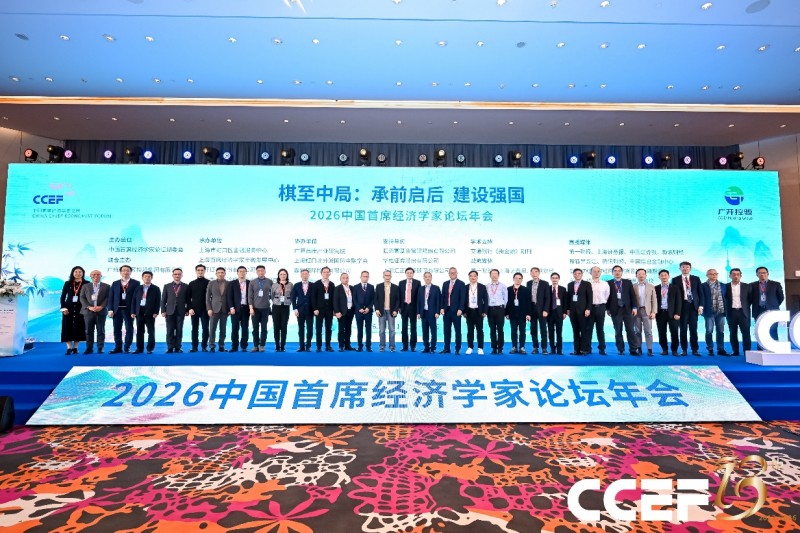
Group 1 - The China Chief Economist Forum annual conference was held in Shanghai, focusing on the theme "Chess in the Middle Game: Building a Strong Nation" with participation from over 50 chief economists and more than 500 experts from various sectors [1] - The forum highlighted the need for China to provide stability to the global economy through its own stable development, as global growth is expected to remain low and uneven [3] - A significant shift in China's financial structure is occurring, with a decrease in the proportion of indirect finance and an increase in direct finance [3][4] Group 2 - The forum discussed the necessity of gradual monetary easing, including interest rate cuts, to guide the economy towards stability and recovery [4] - The development of AI is seen as crucial for creating a complete industrial ecosystem that can transform substantial capital investments into economic value [5] - Predictions for 2026 include the emergence of significant economic bubbles, particularly in gold and AI, driven by technological advancements and resource needs [6][8] Group 3 - The core themes of China's 14th Five-Year Plan emphasize domestic demand, technology, and openness, aiming to establish a unified national market and promote technological breakthroughs [9] - Digital consumption is identified as a key growth area for China's economy, with substantial potential for expansion during the 14th Five-Year period [10] - The forum served as a platform for discussing high-quality development paths for the capital market, with insights aimed at helping investors navigate current market conditions [12][13]

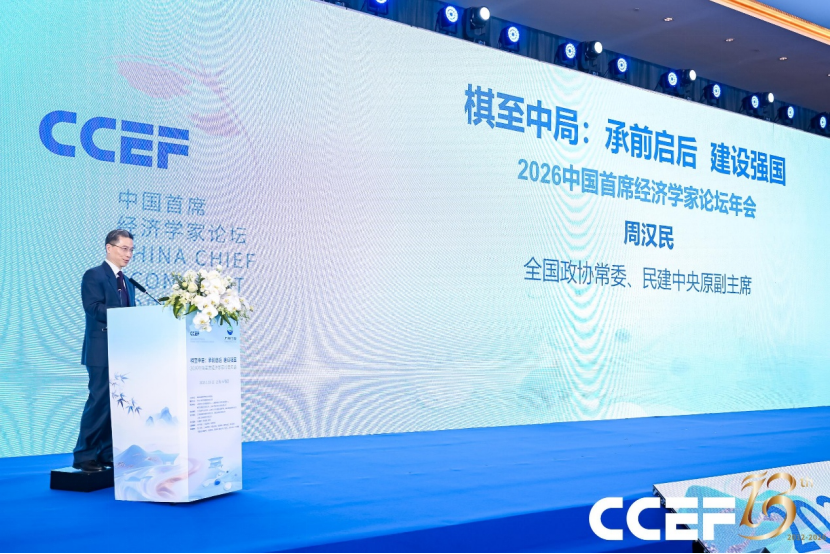
周汉民:中国要在不确定的世界中提供确定性、连续性和可合作性
Guo Ji Jin Rong Bao· 2026-01-12 09:05
Group 1 - The core viewpoint of the article is that the instability of the global economy in 2026 is primarily driven by three structural roots: weak and uneven global growth, a low tolerance state in the global financial system, and the shift from efficiency logic to geopolitical economic logic [1][3][4] Group 2 - The first structural root is the long-term weakening and highly uneven global growth momentum, with a noticeable decline in the global potential growth rate compared to the early 21st century. Developed economies are constrained by aging populations and declining investment returns, while emerging economies face debt constraints and limited development space [3] - The second structural root is the low tolerance state of the global financial system, where the combination of high interest rates, high debt, and high uncertainty has significantly narrowed the buffer space of the financial system. Risks may not manifest as a comprehensive crisis but could erupt locally and transmit across markets, exacerbating systemic instability [3] - The third structural root is the replacement of efficiency logic with geopolitical economic logic, where certain countries systematically weaponize trade, investment, technology, and financial policies, leading to a new form of globalization characterized by higher costs, lower efficiency, and greater fragmentation [3] Group 3 - In response to these challenges, China aims to provide stability to the global economy through four levels of certainty: macroeconomic growth certainty, industrial supply certainty, institutional rule certainty, and financial stability [4][5] - On the macro level, China plans to maintain stable and predictable growth by expanding domestic demand, optimizing investment structures, and fostering new productive capacities [4] - On the industrial level, China's core advantages will shift from cost-based to a complete industrial system, continuous technological iteration, and scalable application scenarios, particularly in sectors like new energy, high-end manufacturing, and digital economy [4] - On the institutional level, China will promote high-level institutional openness and reduce institutional friction costs through regional and multilateral cooperation, opposing protectionism disguised as security measures [4] - On the financial level, China will accelerate the internationalization of the renminbi, deepen regional financial cooperation, and enhance financial regulatory coordination to provide diverse risk mitigation options for global southern countries [4] Group 4 - Overall, the world economy in 2026 lacks stability, predictability, and reliable institutional supply, despite not being short of capital and technology. China's responsibility is to provide certainty, continuity, and cooperation in an uncertain world, which is essential for its own high-quality development and for overcoming structural challenges in the global economic system [5]