
数字消费

Search documents
【宏观经济】一周要闻回顾(2026年3月25日-3月31日)
乘联分会· 2026-03-31 08:21
Core Insights - China's e-commerce sector showed stable growth in January and February 2026, with digital consumption improving and industrial e-commerce driving digital transformation [3] - The "Silk Road E-commerce" initiative enhanced global brand effects and achieved a strong start for high-quality development [3] E-commerce Development - Digital consumption remained active, with national online retail sales of goods and services increasing by 9.2% year-on-year in January and February [5] - Notable growth in smart products was observed, with smart glasses and window-cleaning robots seeing increases of 183.5% and 130.8% respectively [5] - The tourism and catering sectors experienced significant online retail growth, with increases of 36.1% and 27.3% respectively [5] Industrial E-commerce - Industrial e-commerce facilitated enterprise connections and deepened digital empowerment for industrial transformation [5] - Online retail of agricultural products grew by 17.6%, while industrial e-commerce transactions for metals and industrial goods increased by 63.8% and 8.8% respectively [5] - The logistics and AI sectors benefited from industrial e-commerce, with daily express delivery volumes exceeding 590 million packages in January [5] Silk Road E-commerce - The "Silk Road E-commerce" initiative linked domestic and international markets, showcasing products from Central Asia and ASEAN countries [6] - Key e-commerce import platforms reported a 7.6% increase in global product sales, with Icelandic salmon, Thai durian, and Brazilian beef seeing growth rates of 510.9%, 443.6%, and 156% respectively [6] Power Market Transactions - In January and February 2026, the total electricity market transaction volume reached 11,925 billion kilowatt-hours, marking a year-on-year increase of 25.5% [8] - Intra-provincial transactions accounted for 9,543 billion kilowatt-hours, up 29.2%, while inter-provincial transactions reached 2,382 billion kilowatt-hours, increasing by 12.7% [8] Industrial Profit Growth - Profits of large-scale industrial enterprises totaled 10,245.6 billion yuan in January and February, reflecting a year-on-year growth of 15.2% [11] - The manufacturing sector saw profits rise by 18.9%, while the mining industry reported a profit increase of 9.9% [11] - Notable profit growth was recorded in the computer and electronic equipment manufacturing sector, which saw a 200% increase [12] Purchasing Managers' Index (PMI) - The manufacturing PMI for March 2026 was reported at 50.4%, indicating a recovery in manufacturing activity [15] - The production index rose to 51.4%, and the new orders index increased to 51.6%, suggesting improved market demand [17][18] - The non-manufacturing PMI was at 50.1%, indicating a slight improvement in the non-manufacturing sector [21]


每日市场观察-20260330
Caida Securities· 2026-03-30 03:25
Market Overview - On March 30, 2026, the market closed higher with a trading volume of 1.86 trillion, a decrease of approximately 100 billion from the previous trading day[1] - The Shanghai Composite Index fluctuated near the 5-day moving average for three consecutive days, indicating a lack of confidence despite the market rebound[1] - The rise in the innovative drug sector, which had previously seen significant declines, suggests a defensive market sentiment[1] Sector Performance - The pharmaceutical, non-ferrous metals, and chemical industries led the market gains, while utilities, banks, telecommunications, and coal sectors experienced declines[1] - The lithium battery sector showed strong upward momentum, with several stocks reaching historical highs, driven by increased demand due to high oil prices[1] Fund Flow - On March 27, 2026, net inflows into the Shanghai Stock Exchange amounted to 25.574 billion, while the Shenzhen Stock Exchange saw net inflows of 32.41 billion[3] - The top three sectors for fund inflows were chemical pharmaceuticals, energy metals, and batteries, while the top outflow sectors included electricity, commercial banks, and railways[3] Economic Indicators - The Ministry of Commerce reported that by 2025, China's digital consumer spending is expected to reach 25.3 trillion, a year-on-year increase of 8.7%[6] - The growth in digital service consumption is projected at 12.5%, becoming a key driver of overall digital consumption growth[6] Industry Insights - The China Securities Regulatory Commission (CSRC) anticipates that by 2025, the net inflow of long-term funds into the market will exceed 1 trillion, with significant contributions from social security funds and public funds[7] - In the first two months of 2026, profits in the electronics, railway, shipping, aerospace, and electrical machinery sectors increased by 203.5%, 11.4%, and 6.2% respectively[8]
龙虾创始人官宣,腾讯正式成为OpenClaw赞助商;商家用AI图冒充实拍被判退一赔三丨AIGC日报
创业邦· 2026-03-16 00:14
Group 1 - Tencent has officially become a sponsor of OpenClaw, as announced by the founder Peter Steinberger, highlighting the importance of supporting open-source projects in AI [2] - A court in Guangzhou ruled in favor of a consumer who was misled by a merchant using AI-generated images, ordering the merchant to refund and pay three times the amount spent, reflecting a growing trend in consumer protection against digital fraud [2] - Meta is reportedly planning to lay off up to 20% of its workforce to cut costs and prepare for efficiency improvements brought by AI, with a significant investment of $600 billion planned for data center construction by 2028 [2] Group 2 - The 2026 Game Developers Conference (GDC) in San Francisco will feature over 100 sessions related to AI, marking a 110% increase from the previous year, with participation from major tech companies including Tencent, Google, and Microsoft [2]


21社论丨“十五五”开局求新,经济发展稳中求进
21世纪经济报道· 2026-03-13 01:34
Economic Growth Goals - The economic growth target for 2026 is set at an elastic range of 4.5% to 5%, with an emphasis on achieving better results in practice [1] - This target aligns with the long-term goal of achieving basic socialist modernization by 2035 and allows for necessary space to adjust structures and mitigate risks [1] - The focus is on improving resource allocation efficiency and achieving qualitative improvements alongside reasonable quantitative growth [1] Consumer Price and Domestic Market - The expected increase in consumer prices is set at around 2%, aiming for a moderate recovery in overall price levels [2] - The report emphasizes the importance of leveraging China's large domestic market to expand new spaces for domestic demand growth [2] - Strategies include enhancing residents' consumption capacity and willingness through income plans, social security improvements, and optimizing consumer credit environments [2] Investment Focus - The investment strategy will concentrate on new productive forces, new urbanization, and comprehensive human development [3] - There will be increased investment in technological upgrades, industrial upgrades, and major technological infrastructure through long-term special government bonds and new policy financial tools [3] - The aim is to foster new momentum and develop a modern industrial system while supporting traditional industries with significant equipment updates [3] Macroeconomic Policies - The report highlights the integration of stock and incremental policies to enhance counter-cyclical and cross-cyclical adjustments for stable growth [4] - The fiscal policy aims for a deficit rate of around 4%, with an increase in the deficit scale by 230 billion yuan, and a public budget expenditure reaching 30 trillion yuan [4] - The focus is on optimizing expenditure structures to support consumption, investment in people, and ensuring livelihoods [4] Monetary Policy - The core consideration for monetary policy is to promote stable economic growth and reasonable price recovery [5] - The policy will focus on actual interest rates and inflation expectations, utilizing various tools like reserve requirement ratio cuts and interest rate reductions to maintain ample liquidity [5] - New policy financial tools worth 800 billion yuan will be issued to guide financial institutions in supporting key areas such as domestic demand expansion, technological innovation, and small and medium enterprises [5]

京东集团首席经济学家沈建光2026年经济展望:分化中显韧性,攻坚中现机遇
Jin Rong Jie· 2026-02-26 02:29
Core Viewpoint - The article discusses the outlook for China's economy in 2026, emphasizing the need for a focus on domestic demand amidst external pressures and structural changes in the economy [2][4]. Economic Growth - In 2025, China's economy achieved a growth target of 5%, but the growth rate showed a declining trend throughout the year, with net exports contributing 32.7% to economic growth [2]. - The economic growth in 2026 is expected to be slightly lower than in 2025, with a focus on the quality and efficiency of growth [2]. Key Growth Engines - Infrastructure investment is set to lead the growth, with significant national projects accelerating due to policy support, including an increase in funding to approximately 295 billion yuan [2]. - Manufacturing investment is anticipated to recover, driven by technological innovation and the rise of new economic sectors such as semiconductors and artificial intelligence [2]. - Export resilience is expected to continue, with a projected growth rate of around 5% in 2026, supported by diversification into emerging markets and upgrades in export products [3]. Domestic Demand Challenges - 2026 is characterized as a year of "domestic demand challenges," with weak domestic demand and insufficient internal momentum being the primary concerns [4]. - Consumer spending faces constraints from high base effects, pressure on income growth (with disposable income growth slowing to 5% in 2025), and a significant decline in real estate wealth [4]. - Retail sales growth is expected to slow to around 3%, but service consumption presents a potential growth area, with significant room for improvement compared to the U.S. [4]. Policy Adjustments - Macro policy shifts are aimed at releasing potential and enhancing efficiency rather than merely increasing stimulus [5]. - Fiscal policy is projected to maintain a deficit rate of around 4%, focusing on quality and efficiency of spending [6]. - Monetary policy has shifted to include the promotion of reasonable price recovery as a key consideration, indicating a proactive approach to low inflation [6]. - Real estate policies will focus on controlling new supply, reducing inventory, and optimizing supply to stabilize the market [7].

建议提案办理见成效 | 深入听民意抓落实 更好惠民生促消费——商务部认真办理代表委员建议提案
Xin Hua She· 2026-02-25 03:17
Core Viewpoint - The government is actively responding to suggestions from representatives regarding the promotion of service consumption, which is seen as a key driver for economic growth and improving people's livelihoods [1] Group 1: Policy Initiatives - A series of policies aimed at boosting service consumption have been implemented, reflecting the government's commitment to enhancing consumer experiences and economic vitality [1] - The Ministry of Commerce has developed a work plan to address the suggestions made by representatives, conducting extensive research and discussions across various regions [2] - New policies have been introduced to accelerate the cultivation of new growth points in service consumption and to expand service consumption through innovative business models and pilot programs [2] Group 2: Digital Consumption - Digital technology is significantly expanding the space and experience of service consumption, with representatives highlighting the need for improvements in infrastructure and service supply [2][3] - The Ministry of Commerce has issued guidelines to promote digital consumption, incorporating suggestions from representatives to enhance demand stimulation and create a supportive environment for digital products and services [3] Group 3: Engagement with Representatives - The Ministry of Commerce is committed to effectively processing suggestions from representatives, ensuring that their insights are translated into practical measures for reform and development [5] - In 2025, the Ministry received a total of 1,020 suggestions and proposals during the National Two Sessions, indicating a strong engagement with various stakeholders in the business sector [4]
深入听民意抓落实 更好惠民生促消费
Xin Hua She· 2026-02-25 01:55
Group 1 - The core viewpoint emphasizes the importance of service consumption as a key driver of economic growth and a reflection of public well-being, with recent policies aimed at promoting service consumption receiving positive feedback from government representatives [1] - The shift in consumer spending towards enhancing quality of life and self-development is noted, alongside challenges such as the low contribution of the service sector to GDP compared to developed countries, insufficient supply of new and quality consumption, and a lack of policy support and inter-departmental coordination [1] - Suggestions were made to adjust consumption promotion policies, innovate service consumption formats, promote digital transformation in traditional services, and enhance policy coordination and regulatory efforts [1] Group 2 - The Ministry of Commerce quickly engaged with representatives to discuss and implement suggestions, leading to the development of a work plan and conducting research across various regions [2] - Policies were introduced to accelerate the cultivation of new growth points in service consumption and expand service consumption, including actions to improve service quality and introduce new consumption models [2] - Digital technologies are expanding the service consumption landscape, with representatives highlighting issues such as infrastructure gaps and structural imbalances in product service supply [2] Group 3 - The Ministry of Commerce is committed to implementing representative suggestions as a key strategy for advancing digital consumption, with a focus on creating a supportive environment for consumer demand and innovative supply [3] - The 2025 guidelines for developing digital consumption reflect the suggestions made by representatives, emphasizing the need for a robust support system, new supply models, and a conducive environment for boosting consumer confidence [3] - Representatives have contributed insights based on their expertise and field research to enhance service consumption and promote new consumption formats [3] Group 4 - In 2025, the Ministry of Commerce received 1,020 proposals during the National Two Sessions, focusing on key areas such as domestic and foreign trade, foreign investment, and bilateral economic relations [4] - The Ministry aims to improve the proposal handling mechanism and innovate work strategies to achieve consensus and collective efforts with representatives [4] Group 5 - The Ministry of Commerce will continue to align with the central government's decisions, enhance the quality and effectiveness of proposal handling, and transform representative insights into practical measures for reform and development [5]
建议提案办理见成效丨深入听民意抓落实 更好惠民生促消费——商务部认真办理代表委员建议提案
Xin Hua She· 2026-02-24 12:29
Core Viewpoint - The article emphasizes the importance of consumer spending as a key driver of economic growth and highlights the government's proactive measures in responding to suggestions from representatives to enhance service consumption and improve living standards [1][4]. Group 1: Government Response to Suggestions - The Ministry of Commerce has actively engaged with representatives to address their suggestions, leading to the formulation of practical measures aimed at boosting service consumption [2][3]. - A total of 1,020 suggestions and proposals were received by the Ministry of Commerce during the 2025 National Two Sessions, with 584 being suggestions and 436 proposals, covering various aspects of trade and economic reform [4]. Group 2: Focus on Service Consumption - The article outlines a shift in consumer spending towards enhancing quality of life and self-development, while also noting the challenges in service sector contributions to GDP compared to developed countries [1][2]. - The Ministry of Commerce has introduced policies to cultivate new growth points in service consumption and expand service offerings, including innovative consumption models and pilot programs [2][3]. Group 3: Digital Consumption Development - Representatives have raised concerns regarding the infrastructure and regulatory challenges facing digital consumption, prompting the Ministry of Commerce to prioritize these issues in their policy framework [3]. - The Ministry has collaborated with other departments to develop guidelines aimed at fostering digital consumption, addressing structural imbalances in product and service offerings [3].
线上线下人气旺 新春消费热情高
Sou Hu Cai Jing· 2026-02-24 04:50
Core Viewpoint - The 2026 Spring Festival holiday in Nanning saw a vibrant consumer atmosphere driven by various promotional activities, leading to significant growth in sales across multiple sectors, including food, beverages, and entertainment [2][3][4]. Group 1: Consumer Spending and Sales Growth - Key enterprises in the region reported sales growth during the Spring Festival, with food and beverage sales increasing by 19.8% and 15.2% respectively, while sports and entertainment products surged by 38.7% [2]. - The sales of communication equipment and automobiles grew by 32.7% and 3.2% respectively during the holiday period [2]. - Overall, the sales revenue of 30 monitored pedestrian streets and commercial areas increased by 19%, with nighttime consumption growing by 37.7% [4]. Group 2: Promotional Activities and Consumer Engagement - Nanning launched multiple consumer-friendly initiatives, including a lottery for electronic invoices, which attracted over 170,000 submissions and a total invoice amount exceeding 70 million yuan [3]. - The city distributed nearly 6 million yuan in consumer vouchers across various sectors, enhancing consumer engagement during the holiday [3]. - The integration of cultural and tourism activities, such as the promotion of traditional streets and local cuisine, significantly boosted foot traffic and spending, with daily visitors to the Yungzhou Ancient City averaging around 60,000 [3]. Group 3: Digital and Instant Consumption Trends - The digital consumption landscape transformed during the holiday, with online retail sales increasing by 19.6%, and non-physical goods seeing a remarkable growth of 35.9% [7]. - Instant consumption services experienced a surge, with transaction volumes for flash purchases rising by 72.4% and order quantities increasing by 88% [7]. - Popular items in online sales included jewelry, audio-visual equipment, and skincare products, with growth rates ranging from 46.4% to 109.9% [7]. Group 4: Tourism and Hospitality Sector Performance - The tourism sector in Guangxi saw a significant increase, with total visitor numbers and spending rising by 41.9% and 49.3% respectively during the holiday [6]. - Hotel bookings surged by 103%, indicating a strong recovery in the hospitality industry [6]. - Local culinary experiences, such as the Binyang Fire Dragon Feast, became highlights, attracting tourists and enhancing dining revenues, which grew by 19.4% among key restaurant enterprises [6].

春节消费“人财两旺”,首都经济“开门红”
Xin Lang Cai Jing· 2026-02-23 16:32
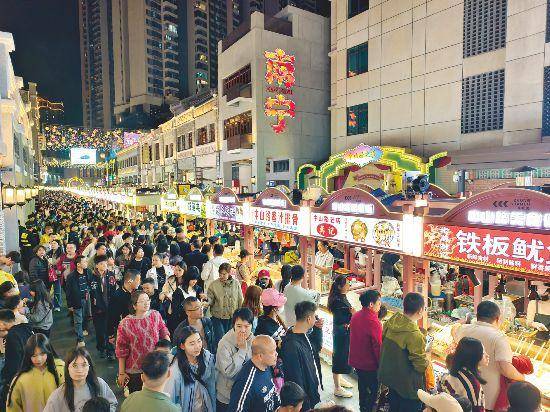
Core Insights - Beijing's consumption vitality is not only reflected in its large scale but also in its new trends, showcasing significant leading and demonstration value [1] Group 1: Consumption Trends - During the 2026 Spring Festival holiday, Beijing received 19.84 million tourists, generating a total tourism expenditure of 33.14 billion yuan, with key monitored enterprises achieving sales of 8.45 billion yuan, and a year-on-year growth of 12.4% in physical commerce [1] - The consumption amount in 60 key commercial districts reached 15.43 billion yuan, with a year-on-year increase of 2.2%, highlighting the revitalization of traditional brands and their integration with modern consumer experiences [2] - The shift from traditional "New Year goods economy" to a combined "New Year goods economy + experience economy" is evident, with over 200 activities launched under the theme "Garden Fun Chinese New Year," attracting 12.585 million visitors during the holiday [2] Group 2: Technological Integration - The integration of technology into consumption scenarios is accelerating, with the New Year technology fair in Haidian District featuring smart markets and robot staff, leading to an 86.3% increase in foot traffic in the Zhongguancun commercial area [2] - The impressive display of humanoid robots during the Spring Festival Gala reflects the growing trend of technology-driven consumer experiences [2] Group 3: New Consumer Dynamics - The trend of "reverse New Year" is gaining popularity, with more families choosing to bring their parents to big cities for the holiday, positioning Beijing as a top destination for elderly travelers during the Spring Festival [3] - The explosive growth in inbound consumption and the diverse supply of cultural consumption have provided solid support for Beijing's Spring Festival consumption, enhancing the overall economic vitality of the capital [3] - The new consumption trends observed during the Spring Festival in Beijing serve as a model for promoting domestic demand and expanding the domestic market [3]