东方星巴克

Search documents
霸王茶姬还没做成“东方星巴克”,先得了星巴克的病
3 6 Ke· 2026-01-09 10:24
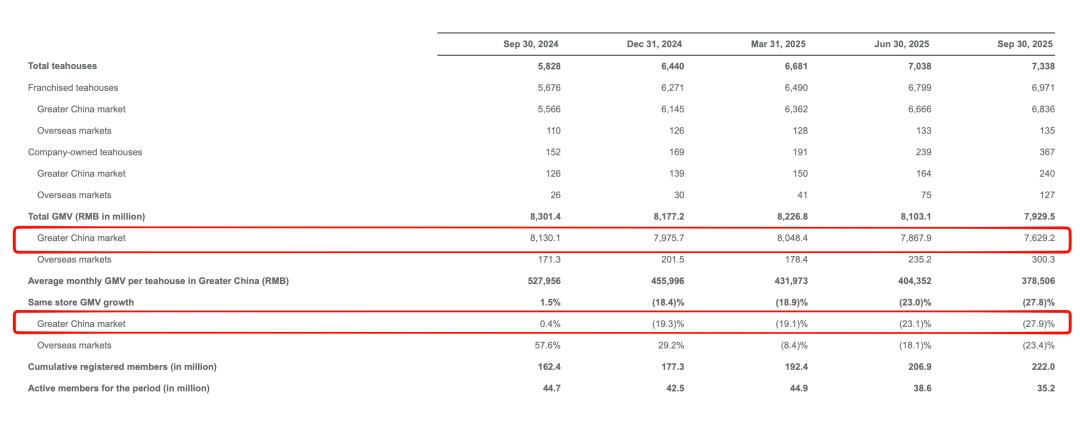
Core Viewpoint - The company BaWang Tea Ji, which went public on NASDAQ less than a year ago, is reportedly considering a secondary listing in Hong Kong, although it has denied these rumors. The company is experiencing a significant slowdown in revenue and profit growth, raising concerns about its market position and brand image [1][3][4]. Financial Performance - BaWang Tea Ji's revenue and profit growth have noticeably slowed over the past year, with growth rates declining for three consecutive quarters. In Q3 of the previous year, the company reported a revenue decline of 9.4% year-over-year and a nearly 40% drop in net profit, marking the first time its quarterly GMV turned negative [1][5]. - The average monthly GMV per teahouse in Greater China has been declining for seven consecutive quarters, with the same-store GMV growth rate falling into negative territory for four quarters, reaching a decline of nearly 28% in Q3 [1][2]. Market Position and Brand Image - BaWang Tea Ji has faced multiple public relations crises that have damaged its high-end brand image, including controversies over product ingredients and employee behavior. The company is known for its significant marketing expenditures, which have helped it establish a premium position in the market [3][4][11]. - The company has refrained from participating in the aggressive food delivery subsidy wars that have benefited competitors, which has contributed to its revenue decline. While other brands like MiXue Ice City and GuMing have seen substantial growth, BaWang Tea Ji's revenue growth has sharply decreased since Q2 of the previous year [5][6][7]. Expansion and Future Strategy - BaWang Tea Ji has expanded its store count significantly, from 1,087 in 2022 to 6,440 in 2024, but the pace of new store openings is expected to slow in 2025 [8][10]. - The company is exploring overseas markets, where it has seen better performance, with GMV in international markets exceeding 300 million RMB, reflecting a year-over-year growth of 75.3% [22]. Stock Performance - Since its peak market valuation of over $7 billion, BaWang Tea Ji's stock price has dropped by more than 60%, with a current market cap of approximately $2.366 billion [23].

霸王茶姬距离“东方星巴克”有多远?
财富FORTUNE· 2025-06-05 13:02
Core Viewpoint - The financial report of Bawang Chaji, released on May 30, shows a steady performance post-IPO, but growth rates are slowing compared to previous years, indicating potential challenges ahead [1][3]. Group 1: Financial Performance - As of March 31, 2025, Bawang Chaji reported a global store count of 6,681, with 169 overseas locations. The quarterly revenue reached 3.39 billion yuan, a year-on-year increase of 35.4%, while net profit was 677 million yuan, up 13.8% [1]. - The net profit margin has declined compared to the same period last year, suggesting pressures on profitability despite revenue growth [1]. - The revenue figures for the past three years were 492 million yuan in 2022, 4.64 billion yuan in 2023, and 12.41 billion yuan in 2024, highlighting a significant slowdown in growth [1]. Group 2: Strategic Development - Bawang Chaji's growth strategy relies on three pillars: ongoing global expansion, differentiated product innovation, and a healthy user ecosystem. The brand has been expanding internationally since 2019, with significant presence in Southeast Asia [3]. - The overseas market's total GMV reached 178 million yuan, reflecting an 85.3% year-on-year growth, with 13 new overseas stores opened in Q1 2025 [3]. Group 3: Market Position and Challenges - Bawang Chaji became the first new tea brand to list on NASDAQ on April 17, 2025, with an initial market capitalization of 5.954 billion USD. However, the stock has experienced volatility, including a drop of 10.88% on May 13, 2025 [4]. - The company faces challenges due to geopolitical tensions and rising costs, prompting plans for localizing supply chains and establishing a raw material processing center at the US-Mexico border [4][5]. - The brand aims to become the "Eastern Starbucks," requiring adaptation to diverse consumer preferences beyond the Chinese demographic, particularly in the US market [5]. Group 4: Product Development and Innovation - Bawang Chaji is increasing its investment in product development, with administrative expenses rising by 62.1% year-on-year to 352.8 million yuan, primarily for R&D and talent acquisition [5]. - The tea latte series contributed 91% to GMV in 2024, indicating a heavy reliance on a few best-selling products [5]. Group 5: Expansion Goals - The company aims to open 1,000 to 1,500 new stores globally in 2025, indicating a strong commitment to expansion despite the challenges faced [6].