中医优势病种按病种付费

Search documents
芜湖入选 国家中医优势病种按病种付费试点城市
Xin Lang Cai Jing· 2026-02-11 17:43
Group 1 - The core viewpoint of the article is the announcement of pilot regions for Traditional Chinese Medicine (TCM) payment by disease, with Wuhu City in Anhui Province being selected as one of the nine pilot cities nationwide [1] - This pilot program is part of the national effort to reform medical insurance payment methods and support the inheritance and innovation of TCM [1] - Wuhu will build on previous experiences with TCM payment practices to refine implementation plans and promote the pilot program steadily, aiming to explore replicable and scalable TCM medical insurance payment experiences [1] Group 2 - The initiative aims to better leverage the unique characteristics of TCM, which are described as "simple, effective, and economical," to benefit a larger number of insured individuals [1]
中医优势病种按病种付费 18个试点地区确定
Xin Lang Cai Jing· 2026-01-31 21:33
Core Insights - The National Healthcare Security Administration and the National Administration of Traditional Chinese Medicine have officially established 18 pilot regions for the payment by disease category for traditional Chinese medicine (TCM) [1] Group 1: Payment System - The payment by disease category system involves grouping or scoring diseases to implement a "bundled payment" model for medical institutions [1] - Pilot regions can determine payment standards for TCM advantage diseases based on historical cost data and implement dynamic adjustments to reflect the value of TCM services [1] Group 2: Pilot Regions - The identified pilot regions include: Beijing, Hebei Province, Tongliao City in Inner Mongolia, Shenyang City in Liaoning Province, Shanghai, Wuxi City in Jiangsu Province, Zhejiang Province, Wuhu City in Anhui Province, Shandong Province, Shaoyang City in Hunan Province, Guangdong Province, Guangxi Zhuang Autonomous Region, Chongqing, Panzhihua City in Sichuan Province, Qiandongnan Prefecture in Guizhou Province, Yunnan Province, Guyuan City in Ningxia Hui Autonomous Region, and Urumqi City in Xinjiang Uygur Autonomous Region [1] Group 3: Disease Categories - A recommended directory of 57 TCM advantage diseases has been established, covering conditions such as fractures, lumbar disc herniation, and strokes [1] - Pilot regions are encouraged to use this directory as a basis for local adjustments and announcements regarding the diseases [1] Group 4: Implementation and Progress - The document emphasizes the need for pilot regions to refine their implementation plans, detail work measures, clarify timelines and task divisions, and regularly summarize progress and outcomes [1] - The goal is to steadily advance the pilot program and accumulate experiences for the reform of TCM payment systems, with a view to gradually promoting it nationwide [1]
山东入选全国中医优势病种按病种付费试点地区
Feng Huang Wang Cai Jing· 2026-01-31 00:39
Core Insights - The National Healthcare Security Administration and the National Administration of Traditional Chinese Medicine have officially identified 18 pilot regions for the payment by disease category for traditional Chinese medicine (TCM), with Shandong included [1][3] Group 1: Payment by Disease Category - Payment by disease category refers to a bundled payment system where healthcare institutions receive a fixed payment based on the diagnosis and treatment of diseases, reflecting the labor value of TCM techniques [3] - Pilot regions can determine payment standards for TCM advantage diseases based on historical cost data and implement dynamic adjustments [3] Group 2: Selected Pilot Regions - The selected pilot regions include: Beijing, Hebei, Tongliao in Inner Mongolia, Shenyang in Liaoning, Shanghai, Wuxi in Jiangsu, Zhejiang, Wuhu in Anhui, Shandong, Shaoyang in Hunan, Guangdong, Guangxi, Chongqing, Panzhihua in Sichuan, Qiandongnan in Guizhou, Yunnan, Guyuan in Ningxia, and Urumqi in Xinjiang [3] Group 3: Recommended Disease Categories - A total of 57 TCM advantage diseases have been recommended, covering conditions such as fractures, lumbar disc herniation, and strokes [3] - Pilot regions are encouraged to use the recommended disease categories as a basis for local adjustments and releases [3] Group 4: Implementation and Progress - The document emphasizes the need for pilot regions to refine implementation plans, detail action measures, set timelines and task divisions, and regularly summarize progress and outcomes [3] - The goal is to accumulate experiences in TCM healthcare payment reform and gradually promote these practices nationwide [3]

18个试点地区落地中医优势病种“打包付费”
Xin Lang Cai Jing· 2026-01-29 19:50
Core Viewpoint - The National Healthcare Security Administration and the National Administration of Traditional Chinese Medicine have jointly announced the implementation of a pilot program for 18 traditional Chinese medicine (TCM) advantageous diseases under a diagnosis-related group payment system [1][2] Group 1: Pilot Program Details - The pilot program involves a bundled payment system for medical institutions based on the grouping or scoring of diseases, reflecting the labor value of TCM techniques [1] - A total of 9 provinces and 9 cities have been selected as pilot areas, including Beijing, Hebei, Inner Mongolia (Tongliao), Liaoning (Shenyang), Shanghai, Jiangsu (Wuxi), Zhejiang, Anhui (Wuhu), Shandong, Hunan (Shaoyang), Guangdong, Guangxi, Chongqing, Sichuan (Panzhihua), Guizhou (Qiandongnan), Yunnan, Ningxia (Guyuan), and Xinjiang (Urumqi) [1] Group 2: Disease Selection and Implementation - A recommended directory of 57 advantageous TCM diseases has been established, covering conditions such as fractures and lumbar disc herniation, which pilot areas can use as a basis for local adjustments [1] - The pilot regions are required to refine their implementation plans, detail work measures, set timelines, and regularly summarize progress and outcomes to ensure steady advancement of the pilot program [2]
晨会纪要:对近期重要经济金融新闻、行业事件、公司公告等进行点评-20251022
Xiangcai Securities· 2025-10-22 01:08
Macroeconomic Information and Commentary - In the first three quarters, China's GDP reached 10,150.36 billion yuan, with a year-on-year growth of 5.2%. The quarterly growth rates were 5.4% in Q1, 5.2% in Q2, and 4.8% in Q3 [3] - From January to September, the industrial added value above designated size grew by 6.2% year-on-year, while fixed asset investment (excluding rural households) was 3,715.35 billion yuan, down 0.5% year-on-year. Private investment decreased by 3.1% [3] - The retail sales of consumer goods totaled 4,197.1 billion yuan, with a year-on-year growth of 3.0% [3] Industry and Company Analysis Medical Consumables Industry - The sixth batch of medical consumables national procurement introduced new regulations, including the concept of "anchor price" for price difference calculation, aiming to stabilize expectations and prevent vicious competition [7][8] - The focus of this procurement includes drug-coated balloons and urological intervention materials, with a trend towards quality competition rather than just low prices [7][8] - High-value consumables companies are gradually digesting the performance pressure from procurement, with recent innovations and overseas business developments expected to provide new growth points [9] - The medical consumables industry is rated as "overweight," with recommendations to focus on companies with rich product lines and high innovation levels [11] In Vitro Diagnostics Industry - Samsung has partnered with Grail to enter the multi-cancer early detection market, investing 783 million yuan (110 million USD) [15] - The IVD market is undergoing a transformation, with challenges from price controls and procurement affecting short-term performance, but long-term growth is anticipated [17] - The IVD industry is rated as "overweight," with a focus on immunodiagnostics and molecular diagnostics sectors [17] Traditional Chinese Medicine Industry - The Traditional Chinese Medicine (TCM) sector saw a slight increase of 0.38% amidst an overall decline in the pharmaceutical sector [19] - A pilot program for disease-based payment for TCM is set to begin, which may enhance the reimbursement for TCM services [23] - The TCM industry is rated as "overweight," with investment recommendations focusing on companies with strong R&D capabilities and unique products [24]
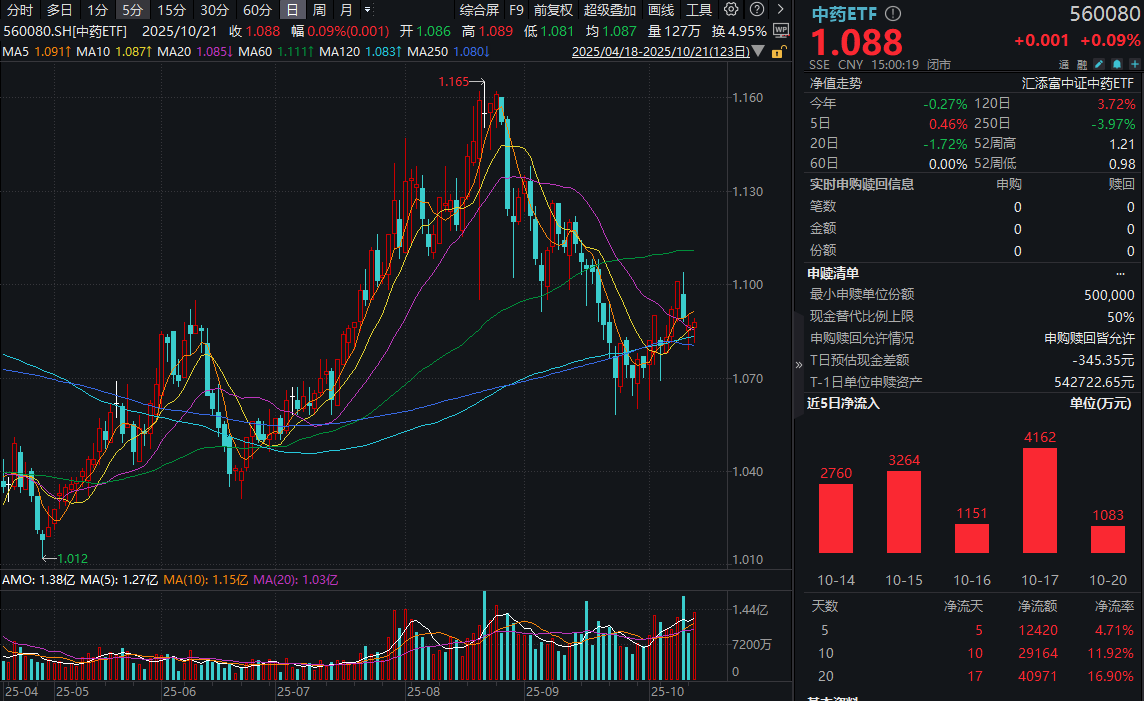
以岭药业涨超2%!中药ETF(560080)小幅收涨0.09%,指数估值逼近10年“机会区间”,资金连续14日净流入!机构:关注高股息创新中药
Xin Lang Cai Jing· 2025-10-21 09:14
Core Viewpoint - The Chinese medicine sector is experiencing a positive trend, with the Chinese Medicine ETF (560080) showing a slight increase and significant trading volume, indicating strong investor interest [1][2]. Market Performance - The Chinese Medicine ETF (560080) rose by 0.09% with a trading volume exceeding 1.38 billion yuan, a 45% increase from the previous day [1]. - The ETF has seen a net inflow of over 350 million yuan over the past 14 days, with a total fund size exceeding 2.7 billion yuan, leading its peers [1]. Valuation Insights - The TTM price-to-earnings (PE) ratio of the ETF's underlying index is 25.17, placing it in the 23rd percentile over the past decade, indicating it is cheaper than 77% of the time in the last 10 years [2]. - The current TTM PE is just 0.43 away from the calculated opportunity value, suggesting a higher valuation attractiveness [2]. Stock Performance - The underlying index of the Chinese Medicine ETF shows mixed performance among its constituent stocks, with notable gains from Yiling Pharmaceutical (up over 2%) and slight increases from Tongrentang, Dong'e Ejiao, and others, while Darentang and Yunnan Baiyao experienced declines [3][4]. Yearly Index Performance - The Chinese Medicine index has a negative return of -2.4% year-to-date, with a decline of 8.13% in 2024 and a slight increase of 0.27% in 2023, indicating a challenging performance trend [4]. Investment Themes - High dividend yields in the Chinese medicine sector are highlighted as a defensive strategy amid market volatility, with companies showing strong cash flow and low debt levels [7]. - The upcoming pilot program for disease-based payment in traditional Chinese medicine is expected to enhance the revenue of institutions with strong TCM capabilities [8]. - Key investment themes include price governance, consumption recovery, and state-owned enterprise reform, with a focus on companies that can leverage competitive advantages and innovation [9][10][11].